For outdoor and heritage brands, a 1095 carbon steel knife needs honest selling copy. It is not stainless. If the product page makes it sound like 420 or 3Cr13, the math does not work; returns start after the first wet weekend. On the bench, this steel sharpens fast on a 1000 grit stone, takes a clean bite after the grinding line sets the bevel, and builds the dark patina that 7 out of 10 bushcraft buyers we quote ask about before they ask about the sheath. Last month one buyer flagged the word "rustproof" on a draft carton sticker. We cut it.
The risk is simple: a loose sourcing spec gives you blades that come out too hard, too brittle, or too easy to stain for your end users. We have seen this go sideways. In our Yangjiang, China OEM programs, we run 1095 around a 56-59 HRC target, QC checks first samples on the Rockwell tester, and we pack a plain care card before carton sealing. Finish choice matters too. Satin, black oxide, or stonewash is not just styling; the wrong finish gets flagged fast when a buyer opens 30 pcs from a pre-shipment carton and sees orange spots near the logo etch. QC pulled one sample at 58 HRC with stains around the laser mark after 18 hours in a damp sheath. That is a field-ready tool turning into a warranty problem.
Why 1095 Still Works
1095 carbon steel still sells for outdoor and heritage knives because the chemistry is easy to explain: roughly 0.90-1.03% carbon and little chromium. On our grinding line, a 1095 blade comes back fast on a 400/1000 grit stone, and the edge feel is obvious even to a first-time user. Simple steel. Simple care. Before sampling, we tell the buyer straight: it will patina. If water sits under a sheath snap or handle scale overnight, red rust can show in 8-12 hours, faster than on stainless.
That tradeoff is not a defect. For bushcraft and hunting patterns, we run 1095 when the customer wants a working blade, not a shiny catalog piece. We have seen this go sideways when a PO says “outdoor knife” but the care card reads like kitchen stainless; QC pulled the sample, the blade passed, then the buyer flagged end-user complaints after 24-hour rain testing. For a field knife, specify the hardness band, finish, and care note around the real use case. A generic kitchen-grade description is the wrong question to ask.
In our Yangjiang, China programs, repeat orders are stronger when the sales copy tells the truth: the blade will darken, the user should wipe it dry, and the knife is built for maintenance. One heritage customer moved from a coated stainless sample to 1095 after checking 12 pcs from pre-shipment inspection and accepting the darker spine marks as part of the look. The buyer even asked us to add a 35 mm wipe-dry icon on the insert card. That message fits brands selling a real tool, not a wall display. If your customer values character over zero-maintenance convenience, 1095 still earns its place.
Heat Treat Sets The Outcome
With 1095, heat treat matters more than the steel name on the spec sheet. Same coil, different knife. Move the austenitizing temperature by 20°C, let the oil bath run slow, or cut the temper hold short, and the buyer will feel it on the first sharpening test with a 600-grit stone. For outdoor knives, we run 56-59 HRC as the working target. Below that, QC sees edge rolling after rope cuts. Above that, on a 4.0 mm spine in rough camp use, the blade loses twist margin when a customer binds it in wood.
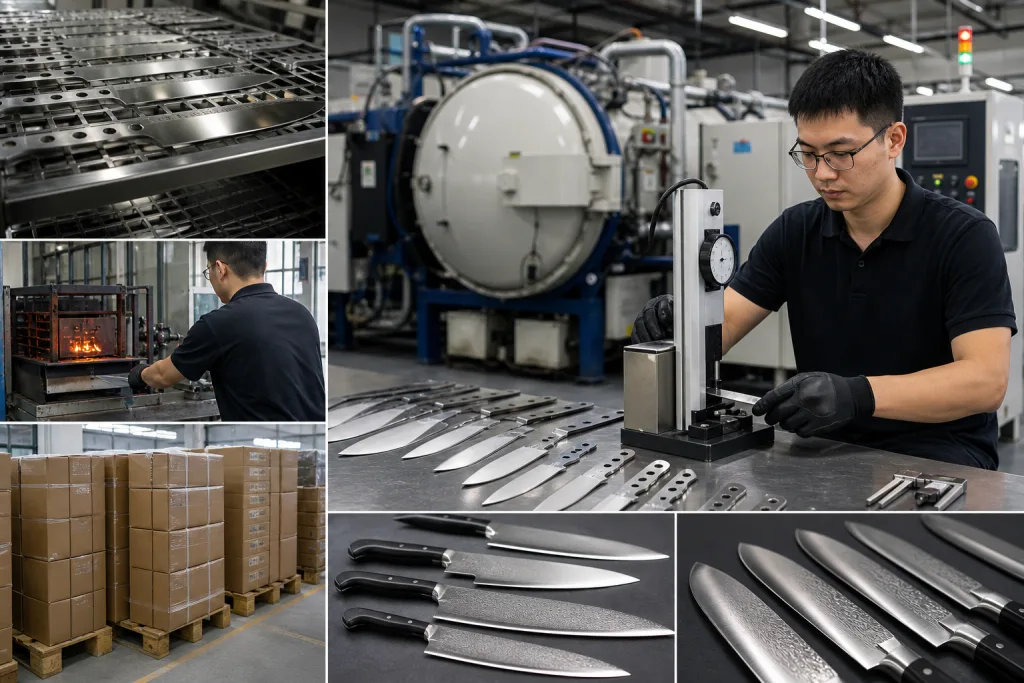
We normally run at least three first-article blades per batch. One blade goes to the Rockwell tester for flat and near-spine readings, one sits on the granite plate for geometry and straightness, and one is cut through rope, cardboard, and dry wood offcuts from the handle room. Simple setup. Good data. Last month QC pulled a sample after temper and got 58 HRC on the flat, but the tip lifted 0.35 mm on the straight-edge check, so the grinding line held the lot before handle assembly. If your supplier will not put the post-temper hardness range in writing, the math does not work. A solid 1095 OEM supplier needs to state if the quench is oil-based and spell out the temper cycle. Put the acceptable warp tolerance in mm too.
For outdoor brands, consistency beats chasing the highest Rockwell number. A 57 HRC blade that sharpens cleanly and survives normal camp use will draw fewer complaints than a 61 HRC blade that chips the first time a customer loads it sideways on kindling. We have seen this go sideways when the PO says “harder is better” and the buyer flagged broken tips in the return photos. That is the wrong target. In our Zhejiang supply chain and Yangjiang production flow, we keep the discussion on usable hardness, not marketing hardness.
Geometry And Finish Choices
1095 works best when blade geometry follows the use on the buyer brief, not the photo on the mood board. For heavy outdoor and survival models, 3.0-4.5 mm blade stock is common: full-flat grind if the buyer wants cleaner slicing, convex grind if they accept more steel behind the edge. We run both on the grinding line. Convex needs the senior hand on the 240# belt, or the edge line can drift 0.3 mm near the belly. Scandi grinds still fit some bushcraft patterns because the user can touch them up on a flat stone in camp, but production needs tight edge control. QC will pull the sample if one shoulder sits higher than the other.
Put the edge angle on the drawing. Do not drop it into a WeChat note after sampling. For 8 out of 10 field knife orders we see, 20-25 degrees inclusive is the working range. Too acute on a utility blade, and the knife feels sharp on copy paper, then rolls after chopping dry pine. Too thick, and it cuts like a wedge. We saw one PO say 18 degrees while the approved sample card said 23 degrees; the buyer flagged the chopping test, and the math did not work. “How sharp can you make it?” is the wrong question to ask. Ask what it will cut, then lock the grind, edge angle, and HRC target before approving the sample.
Finish is not decoration. A satin finish shows early rub marks and the first brown patina, sometimes after one salt-spray check if the blade was handled bare-handed. A stonewashed or tumbled finish hides scratches and gives a tougher shelf look; our tumbler usually gets checked after 25 minutes so the logo does not turn soft. Black oxide and protective coatings only work when the care card tells the truth: they slow corrosion, they do not cancel maintenance. For heritage lines, buyers often choose controlled satin or antique wash because it matches the working-blade story. We ship fewer complaints when the packaging says oil after use instead of promising “rust proof.”
Patina And Rust-Care Messaging
This is where about 30% of new 1095 brands lose buyer trust. With 1095, patina is normal. Red rust is a sales headache. Say it clearly on the product page, hang tag, and care card, with the same wording on all three pieces. Food acid, sweat, rain, damp leather, and finger oil can darken the blade after 3-5 uses. That darkening is working patina. Orange or red spots mean the knife sat wet or the packing failed; QC pulled samples from a wet carton once, and the edge faces already had rust before the buyer opened the inner box.
The care message should be short: wipe dry after use, do not store wet, apply a light oil film if the knife will sit unused, and keep it out of dishwashers. Simple wins. We run this copy on a 90 x 55 mm insert for camp knives, or we ship the knife in a VCI bag when the buyer accepts the small cost. For humid markets, a microfiber cloth and a 5-10 ml oil bottle usually add less than USD 0.30 per set at factory level, and we have seen after-sales photos drop from 18 cases to 9 cases on one 2,000 pcs order. The math works better than arguing with a buyer who flagged orange specks after 12 days in a coastal warehouse.
For outdoor and heritage buyers, the strongest message is honest maintenance, not fantasy durability. A 1095 carbon steel knife should be sold as a tool that ages with use. Do not polish every blade until it looks like a medical sample. Wrong signal. A controlled patina on satin or stonewashed finishes tells the user this knife belongs on a belt or a workbench; our grinding line usually checks that finish under a 6000K inspection lamp before packing, and the buyer will notice if the sample finish and bulk finish do not match.
What To Ask Your Supplier
A solid 1095 carbon steel knife sourcing file needs more than one PO line saying “carbon steel.” Ask for the mill cert by heat lot, target hardness range, blade thickness tolerance, finish method, and inspection standard before we open tooling. We see this on real orders: one buyer approved a polished counter sample, then compared bulk goods against another factory’s belt-finished sample from the grinding line. Wrong question to ask. Send one spec sheet to every factory in Yangjiang, China and Zhejiang, China, then make each supplier quote from the same 2D drawing, with blade thickness tolerance in mm and a clear surface finish callout.
For our OEM work, a normal starting point is MOQ 500 pcs per SKU, 35-45 days for standard production, and around 180,000 knives per month across mixed programs. Capacity is easy to print on a website. The math doesn't work if QC is loose. Ask for a first-article report, Rockwell test records, and in-process checks on grind symmetry and straightness; QC pulled one sample last season where the spine was straight, but the edge line drifted .6 mm near the tip under the Vernier caliper. Small drift. Big argument. If the supplier cannot tell you whether they run AQL 2.5 for general defects and tighter checks for critical issues, the sourcing file is not ready for deposit.
| Spec | Typical Target | Why It Matters |
|---|---|---|
| Steel | 1095, verified mill cert | Confirms chemistry by heat lot, not just the steel name typed on the invoice |
| Hardness | 56-59 HRC | Keeps edge holding and impact toughness in a workable range after heat treatment |
| Blade stock | 3.0-4.5 mm | Controls cutting feel and finished weight after flat grinding and final sharpening |
| MOQ | 500 pcs/SKU | Covers stamping dies, grinding setup, handle fitting, and packing for custom OEM runs |
| Lead time | 35-45 days | Allows time for heat treatment, handle assembly, and final carton inspection without rushing the line |
| Inspection | AQL 2.5 general | Gives the buyer a repeatable shipment standard before cartons leave our warehouse |
If your supplier cannot work to that detail level, the risk sits with your sourcing team, not the factory. We have seen this go sideways over missing hardness records and one PO typo that changed the steel grade after the sample was approved; the buyer flagged it only after our packing team had printed 42 cartons.
Packaging And Market Readiness
A good 1095 blade can still lose at retail if the packaging and compliance story looks loose. For North America or Europe, the carton and insert need to repeat the wipe-dry care message, keep moisture off the edge, and fit the sales channel. Simple job. We usually ask for UPC position, FNSKU placement, carton mark, and suffocation warning on the first artwork proof, because fixing a color box after 3,000 pcs are folded is wasted money. Retail buyers ask this early. One buyer flagged a 2 mm barcode shift after QC pulled the sample from the packing table. If you ship DDP, the pack-out needs to survive 80 cm carton drops and warehouse dwell time; 12 days on the water is different from 18 days sitting in a damp 3PL corner.
For private label and gift programs, packaging is part of corrosion control. We run sealed polybags with rust-inhibitor paper, or a VCI sleeve when the buyer wants fewer complaints after the first wet weekend. It costs less than one replacement claim. If the knife includes leather, coatings, or printed inserts, specify those materials against the target market before mass production starts; QC should check the insert ink, oil bottle cap, and sheath smell before the pre-shipment inspection. REACH matters for coatings and printed components in Europe. If the knife is also sold as a food-use tool, the claim language and handle material test need their own check. The math does not work when sales copy promises kitchen-safe use but the insert only talks about camp care.
Heritage brands usually ask for plainer packaging than mass retail. That is fine, but control still matters. A strong box and a clear care card are enough when the 1095 blade is right. In our Yangjiang and Zhejiang programs, the best results come from honest packaging: name the steel, explain wipe-dry care, and tell the buyer a gray patina after the first week is normal. Say it plainly. We have seen this go sideways when a PO says “mirror finish” but the approved sample shows working satin from the grinding line, with 600 grit belt marks still visible under the packing room light.
Frequently asked questions
For outdoor and field use, 56-59 HRC is the range we usually recommend. At 56-57 HRC, the blade is a bit tougher and more forgiving under hard use. At 58-59 HRC, edge retention improves, but the knife becomes less tolerant of side loads and poor technique. If the design is thin and meant for slicing, you can sit near the top of that range. If the knife is a thicker camp or utility pattern, stay closer to the middle. Ask your supplier to confirm the post-temper hardness on the final production lot, not just on a sample blade.
Yes, if it is left wet or stored badly. 1095 has very little chromium, so it does not behave like stainless steel. In normal field use, the blade will usually develop a gray or dark patina first, then red rust if moisture stays on the surface. The practical fix is simple: wipe the blade dry after use, keep it out of wet leather, and apply a light oil film if the knife will sit unused for weeks. For humid coastal markets, a VCI bag or rust-inhibitor paper in the package reduces damage during storage and transit.
Yes, if the product story is built around maintainability rather than corrosion resistance. Bushcraft users usually want a blade that sharpens quickly in the field, cuts cleanly, and can be brought back on a simple stone. A 1095 carbon steel knife does that well. The usual production spec is around 3.0-4.5 mm blade stock and 20-25 degrees inclusive edge angle, depending on the grind. It is not the best choice for buyers who want a zero-maintenance blade in wet coastal conditions, but it is a strong option for users who accept routine care.
Keep it short and direct. Tell the buyer to wipe the blade dry after use, avoid the dishwasher, and apply a thin coat of oil before long storage. Also tell them that patina is normal and that orange or red rust means the blade stayed wet too long. For outdoor knives, a small oil bottle and microfiber cloth can be bundled at low cost. If the knife will be sold in gift packaging, include the care note in both the insert and the hang tag so the message does not get lost after unboxing.
Ask for the mill certificate, the target hardness band, the quench and temper schedule, the blade stock thickness tolerance, and the inspection standard. A serious 1095 OEM file should also show first-article approval, straightness control, and AQL 2.5 general inspection. If you are buying from China, confirm whether the factory can keep a stable MOQ, usually 500 pcs per SKU, and whether the lead time is 35-45 days for standard builds. That is the level of detail that prevents sample-stage surprises from becoming shipment-stage problems.
Build a better 1095 program
Send your target blade shape, hardness band, and packaging brief. We can quote a practical OEM route from Yangjiang, China with clear care messaging and controlled production.
Request a Quote