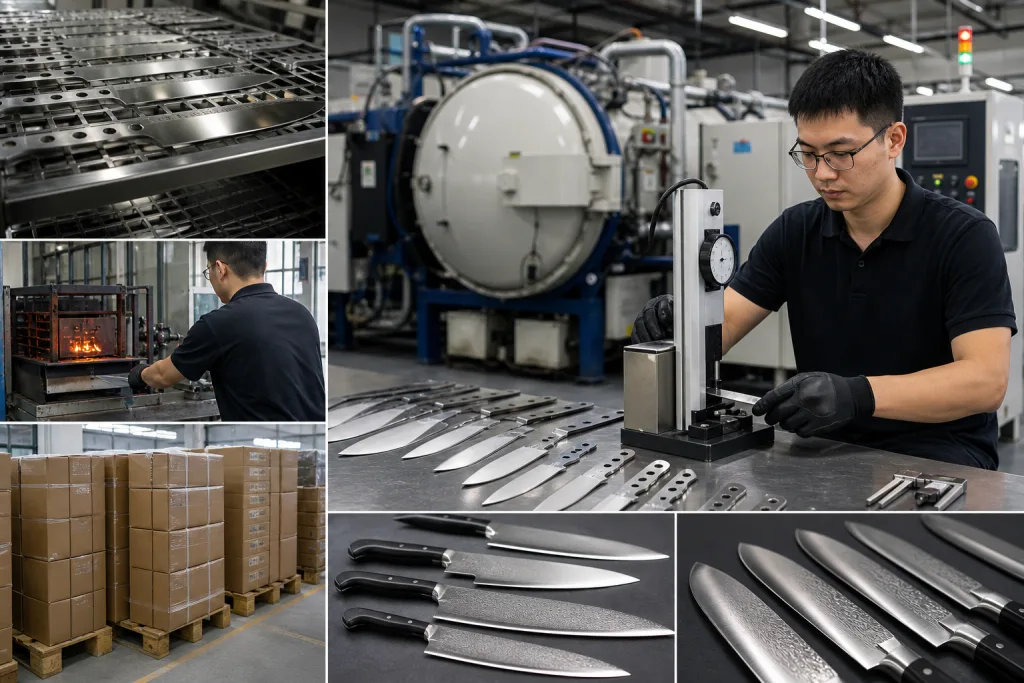
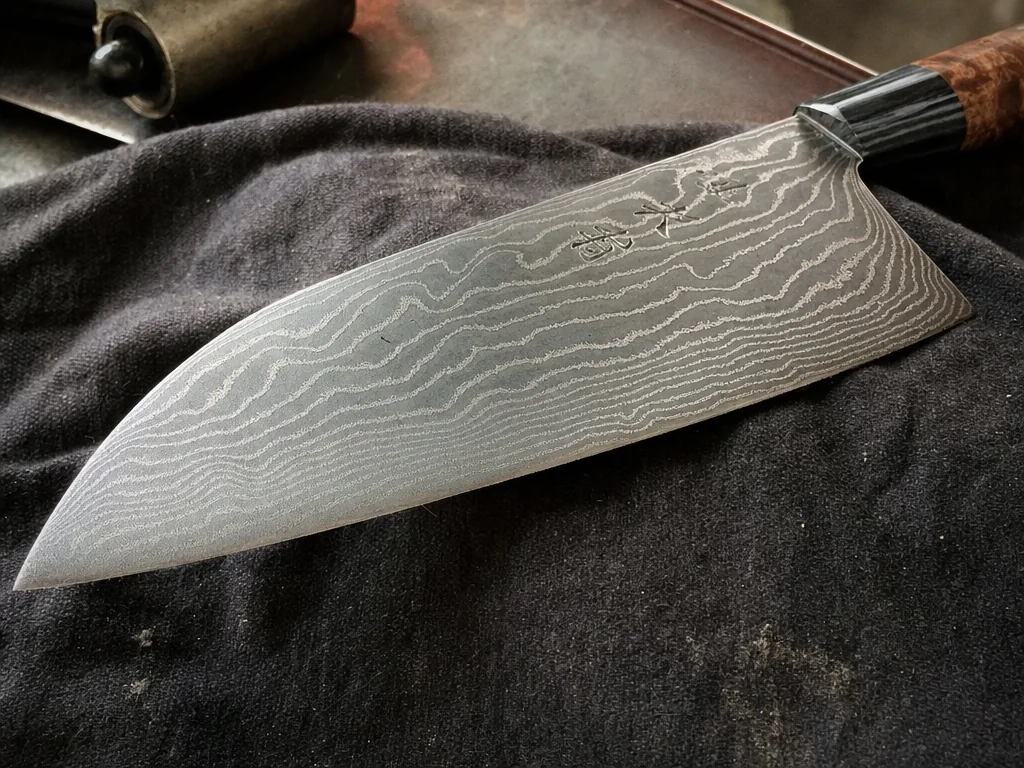
For a thin kitchen blade, steel choice decides whether the knife slices cleanly or starts feeling nervous at 1.8 mm behind the spine. AEB-L sits in the range most buyers actually spec: stainless, hardenable to 58-61 HRC, and stable enough for a fine edge without exotic processing or a heat-treat route that only one subcontractor understands. You feel it on the board. For a serious kitchen line, that beats the logo story on the color box.
At TANGFORGE in China, we run AEB-L on about 6 out of 10 premium kitchen RFQs when the buyer asks for clean slicing, solid stain resistance, and OEM production that ships on schedule. QC pulled the sample last month and flagged a 0.18 mm warp after quench on the granite straightness table; that is why this steel only works when geometry, heat treatment, and finishing stay tight. If you are sourcing from Yangjiang, Zhejiang, or any other knife manufacturing base in China, ask for the grind angle, quench method, straightness tolerance, and final hardness before you push for the lowest EXW price. Price per piece is the wrong first question.
Why AEB-L Fits Thin Blades
AEB-L is stainless knife steel for edge quality, not for winning an abrasion test. That is why we run it on thin kitchen blades. Its carbide structure stays fine, so a lean grind from the grinding line can still hold a clean apex instead of breaking into early micro-chips; on our 400-belt finish, QC can spot a weak edge before the blade reaches packing. Buyers notice fast. A cook can touch it up on a 1000-grit stone in 2 minutes and get that clean bite back on tomato skin. For restaurant prep and home boards, it earns its shelf space.
On thin blades, geometry matters as much as chemistry. If your drawing calls for a 1.8 mm spine and a clean taper down to a 0.2-0.3 mm edge before sharpening, AEB-L runs well at 58-60 HRC. Push thinner without tight heat-treatment control and edge stability drops fast; QC pulled one sample after a brass-rod check showed the apex rolling instead of springing back, even though the laser gauge was still reading on spec. Leave the blade thick and the math doesn't work. If a supplier only talks about the steel grade, that is the wrong question. An experienced aeb-l OEM partner in Yangjiang or Zhejiang should mark up the first drawing with cross-section notes and taper targets.
For product positioning, AEB-L fits chef knives for daily board work, petty knives for trim jobs, paring knives for hand work, and slicing blades for boneless protein where a clean cut matters more than wear-test bragging rights. Customers feel the edge on onions and herbs before they ask about maximum abrasion resistance. We ship this line at MOQ 600 pcs per SKU, and the buyer pushback is usually the same: "Will it feel premium enough on the shelf?" Last month the buyer flagged a PO that said "AEL-B" on the artwork, which tells you how closely retail teams read these details. If you want a stainless range that feels premium without moving into harder-to-control materials, AEB-L is one of the most practical options we ship from China. Chasing max abrasion resistance in this slot misses the point.
Heat Treat Targets That Matter
AEB-L lives or dies on heat treat, not the steel name on the spec sheet. For thin kitchen blades, we run 58-61 HRC most of the time and check each trial lot on the Rockwell tester after tempering. Below 58 HRC, the edge feels tough but flat in hand. Above 61 HRC, the first cut has bite, but a 210 mm chef knife or long slicer starts complaining when the user twists through carrots or frozen meat. Nice demo. Bad field result.
Ask the supplier for the full heat treat sequence: austenitizing temperature with hold time, quench method, cryogenic step if they run one, plus tempering temperature and cycles. Do not stop at "Is it hardened?" That is the wrong question. A capable China factory should hold the lot within about +/- 1 HRC, and QC should be able to pull 5-8 pcs from one batch and show the readings by blade position, not just one pretty number from the heel. Last month our grinding line stopped a thin batch before packing because the spine tested 60 HRC, but two tips came back near 62 HRC after rework. QC pulled the sample twice. We held the lot.
For export buyers, hardness alone does not close the file. Ask for edge retention and corrosion checks that match your category, such as rope cut count for utility knives or a 24-hour wet towel check for kitchen sets. AEB-L is stainless, but "stainless" does not mean the blade can sit wet in a humid warehouse for 18 days with weak VCI paper and still look perfect. Spotting happens. We normally write the target HRC, salt spray expectations, and acceptable visual finish into the sample approval before tooling starts. If that line is missing, the argument shows up later, like shipment two when the buyer flagged a different satin grain even though the blade cut fine.
How To Source AEB-L In China
If you are sourcing AEB-L stainless knife steel, price is the wrong first question. Ask for the mill cert first, then ask how the factory controls heat treatment and keeps blade geometry stable across a full order. We see 40 or 50 knife shops in China that can buy stainless bar stock. In practice, 8 to 10 can run AEB-L into a thin-blade SKU without warping, soft spots, or wavy bevels after grinding. In Yangjiang, the gap between a trading quote and real factory work shows up fast once you ask for the mill cert, furnace chart, and hardness record from the last 500 pcs run. QC pulled one sample from our grinding line last month at 1.8 mm spine thickness, and the bevel wave showed before polishing. That is where cheap quotes start costing money.
| Buying point | What to request | Practical note |
|---|---|---|
| Steel proof | Mill cert, chemistry, batch traceability | Do not accept generic "AEB-L equivalent" on a quote; match the heat number on the cert to the tag tied to the steel bundle |
| Hardness | Target 58-61 HRC, test report | Ask what lot-to-lot swing they allow; QC should test on a Rockwell machine, not write the target and move on |
| Blade geometry | Spine thickness, taper, edge angle | Thin blades need tighter grind control; below 2.0 mm spine thickness at the heel, small drift shows up fast |
| MOQ | 1,000-3,000 pcs per SKU | Handle, finish, and packaging decide this; a custom G10 handle usually pushes the math higher |
| Lead time | 35-55 days after sample approval | Custom handles or gift boxes add time; we ship plain cartons in 35 days, while a new magnetic box can push the job toward 55 days |
For a serious OEM program, the supplier should cover BSCI, REACH, LFGB, or FDA-related packaging documents where relevant. We ship export kitchen knives every month, and buyers flag the same problems 3 or 4 times a quarter: the factory name missing on a test report, the steel grade typed wrong on the PO, or LFGB requested for a box that only needs food-contact confirmation for the knife. One German buyer sent back a PO because "AEB-L" became "AEB-1" in line 6. One character, big delay. A factory in Zhejiang or Yangjiang that works with export brands should explain these points without guessing. If they cannot, stop there; the risk sits with you before the deposit is paid.
Thin Blade Manufacturing Controls
Thin AEB-L blades fail fast on the line. On a 1.8 mm chef knife blank, a 0.25 mm heat bow or a 1.0 mm bevel-width mismatch can move rejects from 2% to 8%. Last month QC pulled 32 pieces for blue tint within 2 mm of the edge after the final pass on the water-cooled belt. Not cosmetic. That color means the edge took too much heat, and the knife will start to steer in a tomato cut after two or three sharpenings.
The basic flow has to stay tight: blanking or laser cutting for profile accuracy, controlled heat treatment, rough grinding, fine grinding, polishing, then final edge setting. Thin kitchen blades are won on the grinding line, not in the furnace brochure. We run a 60-grit ceramic belt for stock removal, step down to finishing belts, and check straightness every 20 pieces with a dial gauge on the granite table. If the operator pushes belt speed without enough coolant, flatness goes first. Local edge softening comes next. Ask an AEB-L supplier what finishing belt speed they run and how often QC checks straightness. Asking only about the furnace brand is the wrong question.
For premium kitchen knives, put the grind window on the drawing: 12-15 degrees per side for a slicing profile, 15-18 degrees for a general chef knife. Match it with a spine taper, for example 2.2 mm at the heel down to 0.9 mm near the last third, and hold final straightness to 0.20 mm over 210 mm. We still get PO notes that say "15 deg" with no "per side," then the buyer flags the first sample because the bevel looks fat under a 10x loupe. We have seen this go sideways. The end user feels a stable, repeatable grind on the first cut, long before they ask what steel is stamped on the blade.
Compliance And Quality Checks
Export buyers should write QC into the product spec at the start. Do not wait until after the first sample; that is the wrong stage to argue about defects. For AEB-L kitchen knives, ask the factory to match incoming steel to the mill cert heat by heat, log spot checks on the grinding line during bevel grinding, and sign off the lot against one signed standard. AQL 2.5 is normal for major appearance and function checks, but edge chips over 0.2 mm, blade looseness, rust spots, or a bent tip need a tighter call. Last month QC pulled one 8-inch chef sample. The edge looked clean in photos, then failed the paper cut on the second pass at the bench.
We run a written inspection plan tied to the PO. It covers blade dimensions down to spine thickness, hardness on the finished blade, surface finish after polishing, handle fit at the shoulder, engraving quality, and packaging integrity. For a thin AEB-L blade, that means caliper checks on spine thickness with a 0.01 mm digital caliper, Rockwell readings on the finished blade, plus a visual check under a 6000K bench lamp after polishing. If you ship to Amazon or retail distribution, add label checks and carton burst strength on the burst tester, then confirm FNSKU placement against the approved artwork. We have seen this go sideways from one PO typo: the buyer wrote inner carton label on the drawing, but the warehouse expected outer carton labels, and the buyer flagged it at inbound. For food-contact programs, packaging materials need to match LFGB or FDA expectations where applicable, and any coating, oil, or anti-rust paper needs a record.
Quality stays under control when the factory already ships export brand orders from China and knows how retailer claims get checked. A domestic-only workflow misses small things; we have seen tip protectors packed loose and carton lot cards left blank. A good inspection report shows dated photos, measured values, and the sampling basis. If a supplier cannot tell you why a sample blade was rejected, the math doesn't work; you are buying guesses. A proper AEB-L OEM project should leave a paper trail from the HRC sheet to the carton lot card. You need records for hardness, dimensions, finish, packaging, and final shipment lot data. We ship this way because buyers ask 12 days later why one batch feels sharper than the last, and the answer has to come from records, not memory.
When AEB-L Is The Right Choice
AEB-L is not the answer for every knife line. If the brief asks for long rope-cut wear life or a camp knife that gets twisted through wood, pick another steel. For thin kitchen blades, it earns its place: a fine edge, steady stainless performance, and heat treatment we can hold in normal OEM production. Simple point. QC checks post-temper hardness on the Rockwell tester, and the grinding line records edge thickness in mm before final sharpening; if the spec says 0.8 mm before edge, we do not want to see 1.2 mm on the sample rack.
It works best when the line needs performance without making production fragile. A factory in Yangjiang or Zhejiang can run AEB-L without special tooling, so the FOB price is easier to protect. For a 3,000-piece order, the cost problem is often not the steel sheet; it is 80 blades needing regrind, 40 handles rejected for fit, or cartons crushed because the insert was too loose. We have seen this go sideways. The math does not work if the buyer wants a thin slicer shape but leaves the bevel heavy, because the grinding line will spend the margin fixing it. AEB-L is efficient only when the blade profile is honest and the process sheet is followed.
If you are building a new kitchen knife series, use AEB-L to make the promise plain. Sharp and stainless. Not indestructible. That is the better sales line, and buyers trust it faster than inflated claims. Match the edge angle and handle balance to that promise, then lock the drawing before sampling; one PO typo on blade thickness can turn a clean 0.8 mm edge target into a week of back-and-forth. QC pulled the sample, the buyer flagged the cut feel, and suddenly everyone is arguing over a number that should have been fixed on the print. Once the geometry is right, AEB-L gives you a refined kitchen blade with a clean cut and fewer surprises in production.
Frequently asked questions
For thin kitchen blades, 58-61 HRC is the practical range. At 58-59 HRC, the edge is a little more forgiving and better for general use. At 60-61 HRC, you get a sharper feel and better initial edge refinement, but the geometry must be controlled tightly. For a chef knife with a thin spine, I would normally start around 59-60 HRC and validate cutting tests before locking the spec. Ask the supplier to report hardness by lot, not just by one sample blade.
Yes, if the factory can control finish and documentation. AEB-L is stainless, easy to sharpen, and suitable for thin chef knives, petty knives, and slicers. For Europe and North America, you should also confirm packaging and any relevant material requirements such as REACH or food-contact expectations. A good aeb-l OEM program from China should include hardness reports, visual inspection records, and stable edge geometry. If the supplier is in Yangjiang or Zhejiang, ask for their export references and current lead time before you commit.
A practical MOQ is often 1,000-3,000 pieces per SKU, depending on handle material, finish, and packaging complexity. If you add gift boxes, magnets, or custom engraving, the MOQ can rise. For a simple chef knife with a standard handle, some factories can work below 1,000 pieces, but unit cost usually becomes less efficient. If you want a serious trial run, ask for 300-500 sample-run pieces and a clear production price for the full MOQ before approval.
Sampling usually takes 10-20 days if the design is straightforward and the handle tooling already exists. After sample approval, mass production is commonly 35-55 days. If you need custom handle molds, special finish work, or complex packaging, expect more time. A responsible supplier in China should give you a schedule that includes steel procurement, heat treatment, grinding, inspection, and packing. Shorter lead times are possible, but only if the factory already has the right tooling and material on hand.
Ask for three things: mill or material certificates, hardness reports from recent production, and photos or videos of the heat-treatment and grinding process. A real aeb-l stainless knife steel manufacturer can explain the target HRC, the blade thickness before and after grinding, and the inspection method. If they only talk about price, that is not enough. A credible factory in Yangjiang, Zhejiang, or elsewhere in China should also be able to discuss packaging standards, corrosion protection, and final AQL targets without hesitation.
Request an AEB-L OEM quote
Send your blade drawing, target HRC, and annual volume. We will map the practical spec, price, and lead time for a thin kitchen blade program.
Request a Quote