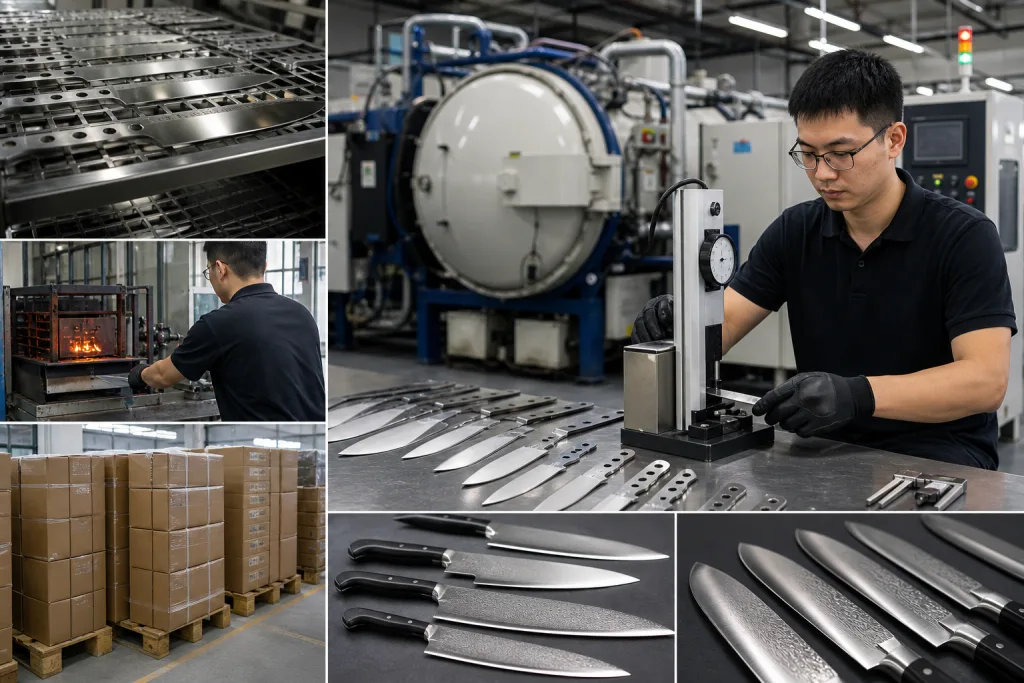
If you source knives from China, blade grind belongs on the same PO line as steel grade and handle construction. Hollow grind bites fast. Flat grind tracks cleaner on prep work. Convex takes harder use. Scandi stays easy to touch up with a stone or a small guided jig. Choose the wrong profile and the buyer flagged the sample as “too thin” or “sticks in food”; by the next email they are asking why sharpening takes so long. We have had that stack up in one AQL 2.5 inspection after QC ran potato slices and 6 mm rope.
At our Yangjiang, China factory, we match grind to use before we talk finish or color box artwork. That is the right order for OEM work. A 2.0 mm kitchen blank and a 3.5 mm outdoor blank can both look fine on a spec sheet, but thickness behind the edge and final edge angle decide whether we ship a clean cutter or carry a warranty problem. HRC matters, but by itself it is the wrong question. QC pulled one outdoor sample last month because the edge measured only 0.25 mm behind the bevel on the digital caliper. For that design, the math did not work. This guide is the view from the grinding line, not a showroom pitch.
What Blade Grind Geometry Changes
The grind is the blade shape from spine to edge. Small change. Big result. It controls how much steel sits behind the edge, how hard the first cut feels, and whether the knife still bites after 50 cuts or 500 cuts. On our grinding line, a 0.25 mm shift measured 1 mm above the edge shows up right away in the tomato skin test and the carton pull. For sourcing, grind is not decoration. It is a working spec.
A thin grind line, for example 0.18 mm behind the edge, gives low drag and a clean first bite. It loses side strength. A thicker line at 0.40 mm takes rougher use, but it wedges in dense carrot and rubber sheet. QC pulled the sample last month, put it through 20 carrot cuts, and you could feel the shoulder fighting the material in one pass. This is why two blades using the same steel, say 14C28N at 59 HRC, can feel like two different knives. Steel gives wear resistance and toughness. Grind decides how that steel meets the material.
For outdoor and kitchen brands, ask this first: do you need easy cut entry or more margin for rough handling? Board stability matters after the main job is clear. Asking only for grind type is the wrong question. If you buy from China or a Yangjiang OEM, put section thickness, edge angle, and grind type on the drawing together. We saw a PO marked "18 dps flat" with no thickness callout; the buyer flagged the sample because it came at 0.38 mm behind the edge and felt dead on onions. A grind spec without thickness data is half a spec.
- Hollow grind: low friction and fast bite on carton and protein trim; below 0.20 mm behind the edge, support drops fast, and we reject more tips after the lateral flex check.
- Flat grind: the practical choice for OEM runs when the buyer wants repeatable cartons, kitchen prep, or EDC cutting; we can hold it within +/-0.05 mm from lot to lot.
- Convex grind: stronger support for rough use and better wet food release; belt pressure has to stay steady, or the shoulder turns lumpy and QC catches it under the side light.
- Scandi grind: simple geometry with easy sharpening on a flat stone; solid control in wood, common on bushcraft SKUs at 300-piece MOQ, and unforgiving if the bevel width drifts 1 mm left to right.
Once this relationship is clear, steel selection and heat treatment are easier to judge. We run the first-off on the Rockwell tester and through a 10-cut sisal rope check before mass production. If the grind is wrong, the math doesn't work, even when the spec sheet looks clean.
Hollow Grind For Fast Slicing
A hollow grind has a concave face, usually cut on a wheel or a large-radius belt contact. We run this profile on the grinding line with a 300-400 mm contact wheel, then QC checks the shoulder by feel and with a caliper after the first tray. Thin shoulder. Fast bite. The blade gets into tomato skin or fish fillet with less drag, so hollow grind fits light kitchen knives and slim folding knives better than thick camp blades.
For buyers, the sales point is simple: clean bite on the first pass. On culinary SKUs such as 8-inch slicers and 5-inch utility knives, a hollow grind improves first-cut feel without making the blade look too tactical on the shelf. On outdoor folders, it makes a thin EDC blade feel sharper at 2.0-2.5 mm stock. One EU buyer flagged this on a pre-production sample: the flat-ground version cut fine, but the hollow sample moved quicker through carton tape and apple skin. QC pulled the sample again, and the difference was obvious in hand.
The tradeoff is real. A hollow grind leaves less steel behind the edge, so the edge rolls or chips sooner if the user twists it in hard material. If your target use is batoning, bone contact, frozen food, or prying, this is the wrong question to ask. We've seen this go sideways when a customer asked for a hollow grind on a 3.5 mm outdoor SKU, then came back after baton testing split two samples at the edge. It also needs tighter grinding control, because a 0.2 mm shoulder difference shows up fast in cutting feel. On a Yangjiang production line, we treat hollow grind as a precision profile, not a generic cost-down choice. The math doesn't work otherwise.
Use hollow grind when fast slicing and low drag matter most. Skip it when retail users will treat the knife like a pry bar and ignore the warning card in the box.
Flat Grind For Balanced OEM Output
The flat grind is the safest default for a blade grind types guide manufacturer because it behaves well on OEM lines. The blade tapers in a straight line from spine to edge, so the grinding line can hold the same geometry across 3,000 or 10,000 pcs, and the buyer can check it with a 0.01 mm digital caliper instead of arguing from photos. For kitchen and outdoor programs, flat grind gives the best balance of cutting speed and unit cost in most RFQs on our desk.
For kitchen brands, a full flat grind suits chef knives and santokus when the spec calls for steady board feel and clean slicing through onion, tomato, or cooked meat. For outdoor brands, a flat or saber flat grind gives penetration with enough shoulder behind the edge. If the blade stock is 2.2-3.0 mm, we can still keep a tidy edge and avoid the thick wedge feel that makes customers complain after the first carton review. Short spec, big risk. We have seen this go sideways when the PO says “sharp edge” but gives no behind-edge target.
The key sourcing data is thickness behind the edge, not just blade length. Ask for this first. A useful target is 0.35-0.60 mm at 1 mm above the apex for 70% of mid-market knives we quote, adjusted for steel and use case. At our Yangjiang factory in China, QC pulled samples with the digital caliper before packing because one buyer flagged a 0.8 mm edge as “too heavy” on a 5-inch utility knife. We run flat grind when a buyer wants one model for retail and e-commerce channels without making the production math messy.
If you need one grind that is easy to quote, easy to make, and clear for end users, flat grind wins. The math works.
Convex Grind For Hard Use
A convex grind rolls into the edge with no hard shoulder. On the grinding line we shape that curve on a slack 120-grit belt, then check it about 0.4 mm behind the edge with a radius gauge. More steel stays under the apex, so we run this profile on camp knives, hunting knives, and survival SKUs. It takes abuse.
For sourcing, the key point is edge survival, not paper-cut sharpness. A convex edge handles twisting and light batoning better than a deep hollow grind because the apex has more backing steel. Last month one buyer flagged edge rolling after sisal rope testing, so QC pulled the sample and reran the cut test; the convex sample held 12 cuts longer than the hollow sample before visible rolling. On camp and field knives, shaving sharp on day one is the wrong question to ask.
The hard part is production control. Convex is harder to hold than a flat grind, especially when we run CNC blanking and manual belt finishing on the same SKU. If one operator leans into a worn 120-grit belt, the profile can drift by 0.2 mm before anyone sees it at polish. That is why we push tighter first article approval with a radius template, then inspect closer at AQL 2.5. We have seen left and right faces go out of balance before final polish. On thin kitchen blades, the math does not work. Too much convex makes a slicer feel bulky.
Use convex grind when the customer expects the knife to survive field use instead of just look clean in a catalog photo. We ship most outdoor OEM convex models in 3.5 mm to 4.0 mm stock because that range brings fewer edge complaints after launch, especially on 1,000-piece repeat orders. For outdoor OEM work, this is usually the safer premium option.
Scandi Grind For Field Sharpening
The scandi grind runs one wide primary bevel straight to the edge, with little or no secondary bevel. On our grinding line, the bevel shoulder shows clearly under a 10x loupe. If the belt drifts 0.2 mm, QC sees it fast, and the user knows exactly where the stone should sit. That matters. For bushcraft and woodcraft, it cuts steady in dry pine, bamboo sticks, and soft camp wood, and field touch-up stays simple. Less guesswork means fewer after-sales messages from users who already keep a field stone in the pouch.
Scandi fits brands selling to customers who maintain their own knives. With a flat stone or guided sharpener, the edge can come back in 5-8 minutes, and outdoor buyers ask this on calls: “Can my customer fix this at camp?” We hear it on 8 out of 10 outdoor calls. The grind bites well for carving and feather sticks, and it handles light camp prep without much fuss. If the knife is built from 3.0-4.0 mm stock and heat treated to around 58-60 HRC, we can run it strong without making the edge too brittle.
The weak point shows up fast in hard food contact and rough general-purpose abuse. Scandi drags in dense vegetables like carrots and squash, and a zero or near-zero edge will chip if the user treats the knife like a pry bar. QC pulled samples before where the bevel looked clean, but the edge failed after side pressure on a pine knot during bench testing. For kitchen or urban EDC brands, asking for “one knife for everything” is the wrong question here. Flat grind usually sells cleaner there. In sourcing terms, scandi needs a clear use case. We have seen this go sideways when marketing uses it as a generic outdoor buzzword.
If your customer cares more about field sharpening than all-around cutting, scandi is still one of the better choices in China OEM production. We ship it best when the PO states bevel angle, stock thickness, and target HRC from the start. One PO typo on 4.0 mm stock versus 3.0 mm can change the whole sample feel on a 500-piece run, and the buyer usually flags it as soon as QC sends photos.
How To Source The Right Grind
Do not price a blade grind from blade length and steel alone. Ask for grind type, stock thickness in mm, thickness behind the edge, edge angle in dps, and the cutting job the user will do. If the PO says only "sharp for camping," our sample room already knows rework is coming. We see it often. At a Yangjiang factory running about 180,000 units per month with 240 employees, clean projects are the ones where the grind spec is locked before tooling starts and before the grinding line programs are released. After sample approval, this is the wrong question to ask.
A normal OEM pilot run is 500 to 1,000 pieces per SKU, with sample approval in 7 to 12 days and mass production in 30 to 45 days after deposit, depending on handle material and finishing. We run first-off checks with a digital caliper at the plunge and behind the edge, because a 0.2 mm miss there changes the cutting feel right away. Small miss, big complaint. For kitchen programs, AQL 2.5 is a realistic inspection standard for appearance and function. For outdoor blades, add blade symmetry, grind line height, and hardness checks, especially if you are targeting 56-62 HRC across different steels. We have seen this go sideways when the buyer asks for a thin slicer, then pushes for pry-bar durability on the same SKU. The math does not work.
| Grind | Best Use | Typical Stock | Edge Angle | Buyer Note |
|---|---|---|---|---|
| Hollow | Light slicing | 1.8-2.5 mm | 12-16 dps | Fast cut; QC pulled the sample after side-load marks showed lower abuse tolerance |
| Flat | Kitchen and EDC | 2.0-3.0 mm | 15-20 dps | Safer all-round OEM choice; output stays steadier and the reject rate is easier to control |
| Convex | Outdoor and hunting | 3.0-4.5 mm | 18-22 dps | Strong edge, but the grinding line needs tighter hand control to keep the same curve across 500 pieces |
| Scandi | Bushcraft and woodwork | 3.0-4.0 mm | 15-20 dps | Easy sharpening; narrow use case, and buyers often flag wedge drag on food prep |
Use that table as your OEM brief starter, then mark target thickness and grind line height on the drawing. We ship cleaner quotes when that sheet is complete, and the sample room loses fewer days chasing blank spaces in the spec. One missing satin finish note, or one PO typo like 2.5 mm stock written as 3.5 mm, can turn a 12 day sample into an 18 day correction cycle.
Frequently asked questions
For most chef knives, a flat grind or slight convex grind is the safest choice. It gives a good balance of slicing speed and edge stability on cutting boards. For stainless kitchen programs, 1.8-2.5 mm spine stock and a 15-18 dps edge angle are common. If you want a lighter, more agile feel for food prep, a flatter grind works well at 56-60 HRC. Hollow grind can slice very easily, but it is less forgiving if the user twists through hard vegetables or contacts bone. If you are buying from China, ask for thickness behind the edge, not just blade length, because that number drives real performance more than marketing language.
For hard-use outdoor knives, convex grind is often the better choice because it supports the edge and handles impact well. A 3.0-4.5 mm spine with 58-62 HRC is a common range for this segment, depending on steel and target price. Convex is especially useful for hunting, camping, and survival SKUs where users may cut rope, wood, and mixed materials. The tradeoff is manufacturing control. If the grind line is inconsistent, the knife can look uneven and cut differently from piece to piece. That is why we recommend first article approval and AQL 2.5 inspection on both geometry and finish when sourcing convex blades in China.
No. Scandi grinds are usually easier to sharpen than flat or convex profiles because the main bevel is broad and easy to read on a stone. Many users can restore the edge with a flat stone in 10-20 minutes if the bevel is clean and the angle is consistent. The challenge is not sharpening, it is maintaining the geometry during production and after user abuse. If the edge gets rounded or the shoulders are damaged, the knife loses the benefit that makes scandi attractive in the first place. For bushcraft buyers, that simplicity is a selling point. For kitchen users, it is usually too specialized unless the product has a very clear niche.
Yes, and this is common in OEM work. The same blade outline can be built as flat, convex, or even a shallow hollow version if the steel, stock thickness, and heat treatment support it. What changes is the grinding program, finishing labor, and sometimes the performance profile. For example, a 3.2 mm outdoor blade can be offered as a flat grind for value buyers and a convex grind for premium users without changing the handle mold. The key is to freeze the technical drawing first, then approve a sample for each grind. In Yangjiang production, a grind change is usually faster than a tool change, but it still needs its own QC record.
We inspect grind quality by measuring thickness at defined points, checking grind symmetry, and confirming that the edge line follows the approved master sample. For commercial knife production, AQL 2.5 is a common inspection level for appearance and function, but critical projects may need tighter internal checks. Practical measurements include stock thickness, thickness 1 mm above the edge, edge angle, and grind line height. On outdoor knives, we also check for waviness, heat discoloration, and burr removal. On kitchen knives, we test board feel and cutting consistency. If you want repeatable sourcing from China, require a blade profile drawing and a signed first article before mass production starts.
Send Your Grind Spec For Quotation
Share blade stock, target HRC, edge angle, and annual volume. We will match the grind to your use case and quote FOB or DDP from Yangjiang, China.
Request a Quote