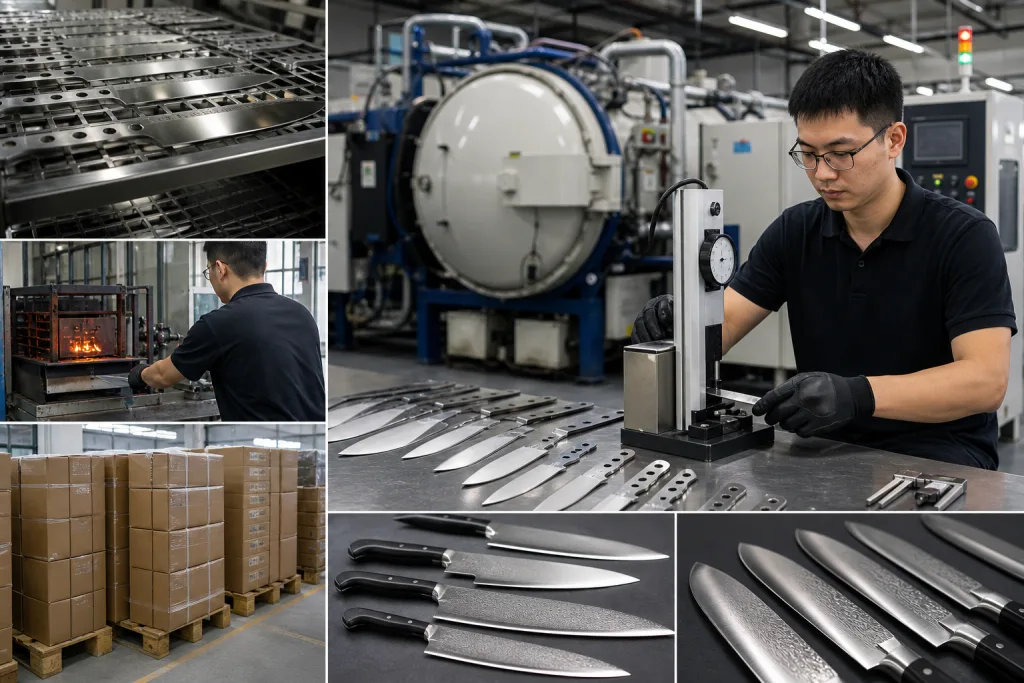
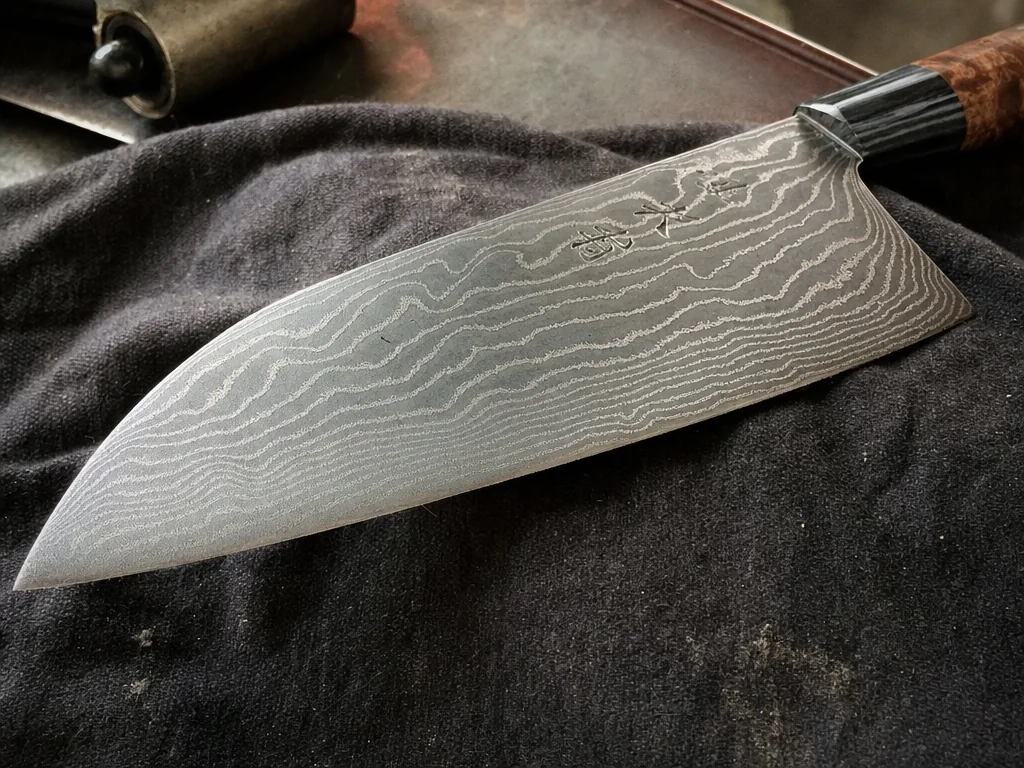
At our Yangjiang, Zhejiang, China knife plant, a chef-collab knife program is not a logo swap. One SKU carries four cost points: the founder story for the sell sheet, the blade spec for the shop floor, the packaging claim for compliance, and the license payment on the settlement sheet. Miss one line and we pay twice. We had a 240 mm sample clear edge retention on the CATRA bench, then QC pulled the carton at final because the PO printed the chef name two different ways. That held 1,200 sets on the floor. In 7 out of 10 RFQs, premium brands still reach tooling with gaps on name rights, artwork approval, royalty base, packaging wording, or who signs the final golden sample. Too many teams start with the logo and skip the paperwork.
The clean programs are boring on paper. They ship. We run production while your team owns the story, but the agreement needs to lock the chef name, knife profile, steel grade, launch date, sales territory, and royalty calculation before we open a mold or book the grinding line. Ask for “a chef knife with his logo” and the math does not work. We have seen this go sideways when a buyer signed off the blade, missed the back-card wording, and then asked us to reprint 3,000 sleeves after packing; the cartons were already taped and stacked 6 high by the dock. For predictable China sourcing, treat it like a private-label program: tighter IP terms, written sample approval, and royalty math that still works after MOQ, packaging, freight, and channel margin.
What a collaboration program really is
A chef collaboration knife program stays clean only when three ownership layers are fixed before the first CAD file reaches the sample room. The brand layer covers your trademark, sales channels, carton copy, and insert card wording. The chef layer covers the licensed name, the 18 mm signature etch, the sleeve-card likeness, and any story the chef is allowed to license. The product layer is the knife itself: blade geometry, the 2.0 mm spine callout at the heel, handle material, heat treat, finish, and the exact SKUs we ship. Start there. If those layers get mixed, the launch looks good in the deck and gets painful when QC pulls the sample under the 6000K light booth.
A chef collaboration knife program manufacturer in China has to split co-brand work cleanly. We run sampling, engineering, sourcing, and mass production on the factory side, including fixture changes on the grinding line and first-piece checks with the digital angle gauge. You keep approval rights on blade marks and box art, retail positioning by channel, and any claim tied to cutting performance or edge retention. A buyer flagged this exact point on one brushed-finish sample last quarter because the satin direction was off spec by 15 degrees. Nobody wanted the plant making brand calls. Fair pushback. The factory should not decide whether a brushed finish or a granton pattern belongs on the brand.
For most premium programs, a 12-piece opening line is the wrong question. Start with one chef knife, one utility knife, one paring knife, and one gift box. Four SKUs are easier to control than a 12-piece line, and the royalty report fits on one clean sheet instead of turning into a month-end argument. Forecasting stays tighter. Packaging waste drops. We have seen this go sideways after a PO typo changed "gift box x 3000" to "gift box x 300" and held the shipment for 2 days while the merchandiser chased a revised stamp. If the collaboration sells through, add follow-on OEM lines later, but the first release needs to be simple enough to explain on one pricing sheet.
Choose royalties before the first sample
I’m rewriting the section directly in the existing HTML structure, keeping the table and all stated numbers intact while tightening the language and adding factory-floor specifics.I’ve tightened the copy and am keeping the original numbers, commercial terms, and table structure intact while shifting the tone toward factory-side royalty negotiation.Set the royalty before we cut steel for the first sample. Leave the royalty base loose and every PI and monthly sales report turns into a deduction fight, then finance starts sending debit notes. On premium-brand programs, we run one of the models below in 7 out of 10 launches. Net sales works only if the contract lists each deduction line in black and white: returns by SKU, freight tied to that order, duty, marketplace fees charged by channel, and free replacement units approved under claim. Do not dump them into one bucket. Last month QC pulled a chef-collab sample at pack-out because the gift box added USD 0.42 per set, and the buyer asked whether the chef royalty also covered that carton insert after the die-line was signed off. That is the wrong question to ask after tooling.
| Model | Typical range | Best use | Watch item |
|---|---|---|---|
| Net sales royalty | 5% to 8% | Established premium line with clean wholesale reports | List each deduction in the agreement |
| Fixed per-unit fee | USD 1.00 to 3.50 | Mid-volume launch where the MOQ and ASP are already stable | Reset the fee when ASP moves |
| Minimum guarantee | USD 15,000 to 50,000 | Chef-led exclusive with committed launch volume | Credit it against future royalties |
In Yangjiang and the nearby export clusters we ship from, I prefer a plain formula that a merchandiser can check against one invoice, and finance can clear it in 2 minutes. Clean math wins. If the net wholesale price is USD 24 and the royalty is 6 percent, the math works. If you sell DDP into Europe, calculate royalty on FOB or net wholesale, not landed cost. Duty and last-mile freight are not brand value. We have seen this go sideways: one PO carried a typo in the royalty line, the buyer flagged it after 3,000 sets were packed, and grinding line 2 had already booked the launch slot for Friday. If the program includes co-branded gift packaging or a signed card, decide up front whether those items sit in the same royalty base. In 8 out of 10 programs, they should not. Pay royalty on freight and promo filler, and the math does not work. A solid chef collaboration knife program sourcing plan protects margin before we run production.
Design the knife for production
The fastest way to kill a chef collaboration is to draw a knife that photographs well, then jams up the grinding line at a cost nobody can hold. Start with the job. Not the render. For a western chef knife going into broad retail, we usually set 56 to 58 HRC because home users need a blade that survives sink hits and sharpens on a pull-through without drama. A higher-end line can run 59 to 61 HRC, but only if the steel lot, furnace chart, and quench record match the signed sample. Handles need the same discipline. POM and G10 stay stable on CNC jigs; pakkawood and stabilized wood look richer, but we run moisture checks before assembly because one 0.3 mm swell at the rivet can make QC pull the sample.
Write every spec so an inspector can check it with a caliper, scale, or angle gauge. Put blade thickness at the spine in mm, point-of-grind position from the heel, edge angle, finished weight, balance point from the bolster, and cosmetic limits in the drawing. For premium kitchen knives, we can hold plus or minus 0.15 mm on critical thickness and plus or minus 5 g on finished weight if the drawing is clean and the sample rack is locked. Write the sharpening angle too: usually 15 degrees per side for European profiles and 12 to 15 degrees for Japanese-inspired shapes. If the sales claim says edge retention, tie it to CATRA-style testing or a fixed cutting trial using the same rope, board, and operator. Simple rule. “Sharper than the chef’s old knife” is not a spec.
Steel choice has to match the customer promise and the landed price. 14C28N gives clean corrosion performance for retail users, 1.4116 keeps the math friendly, VG10 needs tighter heat-treat control, and AUS-10 works when the buyer wants Japanese wording without pushing the MOQ past the launch volume. This is not steel pride. It is returns, sharpening complaints, and whether the royalty model still works after scrap. A chef collaboration knife program manufacturer in China should push back if the spec asks for a mirror finish on a thin bevel that will create rework at polishing. We have seen this go sideways: the buyer flagged tiny belt marks after approving a PO that only said “premium satin.” That is the wrong question to ask after tooling. We are protecting the margin before the die, handle mold, and first 3000-piece run are locked.
Lock down legal rights and approvals
Co-branding breaks fast when the contract is thin. Split the rights line by line: trademark use for the logo on the blade and box; chef likeness for the belly band photo; design ownership for the blade profile and handle line; packaging art files; sales territory by market. We saw one PO typo flip "EU exclusive" to "EU inclusive" on a color-box proof, and the buyer flagged it before mass print. Good catch. The chef licenses the name and signature elements needed for launch. The factory does not own brand assets or packaging files. Process know-how needs the same fence: no loose work-for-hire clause should hand over grinding angles, heat-treat windows, or the polishing sequence, and on our grinding line that spec sheet stays under document control. Keep it narrow. Keep it readable. Stuffing every right into one paragraph is the wrong question.
Run approvals in stages: concept sketch, 3D rendering, first article sample, pre-production sample, then the golden sample. Do not skip the golden sample. Last month QC pulled a sample, checked the swedge with a Mitutoyo caliper, and found it sitting 0.4 mm high against the signed master. That is why we lock one physical reference before the mass run. In a clean program, the sample gets tagged, signed, and stored under the revision code, with blade finish and logo position called out in the file. If the first mass run drifts from that sample, you need a written rework rule with polish, re-etch, or scrap limits, not a 12-email argument after the container booking is already tight. Saving 3 days here often costs 18 days later. The math doesn't work.
For compliance, put the market requirements on page one. European buyers ask for REACH declarations and LFGB where applicable, especially for handles, coatings, packaging inks, and gift sets; in our lab file, handle resin and black soft-touch ink are the first two lines buyers question. US buyers ask for FDA-related food-contact documentation when relevant, along with carton labeling that shows lot code, PO, and production date. We run AQL 2.5 for major defects, and on premium items we tighten the critical-defect rule. Last quarter QC pulled a carton with one missing lot-code digit, and the buyer held 1,200 sets until we re-labeled. Exclusive is fine. Loose paperwork is not.
Source the right China factory
Audit a chef collaboration knife factory the same way you audit the chef's name on the box. Do not buy this like cheap handles by the carton. In Yangjiang, Zhejiang, China, you will see both 6-person trading offices with a neat sample room and real plants where the grinding line is already loud at 8 a.m. Different risk. A factory worth your program should show line-level capacity and heat-treatment control. I also want incoming steel traceability, plus inspection sheets with dates, inspector names, and lot numbers. For a premium program, ask for ISO 9001 procedures, BSCI status if your retailers ask for social compliance, and batch traceability that ties the steel coil or blank lot to the finished carton code. Ask for the furnace log and the temper chart. The brochure can wait.
At our size, about 240 employees, we run roughly 80,000 units per month and keep a chef program moving without turning the whole factory into a sample room. That matters when the launch date is fixed and the first release needs 500 to 2,000 pieces per SKU. A normal first-order MOQ here is 500 pieces per design. We adjust only after the sample room checks the blade profile against the template and the live logo file, then confirms the gift box structure; more than once, the buyer flagged a PO that said laser logo while the approved artwork said deep etching. We usually quote 15 to 25 days for samples and 45 to 60 days for production after approval, assuming the steel is in stock and the new bolster mold passes first trial. If a buyer asks for 12 days on a new bolster mold plus a rigid gift box, the math does not work.
Ask direct questions: who sharpens the knives, who signs the QC report, what stays in-house, and what goes outside. If the answer gets vague, walk. "QC pulled the sample" should mean a named inspector used a Rockwell tester, checked the edge under a 10x loupe, measured logo position in mm with a caliper, and signed the report before cartons moved to packing. We have seen this go sideways: the showroom sample looked clean, then the 3,000-piece run came back with the handle mark shifted 2 mm. Buyers spot that fast. The right chef OEM partner holds HRC where the spec says it should be, keeps the finish steady from batch to batch, and keeps logo placement stable across 10,000 units.
Launch with tight channel control
Launch on scarcity and channel control, not raw volume. Asking how fast you can push the knife into 3 channels is the wrong question. We saw one chef SKU get messy in 45 days because the buyer put it on Amazon and into 18 dealer stores at the same time; the chef story got diluted, and the royalty sheet turned into dispute work. Pick one route first. Dealer-led with a named account list, or DTC-led through your own site. A mixed model works only when the cap is written by region and account type, then locked into the distribution terms before the PO is cut. On our side, we run a separate blade-etch film for the launch batch and hold the first drop at 300 sets, so the story stays tight and the reporting stays clean.
Packaging comes out of the margin. Premium buyers notice 1.5 mm sleeve slack. They notice a soft 1200 gsm insert, a barcode sitting too close to the edge, a crooked FNSKU label, and an unboxing that feels cheap against the retail price. A custom rigid box can add USD 0.80 to 2.50 per set. The math still works better than paying returns for crushed tips or split corners. On the packing table, we run a drop check with a taped master carton; QC pulled the sample last month because the EVA tray let the handle shift 6 mm. If you want a numbered edition, put it into the print file before production, not as a hand stamp after packing starts. We have seen this go sideways after 600 sets when the stamp depth changed between shifts. That is where custom packaging and private label discipline earn their money.
After launch, run it like a real product line and report every month. Track sell-through by channel. Track returns by reason code. Send blade complaints back to the grinding line and watch replenishment time in days; 12 days vs 18 days changes reorder behavior fast. Keep the royalty statement plain. No one needs a glossy dashboard. Show units shipped and net wholesale revenue, with each deduction line and the payment date spelled out. If the product sells in Europe or North America, the packaging and labeling must match the approved artwork exactly. We ship against the signed PDF, and a one-word carton copy change without approval is how chargebacks start or stock gets held at the 3PL. QC pulled the sample on one run because the origin mark moved 4 mm off spec after a plate change. The best programs keep the chef visible and the brand protected. They keep the factory on repeatability, not last-minute improvisation.
Frequently asked questions
Private label is mostly a branding exercise: your logo, your spec, and your channel plan. A chef collaboration knife program adds licensed name rights, image approvals, royalty reporting, and often a tighter launch calendar. That changes the sourcing model. You may still buy from the same China OEM base, but the contract needs more detail on approvals, territory, and marketing claims. For premium brands, I would expect a first MOQ around 500 pieces per SKU, two to three sample rounds, and a written golden sample process. The factory should not decide the story; it should execute the story consistently.
For a recognizable chef name on premium kitchen knives, 5% to 8% of net wholesale sales is common. For smaller or emerging names, 3% to 5% is more realistic, or a fixed fee of USD 1.00 to 3.50 per knife. If the brand sells DDP or through marketplaces with high fees, do not calculate royalty on landed cost; use FOB or net wholesale so the math stays clean. Many deals also include a minimum guarantee, often USD 15,000 to 50,000, which is credited against future royalties. That protects the chef and forces the brand to plan real volume.
That depends on the contract, not the sample room. Usually the brand owns the final CAD, blade geometry, packaging artwork, and mold files if it paid for development, while the chef licenses the name, signature, and likeness for a defined territory and term. The factory keeps its manufacturing know-how unless you negotiate otherwise. In practice, I recommend a written assignment for design assets and a separate license for the chef identity. Keep the approval chain clear: concept, rendering, first article, pre-production, and golden sample. If you skip that, ownership arguments show up after the launch, when they are expensive.
For premium chef collaboration knives in Yangjiang or similar export hubs in China, a practical MOQ is often 500 pieces per SKU, with 1,000 pieces more common if you add custom handle tooling, special packaging, or laser engraving. Samples usually take 15 to 25 days depending on steel and finish. Mass production is commonly 45 to 60 days after approval, assuming materials are available and the line is not overloaded. Repeat orders can move faster, sometimes 30 to 40 days. If a supplier promises much less without asking about specs, they are probably simplifying the real work.
Ask for ISO 9001 procedures, BSCI if your retail customers care about social compliance, and batch traceability from incoming steel to finished carton. For Europe, request REACH declarations and LFGB where applicable, especially for handles, coatings, inks, or gift components. For the US, ask for FDA-related food-contact documentation where relevant. On the quality side, AQL 2.5 for major defects is a sensible baseline, with critical defects set to zero. For premium claims, tie edge retention or cutting performance to CATRA-style tests or a documented internal test method. A factory that cannot show records is not ready for a co-brand program.
Build the collaboration the right way
If you want a premium chef collaboration knife program sourced in China with clean royalty terms, tight approvals, and reliable delivery, start with the contract and the spec, not the sample box.
Request a Quote