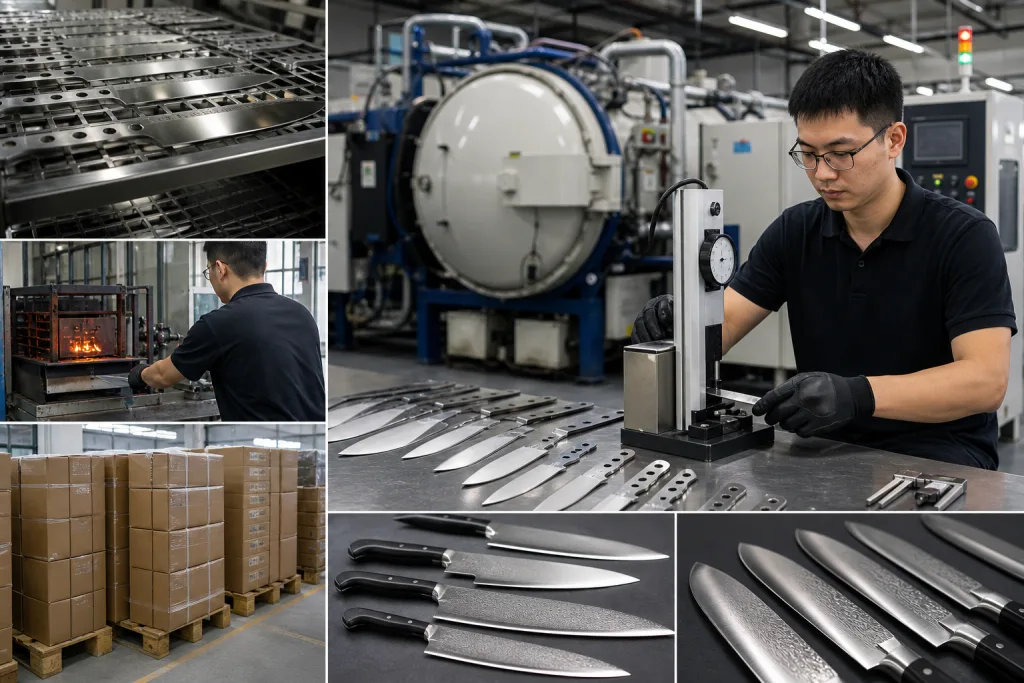
Most importers start china japan taiwan knife sourcing with a lazy country label: Japan is premium, Taiwan is mid-range, China is cheap. On the grinding line, that shortcut fails fast. Buy the spec, not the flag. Check the steel grade, heat-treatment repeatability, 0.2 mm edge-grind tolerance, carton mark artwork, and reorder speed at 12 days vs 18 days. If the shipment lands 2 weeks late or QC reads 52 HRC against a 55 HRC target on the Rockwell tester, the lower unit price has already disappeared. This is the wrong question to ask.
If you sell into Europe or North America, compliance and volume decide the order. A Yangjiang or Zhejiang factory can quote a lower FOB, but the value only counts after QC pulled the sample, the plant works to AQL 2.5, the REACH or LFGB file is ready, and 20,000 pieces ship without the satin finish drifting when the grinding line changes a 240-grit belt at 400 pieces. China can move an OEM program fast, sometimes from one sample round and a 1,000-piece MOQ. Japan and Taiwan usually hold tighter process discipline. The bill shows it: higher MOQ, higher labor cost, and lead time closer to 45 days than 30. We have seen this go sideways over one carton-mark typo on the PO.
What changes by origin
Origin changes the buy in two places first: unit cost and process control. It also changes how fast a factory says "yes" after your spec sheet lands. China, Japan, and Taiwan all make good knives, but they do not want the same order. China usually gives the widest steel and handle menu, more OEM space on logo, packaging, and blade profile, and the lowest unit price once the mold or laser fixture cost is spread across the order. Japan fits buyers selling hand finishing and steady blade geometry; that clean premium cut feel is part of the retail story. Taiwan sits between them on many programs. We see it on the sample bench every month. A China set may offer 6 handle colors at 3,000 pcs MOQ, while a Japan quote may lock the handle and accept 800 pcs, but with tighter heel grind checks and slower sample approval.
For an importer, the country name is not the real call. The factory model is. A China OEM program is reliable when the supplier has stable heat treatment, in-house grinding, and monthly output of 200,000 to 500,000 units across lines. We run into this in Yangjiang all the time: plants are built for scale, export cartons, barcode stickers, mixed-SKU packing, and fast reorder work; in parts of Zhejiang, you see the same discipline on repeat orders and margin control. Japan usually runs smaller batches, with more labor minutes in each knife and less room to bend the process after sample sign-off. Taiwan often pushes functional performance and cleaner lot-to-lot consistency, especially on outdoor knives and utility programs where edge holding matters more than the origin stamp. If your customer wants a private-label kitchen line with sharp pricing, China is usually the practical starting point. If you sell a premium chef knife at a high retail price, Japan can justify the extra factory time. For a balanced outdoor or utility program, Taiwan often fits. One buyer flagged a China quote because the carton drop test failed at the corner seam; QC pulled the sample, changed the outer carton from 5-ply to 7-ply, and we shipped the next approval set without drama.
The mistake is asking which country is best. That is the wrong question to ask. Match the origin to your target retail price, allowed defect rate, and replenishment rhythm. If the retail math needs a $6.80 landed knife and the factory needs 18 days just for hand finishing, the math does not work. We have seen this go sideways when a buyer chases a premium origin, then pushes back on a 0.3 mm grind variance already written into the approved sample. Margin gets protected by boring details: the HRC record, grinding line consistency, AQL 2.5 result, and whether the next PO ships in 12 days or slips to 18 days.
Cost map and MOQ reality
Cost shows up on the quote sheet first. For a standard stamped or basic forged kitchen knife, a Chinese factory usually quotes FOB from USD 2.20 to 4.80 per piece, based on blade size, handle material, and packaging. We run these on export lines in Yangjiang, and a 7 inch chef knife with a PP handle and color box stays in the low lane, while the same blade with pakkawood and a PET blister moves up once the blister sealing station and extra hand packing are added. Small change. Real money. Taiwan often lands around USD 5.50 to 12.00 for similar categories because labor cost is higher and a full handle polish pass can run 18 minutes instead of 11; one buyer pushed back on a USD 0.18 handle polish charge, but the buffing wheel time was already in the sheet. Japan moves into USD 10.00 to 28.00 or more once you specify premium steel, a hand-finished spine, or artisan grinding. These are the ranges buyers see after the first serious RFQ, before somebody asks why the gift box paper is 350 gsm instead of 300 gsm.
MOQ matters as much as unit price. A China knife sourcing manufacturer often accepts 1,000 to 3,000 pcs per SKU for private label, especially in Yangjiang where we already run mixed SKU programs and swap pad-print plates between cartons on the same shift. Japan often asks for 3,000 to 10,000 pcs, and some makers ask for more once you request custom molds or extra handle colors. Taiwan usually sits between those two. Buyers underestimate the split math: if your catalog has 12 knife SKUs and you want 5,000 pcs total, the math does not work in most origins. China is usually the only origin that keeps the program workable. We have seen POs where the buyer wanted 420 pcs per item across 12 models, then flagged the mold charge as “too high” after approval. This is the wrong question to ask. The real check is whether the grinding line can hold the bevel, the packing line can keep carton labels matched to the PO, and QC can stop a handle color mix-up at final inspection.
| Origin | Typical FOB | MOQ per SKU | Repeat Lead Time | Common HRC |
|---|---|---|---|---|
| China | USD 2.20-4.80 | 1,000-3,000 pcs | 30-45 days | 54-60 HRC |
| Taiwan | USD 5.50-12.00 | 1,500-5,000 pcs | 45-60 days | 56-61 HRC |
| Japan | USD 10.00-28.00+ | 3,000-10,000 pcs | 60-90 days | 60-64 HRC |
Use the table as a sourcing map, not a rulebook. A clean Chinese program beats a badly managed Taiwan order. QC pulled one China sample last month with a 0.35 mm edge deviation, checked it on the edge jig, and fixed it before bulk packing; after shipment, the same miss turns into a return claim. We have seen this go sideways. If you need a low-variation premium line, paying more for Taiwan or Japan often cuts hidden cost in claims, replacement stock, and customer service tickets. For mass retail, the order usually goes to the origin that can hit the target FOB, take the MOQ split, and repeat in 30-45 days.
Steel and heat treatment
Knife buyers burn too much time on steel grade and not enough on heat treatment. Wrong question. A 5Cr15MoV blade at 56 HRC can sell cleanly and cut better than a badly treated 8Cr13 blade at the same hardness; QC pulled samples from our grinding line where the 8Cr13 matched the PO, then chipped after the rope-cut test on the third check. Higher specs follow the same rule. AUS-8 needs stable tempering, VG-10 needs tight decarb control, 440C hates sloppy quench timing, 14C28N shows bad edge geometry fast, and powder steel is wasted if the furnace log is guesswork. The buyer is paying for control: quench timing at the furnace door, temper temperature on the controller, blade straightness after cooling, and edge grind held within 0.2 mm from first piece to carton 50.
For most kitchen and chef knives, the practical target band is 55-60 HRC. Below 54 HRC, edge retention drops too fast for export retail; after 40 cardboard cuts the complaint rate starts to show in returns, not in the sample room. Above 61 HRC, the math gets tight. Heat treatment has to be cleaner, and customers need to hear one plain warning: a thin edge is not a frozen-food tool. Japanese factories earn respect because they hold narrow HRC bands and finish sharp angles, sometimes 12 to 15 degrees per side on premium lines. Taiwan is strong on performance blades and outdoor knives, especially when the same geometry has to repeat across 3,000 pcs and then repeat again on the next lot. China is wider. In one Yangjiang week we can see a workshop with loose temper records and, two streets over, a factory logging every furnace batch with Rockwell readings on a Mitutoyo sheet. The difference is usually the factory, not the passport.
If you are sourcing as a brand owner, ask for proof before you listen to sales copy: hardness test records with actual readings, sectioned heat-treatment samples showing the structure, and first-article edge retention results from the line. Then ask what tolerance the OEM factory holds on blade thickness at 20 mm from the tip, spine symmetry under the caliper, and tip alignment after handle assembly. A good factory answers in numbers. A weak one says "premium quality." We have seen this go sideways, including one PO where the buyer flagged "VG-10" in the artwork file but the sample room built 440C because nobody checked the steel code before heat treatment.
Lead time and supply risk
Lead time is where importers lose margin, and most do not see it until the next PO lands. The math breaks fast. If your sell-through plan needs a 35-day replenishment cycle, Japan is usually the wrong origin to quote. We have seen repeat production there sit at 60 to 90 days because batch runs are small, hand finishing eats hours, and one laser-marking station or water-grind queue can freeze the schedule. Taiwan usually lands at 45 to 60 days. Better. Still not the same as a China OEM shop that already has the blade blank die, handle mold, color chip, and carton mark saved in the production file.
China pulls ahead when the item repeats cleanly. In a stable factory, the steel booking is locked, the 2.5 mm blade blank spec is on the worksheet, and 500 sets of pakkawood scales are already on the rack, so we ship within 30 to 45 days after sample approval. That speed matters for Amazon replenishment and chain-store promos, where one missed vessel booking can cost more than a cleaner FOB rate. A 15-day delay on a 20,000-piece order can kill the margin. We have seen buyers fight us for $0.18 per piece, then miss the vessel cutoff because the PO artwork arrived two days late with the carton mark still in last season's font.
Supply risk starts with revision control, not speed. If you changed the handle color from black to green and added laser engraving, the real test is whether the factory can repeat the exact spec six months later. QC pulled samples like this before: the old black Pantone chip stayed in the file, or the logo came back 0.3 mm off center under the caliper. Small miss. Big complaint. In China, especially in Yangjiang and the wider export belt, stronger factories handle this well because they run 300 SKUs and keep old BOMs with carton-mark files. Taiwan is usually strong on repeat consistency. Japan stays disciplined, but the math does not work if you need fast packaging changes every quarter.
If your business lives on reorder speed, China is usually the best balance of response time and cost. We run plenty of programs where the buyer wants a 1,200-piece top-up before the next Amazon promo, and China is the only place that can squeeze it into the grinding line without blowing up the FOB. If your brand sells on low variance and premium positioning, a slower lead time can still make sense. Price it honestly. We have seen this go sideways when the sales team promised fast replenishment and the factory was still waiting on printed sleeves with the corrected barcode.
Compliance and buyer controls
Importers often price the blade and forget the paperwork load by origin. Same 8-inch chef knife, different file on your desk. For Europe, we prepare REACH-relevant declarations and packaging compliance files before the cartons leave Yangjiang. If the set includes a food-contact part, such as a sheath insert or color box accessory, we add LFGB-related material records and match them to the BOM. For North America, buyers ask for chain-of-custody records, material declarations, and retailer label rules down to sticker position; one U.S. account marked up our artwork because the warning label sat 6 mm too low. Small miss. Big delay. If you sell through Amazon, put FNSKU labels, carton marks, and barcode accuracy into the sourcing discussion on day one. Last year QC pulled 47 cartons because one PO had a digit wrong on the EAN code.
China factories handle this well when export control is part of the floor routine. Ask for ISO 9001 status, BSCI if your customer requires social compliance, and written incoming inspection records for steel coils, handle slabs, rivets, and color boxes. A serious supplier should work to AQL 2.5 for major defects and 4.0 for minor defects, with fixed limits for blade scratches, logo position in mm, and crushed packaging corners. Short answer: full inspection means nothing until the checklist states the reject point. Ask for QC photos, torque-test records on folding knives, corrosion test references where relevant, and carton drop-test results for gift sets. On our grinding line, we run the first-piece check before bulk polishing because a 1.5 mm logo shift is cheap to catch there and expensive once 600 units reach packing. The math doesn't work otherwise.
Japan and Taiwan give some buyers more comfort on reputation, but they still need paperwork. This is the wrong question to ask if the buyer only says, “Which origin is safer?” You need written specifications, approved samples, and traceable lot records, with lot numbers tied back to the production date and carton mark. For private-label work, the real test comes later, when the retailer asks for three revised label files, a material declaration, and a signed packing photo before booking. We have seen this go sideways. One buyer held booking because the outer carton mark showed PO-11827 while the packing photo showed PO-11872. A good factory in China can be strong here. A weak one, anywhere, will make customs and retailer onboarding slower than it needs to be; we have seen a shipment sit 12 days vs 3 days because the supplier could not match the blade steel declaration to the invoice.
Which origin fits your program
The right origin depends on the knife category and the claim printed on your carton. For entry kitchen knives with a fixed shelf price, China usually wins. We run a 5-piece block set at 3,000 sets MOQ, match the PP handle color to the approved Pantone swatch within normal tolerance, and still leave margin for a supermarket promo. Good math. If the program is a premium chef knife, Japan earns its place when balance, spine polishing, and the box opening matter more to reviews than USD 0.80 on FOB. For outdoor, tactical, or utility knives that need CNC-clean machining and firm lock-up without Japan pricing, Taiwan is often the practical middle.
For a China Japan Taiwan knife sourcing manufacturer search, split the line by tier. Use China for broad private label ranges and fast-moving replacement SKUs, including gift sets where the buyer is watching carton cube and shelf price. Use Taiwan when the buyer pushes for tighter technical work, like even G10 scales, cleaner liner fit, or a 0.3 mm edge tolerance on samples checked with a digital caliper. Use Japan when the brand story and edge feel support the premium, especially on VG-10 or 60-62 HRC chef knives. Forcing one origin to cover every price point is the wrong question to ask. We ship cleaner programs when entry knives come from China and premium chef knives come from Japan; specialty outdoor pieces can sit in Taiwan while packaging, barcode rules, and carton marks stay unified.
The common buyer mistake is choosing one country for the whole program. Segment by margin band and reorder frequency. Fast SKU, brutal price pressure: choose China. Higher ticket, lower volume: choose the origin with the least quality friction. We have seen this go sideways when a buyer asked one factory to make a USD 4.20 promo knife and a premium boxed chef knife under the same spec sheet. QC pulled the sample; the satin finish passed for the promo SKU, but the premium blade showed belt marks near the heel under a 600-lux inspection lamp. In Yangjiang and across China, 200-plus export factories already understand mixed-origin programs and can support shared packaging with different blade specs.
How to source without surprises
If you want fewer surprises, run sourcing like process control, not shopping. Start with a written spec sheet. Call out blade steel and HRC band. Lock the edge angle, finish standard, logo method, handle material, and packaging. Put tolerances in black and white. Write it plain: 15 degrees per side. Satin finish No. 320 belt. Handle gap under 0.3 mm. Carton drop test from 80 cm. Then require a pre-production sample and a golden sample. No shortcuts. Do not sign off a knife from one photo or a showroom piece someone hand-polished before the fair. Ask for line-run samples, especially from China, because the grinding line tells the truth. QC pulled one sample for us last year where the logo looked clean in the photo, but the pad-printing plate was 2 mm off on the actual batch.
Your next checkpoint is auditability. A China knife factory should be able to show lot traceability, incoming material control, and an inspection routine that repeats week after week. We run this with steel coil records, hardness tester readings, first-piece inspection, and final AQL 2.5 reports. Ask to see the forms. A serious factory will quote lead time, MOQs, and the QC plan without talking in circles. A weak one promises everything and writes down nothing. That is where importing gets expensive. A 2% defect rate on 50,000 units is 1,000 pieces to sort, replace, or discount. The math hurts fast. We have seen this go sideways. On one 24,000-piece order, the buyer flagged 11 cartons that mixed old and new handle rivets, and the PO still had the old rivet code in one line.
For most importers, the practical move is simple: run China for commercial knife volume, keep Taiwan for technical mid-tier programs, and use Japan for selected premium SKUs where the margin supports it. This is the wrong question to ask if you only compare FOB price. The math doesn't work if you ask Japan pricing to cover entry retail, or if you expect a low-cost China line to run like a small-batch VG-10 maker. We ship China programs in 35 days when the steel, packaging, and artwork are locked before deposit. Taiwan specialty-handle programs usually need 45 days vs 35 days because tooling and handle fit need one extra approval round. If a supplier cannot explain how they hold 56-58 HRC, ship in 35 days, and pass AQL 2.5, you are not comparing origins yet. You are comparing sales talk.
Frequently asked questions
Usually yes, but not always on total landed cost. A Chinese OEM knife can start around USD 2.20-4.80 FOB for standard kitchen models, while Taiwan may be USD 5.50-12.00 and Japan USD 10.00-28.00+. But cheaper FOB is not the full story. If a China supplier ships 10 days faster and accepts 1,000-3,000 pcs MOQ, that can beat a higher-cost origin for most importers. If the order needs hand finishing, premium steel, or tighter grind consistency, the price gap narrows. The real question is whether the product sells at your target margin after freight, duty, packaging, and expected defect allowance.
Japan makes sense when the knife is part of a premium range and the buyer will pay for the story, finish, and cutting feel. You are usually looking at 60-64 HRC, narrower tolerances, and longer lead times, often 60-90 days. MOQ can run 3,000-10,000 pcs per SKU, which is heavy for smaller brands. If your retail price can absorb a higher landed cost and you need a prestige product, Japan can be justified. If you are building a broad private-label line with fast replenishment, it is often too expensive and too slow for the commercial segment.
Taiwan is often the middle ground for buyers who want better process discipline than a basic China program but do not want the full premium cost of Japan. Typical FOB can sit around USD 5.50-12.00, with MOQs around 1,500-5,000 pcs and lead times of 45-60 days. It is a sensible option for outdoor knives, technical utility knives, and some premium mid-tier kitchen lines. If you need a balanced mix of quality and supply stability, Taiwan can be a good fit. If you need the lowest unit cost, China is usually better. If you need high-end brand perception, Japan is stronger.
For most stainless kitchen and chef knives, 55-60 HRC is the practical range. Entry-level products often sit at 54-56 HRC to reduce chipping and keep costs down. Better mid-tier products usually run 56-58 HRC. Premium lines may reach 60-62 HRC if the heat treatment is well controlled. Above that, you should be very careful about brittleness and customer use patterns. Ask the factory for hardness test records, not just a spec sheet. If a supplier cannot hold a band within about 1 HRC across a lot, their process control is probably not mature enough for repeat exports.
Use a written spec, not a verbal agreement. Define steel grade, HRC band, blade thickness, finish, packaging, and inspection rules before you approve samples. Ask for production-line samples, QC records, and AQL 2.5 inspection terms. For export programs, request compliance documents early: ISO 9001, BSCI if needed, REACH-related material declarations, and packaging details for Amazon or retail labeling. If possible, start with a 1,000-2,000 pc pilot run before scaling to 10,000+ pieces. A disciplined China supplier can be very reliable, especially in Yangjiang and Zhejiang, but only if you manage the process like a sourcing project.
Build the right knife sourcing mix
If you need a China OEM program, a premium line, or a hybrid sourcing plan across China, Japan, and Taiwan, start with the product spec and target landed cost.
Request a Quote