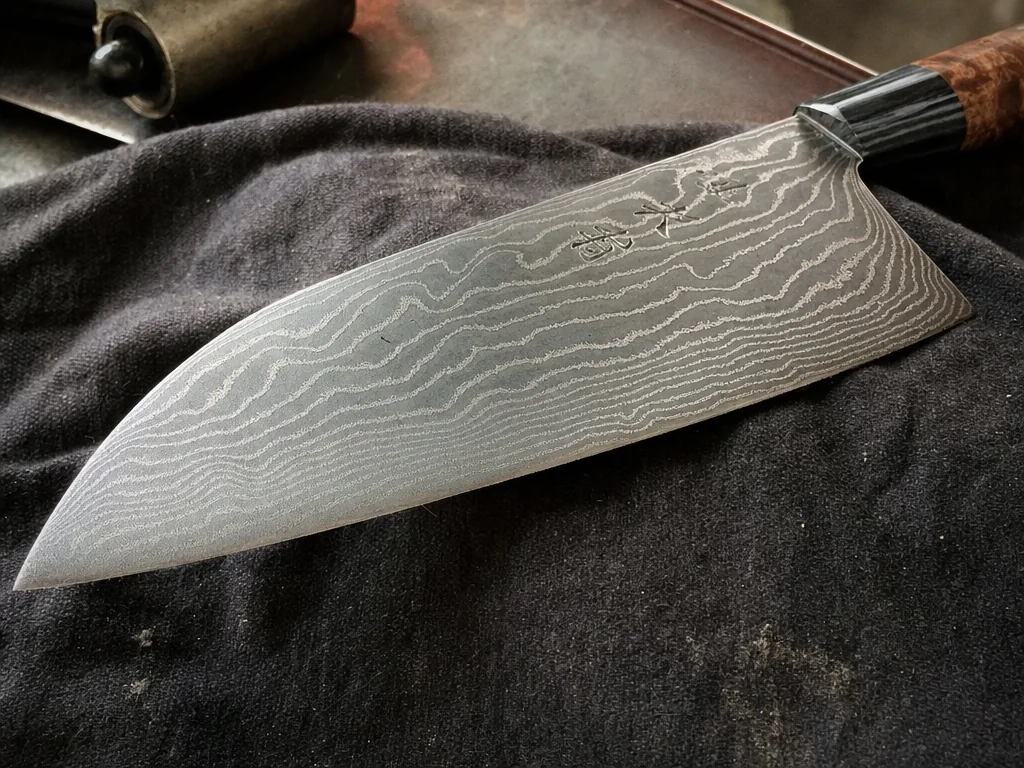
A cimeter or scimitar knife for butcher-supply channels is not a dressed-up slicer. It has one job: break beef, pork, and lamb primals without twisting in a wet trim room. On our grinding line, a 1.8 mm spine, a tight belly radius, and steel that takes a fast touch-up after 7 hours on the table matter more than a shiny handle. The buyer may ask about polish first. Wrong question. If the blade profile drifts 2 mm from sample to sample, the program slips, and we have seen this go sideways fast.
TANGFORGE builds this knife in Yangjiang for export buyers who need controlled specs, not catalog talk. QC pulled the sample at 8:30 a.m., checked the HRC range, handle grip, and carton count, then the buyer flagged a PO typo because the blade length read 10" instead of 10.5". Small line, big problem. For a cimeter scimitar knife program, the real checks are blade length, HRC range, handle grip, packing format, and whether the factory can hold AQL 2.5 on production lots. If you need 5,000 pieces a month in China, ask for the first lot, the re-order lead time, and the defect report. That is the right test.
What the knife must do
A cimeter or scimitar knife is made for long, controlled pulls through muscle and fat, not for tip work. That is the whole point. For butcher-supply brands, the blade has to enter clean, track the primal, and come out without tearing the face. On our grinding line, a 10 inch sample with a flatter belly needed two passes on beef round; the corrected curve finished the same cut in one draw. We ship a lot of these, and QC checks the cut line on the test board first. A straighter knife can still sell, but the proper scimitar gives a cleaner draw on beef rounds and chuck rolls, with fewer complaints on pork shoulders and trimmed loins.
Buyers often start with blade length. That is the wrong question to ask first. On a wet cutting table, an 8 inch knife feels quick, while a 12 inch or 14 inch blade gives better reach on larger primals. Handle angle, bolster shape, and point style decide whether the wrist is tired after 20 minutes or still steady after 2 hours. We had a buyer flag a 3 mm higher bolster because it rubbed the glove seam during pull cuts. If your customers are wholesale butchers, meat processors, or foodservice suppliers, define the cut list before locking the spec. Retail shelf appeal and daily carcass breakdown are different jobs.
In Yangjiang, we start by matching blade geometry to the target cut list. If the buyer wants a cimeter OEM program for supermarket butcher kits, we recommend a safer point, rounded spine transitions, and handle texture that still grips with nitrile or mesh gloves. For industrial meat rooms in China, North America, or Europe, we often push for a slightly thicker spine and a satin finish instead of mirror polish; QC pulled one mirror sample after fat made the blade skate on a pork shoulder. The buyer said it looked good in photos. On the table, that argument falls apart fast. The right knife should cut effort, not just look clean on a spec sheet.
Blade geometry that sells
I’m rewriting the section to sound like a buyer-facing factory note: tighter claims, fewer AI phrases, more shop-floor detail, while keeping the HTML structure and the existing numbers intact.Blade geometry is where most cimeter scimitar knife sourcing jobs get fixed or go off track. On our grinding line, we check the curve against a 300 mm template and a boning board before sign-off. A belly with enough sweep gives a clean draw cut, but if the arc runs too deep, the edge starts dragging on flat trimming passes. The wrong question is how much curve we can add. Ask what the butcher does for 8 hours at a chilled meat table, with fat on the glove and a tray of primals in front of him. We have seen a 2 mm change in belly shape turn a good sample into a complaint.
Below is the sourcing table we use when we talk commercial butcher SKUs with importers and brand owners. Last week QC pulled a sample because the tip sat 3 mm off the spec card, and the buyer caught it on the first box open.
| Spec | Typical range | Buyer effect |
|---|---|---|
| Blade length | 8-14 in / 200-350 mm | Sets reach, carton label, and shelf position on the rack |
| Blade thickness | 2.2-3.0 mm | Changes flex, hand weight, and how long the edge survives daily steeling at the butcher bench |
| HRC | 55-58 HRC | Balances edge holding with easy sharpening at the butcher bench |
| Handle length | 120-140 mm | Keeps wet or gloved hands seated without crowding the heel |
| MOQ | 1,000-3,000 pcs | Normal OEM starting point in China, usually one handle color and one blade mark |
Lock the point style early. QC pulled the sample after a buyer flagged the tip as too sharp for wet-glove handling, and that is where the discussion gets real. A dropped point feels safer in meat rooms. A finer tip helps pierce membranes and silver skin, but we have seen this go sideways when the carton says "breaking knife" and the blade looks closer to a slicer. One PO even came through with "scimmitar" in the label copy. If you sell into Europe, keep the geometry conservative and make the box copy match the blade.
Steel and heat treatment
The steel choice should follow the cut, not the catalog story. For a cimeter scimitar knife sourcing manufacturer in China, we usually run 3Cr13, 5Cr15MoV, 7Cr17MoV, and selected German-style stainless equivalents, depending on the price band the buyer is actually chasing. For butcher programs, we push a mid-tier stainless that holds 55-58 HRC, because the math works on edge life and resharpening speed. On our grinding line, a 10-inch cimeter at 56 HRC still comes back clean on a 400 grit belt during trial sharpening. Go harder and QC starts seeing micro-chips near the belly after drop testing. Go softer and the buyer flags the knife as “tired” after one shift. The wrong question is which steel name sounds premium.
Heat treatment matters more than the steel name printed on the drawing. Same alloy, different furnace control, different knife. If the quench, temper, and straightness check drift, two blades from one batch can cut like two separate products. In a stable cimeter OEM program, ask for hardness reports by batch, not one nice sample result from the salesman’s desk. We run 3-point HRC checks on longer blades, including heel, belly, and tip area, because a 12-inch blade can move differently from an 8-inch blade after grinding. If the factory says the hardness is “around 56,” that is not good enough for a buyer who needs repeat orders to match. This is the wrong question to ask if you want predictable reorders.
For export to the United States and Europe, stainless steel selection ties back to corrosion resistance, cleaning chemistry, and compliance paperwork. If your buyers sanitize with chlorine-based solutions, the blade finish and passivation process need to survive real washroom abuse, not just a clean showroom photo. We have seen this go sideways: QC pulled the sample after 24 hours in a salt spray check and found pin spots near the stamped logo. In Yangjiang, the stronger programs use a practical specification sheet: steel grade, hardness band, edge angle, surface finish, and testing method. That sheet becomes your control document when you source from China on a second or third reorder.
Handle, balance, and hygiene
Handle design decides whether the knife stays on the rail or comes back in a return carton. In a butcher room, grip security and glove fit beat a pretty handle. Every time. One buyer flagged a handle that looked clean in photos, then turned slick when beef fat and 38 C rinse water hit it during a line trial. Ask for the resin family, surface texture depth in mm, and color fastness under meat-room LED lighting; our QC bench checks this with a 10x loupe, a wet-glove pull test, and a quick wipe under the LED booth.
For this category, TPE, PP, POM, and glass-fiber reinforced handles each sell to a different buyer. TPE gives grip. PP keeps the landed cost down. POM feels firmer in the hand and usually gets fewer complaints from old-school cutters. We run those samples on the grinding line and check pull-out after 200 wash cycles. For private label butcher-supply lines, the handle has to support two-hand control on 300 mm blades and reduce pinch at the bolster; asking whether it feels "premium" in a catalog is the wrong question. Balance point matters too. If the knife sits blade-heavy, the wrist pays for it on a 12-hour trimming run, and we have seen buyers reject 18 pcs from a 60 pc sample lot for that reason.
Hygiene requirements are not optional. For Europe or North America, ask for REACH compliance on handle materials, LFGB or FDA-related declarations where relevant, and a cleaning tolerance statement. For repeated wash-down, the blade-to-handle transition must stay smooth enough to stop residue from packing in the joint. QC pulled the sample after a 24-hour soak and found grease sitting in a 0.8 mm seam; that is why 7 of our last 10 commercial butcher projects moved to molded handles instead of a riveted wood look. The customer buys the photo once. They reorder the knife that washes clean.
Pricing, MOQ, and lead times
For a cimeter scimitar knife sourcing program, price sits on the same sheet as MOQ and lead time. On the grinding line, we check the bevel with a gauge; if a factory quotes $0.18 less but the second and third run drift by 1 degree, the saving disappears. A normal OEM setup starts at 1,000-3,000 pcs per SKU. Sample lead time runs 10-15 days, then mass production takes 35-55 days after sample approval and deposit. Change the handle color, blade finish, or packaging, and the schedule moves.
The table below is the quick sourcing readout we use with buyers comparing options from China:
| Program item | Typical range | Buyer note |
|---|---|---|
| FOB unit price | USD 1.20-4.80 | Steel grade, handle, and pack-out decide it |
| MOQ | 1,000-3,000 pcs | Lower MOQ usually pushes the unit cost up |
| Lead time | 35-55 days | After sample sign-off |
| Carton pack | 12-36 pcs | Set by retail or bulk channel |
| Inspection | AQL 2.5 | Common for export orders |
Price is the wrong question to ask first. Scope is what moves the number. What you should lock down is blade etching, laser logo, individual sleeves, master carton marks, and whether the shipment moves FOB, CIF, or DDP. For butcher-supply brands selling through distributors, a wrong carton mark or a 2 mm logo shift costs more than a small unit-price gap on the knife itself. We ask for a written spec sheet and golden sample control before the first mass run, because we have seen this go sideways on a 3,000 pcs order when QC pulled the sample and found a typo on the PO.
QC and compliance controls
QC on a butcher knife is routine work, but it cannot be loose. We check blade length and width in mm with a digital caliper, hardness on the Rockwell tester, edge bite, surface finish, handle gap, rivet or injection fit, and carton labels against the PO. For export orders, we run AQL 2.5 as the default sampling standard unless the retail buyer writes a tighter rule. On our Yangjiang line, QC pulled 125 pcs from one 5,000 pcs cimeter order and rejected 9 for bent tips, wire edge, loose handle fit, visible grinding scratches, rust marks near the heel, or a wrong side label. A 0.3 mm miss looks small on the bench. It gets expensive after the cartons leave. We have paid for that lesson.
Sharpness needs a number or a fixed test, not a salesman saying "sharp enough." Some buyers use slicing tests on standard paper or plastic film; others set an internal cut count for the meat-processing range. Batch repeatability is the point. Sample day is easy. Mass production is where programs fail, especially after the grinding line changes belts at 240 grit and the edge angle drifts from 18 degrees to 22 degrees. Ask for batch-level hardness data, a packing checklist, and first-production photos before the balance payment. If your customer is a distributor, confirm whether they need FNSKU, EAN-13, or case-level labels. We have seen one PO typo on an EAN-13 label hold 312 cartons in the warehouse for 6 days. The buyer flagged it after the pallet wrap was already done.
Compliance sits inside QC, not after it. For North American and European buyers, check whether the supplier can provide REACH documentation, material declarations, and food-contact statements required by your import channel. If the order uses custom color boxes, confirm ink and paperboard compliance too; asking only whether the blade passes is the wrong question. The knife can pass while the printed box creates the problem. We saw this on a 3,000 pcs private-label run when the carton supplier changed coated paper without telling production. A serious cimeter scimitar knife sourcing manufacturer in China should share test reports, inspection photos, packing method, carton drop-test notes, and the actual master carton mark before shipping.
Frequently asked questions
For most butcher-supply programs, 10 and 12 inch blades are the safest commercial choices because they cover trimming, breaking, and portioning without feeling too specialized. If your customer works larger beef primals, a 14 inch model can be useful, but it usually needs a more experienced user. An 8 inch knife is better for tighter work or smaller meat rooms. In sourcing terms, I would define the length by channel: retail kits, foodservice, or industrial butchery. That keeps your SKU count under control and reduces returns from buyers who picked the wrong size.
For most export orders, a stainless steel that can be hardened to 55-58 HRC is the most balanced option. That hardness range is hard enough to keep an edge through repeated use, but not so hard that sharpening becomes slow or the edge chips easily. If you go too low, the knife feels dull quickly. If you go too high, you can create a brittle edge that does not suit butcher work. For a China OEM program, the exact alloy matters less than the heat treatment consistency and batch control. Ask for hardness records per lot, not just one sample result.
Yes. Most cimeter scimitar knife sourcing projects for butcher-supply brands include laser logos, blade etching, printed sleeves, hang cards, and master carton branding. If you need retail-ready packaging, specify barcode type, carton drop-test expectations, and whether the product needs FNSKU or EAN-13 labels. For export buyers, packaging often has a bigger effect on the final landed cost than the knife itself. In China, it is better to approve artwork, dielines, and label placement before the first mass run than to correct it after production. That saves time and avoids rework.
For a standard OEM butcher knife, expect roughly 1,000-3,000 pieces per SKU, depending on blade length, steel grade, handle tooling, and packing. If you want a custom handle color or special carton, the MOQ can move upward because of material setup and inventory risk. A lower MOQ is possible, but the unit cost usually rises and the factory may limit customization. For buyers in Europe and North America, a practical first order is often 1,500-2,000 pcs so you can test market response without overcommitting to a single SKU.
Ask for a golden sample, a written spec sheet, batch hardness data, and a production timeline tied to actual capacity. A factory that can handle around 5,000-20,000 knives per month for export programs is usually more stable than a small workshop, but capacity alone is not enough. You also need QC records, packaging control, and export paperwork discipline. If the supplier is in Yangjiang or another Chinese knife hub, ask how they handle AQL 2.5 inspection, spare packing stock, and repeat orders. Those details tell you more than a sales brochure.
Build your butcher knife program
Send the target blade length, steel, pack style, and annual volume. We can turn that into a controlled OEM spec from Yangjiang, China.
Request a Quote