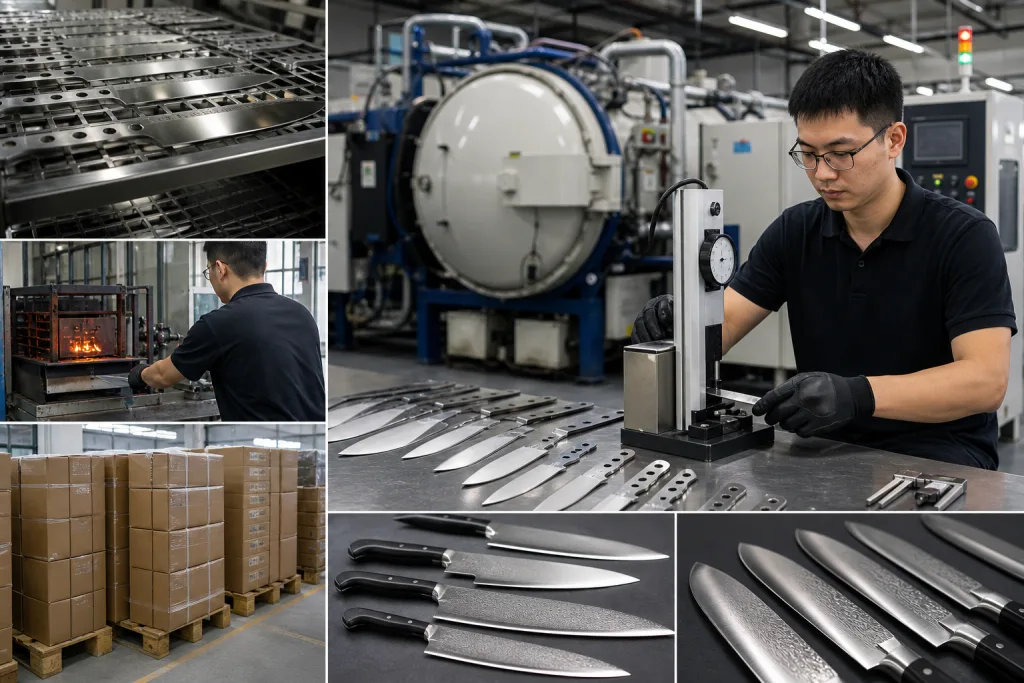
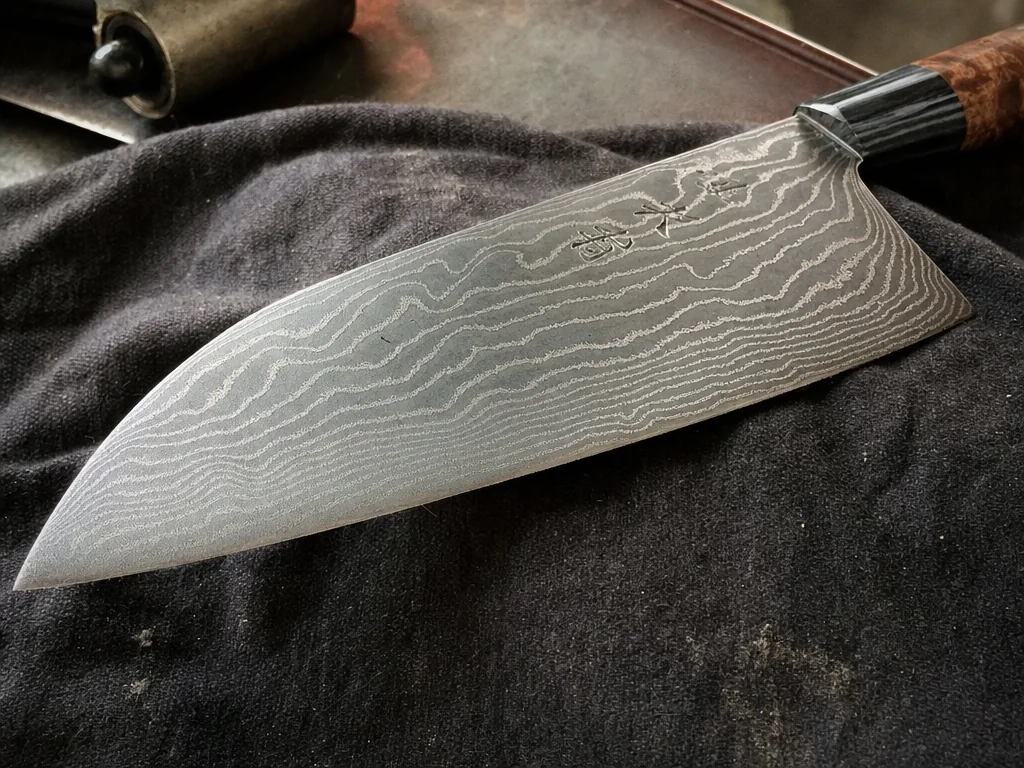
If you are doing yangjiang knife factory sourcing, finding a factory name is easy. Proving the plant can hold a 0.3 mm edge tolerance, pass your compliance file, and still hit ETD after the buyer changes the handle color on the PO is the hard part. Yangjiang has more than 1,500 knife-related workshops and factories, yet that headcount does not tell you who owns a straightening machine, who sends blades out for heat treatment, or who only packs stock blades into a color box. Looks simple from far away. It is not. We have seen orders go sideways when the approved sample came off grinding line No. 2 with a 240 grit wheel, then bulk production ran on another line with a different wheel setting and the buyer flagged the edge feel at final inspection.
A real yangjiang knife factory sourcing manufacturer needs to be checked as a production partner, not treated like a catalog page. Ask for the steel band. Confirm the HRC target and the MOQ by model. Check whether they run OEM tooling in-house or just laser your logo onto stock items with a 20W fiber marker. Ask about REACH and LFGB. Confirm FDA paperwork and the AQL 2.5 plan before price talks; this is the wrong question to ask after sampling, because the math does not work when QC pulls 80 pcs and finds rust spots after packaging. We have had buyers push back on USD 0.06 for better polishing, then lose 12 days on rework after a salt-spray check failed and QC pulled the sample with red dust near the rivet. Map factories by capability first. Then talk price.
Start With the Factory Map
Yangjiang is not one factory. It is a knife cluster: blade blank shops with 200-ton presses, heat-treatment shops checking furnace charts, handle suppliers drilling PP and pakkawood, grinding lines running 240-grit belts, and packaging contractors folding color boxes for export orders. Good buyers read the handoffs. Bad buyers assume every supplier owns the whole line. A real yangjiang OEM partner might keep forging, CNC, polishing, assembly, and packaging under one roof. Or it might send heat treatment to a nearby furnace shop and still ship stable goods. Ask who controls the transfer. Ask who signs the QC sheet. Ask who pays when QC pulled the sample and found soft blades at 52 HRC? That last question makes weak suppliers nervous.
For importers, start with one question: what did this factory make last month? A plant making 120,000 kitchen knives per month and 30,000 pocket knives per month is not the same as a trading office with 80 samples on a wall and no grinding dust on the floor. Ask if they run carbon steel in oil quench, stainless steel through vacuum heat treatment, or Damascus billets bought from another shop. Ask where the goods go: EU retail with LFGB paperwork, Amazon FBA with carton drop tests, or promotional gift sets packed 24 pieces per master carton. A polished catalog tells you almost nothing. We have seen this go sideways when the PO said 3Cr13 but the sample invoice showed 420J2.
When you build your sourcing map, group suppliers by job. Put high-volume standard knives in one bucket, such as 20,000-piece replenishment orders where we run the same handle jig all week. Put custom OEM programs in another bucket when tooling, laser logo position, and color-box artwork need buyer approval. Keep premium work separate, especially Damascus chef knives or tactical models that need tighter blade finish checks under the inspection lamp. This stops you comparing a low-MOQ sample shop against a factory built to run the same SKU for 12 days straight. The math does not work. In Yangjiang, China, the buyer who understands the cluster gets cleaner pricing and fewer surprises, because the quote shows where polishing, heat treatment, and packing are done.
Practical check: ask for production photos from the current line, not library images from last Canton Fair. Ask for the model mix in the last 60 days, and ask who handles blade heat treatment. Get names. Get the furnace number. We ask for the target HRC on the report because “normal hardness” is not a spec. If they cannot say which furnace, which hardness target, and which inspector signs the report, they are not ready for disciplined procurement.
Know The OEM Scope
The biggest mistake in yangjiang knife factory sourcing is asking for "OEM" and letting the factory answer with one soft yes. Make them write the scope. Some shops only laser your logo on a stock SKU and change the carton art. Others will redraw the blade, change steel from 3Cr13 to 5Cr15MoV, swap satin for black stonewash, move a pocket clip 6 mm, then rebuild the insert card and barcode layout. Same word, different job. Different risk. Different lead time.
For new importers, I split programs into three levels. Level one is stock shape with logo and carton art; we run that off existing tooling, often 18-25 days after artwork approval if material is in-house. Level two covers size changes, handle color, and packaging, usually after engineering checks the sample with a digital caliper and the drop-test bench. Level three is full OEM: new mold, new blade profile, custom grind, custom hardness window, and compliance documentation. That means tooling money and engineering review. The grinding line needs a trial run, QC pulled the sample, and lead time is still 45-75 days after sample approval. If a factory promises full OEM in 20 days, the math doesn't work. They are quoting logo printing, not a new product.
MOQ only makes sense when the factory can show the cost behind it. A kitchen knife set with standard blades might start at 1,000 sets, while a custom pocket knife with new scales and clip design may need 3,000-5,000 pcs because the screws, clip mold, and printed blister tray have to be spread across the order. That is normal in Yangjiang. Last month a buyer flagged 3,000 pcs as too high until we showed the clip mold quote at RMB 4,800 and the blister tray cost at RMB 0.62 per pc. Fair pushback. The warning sign is a factory that cannot explain MOQ with numbers.
Ask who owns the CAD, who confirms the first article, and who signs off on the pre-production sample. We want names, not "our team will check." If one salesperson is handling all of it, expect delays and mixed revisions. On a disciplined line, engineering controls the drawing revision, QC measures the first article on a 0.01 mm caliper, and production signs the pilot run after trial packing. We have seen runs stop over a simple PO typo: left-hand clip on the drawing, right-hand clip on the order. The buyer flagged it after 600 pcs were assembled. A disciplined Yangjiang factory should lock those sign-offs before mass production starts.
Match Steel To The Market
Steel choice is where buyers lose money. We see it on about 4 out of 10 new RFQs: the buyer asks for “best steel” before the retail price, cutting job, warranty rule, or dishwasher claim is fixed. Last month one PO said “VG10 level” but gave no target shelf price; after we quoted three steels, the buyer flagged the whole offer. A knife factory in China can quote 5Cr15MoV, 7Cr17MoV, 8Cr13MoV, 9Cr18MoV, 440C, VG10-type, Damascus constructions, plus a few grades that look good on paper and still slow the grinding line. For mass-market kitchen knives, 5Cr15MoV and 7Cr17MoV normally cover the job because cost stays controlled, resharpening is easy, and we can run stable on 1.8 mm stock. For mid-tier chef knives, choose 8Cr13MoV or 9Cr18MoV by the complaint you fear most: weak edge holding or rust marks after wet-sink use. For premium programs, VG10-like structures, 440C, or Damascus constructions only make sense when the shelf price, MOQ, and packaging story can pay for them. Start with the market. Steel comes after. Chasing steel names first is the wrong question to ask.
Hardness beats catalog copy. A typical export kitchen knife might sit in the HRC 55-57 range, and better chef knives often run HRC 56-60. We run Rockwell checks after heat treatment, and QC pulled one 1.8 mm stamped sample last season that read HRC 62; the edge looked fine, then chipped during board testing after 200 cuts. Fast failure. If a supplier offers HRC 62 on a thin stamped blade, ask for the heat-treatment record, blade thickness, and AQL 2.5 inspection plan before you approve the PI. We have seen this go sideways when the sales sheet looked clean and the quench record did not. The number can sell. The return claims still land on your desk.
| Product Type | Common Steel | Typical HRC | Buyer Note |
|---|---|---|---|
| Entry kitchen knife | 5Cr15MoV | 55-57 | Low cost, easy resharpening; check edge burr after grinding with a 10x loupe |
| Chef knife | 7Cr17MoV / 8Cr13MoV | 56-59 | Works for retail and HORECA when polishing is controlled and the spine finish stays even |
| Premium chef knife | 9Cr18MoV / VG10-type | 57-60 | Needs tighter QC, cleaner bolster fit, and a better heel finish before packing |
| Pocket knife | 8Cr13MoV / D2 | 58-61 | Check heat treatment record, lock play, and opening force before mass production |
Do not treat handles as decoration. Wood, Pakkawood, PP, ABS, G10, and stabilized composite react differently to container heat, dishwasher claims, and retail display lights. We had one buyer flag a 0.4 mm handle gap on a Pakkawood chef knife even though the blade passed; the math does not work if your handle choice saves USD 0.18 and creates a rework lot of 3,000 pcs. The handle line is where small problems get expensive, especially when rivet pressure or adhesive spread is off by one setting. If you want LFGB or FDA-friendly positioning for food-contact items, confirm the full bill of materials: adhesive, rivets, color masterbatch, coating, and blade steel.
Check Quality Before Price
Price without QC is a guess. For yangjiang knife factory sourcing, set the inspection route before arguing over the last USD 0.03. A factory can hold ISO 9001 and still ship uneven goods if the Rockwell tester shows 56 HRC on one heat-treatment batch and 59 HRC on the next, or if the grinding line drifts from 15 degrees to 17 degrees with no note on the line sheet. Certifications help. They do not replace a QC plan.
For export orders, AQL 2.5 is common for major defects, but the defect list needs plain shop-floor wording. Critical means stop shipment for safety. Major hits function. Minor is cosmetic only. A loose handle on a kitchen knife is a safety issue; a 12 mm scratch on a gift set box is usually a packing defect. On a pocket knife, blade centering and lock engagement matter more than a small finish mark near the clip. This is the wrong question to ask: “Can you pass inspection?” Ask what they inspect at assembly and final pack, and who signs the traveler card. If you do not define the defect matrix, the factory will use its own judgment. We have seen this go sideways when the buyer flagged lock failure after arrival.
Ask for the incoming steel lot check and the in-process patrol sheet. Then ask for the final random inspection record, with dates and inspector names. A serious Yangjiang factory should show hardness logs and blade geometry checks from a caliper or edge angle gauge. If corrosion matters, ask for the salt spray result too, not a clean PDF made for buyers. If they export to Europe, ask about REACH declarations. If you sell food-contact knives in North America, ask for FDA-related material support where applicable. For wooden handles, ask how they control moisture. For coated blades, ask for adhesion testing. Last season QC pulled one sample with coating lift after 3M tape testing, and the buyer was right to stop the shipment.
One practical move is to require a golden sample and a sealed master carton sample. Then tie the production batch back to those references. Match carton marks and barcode position outside. Match blade finish and handle color inside, then check the packing order. Simple work. We run this check before mass packing, with the master carton taped and dated in the QC room, because it prevents 8 out of 10 warehouse arguments when the order lands at your warehouse or FBA, especially when the PO has one typo and the carton label shows another SKU.
Price Structure And Trade Terms
Buyers comparing Yangjiang offers often stop at unit price. Wrong question. A quote that is $0.12 lower can come back through a printed sleeve, 5-layer master carton, missing fumigation mark, or an EXW term that leaves Yangjiang-to-Shenzhen trucking and export handling on your desk. We run quote sheets with product cost, packing, carton burst strength, pallet size, inland truck, export docs, and destination customs lines separated line by line; last month QC pulled a 12-piece chef set sample where the carton looked clean until the 14 kg drop test split one corner.
FOB is the clean baseline for factory comparison. It shows the real product price, then your forwarder can price freight and duty from a fixed port point. DDP works for a 300-set trial launch or a new Amazon lane, but it hides too many cost layers, and the buyer ends up asking who paid what when customs asks for backup. We ship stable repeat programs on FOB Shenzhen or FOB Guangzhou; DDP only makes sense after the lane has been tested and the buyer has checked at least one real duty bill.
Knife packaging changes the math fast. A plain polybag with a white box is not the same job as a magnetic gift box with 4-color printing, EVA insert tray, hangtag, barcode label, and outer master carton marks printed on two sides. A premium set may add $0.80 to $2.50 per unit just in packaging. For EU retail or chain-store orders, pallet spec and carton compression resistance matter as much as blade steel; we saw a $0.18 cheaper carton fail at 650 N when the buyer required 850 N. Savings gone.
Build the RFQ as a full commercial matrix: product spec with blade length in mm, expected annual volume, target launch date, packaging, test requirements, and trade term. Put MOQ and inspection standard in the same sheet, even if your team thinks it is obvious. This is where the math gets honest. One buyer sent a PO with “FOB Ningbo” on a Yangjiang knife order, and the price moved by $0.06 per piece before the grinding line even opened the work order.
Build A Buyer Shortlist
You do not need 50 suppliers. You need 3 that can run the order clean. For yangjiang knife factory sourcing manufacturer work, build the shortlist on proof: sample lead time, engineering replies, audit readiness, and whether the price still holds after two or three revisions. Fast but vague? Cut it. A factory that answers clearly but needs 18 days for a sample instead of 12 days can still fit a premium SKU, but not a launch window. On our side, the grinding line tells the truth early; if the bevel spec is short by 0.3 mm on day one, the math does not work later.
Start with a request package that includes sketches, target dimensions, target steel, HRC band, logo method, packaging mockup, and target annual volume. Put compliance on page one: BSCI if needed, REACH, LFGB, FDA, ISO 9001, and any buyer-specific audit form. Then ask for the first quotation, sample lead time, and production lead time. A factory that replies in 24-72 hours with a clean quotation sheet, packing size, and one sharp question like “laser logo or etch logo?” is usually run better than 80% of directory names. We have seen RFQs stall for 5 days because the buyer left out 18 mm handle thickness and the sales team still quoted it blind. Bad habit.
When you compare samples, use a plain scorecard. Rate grind symmetry, edge alignment, finish consistency, handle fit, packaging integrity, and documentation quality. QC pulled the sample, checked the edge centering with a digital caliper, and found one side drifting 0.4 mm; that supplier was out even though the price looked good. If the sample does not match the quote, they are not ready for scale. In Yangjiang, China, good factories are not rare, but disciplined buyers get the better production slots because they lock details before the deposit hits.
Once the shortlist is clear, ask for a pilot order or a mixed trial batch. A 300-500 piece run is enough to expose weak cartons, barcode label mistakes, or hardness spread before you commit to a full container. We ship trial runs like this every month, and the buyer flagged issues such as a master carton crush after a 78 cm drop test or a logo placed 2 mm off center. Cheap insurance. We have seen this go sideways when buyers skip the pilot and find the carton problem only after 4,800 pieces are packed.
Plan Reorders Before Launch
Reorder risk should be discussed before the first container leaves Yangjiang. We run 180,000 units per month across several lines, but one SKU can still miss the vessel if a 60,000-piece supermarket replenishment order jumps the queue or a peak-season gift set takes 3 days on the handle injection press. It happens. Our planner writes the grinding line by day, the injection slot by mold number, and the carton ETA from the paper mill on one whiteboard with a red marker. Ask before you place the deposit.
Put reorder rules in the first PO. If you need 3 weeks of safety stock, write that number into the order terms. Ask whether 420J2 or 3Cr13 will be reserved by heat number, or whether your steel needs its own booking. Ask if color boxes and tray inserts can be pre-bought against your forecast at a 5,000-set MOQ. With custom cartons, the paper supplier blocks the plan more often than the blade workshop. In our last 12 reorder delays, 7 came from late board delivery, short rivets at receiving, or the inspection queue after QC pulled the sample and found sleeve color drift against the approved Pantone card.
Match the factory plan to your sales channel. For Amazon goods, ask how we handle FNSKU labeling on each unit and carton labeling on the short side, then request the 1.2 m carton drop test using packed samples straight off the sealing machine. For a distributor warehouse, confirm pallet layer packing by layer count and whether the outer carton mark matches the PO, including small typos like “6pcs” versus “6 PCS.” One buyer flagged a single ship mark and held 400 cartons at booking. If the buyer changes channel after launch, the packing rule should already be on the factory file before shipment two.
A Yangjiang knife factory relationship is tested on the second and third orders, not the first shipment. Knife weight, finish, edge feel, and packing logic have to repeat. No mystery there. We check weight with a digital scale, confirm the bevel on the grinding line fixture, then compare the result with the golden sample signed in round one. We have seen this go sideways when a buyer approved 2.3 mm blade stock on round one, then asked for “same cost, thicker feel” after launch. That is the wrong question to ask after launch. Margin is set in the reorder plan, not in a late argument.
Frequently asked questions
For standard kitchen knives, MOQ is often 1,000-3,000 pcs per SKU if the design uses existing tooling. For custom pocket knives or new molds, 3,000-5,000 pcs is more realistic. If you want a gift set with custom packaging, the packaging MOQ can be the real constraint, especially for printed cartons or magnetic boxes. A factory that quotes 300 pcs for a fully custom program is usually using stock parts or underpricing the job. In Yangjiang, the right question is not only MOQ, but whether the MOQ includes steel reservation, packaging, and logo setup.
Ask for factory registration, production photos, current line output, and the last 3 months of model mix. Then ask which steps are in-house: blade cutting, heat treatment, grinding, handle assembly, printing, and packaging. A true OEM factory should explain its engineering flow and sample approval process. If they cannot name the person responsible for hardness testing or final QC, treat them as a trading office until proven otherwise. In China, especially in Yangjiang, many suppliers look capable on paper; the line check tells you what they really do.
It depends on the market and product type, but ISO 9001, BSCI, REACH, LFGB, and FDA-related material support are the common ones buyers ask for. For food-contact kitchen knives, your concern is material compliance and documentation. For retail buyers in Europe, REACH declarations and traceable packaging are often expected. Certifications do not replace inspection, but they reduce friction during onboarding. Ask for current certificates, not expired PDFs, and confirm the factory name matches the invoice name. If you need Amazon compliance, also ask about carton labeling and FNSKU handling.
For a simple private-label order using existing tooling, 25-45 days after sample approval is common. For full OEM with new parts or new packaging, 45-75 days is more realistic. If the order needs custom molds, special steels, or test reports, the schedule can stretch further. The hidden variable is packaging; printed cartons and gift boxes often add more time than the blade itself. A factory in Yangjiang with a 180,000-unit monthly capacity can still miss your date if it has to wait on packaging components or rework samples.
Use FOB when you want a clean factory comparison and control over freight. It is usually the best way to compare quotes from Yangjiang suppliers because you can isolate product cost from logistics. DDP is useful for a small test shipment or when you want one landed price, but it can hide margin loss in freight, customs handling, and local delivery. For serious procurement, FOB is the better baseline, then you add freight, duty, and warehouse costs yourself. That gives you a clearer view of the real landed cost from China.
Send your RFQ to a real factory
Share your spec, target price, and annual volume. We will map the right Yangjiang OEM path, from sample to FOB shipment, without wasting rounds.
Request a Quote