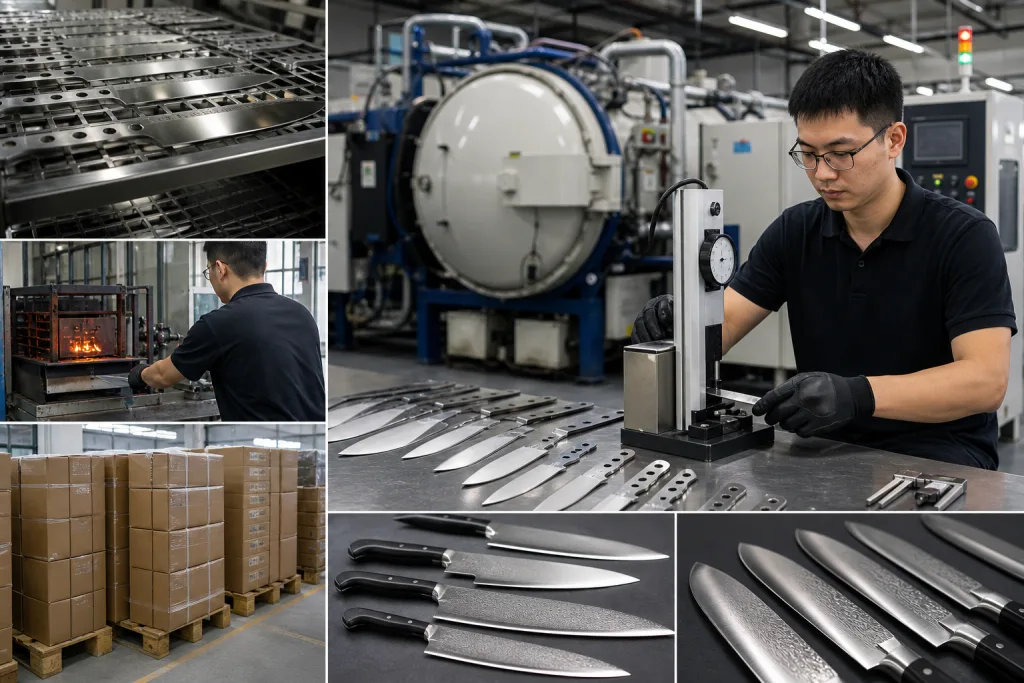
Crowdfunded knife manufacturing is a schedule problem first. Asking for the lowest unit price too early is the wrong question. If the steel grade is still open, the edge geometry keeps changing, the handle material is not locked, the finish sample is unsigned, the packaging dieline is half-done, and the test rules are still being argued after the campaign starts, the math doesn't work. We saw one 2.8 mm blade change after sample signoff burn 12 days on the grinding line; QC had to check the new shoulder position with a digital caliper lot by lot, and most factories in China will answer that kind of loose file with a soft quote.
You want a tighter file. A factory should hand you a frozen spec sheet with tolerances, a tooling map that marks each new die and fixture, a sample calendar with real dates, and a freight plan down to carton count. In Yangjiang, Zhejiang, China, a factory with about 240 employees will usually move faster than a trading layer because we run the sample room ourselves, QC can pull the sample the same day, and the buyer approves milestones in order instead of waiting on three parties to explain why the PO still says satin when the approved sample is stonewash.
Freeze the spec before launch
The first sourcing mistake on a crowdfunded knife project is using the campaign page as the design brief. Wrong document. That page sells the idea to backers; our side needs part numbers, tolerances, and a release spec the grinding line can run without stopping every hour. Freeze the blade length. Freeze the blade thickness. Lock the steel grade, the hardness band, the handle material, the surface finish, and the packing format before launch. For a kitchen line, put 1.8 mm or 2.5 mm on the spec sheet, call out HRC 56-58 or 58-60, and state whether the edge leaves the grinding line with standard machine sharpening or goes to hand finish after QC pulled the sample and checked the bevel under a 10x loupe.
For a crowdfunded OEM order, the factory needs a full BOM, not a mood board with nice angles. Put in the cartons. Put in the EVA or paper inserts. Add label copy, barcodes, laser engraving text, and the spelling exactly as it should appear on the blade. We once had a buyer flag a PO typo after 600 gift boxes were printed, and the math does not work when packaging gets remade during assembly week while 1,000 blades are already waiting in tray racks. If you are using a crowdfunded knife manufacturing manufacturer in Yangjiang or elsewhere in China, a clean spec sheet usually cuts quote corrections from 3 rounds to 1. It protects your margin too, because blade geometry changes and premium packaging add cost fast. A 2 mm wider blade or a switch from ABS to G10 is not a small revision when you are ordering 1,000 units. We have seen this go sideways. Decide early, because every new idea after launch rewrites the schedule.
- Lock the steel grade and HRC band before the first quotation, so the heat-treat target is clear on day one.
- Set the packaging size before the carton supplier quotes, including insert thickness in mm and the drop-test packout.
- Approve one render set for the campaign and match it to the factory drawing used by the tooling room, down to logo position in mm.
- Keep optional accessories out of the first production run unless the MOQ, packing space, and carton count are already confirmed.
Work backward from ship date
Schedules usually break in the first week, when founders start counting from the funding close and ask the factory to “catch up” later. Wrong question. Start with the date cartons must land at the warehouse, then count backward from there. That is how we run it on a real knife order: 7-14 days for final spec alignment, 10-15 days for samples, 7-10 days for sample revision, 20-30 days for tooling and pilot setup, 25-35 days for mass production, 5-7 days for packing and final inspection, then 30-45 days for ocean freight to Europe or North America. The grinding line waits for written approval on blade finish, logo position, handle material, and carton dieline. If the buyer wants the logo held within 0.2 mm, our fixture guy needs that before production starts, not after the campaign page gets 800 comments. Air freight can cut transit to 7-10 days, but the math does not work on a heavy gift set.
A 2-day buffer is pretend buffer. Use 10-15% of the full schedule. If your campaign promises delivery in 90 days, the factory needs to finish goods in about 55-60 days, leaving space for customs holds, carton rework, or one failed hardness check. We have seen QC pull the sample after heat treat and stop the lot over one soft reading. Then the buyer flagged a typo on the PO after the master cartons were already printed. Painful, but normal. In Yangjiang, Zhejiang, China, a factory with 240 employees and a steady knife line can hit these windows if the artwork file, deposit, packing list, and approval chain are clean. Indecision kills the plan. Each late sign-off pushes the shipment toward peak freight season, and we have watched a November vessel turn into a December booking over one missing carton mark.
Pick the right factory model
Full custom tooling should not be your starting point. For 6 out of 10 Kickstarter knife projects we see, the margin is already tight before new molds enter the quote. The wrong question is whether the factory can open tooling. Ask which factory model still leaves money after samples, freight, and the first carton of rejects. Start with unit margin. Then check the one feature backers will notice and the schedule risk your team can carry. A private-label knife on existing molds moves faster and keeps MOQ lower; we run a digital caliper on handle fit and hold a 0.2 mm tolerance check before sampling. A true OEM run gives you a stronger brand story, but you pay for tooling first, then extra sample rounds, then the small failures that show up on the grinding line, like a lock tab sitting 0.3 mm high after heat treat. If you need a crowdfunded knife manufacturing sourcing partner, ask for product, packaging, testing, and freight in one quote file. If they cannot quote all four, the hidden cost lands on your desk.
| Model | Typical MOQ | Lead Time | Best Use | Main Risk |
|---|---|---|---|---|
| Private label | 300-500 pcs | 35-45 days | Fast launch with faster cash return | Limited product difference |
| ODM | 500-800 pcs | 40-55 days | Modified design on existing tooling | Backers may recognize the shape |
| OEM | 800-1,000 pcs | 45-60 days | Unique geometry or a stronger brand story | More sample rounds and tooling risk |
The table is not a rulebook. It is close to how a China knife factory will price the project. Ask for an engraved pocket knife at 300 pcs and the math does not work like a 1,000 pc run. The operator still spends the same time on laser positioning, the first-piece scrap still hits, and QC pulled a sample last week because the logo sat 1.5 mm off center. We had one buyer flag a $0.38 unit increase after adding a black gift box and foam insert late. That is how campaigns lose margin. For most knife campaigns, the cleaner move is a hybrid. Keep the proven blade construction. Change the handle texture or surface finish, then leave packaging and engraving until after the golden sample. It sells better than a stock item, and we ship it without turning the project into a six-month engineering job.
Test samples like a buyer
Samples are not souvenirs. They are gate checks. For a crowdfunded knife project, we run 3 sample stages before the grinding line even books machine hours for mass production. The concept sample is about feel. We check the outline on a profile gauge. We check handle swell in palm and see where the balance point sits near the front pin. Then we hold it for 10 minutes and find out if the knife starts to feel wrong. Short test. Fast answers. The pre-production sample proves the factory can repeat the build with the real jig, the approved screw spec, the same heat-treatment lot, plus the carton spec written on the PO. We had one buyer approve OD green G10, then send a PO typed as “black G10.” The buyer flagged it after G10 sheets were cut. That typo matters. The golden sample is the line reference QC keeps at the inspection table beside the 150 mm caliper. If a factory skips one stage, do not call it “saving time.” The math doesn't work. We have seen this go sideways: a clean CNC handle sample got approved, then the bulk lot landed with a 0.4 mm gap at the liner.
Use measured checks. Verify blade hardness on a calibrated Rockwell tester and keep it inside the agreed HRC band: 56-58 for a stainless kitchen knife, 58-60 for a harder-wearing outdoor blade. Check edge consistency with copy paper, 12 mm sisal rope, or tomato skin. If the campaign has real volume behind it, run a CATRA-style comparison and file the result with the sample card. Then check what fails in use. Push the lock by hand. Cycle the opening action at the pivot. Read the finish under 5000K shop light. If the blade is coated carbon steel, run the corrosion check. QC pulled one sample for us last year that looked clean under the line lamp, then showed red rust after a 24-hour salt spray check. That miss will blow up your comment section. For folding knives, we run a torque check on the pivot screw, often around 0.25-0.35 N.m depending on the washer stack, because a smooth showroom flip can turn loose after 300 openings. For final production, insist on AQL 2.5 for major defects and 4.0 for minor defects, with carton and inner pack checks included. If the factory is ISO 9001 controlled, ask for the actual inspection form, not a certificate wall photo. This is where buyers get lazy. Real control looks plain: the sample is measured, the caliper marks are on the report, the torque data is on file, and the signed limit sample sits on the bench.
- Hold back approval until the golden sample is signed off, then dated and sealed in the sample room cabinet.
- Test at least 5-10 units from the same batch, not 1 polished showpiece pulled from the sales office shelf.
- Ask for lock-up and torque data, plus edge-consistency records, from the exact hardware lot and blade batch used on those samples.
- Require photo records of the pre-shipment lot. Ask for open cartons, inner packs, blade markings, plus the PO detail the buyer flagged.
Map compliance and shipping
Compliance is where Kickstarter founders stall after the money lands. If the blade or handle touches food, we run FDA or LFGB material declarations by sales market, handle resin, coating, and glue system. For EU orders, ask about REACH before tooling starts; black TPR handles, printed color sleeves, soft-touch coatings, and carton adhesive all give the test lab something to question. A BSCI audit helps when a retail buyer comes in later, but it is factory social compliance, not proof your knife is legal to sell. Wrong question. Ask for the exact test report name, sample source, and lab name before you lock the launch date. We had one buyer flag a PO typo where “LFGB handle” was written, but the report covered only the stainless blade; QC pulled the sample before packing and saved 3,000 sets from a relabel job.
Shipping terms matter just as much. FOB is cleaner if you already have a forwarder and want control over sailing date, container loading, and destination charges. DDP looks simple for first-time founders, but freight, duty, and local delivery sit inside one quote, so check the landed cost per knife, not just the total invoice. For Amazon, set carton labeling, FNSKU position, pallet height, and the carton drop test before mass production; our packing bench uses a 760 mm drop for the common carton check, and weak B-flute boxes fail fast. If you are running a kitchen or chef knife set from China, a poor outer carton can push damage above 2-3% even when the blades pass AQL 2.5 inspection. We have seen this go sideways: knives at 58 HRC were fine, but the tray cracked because the buyer cut 0.18 USD from the insert. In Yangjiang and other China knife hubs, factories that ship well treat packaging as part of the knife.
Protect the campaign after funding
Funding close is not the finish line. The job ends when the backer opens the right box and finds the right knife inside. Build the post-funding control plan before launch, before the comment section starts asking where the tracking number is. Reserve 3-5% extra units for replacements. Keep 30-50 spare cartons, EVA inserts, barcode labels, and silica gel bags from the same packing run. Set a reorder trigger when you sell through 65-70% of the first batch. On our side, we bag the golden sample with the spec card, carton mark, and color chip, then sign across the seal before mass production starts. QC keeps that bag at the inspection table, beside the digital caliper and HRC tester. Simple rule. If your campaign overshoots, do not restart a full engineering cycle for a second run. Asking whether the factory can rerun fast is the wrong question. The real question is whether the file is frozen and the golden sample is locked. We have seen one PO typo change “black G10” to “black PP” on a reorder. The math does not work if nobody catches that before material purchase. The replenishment price should already be agreed with the factory, including carton mark, insert, and any blade finish charge.
A factory in Yangjiang, Zhejiang, China with crowdfunding knife experience should support phased shipment. We ship this way often. Send 500 units to backers first, then hold 100 units for warranty claims and influencer replacements. If you are using laser engraving, or the project needs private label numbering tied to serialized packaging, confirm the sequence list before printing. Last month QC pulled the sample after the buyer flagged one missing serial digit. 28 cartons were already labeled, and the packing team had to open them with a blade and relabel by hand. Slow work. Small data errors create 2-3 days of delay once cartons are taped, weighed, and stacked on the pallet. Tie your campaign communication to real factory milestones: sample approved with signed spec, tooling finished, first inspection passed under AQL 2.5, packing complete, freight booked. We have seen this go sideways when a creator posts a ship date before packing is complete. Backers remember that. Protect trust by reporting the line status from the grinding line, assembly table, and packing area, not by promising speed you cannot buy.
Frequently asked questions
For most knife projects in China, a realistic MOQ is 500-1,000 pcs per SKU for custom OEM work and 300-500 pcs for simpler private-label builds. If you add a custom handle mold, colorway, or gift box, the factory may want 800 pcs or more to cover setup cost. In Yangjiang, a straightforward run with existing tooling can move faster, but the price per unit will usually improve once you pass 1,000 units. Ask for MOQ by SKU, not by campaign, because a 3-piece set and a single knife have very different packaging and labor loads.
A normal crowdfunded knife manufacturing schedule runs 45-60 days from pre-production approval to finished goods, assuming tooling is ready and the spec is frozen. Add 5-7 days for final inspection and packing, then 30-45 days for ocean freight to the US or EU. If you need air freight, transit can drop to 7-10 days, but the cost can jump sharply on heavier gift sets. The safest plan is to hold a 10-15% schedule buffer and avoid promising a delivery date that assumes perfect weather, customs, and factory flow.
Yes, but only if you ask early and in writing. For food-contact knives and knife sets, you may need LFGB or FDA-related material documentation depending on the materials, coatings, and intended market. For the EU, REACH checks may apply to handles, adhesives, inks, and packaging. A credible crowdfunded knife manufacturing manufacturer should provide test reports, material declarations, and production traceability. If you want retail readiness later, ask for ISO 9001 process control and a BSCI audit, but do not treat those as substitutes for product testing. Compliance needs to be tied to the exact SKU and exact materials.
FOB gives you more control if you already have a freight forwarder and understand duties, carton labels, and destination handling. DDP is simpler for first-time founders because the factory or forwarder quotes a delivered cost, but you should verify what is actually included: duty, local delivery, appointment fees, and any warehouse surcharges. For a campaign shipping 1,000-3,000 units from China, DDP can reduce coordination work, but it can also hide margin loss if the landed rate is not itemized. Ask for both quotes on the same spec sheet and compare the true per-unit landed cost.
At minimum, approve three stages: concept sample, pre-production sample, and golden sample. The concept sample confirms ergonomics and blade geometry. The pre-production sample proves the factory can repeat the build with the final materials. The golden sample becomes the locked reference for mass production. For a knife campaign, check blade hardness, edge feel, fit and finish, label accuracy, packaging size, and any engraving. If the project is complex, approve 5-10 pieces from the same lot and keep one sealed sample with your production file. That is your baseline if there is a dispute later.
Send Your Spec Sheet For A Quote
Share the blade, handle, packaging, and target quantity. We will map the tooling, MOQ, lead time, and landed cost before you go live.
Request a Quote