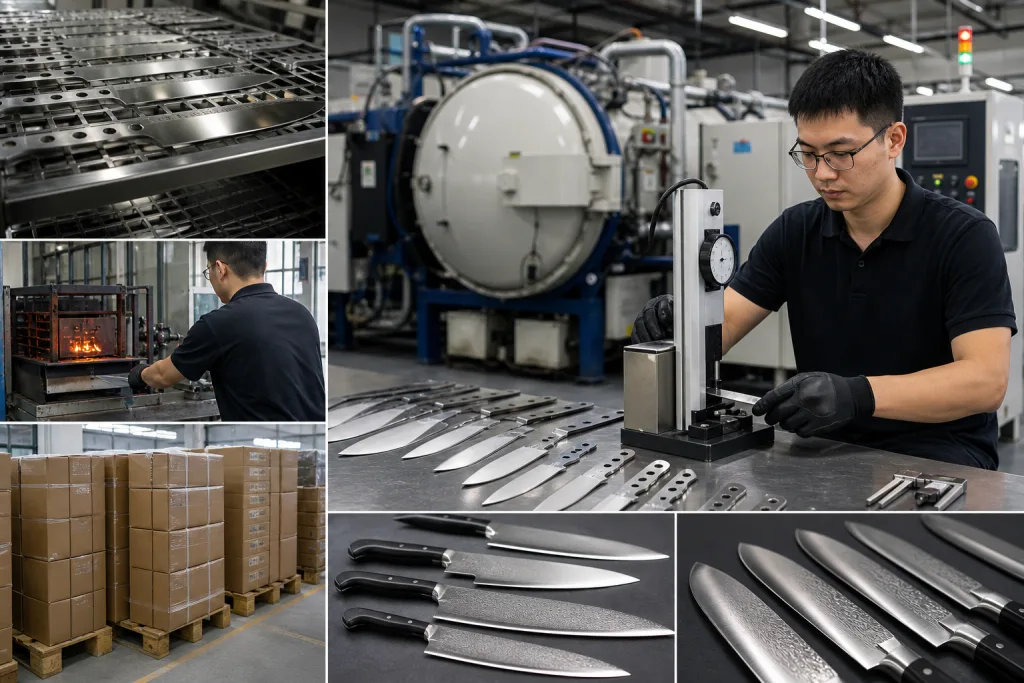
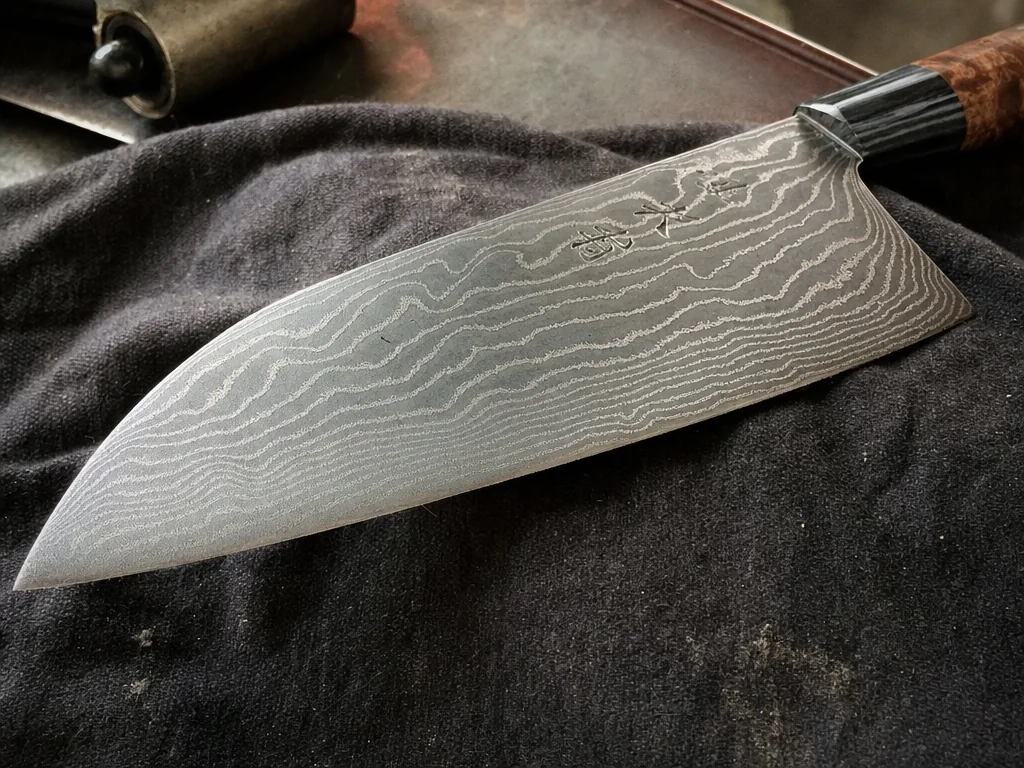
Buyers get burned on Damascus because suppliers use the word for 3 different builds. We have seen this go sideways on gift sets with a 3,000-piece MOQ. A blade can look premium right after acid etch, then one pass on a 400-grit belt exposes decorative cladding, a printed film, or a shallow pattern that disappears after polishing. Bad surprise. For damascus knife authenticity sourcing on a premium or gift program, ask the factory to cut one cross-section from the approved sample, shoot it beside a caliper, and keep that photo with the sealed sample. Then match the billet callout and core steel to the PO, not to a sales story.
At a serious damascus knife authenticity manufacturer in China, layer count alone is the wrong question to ask. Start with the steel stack and core hardness. Check grind geometry at 1 mm above the edge, then trace the sample back to the PO lot; this is where a typo like “VG10 clad” instead of “VG-10 core” turns into a claim. In Yangjiang, Zhejiang, and other China knife export hubs, the better factories cut a cross-section and log the acid etch at 6 minutes per side. They should show the exact route for forged san-mai or pattern-welded construction, and QC pulled the sample off the grinding line before final wash. That is the gap between a knife that photographs well and one your customer still keeps after 12 months.
What buyers mean by authenticity
In knife sourcing, authenticity is simple: the blade construction has to match the PI, not just show a clean wave after acid etching. Looks are cheap. A real Damascus knife is either pattern-welded from stacked steels, usually 67 layers or 33 layers at the target price, or forged san-mai with Damascus cladding over a harder core. At our sample bench, we check with a 10x loupe and polish 0.2 mm off the spine before we quote bulk. If the blade is plain mono-steel under a decorative etch, the supplier needs to sell it as printed or etched pattern from day one. Anything else is a sales trick.
Start with your eyes. Ask where the pattern goes. On a true pattern-welded blade, the lines should carry through the spine and the choil. After a fresh polish, they should still show in the exposed cross-section. If the pattern dies at the blade face, QC pulled the sample for a reason. Nine times out of ten, it is surface treatment. On forged san-mai, Damascus on the cladding with a plain core is acceptable if the drawing says so. The knife must match the spec, full stop. We have seen this go sideways when a buyer approved face photos only, then the buyer flagged the plain spine during AQL 2.5 inspection after QC hit the cut with 600 grit.
For premium brands, authenticity means repeatability in bulk. Bulk tells the truth. One handmade sample from the best smith does not prove the line can run 300 units. If the factory in Yangjiang, Zhejiang, China cannot hold similar pattern density at the heel, the program is not ready for production. If grind height shifts after heat treatment and belt grinding, it is not ready either. Etch contrast has to stay consistent lot to lot. Ask for production photos from the grinding line. Ask for one cross-section sample and the inspection standard before PO release. We normally keep one cut spine sample at the QC desk. We keep one finished blade there too, with the approved acid-etch timing sheet. Arguing whether the pattern looks "handmade" is the wrong question to ask.
Forged san-mai versus etched cladding
Most sourcing disputes start with one bad RFQ line: the buyer writes “Damascus san-mai or etched pattern, same target price.” That is the wrong question to ask. Forged san-mai means we run a hard core steel between softer outer layers, forge the stack at heat, then grind it so the cladding and core share the knife body. Etched cladding means the acid tank and finishing wheel pull a pattern onto the surface; the real cutting feel still comes from the base steel under it. Both sell. Same product? No.
For a premium knife, forged san-mai earns the higher quote because the spine, choil, core line, and final grind tell the buyer more than a studio photo. QC pulled one 210 mm gyuto sample last month where the core line wandered almost 2 mm near the heel; the knife looked clean in the catalog shot, but the buyer flagged it in hand before the carton test. Etched cladding fits better when the math is tight: 1,000-piece gift sets with a fixed retail price, private label programs where the PO says “ship before Week 38,” or seasonal orders where MOQ and delivery beat billet romance. The trouble starts when a supplier sells surface etching as deeper construction. We have seen this go sideways.
| Construction | What you see | What you should verify | Typical buyer fit |
|---|---|---|---|
| Forged san-mai | Patterned cladding, clean core line | Core steel, bond line, HRC 59-61 | Premium chef, collector, gift |
| Pattern-welded billet | Pattern through the body | Layer count, etch depth, grind consistency | High-end retail, branded lines |
| Etched cladding | Strong visual contrast | Base steel, finish durability, disclosure language | Volume gift sets, entry premium |
If your brand needs a clean price ladder, this table matters more than a dramatic product story. Ask the factory what stays stable at 300 pieces and what needs small-batch control on the grinding line; we run this check before quoting the fancy finish, because a 0.3 mm uneven grind at the choil can turn a “premium” sample into a buyer complaint. Small miss, big email chain.
How to inspect a sample properly
Treat the knife sample like a technical part, not a showroom piece. Start at the choil and spine with a 10x loupe while the blade is still clean from the tray. Clean first. If the blade is real pattern-welded steel or san-mai, those spots should show the layer structure; if a blank stainless face sits under a heavy polish job, reject the sample. Then check the grind line. On a premium blade, the cladding-to-edge transition should stay clean on both sides, and the left-right gap should stay within your spec across the sample set, not move 0.3 mm at the heel after the grinding line rushes the last batch.
Use a buyer checklist. We keep the loupe and alcohol wipes on the QC table before the sample bag is opened:
- Request a cross-section or cut-away sample before mass production. Macro photos from one angle are sales material, not inspection.
- Verify the etch is deep enough to hold contrast after cleaning and handling; we wipe with alcohol and check again after 20 passes with a cloth.
- Confirm hardness in the core range you specified, typically HRC 59-61 for kitchen and chef knives, and ask where the Rockwell point was taken. We have seen good numbers pulled from the wrong spot near the spine.
- Check for acid residue, pinholes, delamination, and uneven polish at the heel; QC pulled a sample last month with black residue trapped near the plunge line.
- Ask for a 10-piece pre-production report. One polished hero sample buffed on the wheel proves nothing.
If you are buying from Yangjiang, Zhejiang, China, a supplier worth quoting should not argue about these checks. We run a 10-piece pre-production review with edge-cut cards and visual grading under 5000K light, then place all blades side by side on the bench to compare the grinding line. Packaging gets its own approval sample before we ship, plus a carton drop check. Whether the sample feels handmade is the wrong question. For premium and gift brands, the first complaint often starts when a retailer opens carton 3 of 18 and flags a heel scratch or washed-out etch, not when a metallurgist cuts the blade apart. The math doesn't work if you wait for that call.
Sourcing data that matters
In Damascus sourcing, the numbers that count are the ones that still hold after the golden sample. We run a paid sample first, lock MOQ 300-500 pcs per SKU, then check 45-60 days against the grinding line schedule on the board. For a steady OEM run, monthly capacity should come from your forecast sheet, not a buyer's hopeful email. We have seen a PO show 300 pcs on page one and 500 pcs in the packing note. QC caught the mismatch before steel cutting.
Send every supplier the same data request and compare it line by line. Simple works. Ask for the HRC record, the etching time in minutes, blade yield after grinding, and the name on the final AQL sheet. This is the wrong place to shop by photos. A real damascus knife authenticity manufacturer has an HRC tester on the bench; a reseller has clean images and loose answers.
| Item | Buyer target | Why it matters |
|---|---|---|
| MOQ | 300-500 pcs | Shows the factory can load a real production run, not just sample work |
| Lead time | 45-60 days | Leaves room for the grinding line, polishing, etching, packing, and vessel booking |
| Hardness | HRC 59-61 | Keeps edge retention and toughness in balance |
| Inspection | AQL 2.5 visual, zero critical | Catches contrast marks, handle gaps, logo defects, and other premium appearance issues |
| Documentation | ISO 9001, BSCI, REACH, LFGB where applicable | Supports Europe and North America entry without last-minute document chasing |
In Yangjiang, China, some factories hold these numbers for 3 repeat orders. Some do not get through the first 300 pcs without rework at the polishing bench. The difference is process discipline, not a smooth sales call. If a supplier gets vague on heat treatment, polishing steps, blade yield, or etching time in minutes, the math doesn't work. We have seen this go sideways: QC pulled the sample, the HRC read 57 instead of HRC 59-61, and the buyer flagged uneven Damascus contrast after retail boxes were already sealed.
Specs that protect premium margins
Premium and gift brands rarely lose margin because the Damascus pattern looks weak. They lose it on lazy specs. The steel claim has to match the face pattern, and the box copy has to repeat the same claim. We had one PO marked "Damascus style, premium finish" with no 15 degrees per side, no 0.2 mm handle gap limit after buffing, and no note on whether the etch should run clean to the heel. That is how a clean sample turns into 3 cartons of arguments. For a chef knife or kitchen knife, lock the core steel first. Then write the cladding claim in plain language, target hardness, edge angle, handle material, and finish level before the first mass order. If a buyer asks only for layer count, that is the wrong question.
For European and North American channels, keep the compliance list practical. Paper is cheap. If the handle uses wood or resin-based material, ask about moisture stability and finish durability. Ask what happened after a 24-hour humidity-box check and a 3M 600 tape pull on the handle shoulder. We run that check because shiny pakkawood can still lift at the bolster after buffing compound sits in the joint. If the product touches food, keep the materials and packaging aligned with LFGB or FDA expectations as relevant. If the brand ships through marketplaces, confirm carton size first, then lock barcode placement and FNSKU labeling before production; we have seen a buyer flag a 12 mm barcode shift after 5,000 gift boxes were packed. If your market needs supplier audit support, ISO 9001 and BSCI help. QC pulled the sample on one program and found a wavy grind with a clean audit file sitting next to it. The math does not work if you skip blade inspection.
For a gift set, the box sells the first impression. A strong package carries a higher FOB only if the blade still looks clean under 5000K light and after 20 handoffs from the grinding line to final pack. We have seen buyers ask for a magnetic rigid box while the spine was still rough at 0.4 mm and the etch lost contrast after one alcohol wipe. We have seen this go sideways. The buyer will touch the spine before reading the carton artwork. If the etch looks muddy under light, or the spine catches a finger, perceived value drops faster than it ever would with a plain box. If the goal is a premium retail program, spend the money on blade geometry and finishing first, then let the packaging lift what is already there.
How to brief a Damascus OEM
A usable brief lets the merchandiser quote, lets the sample room build, and lets the grinding line set the jig without three different readings of the same knife. In the first 3 lines, say whether you want forged san-mai, true pattern-welded construction, or an etched cladding look over a core steel. If you write “Damascus style,” the factory has to guess your price target and your quality target from one loose phrase, and that guess usually lands wrong. This is the wrong place to be vague. We have seen it go sideways: QC pulled 12 samples with a clean acid-etched face at 0.18 mm etch depth, checked them again under the bench light, but the buyer expected a real layered billet and rejected the counter sample. Wrong words cost weeks.
Your brief should show blade length in mm, steel grade, target HRC, and handle material on page one. Then lock the surface finish, packaging format, and the sales channel. A chef knife packed for retail hangs is not the same job as a pocket knife in a gift box; the insert changes, the edge protector changes, and the carton layout moves. Put the custom points on the PO before tooling starts. Mark the laser engraving position. Give the logo size in mm. Attach the private label artwork. Check the carton mark spelling. If drop test results matter, name the insert tray material. We run into this every month. One buyer sent “VG10” on the artwork and “VG-10” on the order sheet; the sample room stopped for half a day, the laser file stayed on hold, and the buyer flagged the delay that same afternoon. A solid factory in Yangjiang, Zhejiang, China comes back with drawings first, then process notes, then a sample schedule tied to the grinding line and the jig check. A weak one sends a pretty picture and a unit price. The math does not work if the details are still floating.
For repeat business, ask for one production photo set per batch, one pre-shipment inspection report, and a written spare-parts or replacement policy for damaged cartons. It looks like paperwork. It is margin control. On a 500-piece repeat order, one crushed master carton can turn into 24 replacement gift boxes, plus 24 sleeves if the corner crush hits the print area, and we ship those at our cost if the rule was never written down. QC pulled the loading photos. The buyer still argued. We have seen this go sideways after the vessel leaves Shenzhen and the blame starts moving between forwarder and warehouse, then the seller gets dragged into it. Lock the specification first. Then the Damascus pattern sells the knife instead of turning into a claim your buyer has to defend.
Frequently asked questions
Start with the spine, choil, and any exposed cross-section. On a real pattern-welded or forged san-mai blade, the structure should make sense beyond the face of the knife. If the pattern disappears completely at the edge, heel, or spine, ask what you are actually buying. A good supplier should provide a cut-away sample, a steel spec, and a process description. For premium sourcing, I would also ask for hardness data in the HRC 59-61 range for kitchen use, plus a pre-production sample set of 10 pieces. If the factory cannot explain the build clearly, the product is probably decorative rather than technically honest.
Not automatically. Forged san-mai is usually better when you want a more technical blade with a hard core and a more durable premium feel. It often supports better cutting performance and a cleaner value story for higher-end chef and kitchen knives. Etched cladding is easier to control and cheaper to scale, so it can work well for gift sets, private label programs, and entry-premium lines. The right answer depends on your margin target, price point, and retail channel. If you want a knife that sells on story and performance, forged san-mai is usually the stronger choice. If you want fast repeatability at lower cost, etched cladding is often more practical.
For a real production partner in China, a normal MOQ is often 300-500 pcs per SKU for premium Damascus programs, sometimes higher if the pattern is complex or the handle is custom. Smaller runs are possible, but pricing rises fast because setup, polishing, and inspection are labor heavy. Lead time is commonly 45-60 days after sample approval. If a supplier offers very low MOQ with no clear explanation of process, be careful: they may be reselling mixed stock rather than making your exact build. For a branded launch, it is better to pay for one stable batch than to chase a low MOQ that creates inconsistency later.
Yes, but the factory has to treat compliance as part of sourcing, not as an afterthought. For food-contact programs, the handle materials and packaging should be checked against the right market expectations, including LFGB for Germany-facing business and FDA-relevant expectations for U.S. channels where applicable. If you use wood, resin, or stabilised composites, ask for material declarations. If you sell through marketplaces, label control matters too, including barcode and FNSKU placement. I would also ask for ISO 9001 and BSCI evidence if you need a more formal supplier file. Compliance does not prove blade quality, but it protects your ability to import and retail the product without avoidable friction.
Lock the steel combination, blade thickness, edge angle, target HRC, finish level, handle material, and packaging structure before you approve the sample. You should also agree on how the pattern will look after etch, because that visual standard is part of the product. For a premium knife, ask the factory to define acceptable variation in pattern density and polish lines. If you are sourcing from Yangjiang, Zhejiang, China, a serious supplier will put this in writing and show you the same details across multiple samples. Without that discipline, your second order can look different from your first, even if the unit price never changed.
Request a verified Damascus sample set
Send your target blade type, price band, and market. We will match the construction, spec the right HRC range, and quote a production-ready Damascus program.
Request a Quote