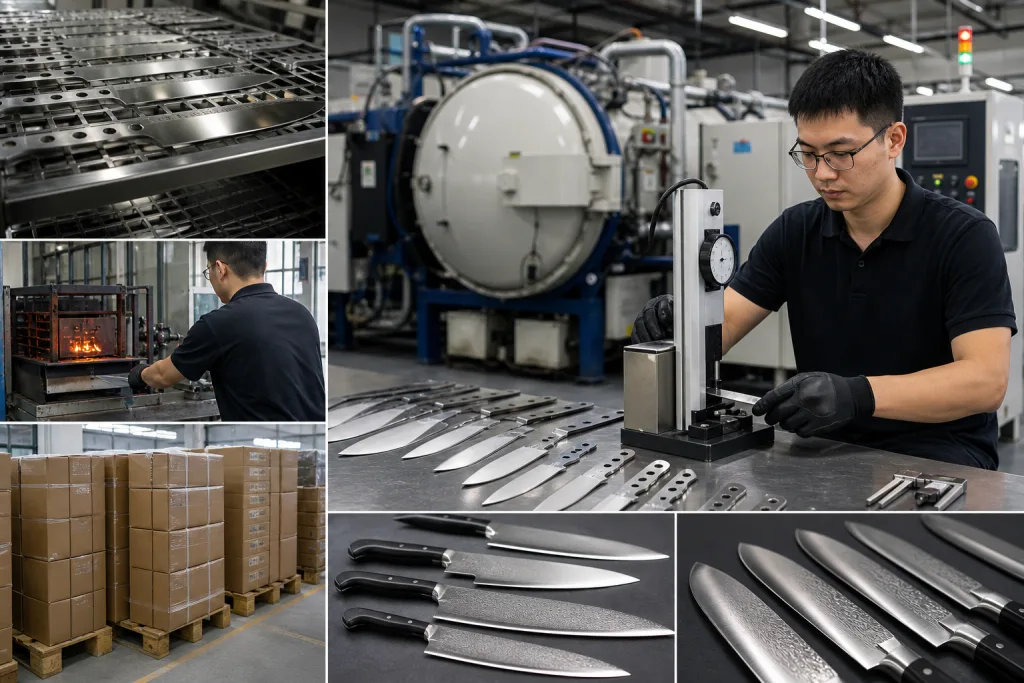
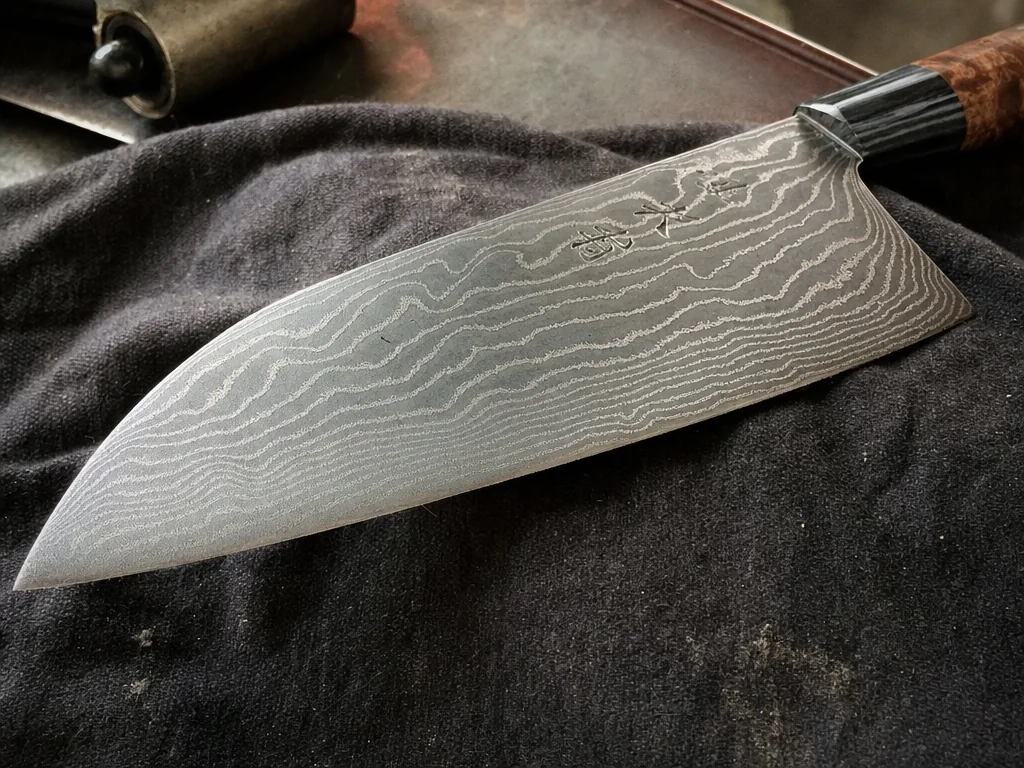
A hamon looks good in photos. On 6 out of 10 quote samples we review, that line is only an acid etch on a standard through-hardened blade. In Yangjiang and Zhejiang, we see both types from the same supplier grade. Some come off the same grinding line, using the same 2.5 mm gyuto blank and the same MOQ 500 pcs. Ask how they masked the blade, what oil or water quench they used, and whether the spine was checked after tempering. Approve the look alone, and the buyer flagged the polish, not the steel.
For a premium brand, decoration is not the job. You are buying edge stability and spine toughness. You are also buying a claim your sales team can defend when an end user asks why the knife chipped after 3 weeks. A real differential heat treatment hamon manufacturer should name the steel and the quench without calling back to the heat-treat room. QC pulled the sample from the Rockwell tester log, and the sheet should show 60-62 HRC at the edge with a softer spine. If they cannot do that, this is the wrong question to ask. You are sourcing a surface effect, not a functional blade.
What A Hamon Actually Shows
A hamon is the line left by differential hardening. After quench, the edge turns to martensite while the spine stays softer and tougher, often closer to pearlite on simple carbon steel. That contrast is what you see under polish. No magic. On our heat-treat rack, QC checks edge and spine with a Rockwell tester after the blades cool; 60 HRC at the edge against 45-48 HRC near the back on a carbon steel sample is a normal reading we record. A hamon is not proof of a good knife. It proves the heat treatment created a transition zone.
For a buyer, the line is not enough. Two blades can show a similar hamon and still cut differently if one is 0.25 mm behind the edge and the other is 0.40 mm, if the steel grade changed, or if quench timing slipped by 2 seconds. We have seen this go sideways: the buyer approved 6 sample photos, then QC pulled the sample, checked it under the polish, and found the blade was hardened almost evenly. On the grinding line, a factory in Yangjiang can buff in a traditional-looking line with a 600-grit belt, but a cosmetic line over uniform hardness is not a true differential heat treatment hamon. Ask for process evidence and hardness readings, not sample photos only.
In premium kitchen work, good hamon projects start with a tight target. Define the steel, blade thickness in mm, expected HRC spread, and how much handwork your price will pay for; at MOQ 300 pcs, extra polishing hours change the math fast. If you want a decorative signature, say it. If you want a working edge with a softer spine, write that into the PO and confirm it before we run the grinding line, because we have seen one PO typo send a batch to full hardening. Those are two different sourcing jobs, even when the blade looks the same on a sales sheet. The wrong question is "can you make this line?" The better question is "what hardness map will this knife ship with?"
Aesthetic Line Or Working Edge
We see this in about 4 out of 10 premium RFQs. Aesthetic hamon and working hamon are not the same thing. A photo-ready line can come from polishing or a 40-second acid etch, then a quick selective pass on the 1200-grit belt. It pops in the light box. For some gift-box programs, that is enough. Last quarter, one buyer flagged a sample because the line looked strong in the catalog photo and almost vanished after 6 sink washes. QC checked it again on the sharpness card. Same edge result. A bold line on camera does not mean the blade will chip less, or hold 12 days of shop use instead of 8.
A working hamon comes from the steel and heat cycle. We run the edge harder, often around 59-61 HRC for kitchen use, while the spine stays tougher and more forgiving. On one batch check, QC pulled the sample on the Rockwell tester: 60 HRC on the edge, about 50 HRC near the spine. Good result. That blade cuts clean without making the whole cross section brittle. The process window is tight. Scrap can jump from 3% to 8%, and the grinding line needs closer control during straightening and finishing, especially when the blade is still moving by 0.3-0.5 mm after tempering.
For premium kitchen brands, I will be blunt: if your customer wants maintenance-free use more than blade story, a hamon is the wrong centerpiece. This is the wrong question to ask. If the knife is headed for a dishwasher, or for casual users who leave citrus and salt on the blade, spend the budget on corrosion resistance and geometry. We ship plenty of programs where the buyer asked for a hamon look, then dropped it after a 24-hour salt test showed staining around the etched line. The math does not work if returns start at 2%. A hamon earns its place only when the buyer understands the story and accepts the upkeep.
Steel And Geometry Decide The Result
Steel decides whether differential heat treatment makes a working blade or just a photo line. We usually run 1095 and 1084 for clean response in the quench, 52100 when the buyer wants more wear resistance, and 80CrV2 when the spine needs a bit more forgiveness. Those alloys let us separate the hardness zones without fighting the chemistry. On our last 1095 sample run, QC pulled the blade after Rockwell testing on the bench unit, and the edge read 60 HRC while the spine stayed around 45 HRC. That split sells. Full stainless grades do not move the same way. For most kitchen programs, the math doesn't work. Quotes marked "true hamon" on stainless are usually an etched line or a polished transition, not a heat-treatment result you can sell with a straight face.
Geometry matters just as much. Too thick behind the edge, and the knife looks tough on the sales sheet but wedges in carrot on the first cut. Too thin, and you give back the toughness margin you paid for. For premium kitchen knives, we run 0.8-1.2 mm behind the edge before final sharpening, then set spine thickness by blade pattern. A 210 mm chef knife and a 135 mm petty knife need different section drawings. Sharing one profile is factory convenience, not good product design. We've seen this go sideways after a buyer approved a hamon sample by photo, then flagged the cutting feel when the grinding line left 1.6 mm behind the edge.
Compare the full spec, not the finish shot. The first question should be steel grade and hardness target, not how dramatic the line looks under studio light. Then check where the clay sits. Check how thick the grind is before sharpening. Check what polishing steps are written on the PO. Check what MOQ the factory will actually run; we have seen 600 pcs quoted up front turn into 1,000 pcs after sampling. If you need a quick reference for steels and trade-offs, use our knife steel comparison guide. A dramatic hamon photo wins the first email. We ship repeat orders only if the knife cuts cleanly and resharpens without complaint. The line is the first thing people notice, not the reason they reorder.
Sourcing From Yangjiang And Zhejiang
For differential heat treatment hamon sourcing, start the supplier call with the heat process, not the unit price. Price can wait. Ask how the factory controls quench temperature, soak time, and post-quench straightening for the exact blade size on your order. Get edge and spine hardness data. Ask for photos of the same sample before etching and after etching, not two polished blades shot under showroom lights. A serious differential heat treatment hamon manufacturer should show the quench tank setting, Rockwell test points, and straightening jig marks; if the answer turns into catalog talk, QC should pull the sample again.
In Yangjiang, China, a 240-employee factory can run about 100,000 knives per month across mixed lines, but a hamon program is not a standard stamped kitchen knife order. Treating it like one is the wrong question to ask. MOQ is often 500 pcs per design for a premium kitchen SKU, or 1,000 pcs when custom handles and gift boxes are tied to special finishing. Lead time is commonly 45-60 days after sample approval, and custom packaging can add another 10-15 days; we have seen a buyer lose 12 days because the PO said “walnut handle” while the approved sample was pakkawood. Small typo. Big delay. For differential OEM work, make the sample stage include one destructive test coupon and one retained master sample, with QC signing off the HRC points before the grinding line starts bulk work.
- Ask for the HRC band on edge and spine, with test positions marked in mm from the tip, heel, and spine.
- Ask whether the line is true differential hardening or surface etch; the buyer flagged this exact issue on two sample sets last year.
- Ask for the defect standard under AQL 2.5, including waviness at the hamon line, etch blur under 600 lux inspection, handle gaps, and blade straightness.
- Ask whether the factory works to ISO 9001 and can document heat-lot traceability from furnace batch to packed carton.
Factories in Zhejiang can also do solid work, but the same rule applies there and in Yangjiang, China: if the heat-treatment record is vague, the hamon is probably a visual feature, not a controlled process. We ship knives with etched hamon too, and buyers sometimes accept that for retail sets. We do not call it differential heat treatment unless the furnace sheet, quench log, and HRC readings match the blade in hand. The math doesn't work otherwise.
QC Specs You Can Put In PO
If you want the same hamon knife on PO #1 and again six months later, write the PO like a part drawing. "Beautiful visible line" is not a spec. We had one buyer flag 200 pcs after etch because the line sat 3 mm higher than the approved sample. That argument started at the light booth, not in the meeting room. We run Rockwell checks and a straight-edge on the grinding line before handle fit, then QC marks the lot card beside the rack. Put numbers in the PO. Adjectives start fights.
| Control point | Suggested target | Why it matters |
|---|---|---|
| Edge hardness | 59-61 HRC | Proves the cutting zone passed on the Rockwell tester, not just on one clean sample from the sample room |
| Spine hardness | 48-52 HRC | Confirms the differential effect, instead of a full-hard blade that can chip when the buyer tests frozen packaging tape |
| Blade warp | 0.3 mm max | Quench pull happens; a 0.3 mm limit keeps the blade straight when the handle team checks it against the steel ruler |
| Visual defect rate | AQL 2.5 | Gives QC a reject line for scratch marks and etch shade spread under booth light, before cartons are sealed |
| Edge chips | None over 0.2 mm | Stops first-use complaints when QC pulled the sample and found a heel chip under the 10x loupe |
For premium kitchen lines, ask for a hardness traverse on at least one sample per heat lot. One surface HRC reading is the wrong question to ask. We have seen this go sideways after the first 500 pcs: the blade face reads fine, then the polished cross-section from the cutoff wheel tells a different story. On the first production run, ask for polished cross-section photos from the cutoff wheel and keep one retained sample in your QC file with the lot sticker. If your market is strict, tie the inspection to knife quality inspection standards and log the result by lot number. That paper trail settles the argument when the same SKU is reordered six months later and the buyer says the new lot feels different on the board.
When Hamon Fits Premium Kitchen Lines
Use a hamon when the blade story carries the sell price, and your team can print a care card that does not say dishwasher safe. Best fit is 300 to 1,000 pcs limited-run chef knives and slicers, or one flagship SKU priced above the normal stainless range. We run these slower on the grinding line. After hand sanding at 800 grit, QC checks both faces under the same 5000K bench light, because a soft line on the left face and a sharp line on the right face gets flagged on the spot. Handmade is fine. A vague steel story is not.
Do not use it for low FOB programs that need low maintenance and broad retail distribution. If the buyer writes an aggressive target price on the PO and still asks for dishwasher tolerance, this is the wrong question to ask. The math does not work. Last year QC pulled a sample with a strong line but a cloudy oxide mark near the heel after a salt spray call, and the buyer flagged it straight away as returns risk. Fair pushback. In that case, ship a well-ground stainless knife with a clean finish. Build the premium story through handle material and packaging. Then lock the laser mark and balance spec on the drawing.
For buyers building a broader line, pair one hamon hero SKU with simpler SKUs around it: 1 hamon chef knife, then 3 to 5 stainless support knives using the same handle profile and carton style. Same shelf look. Less yield pain. We have seen this go sideways when a buyer tries to make a 7-piece set all hamon, cuts the MOQ to 200 sets, then asks why lead time moved from 12 days to 18 days. The polishing bench backs up first. If you need help on handle selection or private label packaging, see our knife handle materials guide, custom packaging for knife sets, and OEM knife manufacturing for premium kitchen brands. In Yangjiang, we ship serious programs this way: one statement piece, then the rest of the range built for margin and repeat orders.
Frequently asked questions
Usually no, not in the classic sense. A true hamon comes from differential hardening on a steel that can form a hard edge and a softer spine. On stainless kitchen steels, especially full stainless grades, most visible lines are produced by etching, polishing contrast, or other surface effects. That does not make the knife bad, but it does mean the line is mostly aesthetic. If a supplier in China says the blade is both fully stainless and has a true functional hamon, ask for edge and spine hardness data, plus a cross-section or hardness traverse. Without that, you are looking at a visual finish, not a verified process.
For premium kitchen OEM work, a realistic MOQ is often 500 pcs per SKU if the blade, handle, and packaging are already close to existing tooling. If you want a custom handle, special box, or more hand finishing, 1,000 pcs is more common. In Yangjiang, China, a 240-employee factory can usually support mixed production, but hamon work still takes more labor and more yield control than a standard stainless knife. Plan 45-60 days after sample approval, and add 10-15 days if you need custom retail packaging or multi-language inserts. If the quote is too low, check whether the supplier is quoting a cosmetic line instead of a real differential heat treatment process.
Ask for three things first: hardness data, visual consistency, and lot traceability. For a true differential heat treatment hamon program, you want edge hardness around 59-61 HRC, spine hardness around 48-52 HRC, and warp controlled to 0.3 mm or less. On the visual side, define what you will reject under AQL 2.5, such as acid stains, uneven etch, or scratches near the hamon line. If your brand sells into premium retail or e-commerce, request photos of the first article, a retained master sample, and at least one destructive sample per heat lot. If the factory only sends polished glamour photos, that is not QC.
The easiest and most reliable steels for this work are simple carbon or semi-carbon grades like 1095, 1084, 52100, and 80CrV2. They respond well to controlled quench and usually give you a clean visual transition after polishing and etching. If you move to full stainless steels, the hamon becomes much harder to achieve as a true functional feature, and many suppliers fall back on cosmetic effects. For premium kitchen brands, that is not automatically a problem, but you need to be honest about what you are buying. If the knife is meant to be low maintenance or dishwasher friendly, stainless is often the better commercial choice.
Yes, but only if the story fits the product and the care level fits your customer. Hamon works best on limited-run chef knives, slicers, and petty knives where buyers appreciate craft, edge behavior, and visual character. It is usually a poor fit for mass retail knives that need low maintenance, high corrosion resistance, and a very low return rate. If your target FOB is below about USD 12, you will usually get a better business result by putting the money into steel quality, grind consistency, and packaging. If your brand wants a premium centerpiece, build the line around one or two hamon SKUs and keep the rest simpler.
Send Your Hamon Spec Sheet
Give us steel, profile, target HRC, MOQ, and price band. We will tell you quickly whether the spec is workable for China OEM production or just a costly photo sample.
Request a Quote