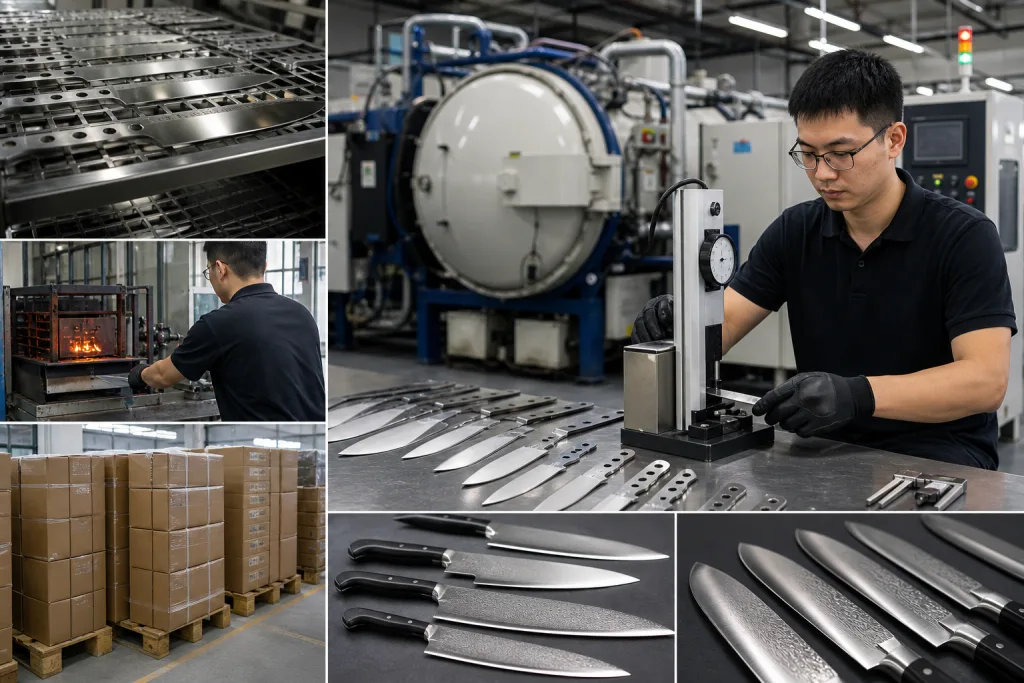
Sourcing kitchen knives from China usually comes down to one part before the handle artwork: the blade blank. Drop forging and stock removal change die cost, piece cost, surface finish, and the rework we run on the grinding line before polishing and edge setting. A forging die often starts at USD 3,000 to 5,000, while a laser-cut stock-removal blank can start at a 600 pcs MOQ. On OEM and private label projects, buyers comparing Yangjiang and Zhejiang suppliers will see both routes on the quote sheet, but they answer different briefs. We check this first with a caliper at the heel, because a 0.3 mm thickness swing can turn into extra belt time before the satin finish passes QC.
Brand owners get into trouble when they treat the two routes as interchangeable. That is the wrong question to ask. A forged chef knife feels heavier in hand and gives that full-bolster look; one EU buyer still asked for it after QC pulled a 2.5 mm stock-removal sample with tighter geometry and less warp at the heel. Stock removal makes better sense on thin kitchen profiles, especially when the schedule is 12 days vs 18 days and the volume is 1,000 pcs vs 3,000 pcs. Start with the handle and the math gets messy. Start with target MSRP and annual volume. Then decide whether you need a forged bolster or a clean laser-cut silhouette.
What the two methods actually do
Drop forging starts with heated steel pressed or hammered into a die, usually on a 400T press line. The blank comes out near final profile, with a thicker bolster and fuller heel, plus a cleaner step from spine to handle. That shape costs money. You pay for the die set and extra press-side work, including the second heat and trimming before the grinding line touches it; if trim flash sits 0.3 mm high at the heel, QC will pull it. On a 210 mm chef knife, buyers often pick forging because the bolster looks heavier on shelf and the handle balance feels more solid in hand. One US buyer flagged that after sample review and moved 2 SKUs from flat blanks to forged.
Stock removal is simpler. We start with flat bar or sheet, cut the outline by laser or waterjet, or stamp it if volume supports it, then grind the bevels and profiles. Tooling risk is lower, and on a 300-500 pcs trial order the die cost usually does not work; the math does not work if the buyer is still moving heel height by 3 mm. For a kitchenware brand, that matters when you are testing a new line or adjusting tip geometry for Germany versus the US. We run both methods in Yangjiang, Zhejiang, and the same drawing can go two ways: forged for a heavier retail look, stock removal for tighter drawing control and faster sampling. On small runs, we ship first samples 6 days sooner with stock removal, often 12 days instead of 18, and that gap is often what gets the PO signed after the buyer fixes a PO typo on the heel callout.
The practical difference is where the shape gets built. In stock removal, the grinder defines most of it; last month QC pulled one sample after a digital angle gauge showed a half-degree bevel change, and the buyer flagged it at once because the knife felt like a different SKU. In forging, the die gives you a head start, but it locks in visual cues fast, especially around the bolster shoulder and heel line, so approvals swing early. This is the wrong question to ask after sampling. Talk cost first, then line up grain direction with the bolster shape and shelf look before the first carton lands at your warehouse in China or Europe.
Cost grain at the sourcing table
Margin starts in the blank, not in the unit-price line. Drop forging pays up front for the die set, furnace time, trimming, and extra bolster polish. Stock removal pays for laser cutting, belt grinding, and hand correction on the grinding line. For an OEM kitchen knife program, choosing the wrong blank can add USD 0.35 to USD 1.20 per piece without moving the retail price. On a 10,000-piece launch, that is USD 3,500-12,000 gone. Fast pain. Last month QC pulled a forged sample with 0.4 mm extra flash at the heel; that ridge needed one more polish pass before packing.
| Item | Drop forging | Stock removal | Buyer note |
|---|---|---|---|
| Tooling | USD 800-3,500 per die set | USD 0-500 for cutting fixture | Die cost needs a firm forecast, not a hopeful sales slide |
| Typical MOQ | 1,000-3,000 pcs | 300-1,000 pcs | Stock removal keeps first PO risk lower when sell-through is unproven |
| Lead time | 35-55 days | 25-45 days | Heat treat queue still decides the calendar, especially before Canton Fair shipments |
| Per-piece look cost | Higher polish load | Lower polish load | Forged bolster eats finishing time on the 240# and 400# belts |
The table is the short version. A drop forging vs stock removal manufacturer in China will often quote forged blanks higher on the first order, then bring the piece cost down if the same die runs through 3 or 4 repeat POs. That math only works with steady annual volume. If your kitchenware brand is still testing retail response, stock removal usually gives better cash conversion because the first order is not carrying heavy die amortization. For a 240-employee factory in Yangjiang, Zhejiang, this is the wrong question to ask as a style debate. We run the numbers from forecast volume, target margin, and first-PO risk. One buyer once sent a PO with 1.4116 on page one and 5Cr15MoV on page three; that typo changed the blank cost before the steel sheet reached the cutting table.
Scrap matters too. Forging can waste more steel during trimming and flash removal. Stock removal can waste less on a narrow chef knife profile, but a curved boning knife or wide cleaver goes sideways when the nesting drawing is poor. We check the laser cutting layout in mm before quoting serious volume; a 2 mm bridge in the wrong place can slow unloading and bend tips. Ask for landed cost, not only ex-works price. A USD 0.18 saving at blank stage can vanish after rework, freight, and final AQL 2.5 inspection. We have seen that math fail on repeat orders.
Grain, edge feel, and appearance
Buyers tell us a forged knife looks premium and a stock-removal knife looks technical. We hear it in sample reviews almost every month. Geometry decides it. Drop forging leaves more steel at the heel and bolster, for example 4.0 mm through the first 25 mm on a chef knife blank, so the knife feels higher-value before the carton is fully open. On a forged chef knife or santoku line, the profile stays fuller and more traditional; we can see that on the press line before the first pass on the 120-grit belt. For gift sets, that visual weight sells. One EU buyer flagged a slim sample as "too light for the box price" before anyone touched the edge.
Stock removal gives cleaner lines and more predictable blade thickness. Want a thin German-style slicer at 2.2 mm spine stock? Stock removal usually wins. Same for a flexible boning shape or a lighter Japanese-inspired kitchen profile. On the grinding line, we hold the grind angle more consistently from pilot run to mass production, and QC pulled samples at +/-0.15 mm on blade stock lot after lot with the digital caliper. That matters when the buyer is chasing tight CATRA performance targets and expects the 6-inch santoku to sharpen the same way as the 8-inch chef knife.
Does forging improve hardness or edge retention by itself? That is the wrong question to ask. Heat treatment does that. A blade at HRC 56-58 is solid if the steel and temper are under control; we run the Rockwell check after temper, not after polishing. A weak forging line can still leave 0.4 mm warp after quench. We have also seen edge decarb, and thick scale eats belt time in finishing. Grain and appearance matter, but the straightness report comes first, then grind symmetry. Ask how much hand finishing the factory still needs after quenching. We have seen this go sideways on programs that looked good in photos and burned labor at final QC.
What to specify for kitchen knives
Kitchenware brands should write the blank method into the full spec sheet, not hide it in one RFQ line. Before we quote, send blade length in mm, heel height in mm, spine thickness at heel and tip, edge angle per side, target HRC, and the finish sample reference. We ask for LFGB, FDA, REACH, or food-contact documents before tooling review because one missing report can hold a shipment 7-10 days at booking. That delay is avoidable. Last month a buyer typed “matt finish” on the PO instead of “mirror finish,” and QC pulled the sample after the grinding line had already run 300 pcs through the 400-grit belt station.
The usual hardness bands are straightforward. Entry stainless kitchen knives often sit at HRC 52-54. Mainstream export lines run HRC 56-58. Premium stainless and some Damascus constructions run HRC 58-60, depending on steel grade and quench control, plus how thin the blade is ground. Balance sells knives. For a forged blank, check the bolster mass before you approve the die drawing; we weigh the first-off blank and compare it with the CAD target. Too much heel weight makes a 20 cm chef knife feel clumsy, and we have seen buyers reject a clean sample because the balance point sat 28 mm too far back. For stock removal, confirm that the factory holds the spine taper on the surface grinder. A flat bar outline with no taper still looks cheap, even with good steel. The math does not work if you pay for VG-style branding and ship a blade that feels like stamped promo stock.
- Ask for cross-section drawings in mm, and mark spine thickness at heel, middle, and 20 mm from the tip so the grinding jig matches the drawing.
- Request samples with the final handle material, because a 120 g pakkawood handle shifts balance more than most buyers expect once the handle press is set.
- Set an AQL 2.5 inspection plan that checks finish scratches under 500 lux bench light, edge burrs after sharpening, tip alignment, and blade straightness.
- Confirm packaging and carton mark requirements early if you need FNSKU labels, hang tags, or retail prep; one carton mark typo will stop a booking fast.
If you are building a private label line, a drop-forged OEM program is easiest once you already know the sell price and want a proven shape family. If you are still testing market fit, stock removal keeps revisions cheap. Changing a laser-cut blank drawing costs less than opening a new forging die, and we ship revised samples in about 12 days vs 18 days when the die shop is involved. We have seen this go sideways when a buyer approves the blade first, then asks for a heavier handle after the carton test. That order burns time.
How to compare suppliers
Do not stop at "forge or cut?" That is the wrong question. Ask how the factory controls quench warpage, blade-face scale, lot-to-lot hardness drift, and polish repeatability on the grinding line. Drop forging vs stock removal only matters if the blade comes out flat after heat treatment and the finish still meets tolerance. Samples can lie. We have seen first samples pass, then QC pulled production knives with 1.5 mm tip twist and another 12 minutes of hand grinding per piece.
Use a short supplier scorecard. Ask for records, not promises. A serious factory in Yangjiang or Zhejiang should show ISO 9001 procedures, incoming steel traceability by heat number, in-process hardness checks on a Rockwell tester, and final inspection sheets with lot photos. For Europe and North America orders, ask for BSCI status where relevant, plus REACH and food-contact documentation support. For kitchen knives, clean polish and a straight edge line beat a glossy sales sample; one buyer flagged a 0.3 mm ferrule gap at the bolster and held the shipment.
Use one rule. Pick the factory that explains why the blank method fits your channel, not the one repeating that forged is better. Mass retail may need the forged look to support a higher ticket. Online sets with tight photo standards and 24 SKU variants usually work better with stock removal, because we run sample changes in 12 days versus 18 days for a new forging die. The best manufacturer will match the blank to your margin and the MOQ you can hold, while keeping the box story believable. If they push one method every time, we have seen it go sideways.
When each method wins
Forged blanks make sense when the buyer wants hand weight and a proud heel bolster that reads as a full-forged knife on shelf. We run this route on 8-inch chef knives and carving knives, plus gift sets where the sample has to feel like a 39.90 USD retail item, not a stamped promo knife. The forging die is not cheap. On the grinding line, the 120-grit belt grinder needs extra passes to clean the bolster shoulder, and that labor shows up fast. If the opening order is stuck at 300 sets, the math doesn't work. Last month QC pulled one forged sample because the bolster line was 0.8 mm off center. Buyers notice that.
Stock removal wins when lead time and revision control matter more than bolster weight. We run it for light kitchen knives and utility shapes, especially new SKU trials where the buyer flagged the handle color after the first carton photo. A laser-cut blank moves through the grinding line faster, and a 2.0 mm blade is easier to tweak because we change the DXF and fixture, not the forging die. For short launches, the timing is plain: 12 days for blank cutting versus 18 days when we wait on forge setup and die correction. If the annual forecast is still a guess, paying tooling before market feedback is the wrong question to ask.
Match the blank to the job in the sales plan. Start there. Forging fits heavier knives that need premium shelf weight. Stock removal fits thin, accurate items that have to move fast. The control points stay the same: steel grade, heat treat curve, grinding tolerance, and carton packing. We ship better knives when the buyer locks those details early. We have seen one small PO typo send a run sideways: 3Cr13 written where the approved sample used 5Cr15MoV, and QC stopped the line after 60 pieces. Choose the blank method after that. Not before.
Frequently asked questions
No. Strength comes mainly from steel selection, heat treatment, and geometry, not the blank method alone. A forged kitchen knife at HRC 56-58 can perform well, but a stock removal blade with the same steel and proper temper can match or outperform it in edge stability and straightness. Forging can improve the visual mass at the heel and bolster, which some buyers interpret as strength, but it does not guarantee better hardness or edge retention. For your spec, ask the factory for hardness test data, warp tolerance, and edge geometry in mm before you judge the blank.
Stock removal is usually cheaper for the first order because you avoid die investment and can run lower MOQ, often 300-1,000 pcs. Forging can require USD 800-3,500 in tooling before the first production batch, plus extra finishing time. If you expect only one test launch or you are still validating a new SKU, stock removal usually gives better cash flow. If you already know the line will repeat at 5,000-10,000 pcs per run, forging can spread the tooling cost and become competitive on landed price, especially when the premium look helps pricing.
Ask for the blank method, steel grade, target HRC, thickness at heel and spine, and the planned finish. Then ask for the process control: heat-treatment curve, straightness tolerance, and final inspection standard. A serious factory in Yangjiang or Zhejiang should also show ISO 9001 discipline, traceability for incoming steel, and AQL 2.5 inspection records. If you sell in Europe or North America, ask whether the line can support REACH, LFGB, or FDA documentation. Do not accept a sales sample without production-side confirmation, because the look of the sample can hide the real cost and yield on mass production.
Sometimes, but only if the steel and process are controlled. Forging can align the material flow in a way that supports certain shapes, especially if the blank needs a pronounced heel or bolster. In practice, for most stainless kitchen knives the difference you feel is often more about weight distribution and visual profile than a dramatic performance jump. If you are paying more for forging, make sure the extra cost is buying you something visible: better shelf appeal, a more premium hand feel, or a traditional silhouette that your market wants. Otherwise, stock removal may be the better value.
Yes, and many brands do. A common approach is to use forged blanks for chef knives or gift-set hero SKUs, then stock removal for utility knives, paring knives, or price-sensitive set fillers. That keeps the range visually coherent while controlling cost where the customer notices it least. The key is to keep steel, heat treatment, and finish consistent across the line so the knives still feel like one family. If you do this in China, make sure the factory can manage two production routes without mixing inspection records or packaging codes, especially if you need retail-ready labeling and FNSKU control.
Send your blank spec for review
If you already have a target price, MOQ, and profile drawing, we can tell you whether drop forging or stock removal fits the line before sampling starts.
Request a Quote