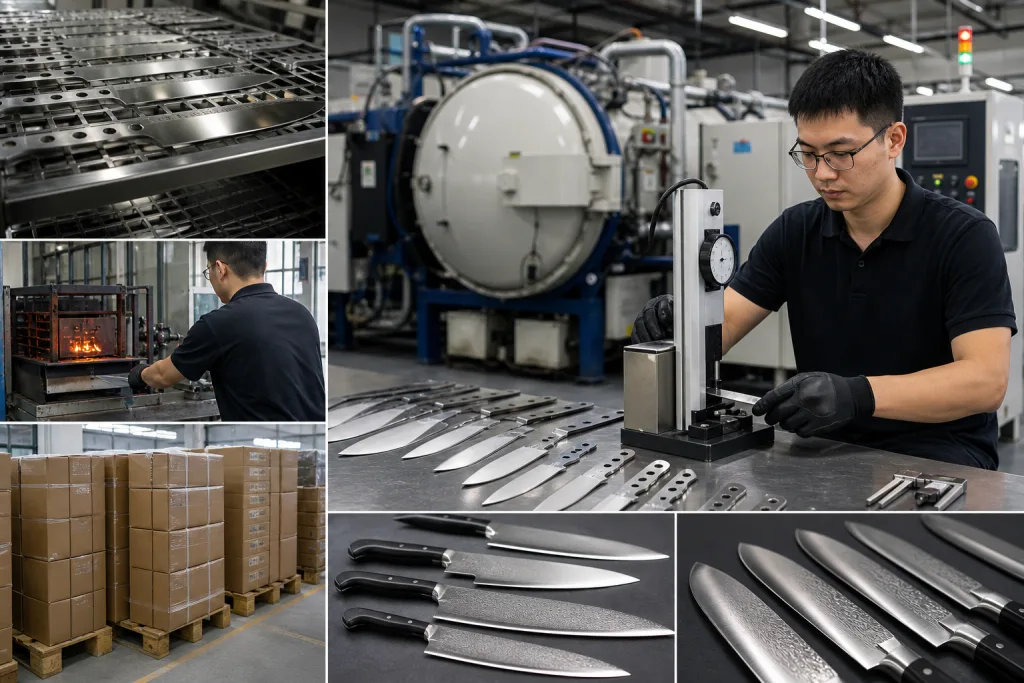
In knife sourcing, full tang vs hidden tang gets decided at the sample bench, not in a catalog photo. For outdoor knives, full tang is the tougher build: when 3.0 mm stock runs through the scales, it handles batoning and twist load better than a narrow stick tang. Hidden tang saves weight and gives an 8-inch chef knife a cleaner handle line, but the slot fit, shoulder contact, and epoxy fill must be controlled tighter. QC once found a 0.3 mm gap at the bolster on a pre-shipment sample. Small gap. Big headache. After sea shipment, that same gap turned into a claim. If you buy outdoor or kitchen ranges, this choice changes landed cost, warranty risk, and what the customer feels in the first 5 seconds.
At our factory in China, we run both constructions every month across 8-inch chef knives and hunting knives, with private-label SKUs on both lines. This week QC pulled a sample from the grinding line because the handle sat 0.2 mm proud near the front rivet. A serious full tang vs hidden tang manufacturer should tell you where each structure fits and where it fails, not just quote a unit price. Unit price alone is the wrong question. In Yangjiang and Zhejiang, we start with the use case, then check retail band and compliance needs like REACH, LFGB, or FDA. We have seen this go sideways over a small PO typo: the buyer flagged it after the hidden tang slot was written as 10 mm instead of 12 mm. That is how we handle full tang vs hidden tang sourcing.
What the two constructions really are
Full tang means the blade steel runs the full handle length, so you see steel at the butt and often along the handle edge. Hidden tang means the steel goes into the handle core but does not fill the whole handle profile. Simple on paper. On the grinding line, that changes blank weight and balance point. It also changes the drilling jig stop, pin-press load, and how much hand fitting we do at the 120-grit belt. We ran the same 210 mm blade profile both ways. After QC pulled the sample and checked the butt gap with a 0.05 mm feeler gauge, the full tang version felt like a different knife because the scale fit had shifted.
For a buyer, asking which construction is "better" is the wrong question. Match the tang to the job. A camping or field knife, especially a butcher-style outdoor model, wants more steel through the handle. Users twist in wood. They pry at joints and strike the spine hard. A chef knife or slicer usually sells better with hidden tang if the target is lighter balance and a cleaner handle line. We have had buyers ask for full tang on a 67-layer chef knife, then reject the 285 g sample because it felt heavy at the heel. The buyer flagged it after one hand test. The math did not work.
When you talk to a full tang vs hidden tang manufacturer, ask for section drawings, not photos alone. Get tang width in mm. Get tang depth at the shoulder and near the butt. Check pin layout by hole spacing. Ask what adhesive they run. Confirm how the bolster is built. Then confirm handle scale thickness and where the balance point lands. If the supplier cannot show that, they are selling a pattern, not a controlled product. For full OEM projects, the tang drives tooling first. It also sets handle-fit labor minutes and the final acceptance standard. We ship to the drawing. One PO typo on 3.0 mm versus 3.5 mm scale thickness can push the handle out of spec before packing starts, and we have seen this go sideways at the first carton check.
Strength, balance, and failure points
Most buyers ask, “Is full tang stronger?” That is the wrong question to ask. The real issue is where the knife gives up first. On a 4.0 mm outdoor blade we run, a full tang spreads load through the handle and takes side pressure better than a narrow stick tang. That matters for outdoor and hunting knives, also for kitchen buyers who expect the knife to survive twisting in frozen meat or dense squash. A hidden tang can still pass normal cutting if the tang diameter, shoulder radius, epoxy fill, and handle stock are fixed on the drawing. QC pulled one hidden-tang sample last month because the tang sat 1.8 mm off center inside the handle. It looked fine outside. It was not fine.
Hidden tang failures usually show up at the joint: loose scales after the drop test, cracked handle slabs near the pin hole, adhesive bond failure, or a weak ferrule transition. Full tang knives fail less often at the handle, but a sharp blade-to-tang shoulder still creates a stress point if the profile is lazy. We have seen this go sideways when a buyer approved a clean sample, then changed the handle slab thickness from 6 mm to 4.5 mm on the PO and forgot to update the liner spec. In sourcing terms, full tang does not automatically mean “strong,” and hidden tang does not automatically mean “fragile.” Ask how the factory controls geometry and heat treatment. Ask for the drawing.
For blade steels in the 56-60 HRC band on outdoor knives and 55-58 HRC on many kitchen models, the tang architecture has to match the steel temper. No shortcut here. A brittle blade with a bad shoulder design is a warranty claim waiting to happen, especially after the grinding line leaves a hard corner near the ricasso. A good China factory should talk plainly about pull strength, torsion, and handle retention, then show test data from the fixture, not just a clean sample photo. If they cannot show the numbers, they are asking you to carry the risk.
Cost differences you can actually quote
Hidden tang looks cheaper on the costing sheet. On the factory floor, the gap moves with handle material, finish grade, and whether the drawing calls for a bolster, ferrule, or visible butt cap. A basic full tang shows more steel, takes extra pin holes on the drill jig, and returns to the grinding line for edge cleanup around the scales. Hidden tang saves steel inside the handle, but if the slot fit is controlled at 0.2 mm, glue-up slows and the assembly team spends more time checking gaps under the bench light.
This is the sourcing view we quote for a mid-volume OEM program. We run it on an 800 pcs order with laser logo and gift box, after QC pulled the sample from handle assembly and checked the glue line with a 0.2 mm feeler gauge.
| Item | Typical impact | Buyer note |
|---|---|---|
| Steel usage | Full tang +10-20% | More visible steel; more belt-grinding time on the scale edge |
| Handle labor | Hidden tang +5-15% | Fit-up and glue line leave less room for error; gaps get flagged fast |
| Weight | Hidden tang -10-25% | Good for chef and gift SKUs; 12 pcs cartons ship lighter |
| MOQ | 500-1,000 pcs | 500 works for laser logo; gift box printing often pushes 1,000 |
| Lead time | 35-60 days | Depends on scale sourcing and the heat-treat queue; gift box approval can hold shipment |
For full tang vs hidden tang sourcing, ask for separate FOB quotations, then check the landed cost against carton pack and duty rate after the final packaging spec is locked. Asking only which one is cheaper is the wrong question. We have seen a PO typo change 12 pcs per master carton to 8 pcs, and that freight jump wiped out the tang savings before we shipped. In 10 RFQs, hidden tang is often only $0.30-$0.70 cheaper, and the math does not work if one warranty claim comes back for a loose ferrule or the buyer flags glue squeeze-out during inspection. Full tang can miss the retail target just as fast if the scales are overbuilt and 2.5 mm liners get added. Quote the numbers. Ignore the slogan.
Where each construction sells best
Market fit beats blade steel on most quotes. For outdoor programs, we run full tang on survival and hunting SKUs because the buyer wants to see steel through the handle before signing off. On the grinding line, a 4.0 mm blade with G10 scales feels nothing like a 2.5 mm hidden tang sample. Buyers notice in 10 seconds. The heft sells confidence, and the exposed tang reads better in listing photos. For tactical-style SKUs, full tang with G10, Micarta, wood, or Pakkawood is still the easier sell once MOQ starts at 1,000 pcs.
Kitchen brands buy on a different set of checks. A chef knife customer usually looks first at pinch-grip balance, handle warmth in hand, and whether the spine and handle transition feel clean off a 400-grit belt, not how much steel shows on the side. Hidden tang fits premium chef knives and Japanese-inspired gift sets where the handle must stay slim and the silhouette has to look polished. QC pulled one 8 inch chef sample last month because the handle came out 18 g too rear-heavy after the buyer asked for thicker Pakkawood. Small change. Big complaint.
Do not force a hidden tang into a heavy prep knife that will be slammed through chicken joints in a commercial kitchen. The math does not work. Do not default to full tang for a fine slicing knife either, because extra handle weight can move the balance point 12 mm behind the pinch and kill tip control. In Yangjiang, China, factories that run both constructions well split the range cleanly: full tang for utility and outdoor work, hidden tang for presentation-led kitchen SKUs. We have seen this go sideways when a PO says “chef knife” but the artwork shows a camp-style full tang handle, and the buyer flagged it at first sample review. This is the wrong place to guess. That is the discipline you want from a full tang vs hidden tang manufacturer.
How full OEM changes the sourcing process
Full OEM turns full tang vs hidden tang into a factory-control issue, not a sample-room debate. The tang decides blanking die width, handle mold clearance, grinding sequence, assembly jig location, and the QC checkpoints we write on the inspection sheet. On our grinding line, a 0.3 mm miss at the bolster seat shows up before lunch when the operator checks the shoulder with a feeler gauge. If a supplier only assembles bought parts, they usually push back on custom tang shoulders, a thinner distal taper, or pin spacing like 48 mm instead of 52 mm. A real OEM shop can revise the blade blank, adjust the tang taper, reset the bolster seat, then match rivets or an end cap so the knife cuts clean and the gross margin still works.
Ask for a process map before tooling approval. A competent factory should show heat treatment, rough grinding on 60-grit belts, secondary grinding with belt change records, handle assembly with jig numbers, buffing, laser marking, final inspection, and packing. For batch programs, we normally see 240 employees supporting mixed production, with daily output split across kitchen, chef, pocket, and outdoor lines. Headcount is the wrong question. Ask whether the line runs repeatable go/no-go gauges every 2 hours, and whether the operator knows why QC pulled the sample when tang thickness came in 0.15 mm over drawing.
If your range includes private label or retail gift sets, bring packaging in at the start. Small changes matter. A 2 mm change in handle length, butt shape, or tang profile can open the handle fit enough to require a new EVA tray, shift the insert cut, and change sample approval from 12 days to 18 days. We have seen this go sideways. The buyer flagged one mockup last quarter because the barcode landed on the shrink seam and the pommel sat proud in the cavity by about 1.5 mm. That is why stronger sourcing teams in China treat construction as part of the commercial spec, not a late packing note. Get the tang wrong and cost control, carton loading, and packout all become harder to hold.
Quality checks that prevent expensive surprises
QC has to match the tang build, not the catalog photo. On full tang knives, we check edge centering and spine symmetry first, then measure tang exposure, pin flushness, and handle-to-blade alignment with a 300 mm steel ruler and feeler gauge. On our line, QC drags a fingernail across every pin because a proud head shows up faster than it does under the light. Hidden tang knives need a tougher check. We add pull testing, rattle checks, adhesive cure verification, and ferrule fit inspection, and QC shakes 20 samples from each carton before packing. Photos lie. A hidden tang knife can pass sample review and still fail in use if the epoxy pocket is short by 2 mm or the tang fit has play.
A practical export inspection plan from China usually runs AQL 2.5 for major defects, but our internal limit on handle looseness is tighter. We run zero tolerance on handle movement because buyers flag even a 0.5 mm shake as a safety issue; one EU buyer stopped approval after three dry shakes at incoming inspection. That pushback was fair. Ship to Europe only after REACH and packaging compliance are confirmed. For kitchen products, LFGB or FDA-related material requirements depend on the market and the contact surface. If the knife is sold for food use, record the steel grade and handle material on the signed spec sheet, then lock the coating system before mass production; one typo on a PO steel grade cost 12 days of rework before shipment.
Do not skip destructive testing on pilot samples. Pull 5 to 10 knives from the first batch. Test handle retention first. Then run drop resistance or blade flex checks where the design calls for them. QC pulled one sample, clamped it in the vise, and the hidden tang moved on the third drop. The grinding line hates losing finished samples, but the math doesn't work if you replace 2,000 units after a customer reports handle movement. If you are buying from a full tang vs hidden tang manufacturer, ask for pre-production samples, lock the golden sample with signatures, and insist on a written checklist tied to the PO. This is the wrong place to save USD 30 on testing.
Frequently asked questions
Not always, but it is usually more forgiving under abuse. A well-made hidden tang with correct shoulder geometry, a tight ferrule, and properly cured epoxy can perform well for normal cutting. For outdoor or hunting use, full tang still gives better resistance to twisting and hard impact. If the steel is in the 56-60 HRC range, the handle design and fit-up matter as much as the tang type. Ask for pull testing, torsion checks, and sample break tests before you lock the spec.
For many chef and slicing knives, hidden tang is the better commercial choice because it gives lighter weight, better balance, and a cleaner aesthetic. That matters when the knife is used for 20-40 minutes at a time in a professional kitchen. Full tang makes sense for heavy utility or prep knives where durability is the main selling point. In a kitchen line, the handle material, bolster design, and overall point of balance often matter more than the tang alone.
For custom OEM production in China, MOQ is commonly 500-1,000 pcs per SKU, depending on handle material and packaging complexity. Lead time is usually 35-60 days after sample approval, with longer timing if you need custom molds, laser engraving, or gift-box packaging. In Yangjiang and Zhejiang sourcing, you will sometimes see faster quotes, but the real lead time depends on heat treatment capacity, handle supply, and final inspection scheduling.
Compare the full landed spec, not just blade price. Full tang may add 10-20% in steel and grinding effort, while hidden tang may add fitting and bonding labor. Then include cartons, inserts, FNSKU labels, testing, and freight under FOB or DDP terms. A hidden tang knife can still end up more expensive if it uses premium wood scales, ferrules, or hand-finishing. Request separate quotations and ask the factory to break out material, labor, and packaging.
Ask for material spec sheets, heat treatment range, sample approval photos, inspection checklist, and compliance documents such as ISO 9001 evidence, REACH declarations, and LFGB or FDA-related material statements where relevant. If you are sourcing from China, a serious factory should also provide carton marks, outer carton dimensions, and packing list details for customs. For private-label projects, include laser mark artwork, packaging dielines, and final approval sign-off before mass production.
Source the right tang for your range
Send your drawing or target SKU list. We can quote full tang and hidden tang options side by side from China, with practical OEM guidance on cost, lead time, and compliance.
Request a Quote