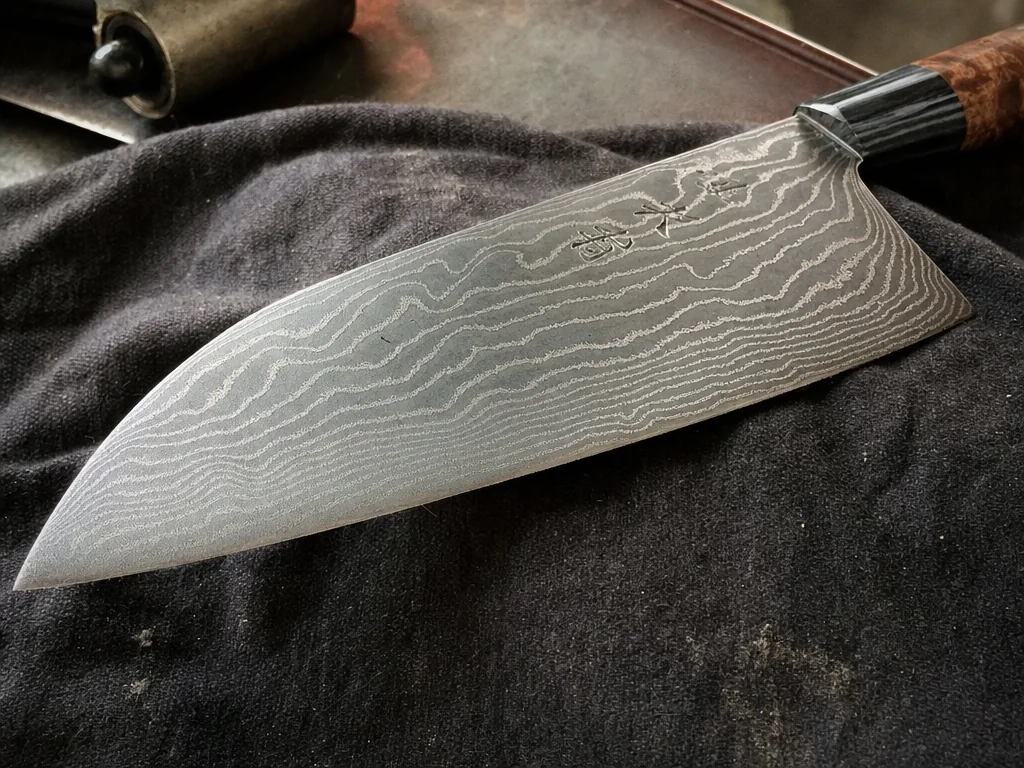
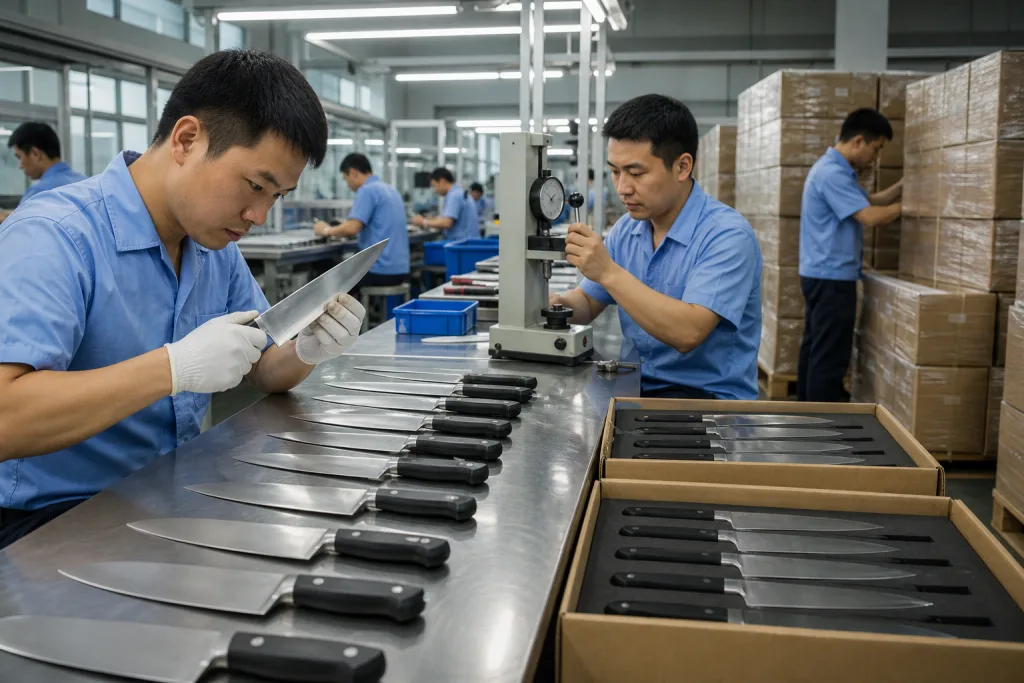
A garasuki is not just another boning knife. For butcher-supply buyers, it is a thick single-bevel blade made to split poultry at the joint, trim cartilage, and stay planted against bone without flexing. If the profile is off, QC pulls the sample and it turns into a narrow chef knife in a different jacket. We have seen that on a 165 mm spec sheet more than once, usually after the buyer circled the tip angle in red and asked for a rework before the carton sample was approved.
For sourcing, the details matter more than the name. Blade thickness, bevel direction, steel, hardness, handle sanitation, and packaging all need to be locked before price talk starts. On the grinding line, a factory in Yangjiang or Zhejiang can run a clean sample fast, but the production order only holds when the drawing is tight. For TANGFORGE-style OEM work, the gap between a usable garasuki and a return-rate problem is usually 0.5 mm of spine thickness or 2 HRC points. The buyer flagged it. The math does not work any other way.
Packaging And Shipment
Packaging has to fit the channel. For wholesale butcher-supply, we ship a 350 gsm insert card and a PP protective sleeve on most garasuki orders; that keeps MOQ manageable and stops the carton from bulking up. On retail runs, we go with a printed box, barcode, hang tag, 5 g desiccant, and a master carton spec that stacks cleanly on a 1,200 × 1,000 mm pallet. One buyer flagged a 6-piece inner box because their PO said 12 pcs per case. The typo turned into a full rework at packing, and the tape machine was already set for the wrong count. A plain sleeve looks cheap on paper, then blade rub shows up after two days in transit.
Freight terms matter too. FOB is cleaner when you already control the forwarder; our loading clerk can send carton dimensions and gross weight from the packing table before the booking cut-off. DDP works for smaller test orders, but the math does not work if customs codes, duty assumptions, and local compliance are guessed after production. For European buyers, confirm whether packaging inks, handle materials, and any coatings fit REACH expectations. For North America, keep the supplier file ready for import questions, especially when the customer is a chain account with a 40-page vendor compliance list. We run into trouble when the buyer asks for landed cost after the cartons are sealed. The wrong time to ask is after the scale ticket is printed.
A good sourcing decision is simple: choose the factory that can repeat the same garasuki with the same bevel, same hardness, and same packaging across three production cycles. QC pulled the sample from our grinding line last month and checked the edge angle at 18° per side, then checked hardness again at the handle end and tip end. That is the real test of a garasuki heavy boning sourcing program, whether the knives are shipping from Yangjiang, Zhejiang, or another export base in China. The question is not whether one sample cuts well. The question is whether the next 3,000 pieces match it. After the first order clears, make the reorder boring.
Frequently asked questions
For heavy poultry work, usually yes. A garasuki has more backbone, a thicker spine, and a geometry that is better suited to working along joints and bone. If you are sourcing for butcher-supply customers, think in terms of task fit: trimming chicken, duck, and similar carcass work. A standard flexible boning knife may be better for fine membrane work, but it will not give the same control when you need leverage. In production terms, a 150-180 mm garasuki at about 54-58 HRC is a practical starting point for most buyers.
For a private label garasuki, a typical MOQ is 500-1,000 pcs per model, depending on steel, handle, and packaging. If you need custom handle color, logo, and retail carton, the factory may ask for a higher commitment. A small test order can be possible, but it usually costs more per unit and gives less room for color or packaging optimization. If you are sourcing from Yangjiang, China, ask whether the MOQ changes by finish or by handle tooling. That saves time before sample approval.
If you want the safest commercial choice, start with a mid-range stainless steel that can hold 54-58 HRC and still tolerate daily sharpening. 7Cr17MoV and 9Cr18MoV are common practical options because they balance cost and corrosion resistance. For higher-end lines, you can go harder and more refined, but the business question is whether your customer will pay for the extra performance. In a wet butcher environment, a steel that is easy to maintain usually beats a more exotic alloy that is harder to service.
Ask the factory to define the working side, bevel angle, and micro-bevel, then test the knife on real poultry rather than paper alone. The blade should track straight through tendon and joint work without wandering, and the spine should feel rigid enough that it does not flex away from the cut. For sourcing, request photos of the grind line and a sample cut test. If possible, compare two samples side by side with the same steel but different bevel finish. You will feel the difference immediately.
At minimum, ask for material declarations, batch hardness records, packing confirmation, and a basic inspection report. If you are selling into Europe or North America, also request REACH-related material statements and any food-contact documentation that applies to handles, coatings, or packaging. Many buyers also require ISO 9001 process control and an AQL 2.5 inspection record. If you are using private label packaging, confirm carton count, barcode placement, and export marks before the goods are released from the factory in China.
Spec your garasuki with precision
Send the blade length, steel target, handle style, and packaging requirements, and we can quote a production-ready OEM program instead of a rough estimate.
Request a Quote