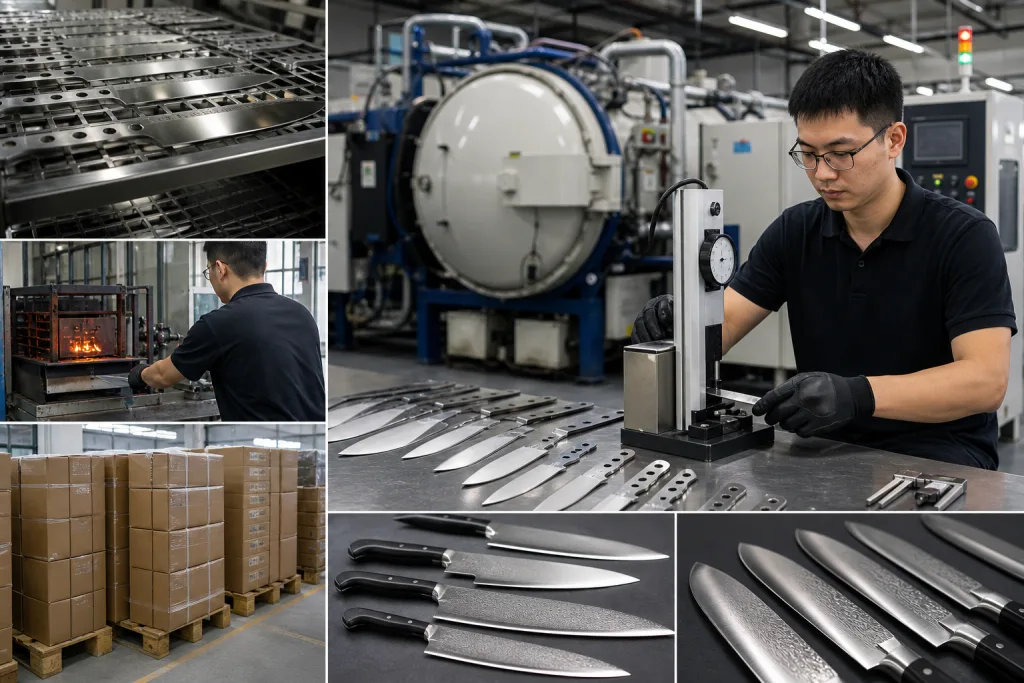
If you source knives for retail or private-label brand programs, put the bevel angle on the spec sheet. Do not leave it to the factory's default wheel setting. That one line decides first-cut feel, edge life, and complaint rate when customers report rolling, chipping, or weak cutting after 30 days on a cutting board. We run sample checks with a digital angle gauge, and QC pulled a sample where a 2 mm shift near the edge made the same steel feel like a different knife. Good steel still gets blamed when the angle is wrong.
In Yangjiang, China, we see this every week: buyers write “sharp edge” on the PO but leave out the knife edge bevel angles spec, then the buyer flags the China sample after home-use testing because it cuts differently in week 3. A knife OEM can hold 15 degrees per side, 20 degrees per side, or a mixed micro-bevel structure, but the target has to match the steel and HRC. It also has to fit the intended use and the price point. “Can you make it sharper?” is the wrong question. Ask what angle the grinding line will hold in mass production, because we've seen this go sideways right after a belt change. If your factory also has to meet MOQ 500 pcs, 35-50 day lead time, and stable production across 180,000 units per month, the spec has to survive production, not just look good on one showroom sample.
What bevel angle really changes
Bevel angle decides how much steel sits behind the apex. On a drawing, 15 degrees per side looks only 5 degrees sharper than 20 degrees per side. On the grinding line, we see the difference in the first 30 pieces. A lower angle cuts with less drag because the apex is thinner. A higher angle leaves more backing steel, so the edge has a better chance of surviving frozen food, light bone contact, or a rough PE cutting board. Simple trade-off. We check first pieces under a 200x scope; if the burr line is uneven by 0.2 mm, the wheel setup is already telling us something.
For a buyer, angle alone is not a spec. This is the wrong question to ask while steel grade and heat treat are still open. A thin blade ground to 15 degrees on both sides may feel sharp out of the box, but soft steel or uneven heat treatment will kill that edge after a few cartons of real use. In a Yangjiang OEM line, we set the edge around steel grade, hardness band, and the person who will use the knife. For example, a kitchen knife at HRC 56-58 often runs well at 15-17 degrees per side, while a utility or outdoor blade at HRC 58-60 is safer at 18-20 degrees per side. Last quarter QC pulled the sample and found a 1.5 HRC spread in one tray. Day one cutting was fine. Two weeks later, the buyer came back with dull-edge photos. The math does not work if the angle is tight but the heat treat drifts.
If you are writing a knife edge bevel angles spec for sourcing, state whether the target is per side or included angle. Most disputes we see start with that missing phrase. One factory reads “20 degrees” as per side, while the buyer expects 20 degrees inclusive. That is a 2x mistake. We have seen a PO typed as “20 deg both,” then the buyer flagged the pilot lot after the optical comparator showed the wrong setup. Put the angle callout on the drawing first. Repeat it on the inspection sheet and the sample approval record.
15 vs 20 degrees in practice
The 15 vs 20 degree debate usually starts with the wrong question. Start with use. A 15 degree per side edge fits buyers chasing clean slicing and low push resistance, and it gives that sharp out-of-box feel on the first carton check when the sample hits paper. We run this spec on chef knives and long slicing knives, plus some compact pocket knives where the user controls the cut and accepts more care. Tomatoes show it fast. Fish skin does too. Packaging film is another quick tell. On the grinding line, a 600-1000 grit finish and clean burr removal under a 10x loupe matter more than brochure claims; if the steel rolls after three test cuts, the spec was wrong before packing.
A 20 degree per side edge is the safer call when use is rough and less controlled. Outdoor knives and utility knives, especially hunting patterns, need more metal behind the edge. If the blade is going into wood, double-wall cardboard, rope, or field material with grit in it, 20 degrees cuts the chance of edge collapse. QC pulled samples from one 3,000 pcs order after the buyer asked for 15 degrees on a belt knife, and the buyer flagged micro-chips after rope testing. Under the loupe, the chips were already there. The math did not work for that market. We ship repeat European distributor orders this way because retail users are not all sharpening experts, and a tougher edge usually means fewer returns.
The commercial side matters too. A 15 degree spec is harder to hold in high-volume production unless the steel batch is stable, the heat treatment is on target, and the grinding line stays under control. In China, especially on Yangjiang mass-production lines, angle consistency lives or dies on jig setup, operator training, belt wear, and post-grind inspection with an angle gauge, usually within +/-1 degree if the line is set right. A fresh belt and a worn belt do not cut the same. If the buyer brief does not justify 15, a 17-20 degree spec is often the more honest product choice. We have seen this go sideways when the PO says “premium razor edge” but the target retail is camping kits at a low MOQ.
Micro-bevels make the edge tougher
Micro-bevels let us keep the cut lively without sending a weak apex into the carton. We grind the primary bevel at the ordered angle, then give the edge one short steeper pass, usually on the fine wheel after the main grinding line stops drifting. That last pass matters. For sourcing, you can sell the feel of a lower angle and reduce chipping claims after 200 carton-open cuts, cutting-board demos, or the buyer's own abuse test with frozen sausage. Good tool. In a knife OEM program, I would rather write the micro-bevel into the spec than explain later why a 15 degree edge came back with rolled tips after QC pulled the sample under the 10x loupe.
A common setup is a 15 degree primary edge with a 20-25 degree micro-bevel, or a 17 degree primary edge with a 20 degree finishing bevel. For kitchen blades, we usually run the micro-bevel around 0.3-0.5 mm wide; QC can catch that with a 10x loupe and a simple width check on the inspection bench. For outdoor knives, the micro-bevel can show more, around 0.5-0.8 mm, depending on blade thickness and steel. Do not make it a wedge. The wrong question is "how steep can we go?" Ask whether the apex survives the buyer's cut test while still feeling sharp out of the box. We have seen 0.9 mm pass the chip test and still lose the buyer because the sample dragged on tomato skin.
Micro-bevels also help when the factory has to balance line speed and reject rate. A steady final bevel is easier to inspect than a thin sharp edge that changes with the operator or wheel wear; we saw this go sideways after 600 pcs, when the morning samples looked clean but the afternoon batch showed uneven light reflection along the edge. If you are working with a knife edge bevel angles spec manufacturer, ask how they control the last pass: resin wheel or belt type, the grit sequence with the final grit stated, the angle jig setting in degrees, and whether QC measures the micro-bevel by eye or with a fixture. The math does not work if the PO says 15 degree only, the sample has a hidden 22 degree finish, and the buyer flags the edge during AQL 2.5 inspection.
Steel hardness and angle must match
Angle without hardness is half the spec. The same 15 degree edge behaves like two different knives at HRC 54 and HRC 60. On our carton-cut bench, the HRC 54 sample started rolling after 30 carton cuts; the HRC 60 sample was still biting cleanly. Softer steel deforms first. Fast. It feels sharp out of the sleeve, then the edge falls off. Harder steel can carry a lower angle, but the wrong alloy or a loose heat treat turns rolling into chips. Last month QC pulled the sample, checked it under a 20x loupe, and the rolled foil at the apex told the story. Asking for angle alone is the wrong question. Your knife edge bevel angle spec needs to sit beside the steel grade and heat treatment data.
For kitchen knives, 7 out of 10 export programs sit in the HRC 56-58 range because the edge cuts cleanly and the end user can still maintain it with a normal pull-through sharpener or whetstone. For outdoor or tactical knives, HRC 58-60 is common when the blade has to survive rope, hard plastic, or mixed warehouse work. Push past that and process control gets tight. Not every factory in Yangjiang, China will land the same result. We see it on the grinding line: if the 400 grit belt runs hot or the operator skips the cooling pause, the last 0.2 mm at the edge softens even when the core heat treat is good. One buyer flagged it as "good steel, weak edge," after incoming inspection. Fair call.
Rule of thumb: higher hardness and cleaner steel let you justify a lower angle. If the knife is going into rough work, add a little angle or add a micro-bevel; we ship some camp SKUs with a 0.15 mm micro-bevel because the math does not work on a thin naked edge. If your program covers kitchen stainless, field-knife carbon steel, and Damascus gift-set builds, split the spec by SKU instead of copying one bevel angle across the order. Set the angle per SKU. Put it on the fixture card. We have seen this go sideways when a PO copied the bevel note from one item to the next, the typo stayed in the file, and nobody caught it until first article.
Sourcing data buyers should request
Put the cut angle on the sample spec sheet before the OEM grinds the first blade. Do not bury it in a WeChat note that sales reads one way and the grinding line reads another. The factory needs to mark whether the edge is belt-ground on a 400-grit belt, ceramic-wheel honed, stropped, or finished with a micro-bevel. One buyer flagged a 2 deg gap between two samples from the same PO; QC pulled the sample card and found the angle gauge reading beside the inspector stamp. That stopped the argument. If you compare 3 suppliers, send the same edge spec to all 3 with the same blade thickness and test target. If not, the result is already dirty.
| Use case | Target bevel | Typical HRC | Suggested edge note |
|---|---|---|---|
| Chef knife | 15-17 deg per side | 56-58 | Fine finish, optional 20 deg micro-bevel if QC sees edge roll |
| Kitchen utility | 18-20 deg per side | 55-57 | Durability first, easy touch-up on a stone |
| Pocket knife | 15-20 deg per side | 56-60 | Match to blade thickness and actual user profile |
| Outdoor knife | 18-22 deg per side | 58-60 | Micro-bevel recommended for chopping and field abuse |
In the RFQ, ask for target angle per side and angle tolerance in deg first. Then lock the edge finish, micro-bevel width in mm, steel grade, HRC band, and the final QC inspection method. If the supplier cannot tell you how they check it, ask again. We want to hear goniometer at final QC, edge angle gauge at the bench, or a cut-test fixture for spot checks; otherwise the math doesn't work. We run these points before the first pilot run in our 240-employee Yangjiang factory, usually on 12 samples, and the grinding line signs off before bulk sharpening starts. We have seen this go sideways: 15 deg samples looked sharp in the showroom, then 19 deg bulk goods arrived after the PO wording said only "sharp edge." For DDP or FOB shipments, repeatability beats a perfect sample every time.
How to write the OEM spec
A bevel angle spec should be short enough for the operator to check beside the line. Skip “sharp” and “premium edge.” Write the geometry, the measuring point, and the pass range. For a chef knife, specify a 16 degree per side primary bevel with a 0.4 mm micro-bevel at 20 degrees, checked at the final grinding station with a digital bevel gauge. For a camping knife, write 20 degrees per side with no secondary micro-bevel, or call out a 0.6 mm micro-bevel when the buyer wants more abuse resistance. Simple wins.
Put the tolerance in the same line. On most programs we run, plus/minus 1 degree per side is normal for higher-end knives; plus/minus 2 degrees is what we hold on higher-volume commercial knives, depending on target price and inspection method. State whether the edge must be symmetrical. Some blades are ground with planned asymmetry, but if your PO is silent, the buyer flags it later as a defect claim. Burr removal needs its own line. QC pulled a sample under a 10x loupe last month and found a bright wire burr on the apex. A sharp edge with a visible burr is not a finished product. The math does not work.
On the quote side, a clean spec lets the factory price the job correctly. If you ask for a 15 degree fine edge, we already know the grinding line will slow down, often from 18 seconds per blade to around 27 seconds once the operator starts correcting the apex. Add laser engraving and custom packaging. Add REACH or LFGB compliance with AQL 2.5 inspection. Then we can price the labor and reject rate from day one. This is the wrong place to save words. We have seen a PO with “15 dregree” typed on it turn into expensive rework after QC measured 17 degrees on one side and 15 on the other.
QC tests that catch bad edges
Edge inspection starts after the bench lamp, not under it. A blade can look clean and still drag through copy paper or go dull after 30 cartons because the burr is still hanging on the edge. On serious orders, we run the angle on a digital gauge, check the burr under a loupe, then cut to a fixed sample count. No guesswork. The approval needs numbers on the QC sheet, not one inspector writing "feels sharp." For kitchen knives, a paper slice catches the obvious misses in 20 seconds. Used by itself, that is the wrong question to ask. For outdoor SKUs, we run samples through 5 mm cardboard, 10 mm rope, then a controlled push-cut after the grinding line clears the batch.
Ask the factory how the line checks the edge. Then ask who signs the record. Some plants use a digital angle gauge or an optical comparator. Some lock the blade in a jig and pull samples every 200 pieces at the grinder exit. Either setup can pass if the fixture stays put, but the method needs to be written on the QC sheet, not left in the foreman's head. AQL 2.5 is fine for appearance and workmanship. It does not cover edge performance. The math doesn't work. Set a separate acceptance rule. A chef knife sample should shave paper cleanly after standard finishing. An outdoor knife sample should finish repeated rope cuts with no visible rolling under a 10x loupe.
The common miss is approving one golden sample and trusting the bulk lot. We have seen this go sideways. In Yangjiang and other knife manufacturing centers in China, the sample can be right on spec in the morning, then production drifts after the grinding wheel wears down by 2 mm or an operator resets the angle jig after lunch. Bulk is where the risk sits. Ask for first article approval at start-up, in-process checks on the line, and a final inspection record that shows the measured angle range by batch. QC pulled one 500-piece lot last year because the PO said 18° per side, but the final check found 22° on 37 pieces. The buyer flagged it, and they were right.
Frequently asked questions
Yes, a 15 degree per side edge usually feels sharper at first because the apex is thinner and cuts with less resistance. But “sharper” does not mean “better” for every use case. On a chef knife or slicing knife, 15-17 degrees can be a strong choice if the steel is around HRC 56-58 and the user handles the blade carefully. On an outdoor or utility knife, 20 degrees per side often gives better durability and fewer edge failures. The real decision is edge geometry plus hardness, not angle alone.
For most export kitchen knives, 15-17 degrees per side is a practical target. If you are building a premium chef knife line, a fine finish at 15 degrees per side can work well, especially with good stainless steel and HRC 56-58. For general kitchen utility or mass retail, 18-20 degrees per side is safer and usually easier to maintain in production. If you want to reduce claims from users who cut on glass boards or hard surfaces, add a small micro-bevel rather than pushing the primary edge too thin.
Usually yes. Outdoor knives see rougher contact than kitchen knives, so a micro-bevel helps protect the apex from rolling or chipping. A common setup is 18-20 degrees per side on the main bevel with a 20-25 degree micro-bevel near the edge. The final micro-bevel may only be 0.5-0.8 mm wide, but it can improve real-world durability a lot. If your blade is thicker, harder, or intended for rope, wood, and field use, the micro-bevel is often the most efficient way to balance cutting and toughness.
State the angle per side, the acceptable tolerance, and whether the edge must be symmetrical. For example: 16 degrees per side, plus or minus 1 degree, with a 0.4 mm micro-bevel at 20 degrees. Also specify how the factory should measure it and whether the edge must be ground, honed, or stropped. If you skip tolerance, suppliers may quote different assumptions, and your sample approval may not match bulk production. Clear tolerances make knife OEM sourcing more predictable and reduce rework.
They matter together. A 15 degree edge on soft steel can roll quickly, while a 20 degree edge on very hard steel can still chip if the alloy or heat treatment is wrong. For many kitchen programs, HRC 56-58 gives a stable balance at 15-17 degrees per side. For outdoor knives, HRC 58-60 often supports a slightly tougher edge profile. If you source from China, especially Yangjiang, make sure the supplier ties the angle spec to the steel and heat treatment spec instead of treating them as separate topics.
Send your edge spec for review
We can turn your knife edge bevel angles spec into a production-ready OEM brief with angle, HRC, tolerance, and QC points aligned before sampling.
Request a Quote