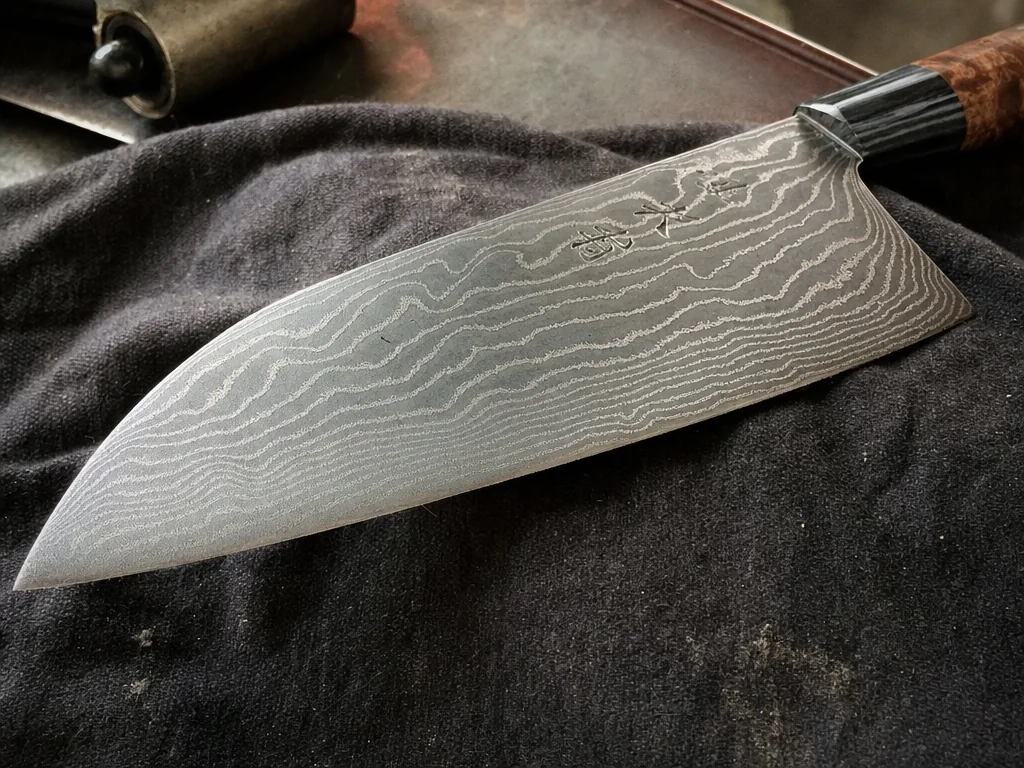
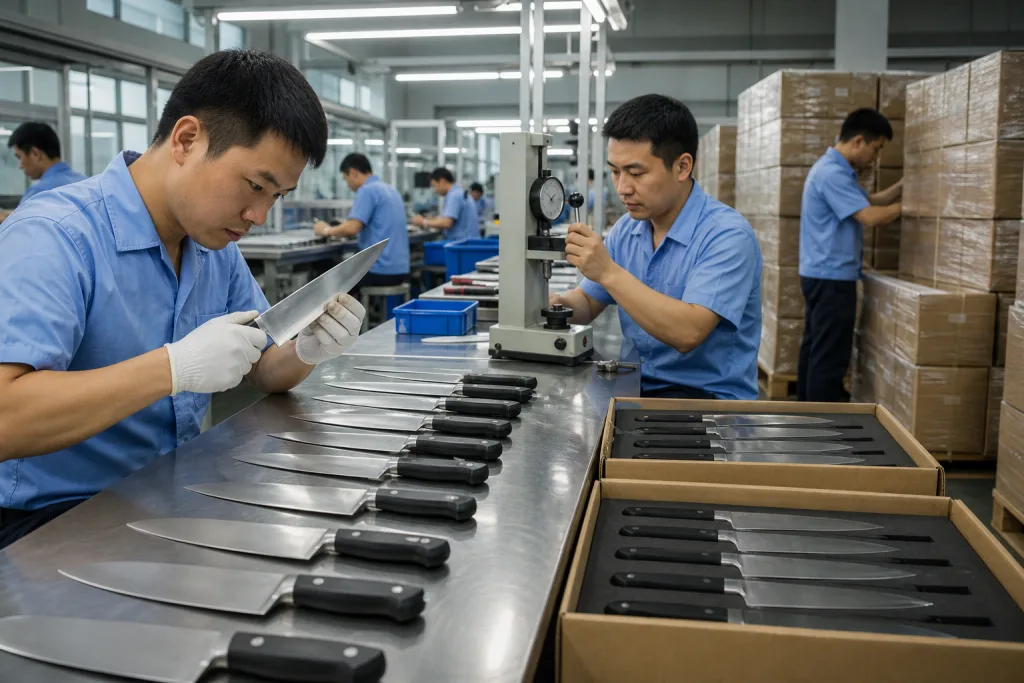
Nickel release is not nickel content. A blade can have nickel in the alloy and still release almost nothing in normal cutting, while a plated bolster or a rough collar at about 0.8 um can give a worse result than the blade steel. We have seen QC pull a sample off the grinding line where the blade passed, but the plated joint failed after an acid wipe test; the white cloth came back with grey residue. Small detail. Big problem. The wrong question is “does this steel contain nickel.” The spec needs to cover the finished knife: plating, polishing marks, weld joints, handle hardware, and every area the sponge or food can touch, not just the steel grade printed on the sample card.
For food-contact sourcing, define three things before we run mass production. First, list every part that touches food, down to rivets and exposed tang edges; on a 3-rivet handle, that means checking all 6 rivet faces, not just the blade. Second, set the wet contact case, such as tomato juice for 30 minutes or salt brine during prep. Third, decide what the user does after cutting, because lemons, onions, 200 dishwasher cycles, and abrasive pads can change the test result. A knife used on wet protein for 30 minutes is not the same compliance case as a display sample sitting dry in a box. In Yangjiang and Zhejiang, strong OEM teams lock this down before mass production: steel selection, surface finish, handle parts, rivets, packaging inks, and lot traceability all tied to one inspection file. We run that review before the PO is released, because we have seen this go sideways when the buyer flagged nickel after the color box was printed with the wrong item code.
What Nickel Release Actually Means
Nickel release is not nickel content. A blade can show 8% nickel on the mill cert and still give almost no release in normal kitchen use. A plated bolster or rough collar can fail first. QC once pulled 12 finished samples off the polishing bench; the bad piece was not the blade. It was a mirror ring where buffing cut the plating thin on the edge. That is why a knife food contact nickel release program has to be checked on the finished article, not only on the alloy chemistry printed on a mill certificate.
For kitchen knives, exposure is the real issue. The edge hits food first. The spine gets wet too, and the bolster, ferrule, rivets, logo plate, or decorative ring can sit in lemon juice or dishwasher alkali. Acid changes the reading fast. Tomato juice, vinegar soak, and a cut lemon left on the prep line for 20 minutes do not behave like a dry showroom sample sitting in a tray for 30 days. EU buyers usually ask for proof that the exact article is safe for its intended use, and the report has to match the construction we ship. A chef knife with a one-piece molded PP handle is one case. A folding pocket knife with nickel-plated liners is another. We have also seen a Damascus sample get flagged because the buyer asked for a bright decorative spine treatment and the lab treated that area as exposed contact.
The mistake I see most often is treating nickel as an alloy question only. Wrong question. Surface finish matters. Passivation matters. Plating thickness can swing the result even when the base steel stays the same. On our grinding line, a 0.2 mm burr left near a bolster shoulder can trap polishing compound and make the sample read dirtier than the drawing suggests. We have seen this go sideways. If you are buying from China, ask your knife OEM to break the release risk out part by part before sample approval. If they cannot talk through the blade, rivets, ferrule, and coating one by one, they are selling you a photo, not a compliance system.
Where Nickel Usually Enters The Risk Chain
Nickel release trouble in a knife order usually starts with the metal parts nobody spelled out on the PO. The blade is usually not the problem. Buyers stare at it first. We don't. The leak point is often the plated bolster at the finger stop or the rivet head sitting proud after peening; we also see it on bright inserts molded into a TPR handle when the finish note is too loose. Last year QC pulled 32 pcs from a pre-shipment sample after our salt spray cabinet showed pinholes on the collar edge at 24 hours. A martensitic stainless blade and a shiny plated trim part are different risks; once the coating chips at the 0.3 mm edge radius, the math doesn't work.
| Part | Typical Risk | What To Specify |
|---|---|---|
| Blade | Nickel in the alloy, Ra finish marks that hold residue, plus passivation missed on the cutting edge or spine | Steel grade, hardness target, polishing standard, and nitric or citric passivation method |
| Bolster or collar | Food acid and rinse water sit on one plated edge every day, right where fingers rub during use | No plating flake, smooth 0.3-0.5 mm edge transition, corrosion test evidence |
| Rivets or pins | Detergent and lemon juice get trapped under the rivet head, worse when peening pressure varies by 0.1 mm | Base metal, press-fit or peened assembly method, corrosion resistance, pull test |
| Decorative plating | Main complaint point after 50 dishwasher cycles or after one buyer scratch test with a coin | Food-contact-safe finish, cross-hatch adhesion test, wear resistance data |
On food-contact knife projects, we check every metal part against actual use before we quote, and we run the XRF gun on trim parts when the finish note looks soft. If the first question is only “what steel?”, that is the wrong question to ask. A table knife washed 2 times a day in a hotel dishwasher needs tighter control than a hunting knife packed dry in a nylon sheath. Simple. A chef knife for Germany gets different questions from a gift set for France or the Nordics, and the buyer pushback changes too. The drawing matters. The vendor list matters more. We have seen this go sideways when one subcontractor changed the rivet plating bath, the invoice still said “silver finish,” and the buyer flagged it only after first articles.
EU Rules Buyers Actually Need
For EU buyers, the compliance file starts with EC 1935/2004 for food-contact materials and EC 2023/2006 for GMP. That is the floor. Not the whole binder. Most supermarket and distributor customers we ship to ask for a Declaration of Conformity plus migration test reports, and 7 out of 10 also ask for traceability records tied to the exact knife build. Germany usually means LFGB paperwork on top. The food-contact file still has to match the knife in the carton: blade grade, handle resin, coating, glue, rivets, and any printed claim. QC pulled one sample last quarter where the PO said 3Cr13, but the work order listed 420J2. Clearance slows fast when the lab sees that mismatch, especially after they check the blade stamp under the bench light.
Do not mix up buyer requests with the legal minimum. This is the wrong question to ask. Ask where the knife will sit on shelf, and what claim is printed on the carton. Some importers ask for REACH screening because the handle uses ABS, TPR overmold, or painted end caps. Others want fluoride-free, heavy-metal-free, or dishwasher-safe wording backed by a report, not a supplier promise. We run the test plan before mass production. Changing a black soft-touch coating after 8,000 sets are packed makes the math ugly. We have seen buyers flag one word on a color box, then hold shipment until the lab report matches it. A knife OEM in China should issue the document set for a private-label Europe order and tie batch traceability to the carton mark, work order, and steel lot number.
For a working program, build one compliance file per construction. If the blade steel changes, if the handle moves from PP to POM, or if you switch from satin polish to black PVD, treat it as a new compliance event. One report does not cover every SKU variant. We have seen this go sideways when a buyer used a plain stainless test report for a coated knife, then the lab asked for the coating thickness in microns and the factory only had the grinding line record. Keep the file tight: exact material names, supplier lot, test sample photos, and the final carton label.
Materials And Finishes That Help
Material choice is still the cheapest control point for nickel release. For kitchen knives, a stable stainless blade in the 56-60 HRC range usually beats an exotic decorative build because the heat-treat window is steadier and the grinding line can hold one scratch pattern across 3,000-piece lots. Hardest steel? Wrong question. Pick the steel and finish around target use, selling price, and the test bill. In Yangjiang, we run cleaner production from a sensible stainless platform when the surface process stays tight: #400 satin belt, rinse tank pH check, and passivation time recorded lot by lot.
- Blade steel: Use a grade with known corrosion behavior and a stable heat-treatment window; if the furnace swings 15 C, the hardness chart and salt-spray sample will show it before QC signs off.
- Handle material: Choose PP or POM with a clear EU food-contact declaration from the resin supplier; we ask for the latest DoC before MOQ is locked, not after a PO typo gets copied into the work order.
- Finish: Satin or fine polish leaves fewer variables than decorative plating; a 320 grit belt finish is easier to repeat than plated color, where one weak rinse can change the next 500 pieces.
- Assembly: Cut down crevices and mixed-metal contact points where moisture can sit; a 0.2 mm gap at the bolster is enough for the buyer to flag it during incoming inspection.
If the buyer needs premium shelf impact, a controlled coating can pass, but it adds another test layer and one more failure point. We have seen this go sideways. For a knife food contact nickel release manufacturer, the safe default is simple first, decoration second. A clean one-piece handle and a well-passivated blade from a predictable grinding line are easier to defend in the EU than a build split across three vendors and two surface treatments, especially after QC pulled the sample and found pinholes near the heel.
What To Ask Your Supplier
For nickel-release sourcing on food-contact knives, use a questionnaire that makes the factory write checkable facts, not brochure words. Before we open the PO folder, we ask four things: exact steel grade by SKU, handle resin code from the material card, EN 1811 or other test method with the lab name, and a note on any change since the last approved sample. Short answers are fine. Blank lines are not. Last month QC pulled one pre-production blade from the grinding line because it looked brighter than the approved 600# satin sample on the process sheet; under the light box it was closer to mirror polish at the spine. That mismatch can change the release result. If the reply is vague, stop the order. "Is it safe?" is the wrong question. Ask what changed, who tested it, and get the lab name on paper.
Ask for the compliance pack before artwork or color box printing. I want material declarations by lot, third-party test reports with sample photos, a Declaration of Conformity, batch traceability, and a written change-control commitment with the factory stamp. We run this check before carton marks are locked because one typo on a PO steel grade can follow the shipment into an importer audit; last quarter a buyer sent a revision sheet with one character missing in the steel code, and QC caught it only when matching the blade tray label to the ERP printout. For export work, I also ask pricing for FOB China and DDP EU as separate lines. The math does not work when customs handling, carton spec, label position, or document prep is guessed after deposit.
Use sourcing numbers, or people hide behind "no problem." A 240-person plant in Yangjiang often supports 50,000-120,000 pcs/month across kitchen and chef lines, with a standard MOQ of 1,000-3,000 pcs per SKU for simple OEM work. For a new private-label program, budget 35-50 days after sample approval, plus 7-14 days if a fresh lab test is required. That is normal. We ship on that timing when the grinding line is stable and the signed sample board has the same finish, handle resin, and logo position as the PP sample. What is not normal is a supplier talking about nickel release without naming the lab or stating how many pcs were tested on which finish. We have seen this go sideways when the buyer flagged the test report after 8,000 color boxes were already printed.
| Spec Item | Target | Why It Matters |
|---|---|---|
| Steel grade | Named and fixed by SKU | Stops quiet substitution between quote and mass production |
| Handle resin | Declared and traceable | Controls food-contact and REACH risk by material lot |
| Surface finish | Defined by approved sample and process sheet | Affects release result and corrosion check after the polishing wheel |
| Documents | DoC, test report, traceability file | Gives the EU importer a clean audit trail when the shipment lands |
Inspection And Change Control
A spec sheet means nothing if the line checks the wrong item. On EU knife orders, we run four gates: incoming steel at IQC, grinding-line checks every 2 hours, final pre-shipment inspection, and a line-by-line document match to the PO. The paperwork has to match the PO line by line. Last month QC caught a one-digit typo in the heat number on a 420J2 lot card; the blades were fine, but the file was not. If the lot code on the carton, the test report number, or the material declaration is off by one digit, we stop the shipment. No debate.
For appearance, AQL 2.5 is the normal starting point for major and minor defects, with critical defects at zero. That covers finish scratches, handle gaps, and crushed inner trays under a 5000K inspection lamp, but it does not replace the compliance gate. We check blade hardness on the Rockwell bench against the agreed band, such as 56-60 HRC for a standard kitchen knife range, and we keep each corrosion-sensitive part tied to the exact lot that passed the lab test. QC pulled the sample with the sealed reference knife from the same batch, tagged it with a 6 mm lot sticker, and logged it for 12 months. This matters. When a buyer comes back six months later with a stain photo and says the sample was cleaner, we need to trace that lot in 2 minutes.
Change control is where programs go sideways. If the supplier switches steel mill, coating line, handle resin, polishing compound, or rivet subcontractor, it is a different article, full stop. The math does not work any other way. We ship a fresh notice, then run the lot through the same compliance path again, because one quiet change can blow up nickel release results or food-contact paperwork. Buyers still call it a small change. That is the wrong question to ask. On the factory floor, a new polishing compound on the buffing wheel shows up in wipe residue and surface feel on the first 200 pcs. A strong factory in Yangjiang does not wait for the buyer to flag it on an inspection report.
Frequently asked questions
No. Stainless steel is not a pass/fail guarantee by itself. The alloy may contain nickel, and the finished knife can still behave differently because of polishing, passivation, welding, plating, or handle design. For EU sourcing, the lab looks at the finished article under the agreed test conditions, not just the steel certificate. Two knives made from the same nominal steel can produce different outcomes if one has a rougher finish, a plated bolster, or a damaged coating. If you are buying from a knife OEM in China, ask for the exact construction, the test basis, and the report tied to the same SKU and lot number. That is the only way to make the result useful for a real shipment.
Often, yes, because they answer different questions. LFGB is commonly requested by German buyers for food-contact suitability, while REACH screening is usually about chemical restrictions in the article, especially for handle materials, coatings, and auxiliary parts. A knife can be good on food-contact migration and still have a problem with a restricted substance in a resin or finish. For a clean EU file, keep both tracks open: food-contact documentation, test reports, and a material declaration for non-metal parts. If you sell across Europe from China, it is easier to build one technical file that satisfies the strictest market in your channel than to patch together separate documents later.
Test the full finished article, then focus on the parts most likely to drive the result. That usually means the blade, bolster, ferrule, rivets, decorative collars, plated hardware, and any metal insert near the food-contact zone. If the knife has a soft-touch or molded handle, do not ignore the interface where the metal core meets the resin. Moisture can sit there and change the behavior. For a chef knife, I would also check the exact polishing and passivation process, because those steps can shift surface release. If the knife is a pocket or outdoor model, the same logic applies, but the exposure scenario is different, so the supplier should match the test to the declared use.
For a standard knife SKU, third-party testing often lands in the USD 180-450 range per sample set, depending on the lab, the number of analytes, and whether you need food-contact plus REACH or LFGB screening together. A full compliance program costs more than one report because you may need test repeats after sample approval, packaging approval, or a material change. Lead time is commonly 7-14 days once the lab receives a representative sample, but it can stretch if the method or market scope is unclear. The cheapest way to spend money is to freeze the construction first, then test once on the correct finished article.
You can reuse the core technical file, but not every market expectation. The base file should travel with the SKU: material declarations, traceability, test report, and Declaration of Conformity. After that, some buyers or countries may ask for extra evidence, especially Germany through LFGB-style expectations or channel-specific requirements from retail chains and importers. If the same knife is sold in France, Germany, and the Nordics, keep the build identical and maintain one controlled master file. If the handle, coating, or packaging changes, update the file first and retest if needed. That is much cheaper than explaining a mismatch after customs or a retailer audit.
Request a compliance-ready quote
Send the SKU, steel grade, handle material, target market, and annual volume. We will map the nickel release risk, test needs, and production route before you place the PO.
Request a Quote