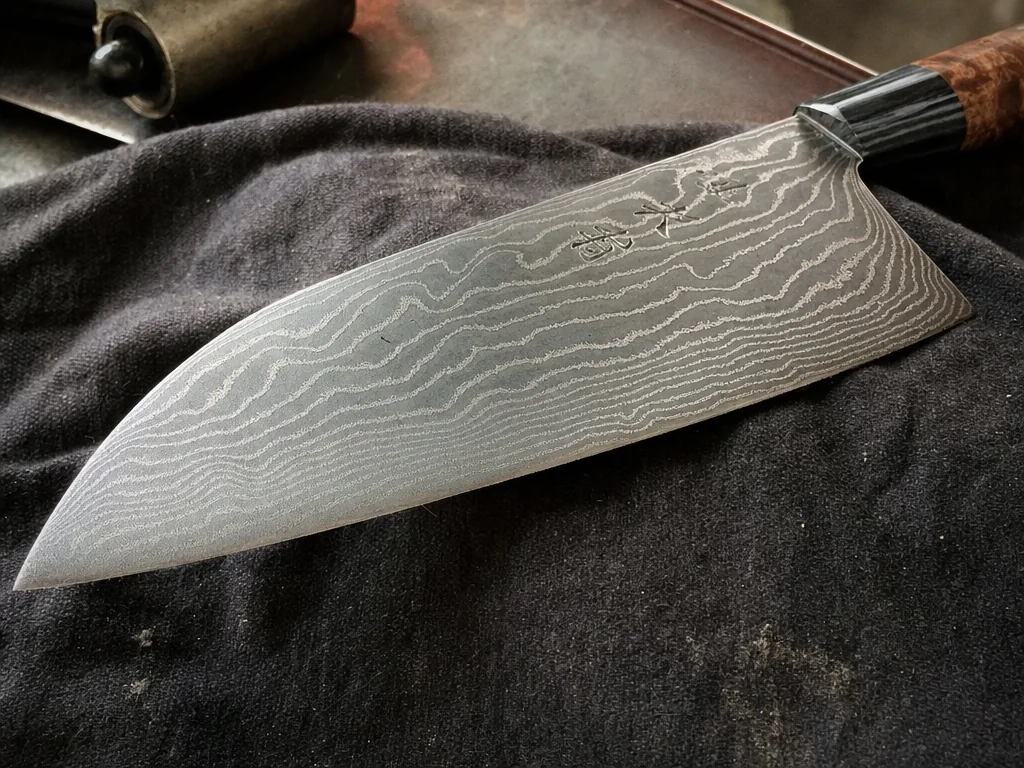
Pick handle rivet pins or full epoxy bedding, and you are deciding how the knife behaves after 200 wash cycles at 72C, one drop from a 900 mm prep table, and daily line use. Not cosmetics. In a Yangjiang, China OEM program, that choice changes scrap at handle assembly and adds inspection time at the 3-ton arbor press; after six months in a restaurant kitchen, the handle still feels tight or it starts talking. Saving $0.06 here is bad math. We have seen this go sideways.
On a 1,000 to 5,000 piece run, the wrong attachment method leaves loose scales and gives water a path through a 0.15 mm gap. Day one looks clean. By day ninety, the joint feels weak. A good knife OEM should tell you if the rivet is carrying the load, if the epoxy is doing the real holding, or if the pins only locate the scales while epoxy seals the full tang. Then they should show unit cost, lead time, and repair limits before you approve tooling. Last month the buyer flagged a sample after QC pulled it and found an epoxy skip near the front rivet.
What Rivets Actually Do
A rivet is not decoration. It is a mechanical fastener that clamps the handle scales to the tang and stops the stack from shifting when the knife is twisted in use or pushed past its design load. On a full-tang kitchen or outdoor knife, two or three stainless pins at 2.5 mm to 4.0 mm spread the load across the handle. We run the drilling jig and hold pin centers within 0.15 mm; miss that, and the scale fit starts arguing with us on the grinding line. Simple as that. Riveted handles still land in about 7 of every 10 knife OEM programs we quote in China because buyers trust visible hardware.
Rivets earn their keep when the handle material moves. Wood and pakkawood shift with humidity, and some composite scales do the same after a warehouse jump from 45% to 80% RH. The pin becomes the backup when the adhesive line ages or takes repeated thermal cycling. QC pulled the sample on one order last August and found a hairline gap at the front bolster after oven-and-freezer cycling; the buyer would have caught it fast during incoming inspection. Buyers pick rivets for function. They want the knife to read as a mechanical build, not a molded handle with a nice story.
There is a tradeoff. Every drilled hole creates a stress point, and every poor pin fit becomes a water path. We have seen this go sideways: the buyer flagged it after a 24-hour soak test because one pin had a 0.08 mm halo around the shoulder under a 10x loupe. The joint looked tight. It was not sealed. That is why the best riveted builds still get epoxy bedding. Pins hold alignment; adhesive seals the joint. If your supplier says rivets alone are enough, push back. That is the wrong question to ask. On a premium build, the pins should reinforce the bond, not replace it.
- Best fit: full-tang knives where the buyer wants visible scale hardware and a mechanical build signal
- Typical pin count: 2 or 3 pins on most chef and outdoor knives, usually 2.5 mm to 4.0 mm depending on handle size
- Common failure: pin loosening from poor hole fit, seasonal wood movement, or a pin shoulder that was not sealed cleanly before final buffing
What Full Epoxy Bedding Solves
Full epoxy bedding puts the tang into a continuous adhesive bed across the full contact area, so the bond line takes the load instead of asking a pair of 4 mm pins to carry the whole handle. On the grinding line, that shows up fast. QC pulled the sample after a 400-grit side finish and saw lighter witness marks around the scale because fewer pin heads were telegraphing through. The tang shoulder seals tighter. Handle buzz drops. In hand and in pack shots, the profile reads cleaner. If the buyer is chasing a flush, modern build, this is what we run.
The weak point is process control. Epoxy is only as good as the surface prep, mix ratio, clamp pressure, and cure schedule, and the math does not forgive sloppy mixing. On a clean line, a bond gap around 0.1 mm to 0.3 mm is normal and strong; we run that with a simple clamp jig and a roughened tang, usually after an 80-grit pass, not a mirror-polished one. If the tang comes over oily, polished too smooth, or the assembler closes it up before the mix is uniform, the joint can fail by peel or creep even if first inspection passes. Comparing knife handle rivet vs epoxy sourcing by unit price alone is the wrong question. One return lot wipes out the savings.
For export knives, epoxy selection is not paperwork filler. A food-contact adjacent assembly still needs REACH awareness, and EU or U.S. buyers will ask for LFGB or FDA-aligned documentation depending on the market. In a Yangjiang, China factory that runs mixed OEM orders, the adhesive spec belongs on the BOM, not in the line leader's memory; we have seen 600-pc POs that say only "AB glue," and that is where mix-ups start. QC has pulled two near-identical kits off the same rack with different pot life labels. We have seen this go sideways. If you want repeatability, ask for the exact epoxy brand or chemistry, cure temperature, and post-cure handling window.
What epoxy does well
- Seals the tang-to-scale interface against water and detergent during wash cycles, which matters once the knife sees sink time instead of a carton test
- Cuts handle buzz and gives the grip a denser hand feel after assembly; QC usually catches it on the first hand-check sample
- Runs well with stabilized wood after moisture is checked, with G10 after fresh belt prep, and with micarta after the tang dust is blown clean with an air gun
Where Each Method Fails
The sourcing question is not which method wins a lab chart. It is which failure your customer sees first. With rivets, the trouble usually appears early: a pin backs out 0.3 mm, one scale lifts, or a 0.15 mm rear gap opens and QC slides in a feeler gauge. We have stopped 600-piece lots for less on the packing table. Easy call. That defect can be caught before the claim reaches your inbox.
Epoxy failure is harsher because the handle may still look clean while the bond line is already weak. We have seen returns 60 to 90 days after shipment because the tang came off the grinding line with oil or buffing wax, and the adhesive never wet the steel. First article passes. Warranty photos arrive later. QC pulled the sample, the handle looked fine under the LED bench lamp, and the math still did not work. Pretty samples prove nothing. A knife OEM should show peel data or pull data, not only a polished handle.
Heat separates these two methods fast. Kitchen knives that go through dishwashers see repeated cycles around 55 C to 70 C, plus detergent chemistry, and we run that test on the same SKUs buyers label "home use only." Rivets take that abuse in a way you can read on the bench: the pin loosens or the scale shifts, then the defect shows. Epoxy-only builds depend on adhesive grade and whether the handle stock stays stable after cycling. Wood gives the least room for error; at 12% moisture content we have seen rear gaps open after one week. G10 and micarta stay steadier. Molded polymers work if the tang was roughed with an 80-grit belt before bonding.
- Rivet risk: stress around the pin shoulder, followed by loosening or rust bloom around the hardware after 7 days of wet-pack storage
- Epoxy risk: weak 180-grit prep and poor wet-out on the tang; hidden delamination usually shows only after heat cycling
- Buyer rule: pick the failure mode your QC team can check with a pull test or a 0.15 mm feeler gauge; this is the right question
If your product is going into professional kitchens, where handles see hard sink washing and 8 to 10 hours of daily use, asking for epoxy-only is often the wrong question. We usually quote a joint with 2.5 mm stainless pins plus full-bed epoxy sealing, especially on runs above 3,000 pcs. We run that build every week. The buyer flagged the extra step once on a PO marked "cost down," then stopped pushing after field complaints on an older epoxy-only order. That is not a compromise. It is how we ship knives that need to survive real sink time.
Cost, MOQ, And Lead Time
On paper, full epoxy looks cheaper: no rivet pins, fewer drill hits, no countersink bit on the handle scale. On our Yangjiang floor, that is the wrong question to ask. A low quote line does not stay low once you count 24-hour cure racks, spring clamps, reject bins, and the extra pull checks QC runs when a scale sounds hollow after bonding.
On an OEM run at MOQ 1,000 pcs, riveted construction adds fixed labor and hardware cost, while epoxy-heavy assembly adds process risk. A 240-employee knife factory can build both, and we run both, but when the grinding line is packed with 6 mixed SKUs, epoxy-only handles slow the flow because the parts must sit before final shaping on the 240-grit belt and buffing wheel. We usually see +2 to 4 days on the schedule. Short sentence. In humid weeks, the buyer flags the same pushback every time: why 12 days became 16 days. Handle material also decides a lot. If pakkawood comes in at 9% moisture, we hold it before bedding because the math does not work.
| Build type | Typical unit cost impact | Lead time impact | Best use |
|---|---|---|---|
| Rivets only | USD 0.18-0.65 | Minimal | Mechanical look, fast visual QC with a go/no-go gauge on pin heads |
| Full epoxy bedding | USD 0.10-0.40 | +2 to 4 days | Sealing, clean profile, low vibration when cure control is tight |
| Hybrid pin + epoxy | USD 0.25-0.80 | +1 to 3 days | Export knives where buyers want durability and fewer handle complaints |
If you are sourcing from a knife handle rivet vs epoxy manufacturer, do not chase the lowest FOB number first. Ask whether the factory can hold AQL 2.5 on appearance and joint integrity without pushing 70 pcs into rework after final polish on the sisal wheel. QC pulled the sample. The bond line failed on one side. If the result depends on one senior assembly worker mixing epoxy by eye in a paper cup, we have seen this go sideways.
Match The Joint To The Material
Handle material sets the joint before marketing signs off the box art. Box art comes later. For POM and other injected polymers, we run molded locks or through-features; on our molding line, the undercut gauge must read 0.8 mm, or that lock will not carry the load. For a full-tang premium knife, pin-plus-epoxy is still the shop standard. We run 304 pins to locate the scales, then spread epoxy across the tang face before the clamps close. G10 and micarta are simpler on the line. After a 120-grit scuff, they stay flat and give us less rework at final assembly.
Wood and pakkawood need discipline. They sell well on the shelf, but moisture movement is what opens the joint; QC pulled a sample with a 0.3 mm shadow line along the tang after 48 hours of conditioning. For a kitchen knife, a rivet-plus-epoxy build is the safer call. We ask for sealed end grain and controlled moisture content before assembly, and we normally hold the blocks at 8% to 10% MC before drilling on the pin jig. Europe exposes weak prep fast. Buyers push back on this step, then dishwasher misuse and humidity swings prove why we insist on it after one retail season.
Blade hardness belongs in the same decision, not at the end of the PO. A chef knife in the 56 HRC to 60 HRC range does not show much difference on a static pull test, but a thinner, harder blade moves the balance point and changes how the load runs into the handle in real use. On the grinding line, if a blade-heavy sample balances 18 mm forward of the front pin, the operator feels more twist during carton-cut and board-chop checks. Then a weak bond shows up. The math doesn't work if the handle joint is treated as an afterthought. Match the method to the knife class from the start.
- Wood and pakkawood: use rivets plus epoxy; seal the end grain and check moisture before assembly, with the blocks held at 8% to 10% MC before drilling
- G10 and micarta: epoxy-only works if prep is controlled and the scales are scuffed to 120 grit before bonding
- POM and molded polymers: use the factory retention design, such as molded locks or through-features; do not guess from appearance, and do not ignore the 0.8 mm undercut
Ask for a handle-material compatibility note in the sample approval package. If you are comparing knife handle rivet vs epoxy sourcing across several suppliers, asking only "rivet or epoxy" is the wrong question. Have each factory state the pin diameter and adhesive spec, then attach one pull-test result; we have seen quotes line up on price while one supplier runs 2.5 mm pins and another runs 4.0 mm. On paper the numbers match. In production they do not.
How To Write The OEM Spec
Asking for a "better handle" is the wrong question. Write the joint spec. State full-tang or hidden-tang construction, pin count, pin diameter, pin material, adhesive type, cure schedule, and the pass/fail numbers for gap, flushness, and visible voids. Be specific. On our grinding line, the inspector checks the front shoulder and butt end with a 0.05 mm feeler gauge; nobody signs off by eye. That is how we control an OEM knife run, not by approving one sample polished up for a photo.
For a serious private-label order, I would write the RFQ like this: pin material 304 or 420 stainless; pin diameter 2.5 mm to 3.5 mm based on handle width; epoxy cure at room temperature for 24 hours, or accelerated cure only after the line has passed trial production; final inspection under AQL 2.5 for appearance, plus a destructive pull check on first batch samples. We saw this on a 500 pcs pilot. QC pulled the sample after buffing and found a 0.3 mm void at the front pin. The buyer wanted 12 days, the glue schedule needed 18 days with packing and inspection, and the math did not work. If food-contact paperwork matters, ask for REACH and LFGB, plus the adhesive declaration before packaging approval.
Use this checklist in your spec
- Full-tang or hidden-tang construction, shown on the drawing with the handle cross-section
- Rivet count, diameter, and head style; call out spun pin or Corby, not just "steel pin"
- Epoxy chemistry with cure time and temperature, written as a shop process the glue-up team can run
- Surface preparation method before bonding, like an 80-grit scratch and solvent wipe before glue-up
- Pass/fail limits for max gap in mm, flushness tolerance, and any delamination reject criteria
If the factory cannot answer those points in one marked drawing or one email, stop there. We have seen this go sideways: the buyer flagged a 0.2 mm glue line, but the PO still said "premium finish" and nothing else. A clean sample does not fix a weak spec. On the line, the cheapest path wins, and the build will drift if your drawing leaves the joint open to guesswork.
Frequently asked questions
It is both, but process usually decides the outcome. A well-bonded epoxy joint can outperform a poorly fitted riveted joint in static pull, but rivets still add mechanical redundancy when the handle sees torsion, impact, or heat cycling. In practice, a 2-pin or 3-pin hybrid build with 2.5 mm to 3.5 mm stainless pins is the most forgiving option for export knives. If you want repeatable results from a knife OEM in China, require surface prep, adhesive spec, and a cure window of 24 hours at room temperature or a validated accelerated cycle. Do not approve samples without a pull or peel test on the first batch.
For dishwasher-safe claims, a hybrid pin-plus-epoxy joint is usually safer than epoxy-only, especially with wood or pakkawood. Dishwasher exposure means 55 C to 70 C water, detergent, steam, and repeated drying cycles, which is hard on adhesive lines and even harder on unstable natural materials. If you need a dishwasher-tolerant product, specify G10, micarta, or molded polymer handles, sealed edges, and no open gaps larger than 0.2 mm. Ask the factory to run at least 50 dishwasher cycles on samples and inspect for looseness, clouding, and edge lift. If the handle is wood, I would not market it as dishwasher-safe.
Yes, but only if the factory controls the bond line and the handle material is stable. Epoxy-only works best with G10, micarta, stabilized wood, or molded structures where the adhesive can wet a clean surface and cure without movement. For a chef knife in the 56 HRC to 60 HRC band, the balance and hand feel matter, so the handle must not loosen or buzz under repeated rocking cuts. Ask for a sample cutaway, a 1 m drop test, and a thermal cycle test if the knife will be sold into professional kitchens. If the adhesive spec is not documented, epoxy-only is a risk, not a premium feature.
At MOQ 1,000 to 3,000 pcs, riveted builds usually add USD 0.18 to 0.65 per knife depending on pin material, machining, and finish. Full epoxy can look cheaper in raw parts, but the real cost includes curing racks, extra handling, and higher reject risk if the line is not stable. In a mixed-SKU factory in Yangjiang, China, I usually see epoxy-heavy programs add 2 to 4 days to lead time. If the supplier claims epoxy is cheaper by a wide margin, ask how they are counting rework, inspection, and scrap. FOB price alone is not the full sourcing answer.
Ask for the pin diameter, pin material, adhesive brand or chemistry, cure time, cure temperature, and the exact surface-prep step before bonding. Then ask how they inspect the first batch: AQL 2.5 is a common appearance target, but joint integrity also needs a destructive check on sample pieces. For export to Europe or North America, ask for REACH status, LFGB or FDA-related documentation where relevant, and a statement on whether any adhesive or finish has food-contact implications. A serious knife handle rivet vs epoxy manufacturer should answer these questions without hiding behind a marketing sheet. If they cannot, the process is probably under-controlled.
Specify the handle, not just the blade
Send your drawing, target price, and market requirements. We will tell you whether rivets, epoxy, or a hybrid build is realistic for your OEM program in China.
Request a Quote