Knife import and carry laws by country do not fit one clean rule. We shipped a 96 mm folding knife that cleared customs and passed the carton check. QC pulled the sample against the packing list, then the buyer flagged the same SKU because the liner lock made public carry illegal in his market. That is normal. The wrong question is whether customs will release it. A knife can be legal to import and still dead on arrival at retail.
If you buy from Yangjiang, China or another China knife factory, build one sourcing file before we run tooling: importability, retail legality, and carry risk for that SKU. Start with the target market, blade length in mm, lock type, finish, packing format, and broker documents. Your OEM partner should confirm all of that before the grinding line starts. We saw one PO typo on "assisted opening" hold a shipment for 12 days, and the math does not work if you fix paperwork after production.
Start With The Legal Split
Most sourcing mistakes start when a buyer files import law and carry law together. Wrong folder. Import law is customs work: can the carton enter, does the invoice line match the product, and are the packing, label, HS description, or material declaration complete. Carry law is user-side: can the customer keep that knife on the street, in a car, at work, or inside a public venue. We have seen a kitchen utility knife clear customs, then get blocked by a retail compliance desk because the POS copy called it an EDC knife. One word killed the SKU for that channel.
For buyers, blade steel is not the first question. Handle finish is not either. Ask where it will sell and how the user will carry it. A 3.5 mm thick outdoor blade with a locking mechanism may pass import review in 20 countries, but the same model can hit carry limits once marketing calls it an everyday carry knife. QC pulled one sample last year where the carton said "camping tool" and the PO said "pocket knife"; the buyer flagged it before balance payment. Good catch. Knife import carry laws by country need checking at SKU level, not factory level, especially when one listing is planned for Amazon DE, a UK distributor, and a US outdoor chain.
A practical OEM file should include blade length in mm, open length, locking type, one-hand opening note, sharpening angle, steel grade, and intended use statement. Add side and top photos with a ruler in frame, not only a clean catalog render. In Yangjiang, China, we run digital calipers on blade length and record hardness after heat treatment, often 56-58 HRC for standard kitchen lines unless the spec says otherwise. A serious factory can send the technical sheet on day one. If the supplier cannot say whether a model is a kitchen knife, folding utility knife, or hunting knife, the math does not work. Define the market and legal use case, then freeze the spec the same way we freeze food-contact packaging before mass production.
Channel strategy decides whether the order moves. A model that works for a trade-show demo or B2B sample set may fail for direct-to-consumer resale in some countries. Amazon and a retail chain may read the same knife two different ways; the strictest gate usually controls the order. We have had a 500-piece sample run delayed 12 days because the product title used "tactical" while the buyer's approved description said "outdoor utility." The grinding line was ready, but the artwork file sat in approval. Build the legal view before production starts, not after the first shipment is on the water.
United States Rules
The United States does not have one knife law. Import sits at the federal level; carry is split across 50 states, and cities can add blade-length or concealed-carry limits on top. From our export desk, customs entry is often the cleaner job. We had one PO where the buyer typed "assisted" instead of "manual," and that one word brought 6 extra email questions before release. A folding knife with legal materials can clear import without trouble. We ship it, then the buyer calls about a 3 inch blade cap, switchblade wording, gravity-knife treatment, or pocket-clip carry rules after the cartons arrive. Same SKU. Different state, different headache.
Classify the product before the purchase order is released. "Is this legal in the US?" is the wrong question to ask. Ask which states you will sell into and what use will be printed on the box. A fixed-blade camping knife, a kitchen retail chef knife, and a locking pocket knife sit in different risk files, so treat them that way. A 90 mm chef knife sold for food prep is one compliance file; a clipped EDC folder with a liner lock is another. We usually put the target use on the spec sheet before the grinding line starts, because changing carton copy after tooling approval can cost 7-10 days. If the blister card or Amazon copy says self-defense, the math changes fast. Keep the use case plain.
Ask your knife OEM to confirm blade material, handle material, and stated end use in writing. We put those lines on the approval sheet. QC has pulled samples before mass production because the handle resin code on the sample tag did not match the PO. If you need food-contact positioning, ask for LFGB, FDA, or the declaration your sales channel accepts. Premium retail buyers often want traceability records, exact carton labels, and barcode placement; one US manual asked for the barcode 30 mm from the carton edge. Amazon and several US distributors will ask about FNSKU labeling. They also check master carton marks, and some channels require age-gate controls. Commercial detail? Yes. It saves compliance time.
For us in Yangjiang, China, a common export spec is a stainless blade in the HRC 56-60 band with MOQ 500 pcs and 35-45 day production on repeat orders. We run that spec every month. QC pulled one recent sample at 58 HRC on the Rockwell tester, and the batch passed. Those numbers help with quotation, packing plan, and vessel booking. They do not answer the legal question. The US buyer still needs to map the SKU against state restrictions before packaging print. We have seen this go sideways: 2,000 boxes finished, front card already printed, and a legal claim nobody meant to make sitting right under the hang hole.
Europe And The UK
Europe looks unified on a map. Ship knives into it and it splits fast. Customs is one file. Carry law and retail law sit country by country, and this is the wrong place to assume one rule fits all. Germany, France, Spain, Italy, the Netherlands, and the Nordics do not read folding knives and fixed blades the same way at retail or in public carry. One-hand opening makes the file messier. Last season our QC desk had 6 samples from the same PO: two slip joints with nail nicks, two liner locks with thumb studs, and two 95 mm fixed blades. QC pulled the sample set under the bench light, and the buyer flagged it because only the fixed blade copy had public-carry wording. The UK stands apart again on prohibited items and offensive weapons, so we issue the import notes and the carry notes as separate documents.
Start with the sales channel. It decides more than blade shape. A professional kitchen knife set is cleaner than a pocket knife program for consumer retail, and we see that in carton spec, label copy, and case-pack problems. A chef knife line sold into horeca may need different labeling, carton language, and inner-box quantities than a camping knife line sold through sporting goods. We run into this at carton marking more than buyers expect: one buyer asked for 24 pcs per master carton, then the PO showed 36 pcs and the warehouse label still said “chef set.” Small mistake. Big delay. If your sales team wants one global SKU, push back. The math does not work once UK retail, German carry notes, and EU food-contact files all sit on the same item.
Europe is also where materials get checked hard. If your handle uses coated metal, mixed polymers, or food-contact parts, ask the factory for REACH-related documents or a material declaration before sampling goes too far. For kitchen programs, LFGB and food-contact paperwork carry more weight than polished claims on a sell sheet. Ask for declared steel grade, hardness range, and coating spec. Simple request. On the grinding line, we record hardness by batch, usually every 200 pcs on the Rockwell tester, and the QC sheet notes the operator, furnace lot, and blade size in mm. If a chef knife is sold as 56-58 HRC and QC pulls 54 HRC, the traceability file needs to show where that batch went. If the file is thin, we have seen this go sideways.
From the China supplier side, the support package should stay plain: commercial invoice, packing list, HS code suggestion, product photos, material declaration, and batch traceability. In Yangjiang, China, a well-run factory can send these without a week of back-and-forth, often the same day the PI is issued. We ship the file set with the PI because brokers ask early, not after the container reaches port. If the supplier cannot send it, your broker will burn 3 to 5 working days chasing basic answers, sometimes over something as small as a missing steel grade on page 2 or a model number typo copied from the PO. That delay hits freight planning and retail launch timing. We have seen a two-week slip push a knife program past the camping-season shelf date.
Canada, Australia, And New Zealand
Canada, Australia, and New Zealand catch importers on the same point: customs clearance is only half the job. We have shipped the same 84 mm folding knife sample into all three markets, then watched the retail team reject the listing copy after QC had already signed the carton label with a black marker. Canada usually starts with blade shape and stated use. Australia gets tighter once state rules and carry wording hit the file. New Zealand buyers often care less about the invoice line and more about whether the knife feels like a normal work tool when a customer opens it at the counter.
In Canada, blade shape, stated use, and product description all matter, but label copy is where buyers stumble. Australia is tougher at the state level, especially if a pocket knife is pitched as concealed carry gear. New Zealand will push back on tactical wording even when the steel and lock are ordinary. Keep pocket knife copy plain. For hunting and outdoor SKUs, state the use honestly: camp prep on a 3 mm spine fixed blade or field dressing on a 60-62 HRC edge; farm work is fine if the handle and sheath match that story. Do not pair a kitchen photo with a combat-style name. A buyer flagged that exact mismatch on a PO after one word was typed wrong, and the math does not work when 3,000 printed boxes need rework.
A better sourcing rule is simple: hold the knife spec steady and change the compliance pack by market. We can run the same stainless steel and HRC range with the same handle construction, then swap the insert card, warning line, barcode label, and marketplace copy after your legal team signs off. One market will ask for age gating or retail controls. Another only wants clean tool-use wording. The factory should not invent legal claims; this is the wrong place to gamble. We build to the brief, attach the approved documents, and let QC match the carton mark to the packing list before the shipment leaves Yangjiang.
For OEM planning, sample approval is where this gets real. Ask for pilot samples, then check the edge geometry, the lock-up, and whether the thumb stud or flipper opens cleanly before you order bulk packaging. QC pulled a sample last month where the thumb stud sat 2.5 mm higher than the approved drawing. Small detail. Different compliance conversation. In Yangjiang, China, this is normal engineering work. A capable factory can adjust thumb stud size, detent strength, spring tension, and box copy without touching the grinding line or turning a 12-day pilot run into an 18-day rescue job.
Asia Markets And Transit
Asia is not one market. Japan wants declared use, blade length, lock style, and photos that match the invoice wording. Singapore reads the courier paperwork line by line; one DHL note saying "survival knife" can slow a clean folding SKU. Gulf buyers get questioned fast when the image looks tactical instead of kitchen or outdoor. We run export cartons through Shanghai or Shenzhen most weeks, and one strict transit hub can turn a 12-day booking into 18 days. Check the destination first. Then check the route. A SKU that clears the final market can still sit if the transshipment point or courier rule is tighter.
Japan is exact about knife type, intended use, blade length, locking style, and visible features on the product page. Singapore needs a cold review; a folding knife that sells cleanly in North America can draw questions there if the blister card says survival or combat. In the UAE and nearby markets, the fight is tool optics versus weapon optics. Same blade. Different risk. Last quarter QC pulled a sample where the buyer's artwork added a skull icon next to a 95 mm folding knife, and we pushed back because the math doesn't work if customs reads your chef or outdoor SKU as a weapon-like article.
This is why knife import carry laws by country manufacturer guidance has to sit inside freight planning, not after it. If we ship from China, tell the forwarder whether the cargo is kitchen knives or outdoor knife stock, and make the PI, carton marks, and courier declaration use the same words. For mixed cartons, split by channel or at least by SKU group; customs questions are easier when Carton 1-24 says kitchen knife set and Carton 25-40 says camping knife. Do not write steel goods. Too vague. We have seen that go sideways, especially when the carrier asks for product photos and the buyer only has a loose PO with one typo in the item name.
| Market | Import focus | Carry focus | Buyer action |
|---|---|---|---|
| Japan | Product type, stated use, blade length, lock detail | Blade length, lock, carry style | Confirm SKU wording before PI release |
| Singapore | Carrier rule, declaration wording, sales copy | Strict public carry control | Use plain packaging and clean invoices |
| UAE | Customs description and product photo | Tool optics versus weapon optics | Keep branding neutral |
For brands, the lesson is plain: route, description, and packaging can matter as much as the blade itself. A Yangjiang factory can hold the grind at 0.3 mm behind the edge, pack 40 cartons to the booking list, and pass final inspection, but we still need to know how the knife will be declared, sold, and transported. This is the wrong question to ask at the loading dock. Ask it before artwork approval, before carton marks, and before the forwarder books space. That is where the buyer protects margin and avoids a destination hold.
Build The OEM Compliance File
If you buy from a knife OEM in China, never take “legal in your market” as a verbal yes. Build the compliance file before we open the work order. List blade length and thickness in mm, steel grade, hardness range, handle material, surface finish, packing format, intended market, and the exact warning or age statement for printing. No blanks. For kitchen programs, request food-contact backup where the destination asks for it. For outdoor and pocket programs, keep the product description plain. Remove tactical, self-defense, and combat unless your lawyer is ready to defend those words. We saw a PO approved with a 95 mm blade, then the buyer flagged the retail card because the copy said “survival weapon.” Wrong question. The issue was not the steel; it was the claim.
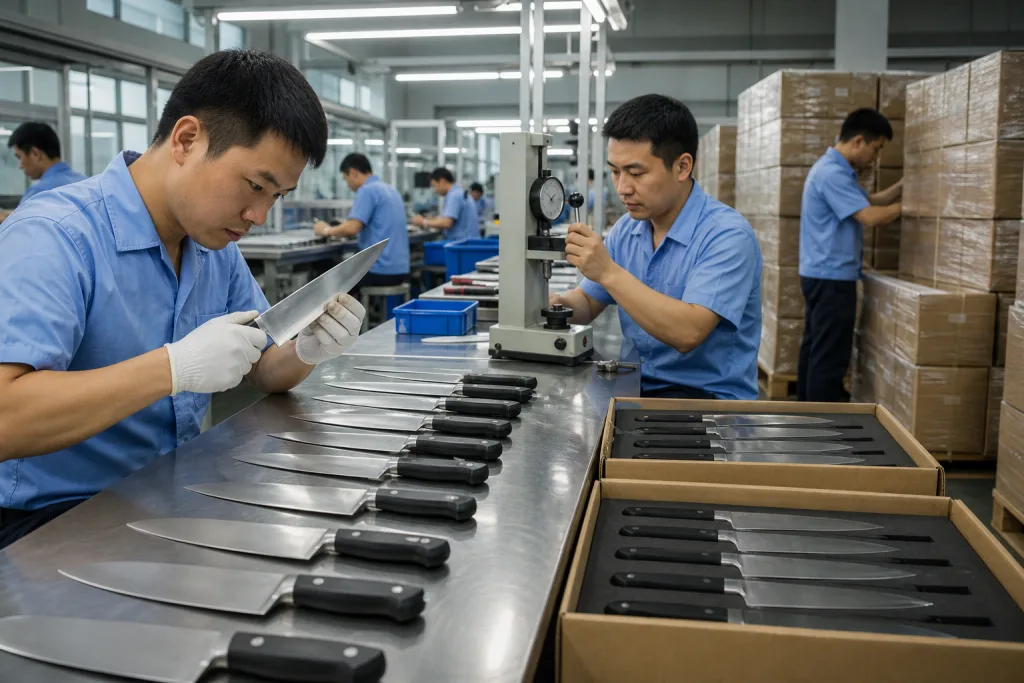
A solid Yangjiang, China factory should show process control, not just clean sample photos shot under good light. We run incoming material checks with a handheld spectrometer, in-process inspection at the grinding line, and final inspection against a standard such as AQL 2.5 for major and minor defects. QC pulled one folding-knife sample last month because the liner lock travel was past spec after 300 cycles, even though the satin finish looked fine. The line stopped for 40 minutes. If the line runs under ISO 9001 discipline, that supports confidence. Still, do not treat a certificate as a country carry-law review. Certificates prove the factory has a process. They do not tell customs whether a pocket knife can be sold in Munich, Toronto, or Sydney.
The practical split is simple: the factory controls the product, and you control the market claim. We can confirm MOQ, lead time, and steel consistency. For example, a repeat stainless model might run at MOQ 500 pcs, 35-45 days, and HRC 56-60. Good for sourcing. Good for costing. It is not legal advice. If you need REACH, LFGB, FDA, or country-specific documentation, write it in the RFQ and again in the purchase order. Put the test item, market, and report language there too; one missing word in the PO can cost 7 working days. Do not wait until pre-shipment inspection, when 18 cartons are already sealed and the lab sample still needs another 7 working days.
Use the same discipline for branding. If you want laser engraving, confirm whether the mark goes on blade, bolster, or handle, and whether it changes the commercial description. A 12 mm logo on the blade face is not the same as a small handle mark when the buyer’s compliance team reads the listing. If you need custom packaging, confirm whether carton text, barcode label, warning line, and age statement must change for the destination market. The best knife import carry laws by country sourcing process is direct: define the market, define the claim, freeze the spec, then make the factory repeat it on the sample tag and carton artwork. We have seen this go sideways. A cheap sample becomes an expensive relaunch when the knife is correct but the box says the wrong thing.
Buyer Checklist Before PO
Before you release a purchase order, make the team answer 6 plain questions. Where will the knife clear customs? What is it exactly: kitchen knife, chef knife, pocket knife, hunting knife, or tactical style? Put blade length in mm, lock type, opening method, sheath type, edge style, and pack quantity on the spec sheet. We have seen a 92 mm pocket knife pass one market and get stopped in another because the same liner lock was treated as restricted carry. QC wrote “92 mm, thumb stud, liner lock” on the sample tag with a black marker. Small note. It saved 2 emails later.
Then check the commercial side before the PO goes out. Do you need private label, custom packaging, barcode setup, FNSKU, or bilingual carton text? Do any parts need ASTM or food-contact declarations? Does the buyer file need BSCI, ISO 9001, or inspection records? If you are buying from China, ask the supplier to mark standard items and extra-cost items line by line. We run into this on the office table almost every month: laser logo is included, color box artwork is not, FNSKU sticker labor changes at MOQ. QC pulled the sample, the buyer flagged a carton typo, and the PO sat for 3 days. That delay can kill a launch week.
A second pass should cut the obvious risk. Ask for a pre-production sample and a pre-shipment inspection report. Use AQL 2.5 unless your customer has a tighter line. Match final carton count, carton marks, gross weight, and pallet plan against the forwarder booking. On the packing table, one wrong “Made in China” position can turn into rework across 280 cartons. If the program will sell in Europe or North America, keep claims tight and avoid wording that points to weapon use. We have seen this go sideways. A bad product sentence causes more trouble than a 0.3 mm nick on the edge.
Keep an internal file by market. A kitchen program for Germany is not the same as a pocket knife program for the US, even when the steel is identical. We run separate compliance notes, separate labels, and, in some cases, separate SKUs from the same plant in Yangjiang. This is the wrong place to save paperwork. The math does not work any other way. If one market slips into another without a clean paper trail, customs can hold the shipment for 14 days and your cash sits there with it.
Frequently asked questions
Yes. That is common. A folding knife may clear customs in the US, Canada, or parts of Europe, but public carry can still be restricted by blade length, locking type, or local rules. For a buyer, the safe approach is to separate importability from retail legality and carry law. If you sell one SKU across several countries, check each market before production. A 90 mm pocket knife and a 200 mm chef knife can have very different legal treatment even when both are perfectly manufacturable in China. Ask your broker and local counsel to review the exact use case, not just the HS code.
Ask for a technical sheet, material declaration, blade length, steel grade, hardness range, handle material, and pack-out details. If the model touches food use, request LFGB or FDA support where relevant. For consumer programs in Europe, REACH-related material declarations are often useful. For production control, ask for ISO 9001 evidence, in-process inspection records, and final inspection based on AQL 2.5. In Yangjiang, China, a capable factory should also give you commercial invoice, packing list, carton dimensions, and photos for the forwarder. Do not wait until the shipment is on the water to collect these items.
Often yes. The blade itself may stay the same, but the label, warning text, age statement, barcode, and channel markings can change by market. A kitchen knife set for the EU may need different compliance language than a pocket knife line for the US. If you sell through Amazon or a distributor, you may also need FNSKU labels, master carton marks, or pallet IDs. Packaging is not just marketing. It is part of the compliance file, and a bad carton claim can create more trouble than a minor cosmetic defect from the factory.
Use a precise description, not a vague one. State the knife type, blade material, handle material, intended use, and quantity. Make sure the invoice, packing list, and carton marks match. Avoid aggressive or tactical language if the product is sold as a tool. Ask your Chinese supplier to prepare photos, technical data, and a clean HS code suggestion. If you are shipping from Yangjiang, China, confirm the freight route as well, because transit hubs can add their own checks. A clean paper trail reduces questions, and questions are what usually cause delay.
Longer blades, one-hand opening mechanisms, strong locking systems, and tactical styling get more scrutiny in many markets. A fixed blade used for hunting or outdoor work is usually easier to explain than a flashy EDC knife with self-defense marketing. For kitchen knives, the review focus is different: food-contact materials, corrosion resistance, and labeling matter more. A stainless blade in the HRC 56-60 band is common in export programs, but hardness alone does not solve legality. Match the spec to the channel and the destination country before you sign the PO.
Check your markets before the PO
Send us your target countries, blade lengths, and channel plan. We will help you turn the legal risk into a clean OEM spec from China.
Request a Quote