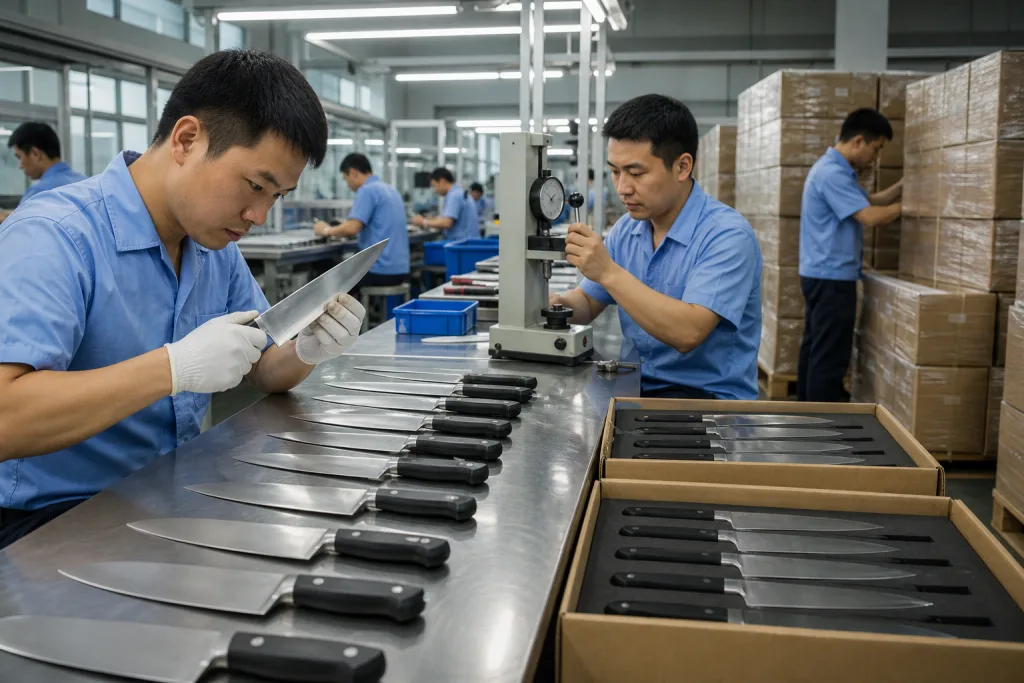
Ask a knife OEM for MOQ and you are not asking for one magic number. A 1.8 mm stamped paring knife, a 3.0 mm forged chef knife, and a PVD-coated pocket knife land in separate MOQ bands because steel coil width, forging die time, grinding minutes, and coating rack positions do not swap like carton tape. On our Yangjiang and Zhejiang runs, 1.8 mm stamped blades can share blanking and heat-treatment slots; 3.0 mm forged chef knives cannot. QC sees it fast. Six hundred stamped blanks can sit in one blue tray beside the punch press, while forged chef knives need separate straightening checks before rough grinding. The first quote is usually setup loss from the press, belt grinder, and finish line, not some quiet margin padding.
At a 240-employee factory shipping about 60,000 units per month, the better question is simple: can your spec ride with our current material, heat treatment, and packing run? We check this before quoting: steel grade and blade thickness, HRC band and handle color, carton mark, and whether the buyer's PO says satin while the artwork says mirror polish. That typo has cost buyers 4 days. If the spec fits an active batch, MOQ can sit at 1,200 pieces instead of 3,000. If it needs a separate coating fixture or a new blister mold, the math does not work. Blade type, finish, and HRC band move the MOQ; pushing only on price is the wrong question, especially when an 18-day lead time could have been 12 days with the right finish choice.
What Actually Sets MOQ
MOQ is not a factory mood. It is the point where setup cost, steel loss, and line speed finally line up. A knife MOQ by blade type manufacturer sets the minimum from three hard checks: whether the blade shares existing tooling, whether the finish can run in a clean batch, and whether the box can join the same packing schedule. On our side, QC pulls the first piece at the grinding line, checks spine thickness with calipers to +/-0.1 mm, and signs the job card before we release the batch. If those checks pass, 500 pcs can work. Miss one, and the minimum jumps fast.
For a knife OEM in Yangjiang or Zhejiang, tooling reuse is the first break point. A 1.8 mm stamped utility blade with satin finish might run at 500 pcs because the die is already on the shelf and changeover takes about 40 minutes. A 4.0 mm forged chef blade with bolster, sand polish, and laser logo can need 2,000 pcs before the math works. Buyers push back on that number every week. Then the scrap tray tells the truth: bolster grinding loss, 2 mm logo drift, and re-polish pieces eat margin before packing even starts. This is normal. It is not a sales trick.
- Low setup: standard steel and length, one finish, stock handle mold in house, usually 500-800 pcs.
- Medium setup: new handle color plus new logo, one extra sharpening pass, custom box with a fresh insert, often 1,000-1,500 pcs.
- High setup: new die or PVD work, mirror polish, packaging change, compliance paperwork on the job card, often 2,000 pcs or more.
If you want a useful quote, ask for MOQ split by blade, finish, and packaging. Do not ask for one all-in number. We have seen a PO typo turn "satin" into "mirror" and waste a full carton check before the buyer flagged it on photos. One all-in number is the wrong question to ask. With the split shown clearly, knife MOQ by blade type sourcing becomes comparable across suppliers in China.
MOQ Bands By Blade Type
Blade type sets the MOQ first. It decides how many stations we touch before one finished knife reaches the inner box. Stamped kitchen knives move fast on the blanking press, and the blanks nest well on 420J2 or 3Cr13 sheet. Forged knives slow the grinding line, mainly at the bolster and heel. Heat treat is tighter. A 58-60 HRC target gives QC less room for loose sorting. Pocket knives and outdoor knives add pivots, screws, clips, liners, sheath fit, and open-close checks to the order. Damascus looks simple on a quote sheet. It is not. QC pulled one 600 pcs lot because the acid etch was lighter near the tip on 37 samples. If a buyer asks for one MOQ across every blade category, that is the wrong question.
| Blade type | Typical MOQ | Why it sits there | Finish note |
|---|---|---|---|
| Stamped kitchen and paring | 500-1,000 pcs | Shared dies, fast blanking, simple handle assembly, fewer grinding passes on the belt line | Satin or stonewash keeps MOQ low |
| Forged chef knife | 1,000-3,000 pcs | Extra grinding passes, bolster cleanup, heel shaping, tighter heat-treat control at 58-60 HRC | Mirror polish usually pushes minimum up |
| Pocket knife | 1,000-2,500 pcs | Pivots, washers, lock fit, spring tension, screw torque at assembly, clip position checks | PVD and anodized parts need color batching by lot |
| Outdoor or hunting knife | 500-1,500 pcs | Fixed blade build is simpler, but sheath fit, guard gap, and edge angle still get inspected | Black oxide and bead blast are easier to batch |
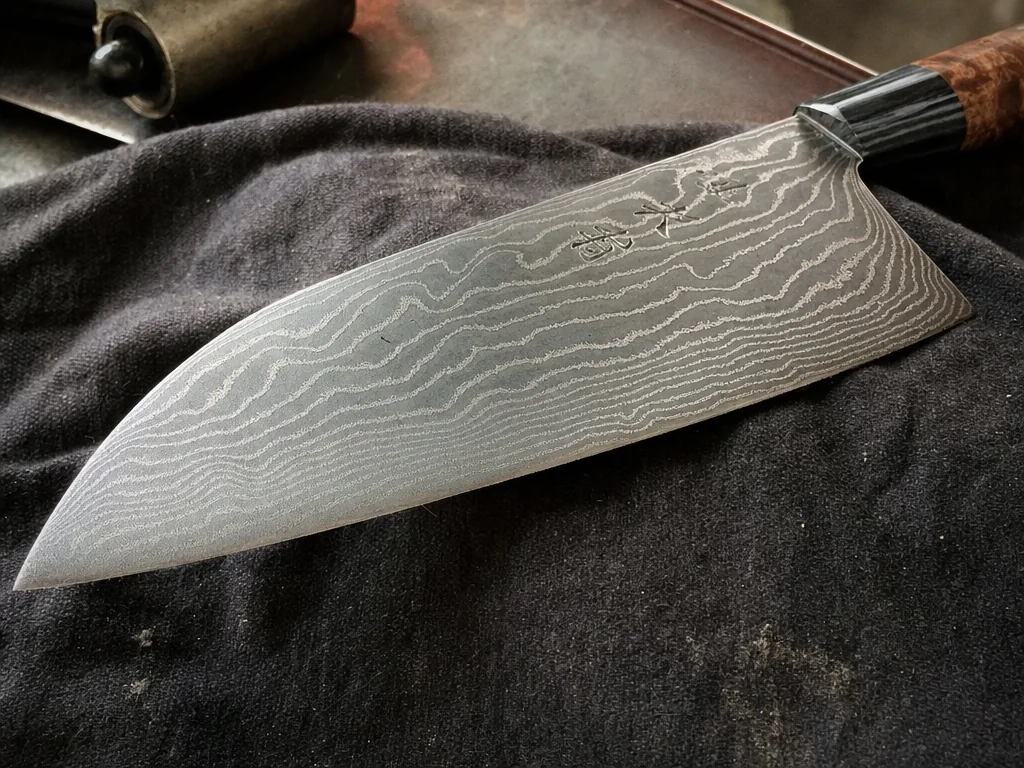
| Damascus knife | 300-800 pcs | Layer pattern control, etch consistency, hand polish, visible rejects after finishing | Pattern finish and acid etch raise the rejection rate |
| Gift set | 500-1,000 sets | Box MOQ, EVA insert tooling, barcode labels, assortment packing on the final bench | Custom box inserts often set the real floor |
Blade length alone does not set the number. A 150 mm utility knife in plain satin can run at 500 pcs without much drama; we ship that style on shared polishing wheels. A 210 mm chef knife with polished spine, hidden tang, and branded insert card may need 1,500 pcs to keep setup loss under control. We have seen buyers push for the same MOQ on both, then flag a 0.2 mm spine mismatch during AQL 2.5 final inspection. The math doesn't work. For knife MOQ by blade type sourcing, quote geometry and finish together.
How Finish Changes The Minimum
Finish is where 7 out of 10 new buyers misread the MOQ math. Satin and bead blast are forgiving. Mirror polish is not. PVD and DLC bring fixture setup, and powder coat or acid etch do the same. Some finishes are hand work on the 400 grit belt. Others need blades racked 48 at a time, masked at the ricasso, and moved to a curing line before the buffing room touches them. Want a lower MOQ? Simplify the finish first. Chasing steel first is the wrong question.
Satin and stonewash keep MOQ lowest because they hide small cosmetic variation. QC pulled the sample under a 6000K light box, and those finishes rejected fewer blades than mirror polish. Mirror polish adds 20-40% to MOQ because one line from the cotton wheel sends the blade back to rework. PVD and DLC start at 1,000 pcs per color because the coating fixture needs a full rack of 120 blades or the math doesn't work. Powder coat and black oxide fit outdoor knives, but we still need enough units to cover masking labor and a 25-minute curing cycle.
- Stonewash: fits pocket knives and outdoor knives. We run it in a tumble barrel with 3 mm ceramic media, so minor texture variation is normal, and that is the point.
- Mirror polish: fits premium kitchen knives. QC checks each blade face after the final buff, and scrap allowance goes up once the buyer wants a clean showroom reflection with no haze at 30 cm.
- PVD/DLC: gives a blacked-out tactical look. The rack holds 120 blades. Witness points still happen, and matching black between lots pushes the floor higher.
- Acid-etched Damascus: the pattern has to stay consistent blade to blade, so one light etch on the first-off sample can stall batch approval until the ferric chloride bath time is reset by 15 seconds.
If your market will not pay for cosmetics, do not bury margin there. We shipped 3 orders last quarter where the buyer dropped mirror to stonewash after the PP sample, and lead time closed at 12 days instead of 18 days. The grinding line felt it right away because fewer blades came back from final buff. Ask a practical knife OEM what is already running in Yangjiang or Zhejiang and what forces a separate run in China. If they stay vague, we've seen this go sideways.
Steel, Geometry, And HRC
Steel and geometry move MOQ because they move yield. A 2.0 mm stamped blade in 3Cr13 or 420J2 comes off the press clean, and the straightening worker can fix most bend with a flat anvil and hand press in one pass. Easy job. A 4.0 mm full-tang blade in 9Cr18MoV or 14C28N at 59-60 HRC is a different shift. Less margin. After heat treat, QC checks the spine and edge under the 10x loupe, then pulls pieces for warp, hairline cracks, and small edge chips near the tip. Last month we scrapped 37 pieces from one 800-piece trial before polishing even started. That loss is baked into the minimum.
For kitchen knives, 8 out of 10 export programs we quote stay around 56-58 HRC because buyers still want easy re-sharpening after the sale. Outdoor and pocket knives often run 58-60 HRC, with premium stainless going higher only when the buyer accepts the reject risk. Ask for a tight HRC band with a 15 degree bevel and a needle-thin tip, and we need more blades in the batch to cover pieces QC will kick out. A 2 percentage point hardness change looks harmless on a PO. On the grinding line, it can turn 300 clean blades into two trays of rework.
Thickness matters too. A 1.2 mm blade and a 3.0 mm blade do not share grinding time or the same satin belt sequence. The fixture may change as well. If you want CATRA test data, LFGB or FDA compliance, or REACH documentation, the file needs extra sample blades and more paperwork time from the merchandiser. We have seen this go sideways when a buyer approved 3.0 mm in the drawing but typed 2.5 mm on the PO, then pushed back after QC pulled the sample. The MOQ is process control math, not blade type alone.
When you discuss knife OEM with a factory in Yangjiang or Zhejiang, ask for the exact steel grade, target HRC band, and blade thickness in millimeters. Those three numbers explain the quote better than the product photo. This is the right question to ask before we open steel or book the grinding line.
What Lets You Lower MOQ
The fastest way to lower MOQ is to remove extra setups. Use one steel grade, one blade finish, one handle platform, and one packing structure. Simple. Buyers sometimes change all four on one PO, then ask why the minimum moves from 500 to 2,000 units. The math doesn't work. On our Yangjiang grinding line, switching from satin to blackwash means changing the 320 grit wheel set, washing the parts in a separate basket, and letting QC check the first 20 pcs before bulk continues.
Some changes save money without making the knife look cheap. A stock handle mold beats opening a new tool; a new G10 scale mold can add 12-18 days before bulk starts, and the tool room still has to test-fit the first scales with the brass pins. Put two logo versions into one laser position if the brand team accepts it. Run one carton print and one inner tray for the full family. Mixed sets work only when the blades share the same line and packing route. If the 8 inch chef knife runs on one fixture and the cleaver needs another jig, the schedule gets messy fast. We've seen this go sideways, usually after the buyer flags a small PO detail that should have been fixed before deposit.
- Stay with one blade length family, such as 8 inch and 10 inch only, so the grinding line keeps the same gauge setting.
- Choose one finish, such as satin or stonewash, across the first order, instead of splitting polishing lots from tumbling lots.
- Ask for one steel grade and one HRC band, not three; QC pulled the samples faster when hardness checks stayed in one range.
- Keep packaging generic on the first run, then upgrade after approval, especially if the buyer has not signed the color box proof with the PMS code.
Clear specs win. With clean specs, MOQ can drop 30-50% without asking the factory to run a loss-making batch. We ship these orders when the setup stays tight and one routing card covers the run. On the production board, that means one steel lot, one finish code, and no last-minute sticker typo from the PO. This is the practical side of knife MOQ by blade type sourcing.
What To Ask In The RFQ
A clean RFQ saves 2 rounds of email. Send one photo and a USD target, and we have to price in guesswork, so the MOQ goes up. The grinding line still needs a setup sheet. QC still needs the first sample checked on a digital caliper before we quote cleanly. With a proper spec sheet, a knife OEM can tell you whether the real floor is 600 pcs, 1,200 pcs, or one full steel coil batch. If you need landed pricing and compliance files, say it on the first RFQ page; pushing unit cost before the spec is locked is the wrong question.
Your RFQ should list blade type, blade length in mm, thickness, steel grade, target HRC, finish code, handle material, logo method, packaging spec, and destination market. For EU sales, ask for REACH and food-contact documents at the start; our export clerk has seen 1 missing LFGB line hold a shipment for 12 days vs the normal 3-day document check. For the US, confirm if the handle and coating need FDA review. Amazon order? Put FNSKU placement and carton labeling on page 1. We have seen this go sideways when the buyer changed the color box after pilot samples, the print plate had to be remade, and the MOQ math no longer worked.
- Blade and handle drawing with dimensions, including blade length, spine thickness, tang shape, and hole position in mm; our sample room checks these on a digital caliper.
- Target finish and any color code, such as satin, mirror, stonewash, black coating, or PVD tone; black alone is not enough for the coating rack.
- Target quantity per SKU and per color, because 500 pcs in one finish is not the same setup as 5 colors at 100 pcs each; we run those as separate jobs.
- Compliance needs: ISO 9001, BSCI, REACH, LFGB, FDA; list the required reports in the RFQ, not after sampling.
- Inspection target: AQL 2.5 for major defects is common, and QC pulled the sample against that level before packing.
Once the RFQ is complete, the supplier can price tooling, production, inspection, and packing as separate lines instead of hiding them inside one padded unit price. Cleaner quote. Cleaner argument. It also makes comparison easier between Yangjiang, Zhejiang, and other China sourcing bases, because you can see whether the MOQ comes from the laser-cut blade blank batch, the handle mold, the carton MOQ, or a buyer-side compliance request. If that cost split is missing, the comparison is weak, and buyers end up arguing over the wrong number.
How To Read The Quote Sheet
Two quotes can look almost the same and still buy different things. Unit price alone is the wrong question. One price includes tooling amortization, laser engraving on the blade, the inner box, and the export carton. The other covers only the blade blank and handle. We run into this on 8-inch chef knives almost every month. A buyer compares USD 2.18 with USD 2.05, then QC pulled the approved sample and found the logo charge buried in the unit price. Ask where the setup charge sits. If you are comparing knife MOQ by blade type offers from different factories, make them show setup charges on their own line. If not, the MOQ looks low on paper, but the math doesn't work at shipment time.
Ask the supplier to break the quote into four lines: tooling, sample cost, unit price, and optional packing upgrades. Then lock the commercial term. FOB is cleaner for importers with a forwarder because you control freight and insurance. DDP works for a 300-600 pcs launch order only when the landed-cost sheet shows duty, the full delivery address, and carton CBM. We have seen this go sideways: one PO said "DDP USA" with no zip code, and the booking sat for 2 days before the buyer flagged it. Lead time should be printed on the quote, not promised in chat: 7-15 days for samples, 30-45 days for a standard production run, 45-60 days if the finish is PVD or the packaging is custom printed.
For export programs, request a pre-production sample, the hardness report, and the final inspection plan before deposit. Simple ask. On the grinding line, a 1 mm thinner spine or a 2 HRC miss on the Rockwell tester changes the buyer's whole review. Get the control points in writing. Ask how QC pulls samples, how hardness is checked, and how AQL 2.5 is applied at final inspection. We ship repeat orders to buyers who ask these questions early, because problems found before deposit are cheaper than problems found after cartons are sealed. A factory that can answer without pushing only the lowest first quote is the one we trust with a repeat order.
Frequently asked questions
For most custom kitchen knives, a realistic MOQ is 500-1,500 pcs per SKU. A stamped paring knife or utility knife with satin finish can sit near the low end, especially if the steel and handle are already in production. A forged chef knife with bolster, polished spine, or custom packaging often moves into the 1,000-3,000 pc range. If you want a specific HRC band, for example 56-58 HRC, and you also want LFGB or FDA support, the factory will usually want a cleaner batch plan. In Yangjiang and Zhejiang, the quote usually improves when you keep one steel, one handle mold, and one finish across the first order.
Mirror finish raises MOQ because it is a labor-heavy cosmetic process with higher reject risk. Every scratch, buff mark, and edge haze shows up immediately, so the factory has to allow more time for polishing and more pieces for quality sorting. In practice, mirror polish can add 20-40% to the minimum compared with satin or stonewash. On a forged chef knife, that means a 1,000 pc program may need to move toward 1,500 pcs before the line is efficient. If the blade is also thin, hard, or highly polished near the spine, the scrap rate can climb further. For importers, the cheapest way to preserve MOQ is usually to accept a more forgiving finish on the first order.
Sometimes, but only if the parts share the same production route. If you are asking for one steel grade, one finish, and one packaging spec, a factory in China may allow mixed lengths within one family, such as 8 inch and 10 inch chef knives. Handle colors are harder. If the color needs a separate molding or coating batch, the MOQ usually applies per color, not across the family. A practical compromise is to use one base model and vary only the logo or the outer carton. If you try to mix too many options, the supplier has to split the batch, which pushes unit cost and lead time up together. That is why knife OEM programs usually become more efficient after the first replenishment order.
No, but it usually needs a more careful process than a standard stainless blade. A true layered Damascus or clad Damascus program can sometimes start at 300-800 pcs if the factory already has the steel, etching, and polishing flow in place. The MOQ rises when you want a specific pattern match, a deep acid etch, or a premium polished face with low visible variation. If the blade also has a custom handle, gift box, or laser logo, the minimum can move closer to 1,000 pcs. For importers, the important question is whether the supplier is doing real layered production or simply finishing an etched surface. Those two programs do not carry the same cost or risk.
Ask for a clear spec sheet, a pre-production sample, and a quote that separates tooling, unit price, and packing. Then ask for the steel grade, target HRC, finish code, and the compliance documents that match your market, such as REACH, LFGB, FDA, or a material declaration. For quality control, ask what AQL the factory uses for major and minor defects; AQL 2.5 is a common export target. If you sell online, confirm FNSKU placement, carton marks, and master carton count before production starts. A factory in Yangjiang or Zhejiang should be able to show how it controls hardness, edge finish, and final inspection without changing the quote after approval. If the paperwork is vague, the MOQ will usually become expensive later.
Send your spec for a real MOQ
Share blade type, finish, steel, HRC, and pack details. We will map the minimum against current lines in Yangjiang and Zhejiang, then quote FOB or DDP cleanly.
Request a Quote