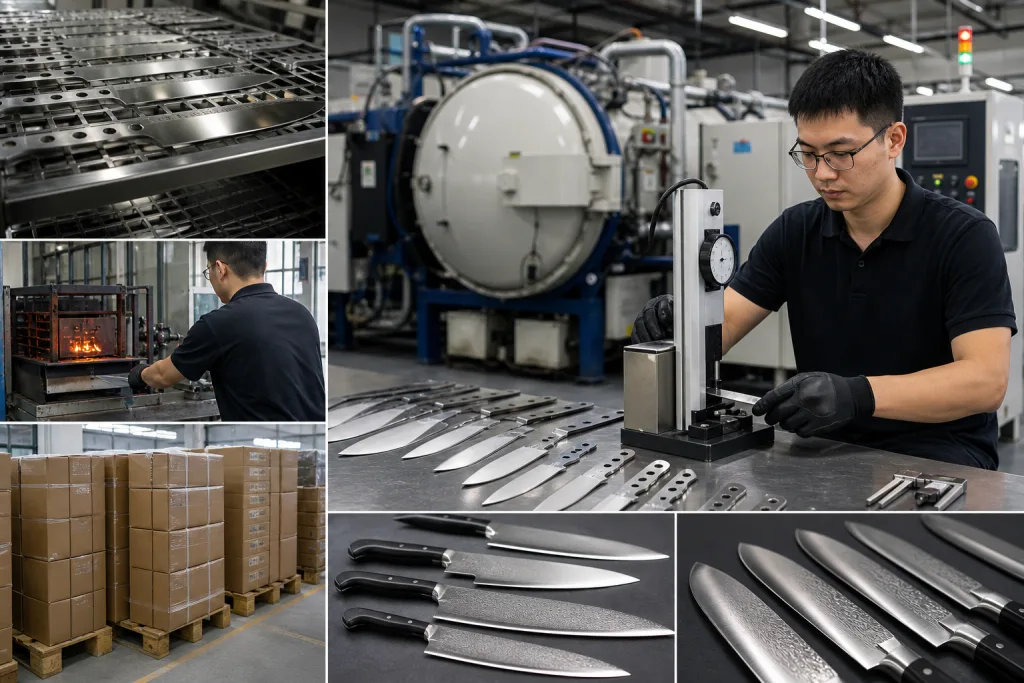
Buyers comparing laser vs waterjet blade blanks usually start with price per cut. That is the wrong question. On our quoting desk, a laser blank might look cheaper by 0.08-0.15 USD, but the math breaks once the grinding line has to open the pivot hole by 0.20 mm with a carbide reamer or pull a warped spine across the surface grinder. That is where margin disappears. Real cost shows up later in grinding hours, hole correction, flatness work, and scrap that rides into assembly and packing. In China, we have seen 6 out of 10 troubled blank programs fail at this stage, not at the first cutting quote, especially when the laser vs waterjet blade blanks manufacturer also runs heat treatment, finishing, and export packing.
At a knife factory in Yangjiang, China, we see this split every week on the floor: simple kitchen and pocket blanks stay on the laser line, while 4.0-6.0 mm thick or heat-sensitive plates usually earn a waterjet quote. Last month QC pulled one sample lot because the lock face shifted after heat treat, even though the outside profile still looked clean on the CMM report and the 6 mm gauge pin passed the pivot hole. This is where programs go sideways. Process choice matters less when the blank is oversized and fully ground later. It matters a lot when the pivot hole has no room, when the lock face angle is already fixed, or when the spine geometry is tight from the start. If you are sourcing a private label line from Yangjiang or another manufacturing hub in China, send a drawing that says what the blank must do in assembly, not just what it should look like.
How Laser and Waterjet Differ
Laser and waterjet both cut knife blanks, but the problems land at different stations after cutting. A fiber laser puts heat into a narrow kerf, melts the steel, then blows it out with nitrogen or oxygen assist gas. Fast job. On our 3 kW fiber table, a 2.0 mm 420J2 blank can run clean with low setup cost if the drawing leaves enough grinding allowance; QC checks the first 10 pcs with a digital caliper and overlays them against the DXF before we release the nest. Waterjet uses pressure and garnet abrasive, so the edge stays cold and there is no heat-affected zone for QC to chase later. For blade blanks, that matters when the steel has higher carbon or will go to hardening; we have seen laser-cut tool steel edges make the grinding line work harder after heat treat, especially when the 80-grit belt has to clean up a blackened 0.2 mm edge band.
For a laser vs waterjet blade blanks sourcing decision, steel grade alone is the wrong question to ask. A 2.0 mm 420J2 chef blank cares about speed and stable nesting. A 2.5 mm 8Cr13MoV pocket blade brings different pressure: the buyer will look first at pivot hole position, burr height, and whether the liner fit still works after tumbling. A 6.0 mm D2 outdoor blank can wreck the quote if distortion or edge cleanup eats the savings. Laser wins on a simple profile, a 3,000 pcs batch, and a blank that still has 0.3-0.5 mm stock for final grinding. Waterjet makes more sense when distortion costs money, the plate is thick, or the buyer wants the cut edge kept close to the parent material condition. We had one PO typo calling out 6.0 mm D2 as 3.0 mm; the buyer flagged it after the first DXF review, and the cutting quote changed the same day.
- Laser: fast on volume and lower unit cost after setup, with a small kerf; the tradeoff is thermal change on the edge, so plan extra grinding if the blank goes through hardening.
- Waterjet: cold cut with no heat input, but the kerf is wider and the feed rate is slower; garnet, mixing tube wear, and nozzle cost show up in the unit price.
- Buyer rule: if the blank will be ground hard later, speed matters more than perfect cut-edge cosmetics; the math does not work if you pay waterjet pricing and then remove the whole edge on a belt grinder.
That is why a serious laser vs waterjet blade blanks manufacturer in Yangjiang, China will ask for your final grind allowance before quoting the cut method. We run the quote from the finished blade drawing, not just the blank DXF, and the grinding line lead marks the allowance in red pen before purchasing locks the price. Small detail, big bill. If that allowance is missing, QC may pass the blank and the assembly room still complains because the edge geometry has no room left to clean up.
Tolerance, Burrs, and Flatness
The tolerance report shows the process choice before the sample even reaches assembly. On 1.5 mm to 2.0 mm stainless sheet, laser usually holds the outside profile at +/-0.10 to +/-0.20 mm, but sheet stress and nest spacing still matter. We run 600 to 1,200 blanks per sheet on small utility blades; if the coil was slit tight, the part can spring after cutting. It happens. On the grinding line, QC checks the first tray with a Mitutoyo height gauge: one lot sits inside +/-0.10 mm, the next lot lifts 0.18 mm at the tip. Waterjet keeps the edge cold. No HAZ. On 4.0 mm plate, the tradeoff is taper and a rougher cut face, often 0.12 mm wider at the bottom edge if the nozzle is worn. If the blank has a pivot hole or the lock face must sit clean to the liner, separate cosmetic profile tolerance from functional holes and datums.
| Process | Typical profile tolerance | Edge condition | Best use |
|---|---|---|---|
| Laser | +/-0.10 to +/-0.20 mm | Small burr or oxide, possible HAZ | Thin to medium blanks, repeat production |
| Waterjet | +/-0.10 to +/-0.25 mm | Cold edge, possible taper, no HAZ | Thick plate, heat-sensitive steels |
These are sourcing ranges, not CMM trophy numbers. Profile tolerance is the wrong question to ask first. On a blade blank, hole position decides whether assembly keeps moving or the line stops. QC pulled the sample on a 50 pcs trial last month, checked it with 3.00 mm and 4.00 mm pin gauges, and the buyer flagged a 0.06 mm hole drift, not the outside profile. For a pinned pocket knife or a frame-lock blank going straight into assembly, call out +/-0.05 mm on critical holes. If the blank will be fully ground and reamed later, +/-0.10 mm is enough. Chasing tighter numbers at the blank stage wastes money. Flatness bites too. A blank off by 0.30 mm over 100 mm still looks fine on the bench, but it burns fixture time and can push scrap after heat treatment.
Specify the blank around the process chain after cutting, not as a standalone part. We run laser first. Then the Timesavers takes the burr down with a 120-grit belt, and we ream critical holes only where the drawing calls for them. If the PO only says "tight tolerance all around," that is not a spec. The math doesn't work. We've seen this go sideways: one buyer typed "flatmess" instead of "flatness," and pre-production sat for 2 days while we confirmed the limit by email.
What Drives Blank Cost
Price per cut is one line on the quote sheet. Real blank cost sits in sheet yield, machine minutes, nitrogen or abrasive, rework, and rejected pieces. Laser usually wins on throughput because setup is short and feed is fast; on our fiber laser, we run a 2.5 mm 420J2 blank program while the grinding line is still waiting for the next tray, with only a nozzle check before start. Waterjet brings garnet abrasive, pump seal wear, slower cycle time, and extra cleaning around the table with wet scrap packed under the slats. Messy work. At 500 to 2,000 pcs of one blank, the gap shows up fast. In our Yangjiang, China shop, a standard laser program on 2.0 to 3.0 mm stainless often ships in 12 days vs 18 days for waterjet, at a lower total cost, before we count labor for sorting, wiping, and burr checking.
For OEM buyers, the hidden cost is nesting efficiency. We saw one steak knife blank move from 72 percent to 80 percent sheet utilization after the programmer rotated the profile 7 degrees and tightened the bridge spacing on a 1,220 x 2,440 mm sheet; the SigmaNEST screen showed the saving before the first sheet hit the bed. That saving beat the process premium. If the buyer compares only laser cut price with waterjet cut price, this is the wrong question. Ask for the nesting plan. A serious laser vs waterjet blade blanks manufacturer should quote the cut method and show the nesting plan, not throw out a unit price. On higher-volume programs, laser runs 15 to 30 percent cheaper than waterjet on the same geometry. On 6 mm or thicker stock, waterjet is often the better call because distortion scrap gets expensive; QC pulled samples last month where laser heat pushed the tip out by 0.4 mm, and the math did not work.
- Material yield: profile nesting and sheet size swing the quote more than most buyers expect; we have seen a poor layout burn 18 percent of a stainless sheet before the first blank reaches the Timesavers deburring belt.
- Consumables: laser gas is steady to cost; waterjet abrasive is not. An 80-mesh garnet run on a long program looks cheap on paper and turns expensive once the buyer asks for a cleaner edge and the feed rate drops.
- Post-process: if laser leaves heavy dross at the heel or a blue heat mark near the tang, the saved cut cost dies at the bench. We end up with hand cleanup on a flap wheel and another round of burr checks.
For a typical private label program, a 500 pcs MOQ and 20-30 day lead time is realistic if drawings are clean and the tolerance stack stops moving. We ship faster when the DXF, steel grade, and edge allowance match the PO. We have seen a 2.0 mm blank delayed because the PO said 3.0 mm in one line and 2.0 mm in another, and the supervisor circled the mismatch on the traveler before we cut the wrong sheet.
Best Fit by Knife Category
Each knife type puts a different load on the cutting process. For kitchen and chef knives, we still run laser on 1.5 to 3.0 mm stainless for most repeat SKUs; the profile is thin, nesting is tight, and we leave about 0.3 mm at the edge because the grinding line cleans it after heat treat. Simple math. Pocket knives are different. Laser fits most orders, but the blade outline is rarely where the shipment gets stuck. The arguments start at the pivot hole and stop pin seat. One buyer flagged a 0.04 mm hole shift before he even checked the outside profile with the caliper. For outdoor and tactical knives, waterjet starts to earn its place when stock moves into 4.0 to 8.0 mm, because the cold cut keeps the blank flatter and avoids heat marks along the edge zone.
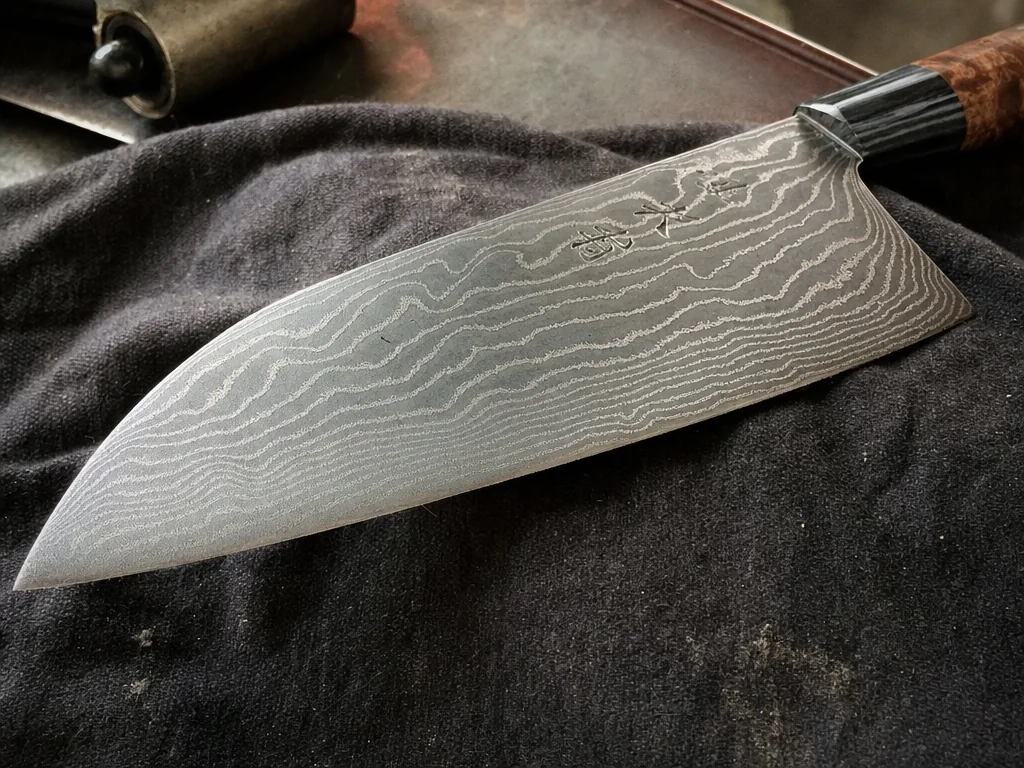
Damascus programs need a separate call. Chasing the lowest cut price is the wrong question here. If the pattern-welded billet has been stabilized, both laser and waterjet can work, but the factory has to protect the pattern and leave enough stock for hand finishing. For laser vs waterjet blade blanks on a Damascus line, ask how much edge cleanup we expect after cutting and whether the blank gets re-flattened before heat treatment. QC pulled the sample last month and found a 0.35 mm bow on the granite plate; after pressing and re-grinding, the cheap cut was not cheap. We have seen this go sideways on a 300-piece trial order when the PO said “mirror finish” but the approved sample still had light cut marks near the heel.
- Kitchen and chef: laser stays the sane default on 1.5 to 3.0 mm stainless, since final edge work comes later on the grinding line.
- Pocket: laser works for volume, but keep CNC control on the pivot hole, stop pin seat, and lock face because 0.02 mm can start a complaint.
- Outdoor and tactical: waterjet makes more sense once stock moves into 4.0 to 8.0 mm and flatness matters more than cycle time.
- Damascus: choose the method that keeps the pattern clean and the blank flat, not the lowest headline quote.
Start from heat treat. If your finished blade target is 56 to 60 HRC, the cut method should support that route. Before we release a furnace lot, QC checks blank flatness on a granite table with a feeler gauge, usually at 5 points on the blank, and the math does not work if cutting damage has to be fixed twice.
How to Specify an RFQ
Most blank RFQs land half-empty. We get “blade blank, steel grade, 5,000 pcs” plus one line asking for the best price. That is the wrong question to ask. It is how you end up with a 28% quote gap and a sample that looks fine until QC sets it on the height gauge and catches the profile drift. A usable sourcing pack tells the factory what the blank must hold after cutting and before grinding: outline tolerance, hole size, burr height, flatness, and grind stock. If you want laser first and waterjet as backup, write both on the drawing. If you do not, the shop will pick the cheaper route, and the grinding line can lose 12 minutes per batch cleaning up an edge that should not have left cutting.
Send the drawing pack with steel grade and thickness in mm first. Then list blade length, hole positions from a fixed datum, grind allowance per side, burr limit, flatness requirement, and any stress-relief requirement before shipment. Put the hard numbers on it: for example 2.0 mm 5Cr15MoV, outline +/-0.15 mm by laser, holes +/-0.08 mm by ream after cutting, burr under 0.08 mm. If export paperwork matters, add the mill certificate and REACH statement, plus packaging details such as rust oil, VCI bag, and carton mark format. We have seen this go sideways. One PO came in with “VC bag” instead of “VCI bag,” and the buyer flagged orange spots after 18 days at sea. For kitchen lines sold into Europe or North America, ask which food-contact claim sits on the handle or coating material. The blank is usually the wrong place to spend that argument. We ship steel, not miracles.
- State tolerance by feature: give outline, hole, thickness, and flatness separate limits. One +/-0.10 mm note does not cover all four, and QC pulled a sample last month where the holes passed but the plate missed flatness by 0.18 mm.
- State process sequence: say cut before heat treat, after heat treat, or after anneal, since laser heat tint and waterjet edge wash behave differently at 60-62 HRC; on the grinding line, that difference shows up fast.
- State approval method: require 5 pcs first article with CMM or projector report, then release the mass run, then approve shipment against AQL 2.5. Skip this step and the math does not work once 5,000 pcs are on the floor.
- State commercial terms: FOB, DDP, or ex-works changes freight, duty risk, and who pays when the carton mark is wrong; we have had buyers push back on a single transposed letter on the outer mark.
With a clean RFQ, a Chinese factory can quote on the first pass. We run the nesting, check scrap rate, QC pulls one sample off the projector, and we price laser against waterjet without padding the quote for missing data. That saves 2 rounds of email in a normal week.
Inspection Rules That Prevent Surprises
Blank inspection should be boring: caliper, height gauge, go/no-go pin, signed sheet. The common buyer mistake is checking the outside profile and missing the features that decide assembly later. On a laser-cut blank, we check dross thickness, oxide scale, heat tint, and local hard spots; QC pulled one 5Cr15 batch at 47 HRC near the slot after the laser dwell was set too slow. On a waterjet blank, we check taper, abrasive grit left in holes, and edge roughness; a rough 0.8 mm edge can add 12 minutes of hand-polishing per tray on the grinding line. Looks come later. The acceptance rule should follow the blank's next process: grinding line, handle fitting, heat treat, or final polish. This is where buyers sometimes ask the wrong question. A shiny blank with a 0.15 mm hole drift is still a bad blank.
For most OEM programs, we run first-article approval on 20 to 30 pieces, then in-line sampling under AQL 2.5 for major defects and AQL 4.0 for minor defects if the design is already mature. Major defects include a wrong profile that fails the CAD overlay, hole drift beyond tolerance that blocks rivet fit, gross warp that rocks on the granite plate, or burr heavy enough to cut oil paper in packing. Minor defects include light discoloration, shallow edge marks under 0.2 mm, or cosmetic staining that cleans off before grinding. For a high-end kitchen or pocket line, tighten hole tolerance and profile checks first; polishing callouts can wait if the next station will remove the edge skin anyway. We have seen this go sideways when a buyer approved shiny samples, then rejected 800 pieces because the 3.2 mm pin holes sat 0.18 mm off datum.
- Profile: verify against CAD overlay, not just a paper template; we mark the datum on the drawing before QC starts.
- Hole location: measure from the same datum every time, usually the tang end or centerline, so rivet fit does not become a guessing job.
- Flatness: record it after cutting and after any stress relief; use the granite plate, not a workbench.
- Packaging: separate blades with oil paper or trays to stop edge damage, especially when blanks move by courier for heat treat.
If you work with knife inspection standards and a clear production flow, the blank method becomes one controlled variable. We ship fewer argument emails that way. Last month a buyer flagged a PO typo showing +/-0.05 mm on a decorative slot; the math did not work for waterjet at that MOQ, so we changed the spec before steel was cut.
Frequently asked questions
Yes, on most thin and medium blanks. For 1.5 to 4.0 mm stainless sheet, laser is often 15 to 30 percent cheaper because the cut speed is higher and setup is simpler. Waterjet becomes more expensive once you add abrasive, pump wear, and longer cycle time. The exception is thick or heat-sensitive steel, where waterjet can save money later by reducing warp, rework, and scrap. If your MOQ is 500 to 2,000 pcs and the geometry is simple, laser usually gives the better total landed cost from China. If the blank will be heavily ground anyway, the lower cut cost matters more than the edge finish.
Do not use one tolerance for everything. For the outer profile, +/-0.10 to +/-0.20 mm is common and realistic for laser or waterjet on standard sheet. For a critical pivot hole or lock interface, ask for +/-0.05 mm if the part will go directly into assembly. Flatness should be stated separately, and a practical target is under 0.30 mm over 100 mm after cutting, or after stress relief if you use it. If the blank is only a rough preform that will be fully ground later, you can relax some of these numbers and focus on consistency rather than cosmetic perfection.
Choose waterjet when heat matters more than speed. That includes thicker plate, hardened or heat-sensitive steel, and designs where distortion would create expensive downstream work. Waterjet is also a good option when you are prototyping a new blade shape and want to avoid any thermal edge change before heat treatment. It is less attractive on high-volume kitchen or pocket programs because the abrasive cost and longer cycle time add up quickly. As a rule, if the blank is 6 mm or thicker, or if you are cutting a material where heat tint or edge hardening is a concern, waterjet deserves a close look.
Start with the drawing, not the sales quote. Ask each laser vs waterjet blade blanks manufacturer for the same steel grade, thickness, tolerance table, lead time, MOQ, and inspection method. A serious factory should answer with a sample schedule, mill cert availability, and a clear quote basis such as FOB or DDP. In Yangjiang, China, a good OEM plant will also tell you whether the blanks are cut before or after heat treatment and what stock allowance is left for grinding. If the answer is vague, the price is probably hiding rework or scrap. Compare the total landed cost, not the cut price alone.
Approve a first article before you approve volume. Check outline, hole positions, burr level, flatness, and any heat tint or abrasive residue. Then ask for a small pilot run of 20 to 30 pcs from the same setup that will be used in mass production. For ongoing QC, AQL 2.5 is a sensible starting point for major defects on mature programs. Also confirm packaging, rust prevention, and whether the supplier can keep part-to-part consistency across at least one full batch. For export orders, you should also lock the carton count, outer mark, and document set before the first shipment leaves China.
Send your blank drawing for a pricing check
We can quote laser vs waterjet blade blanks by steel grade, thickness, hole pattern, and volume, then show you where cost and tolerance risk really sit.
Request a Quote