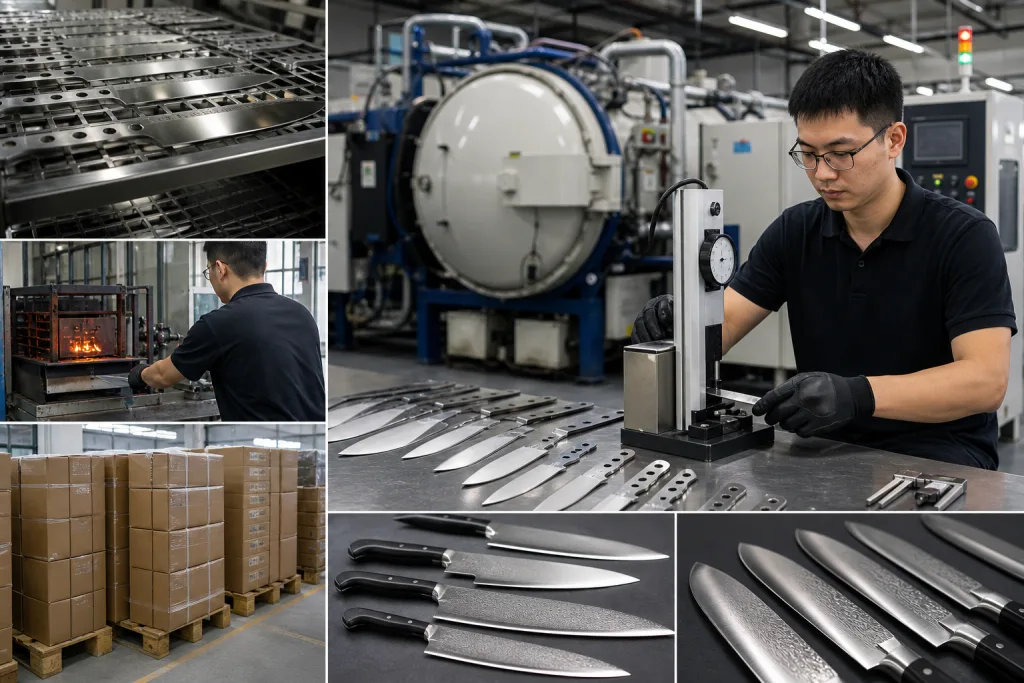
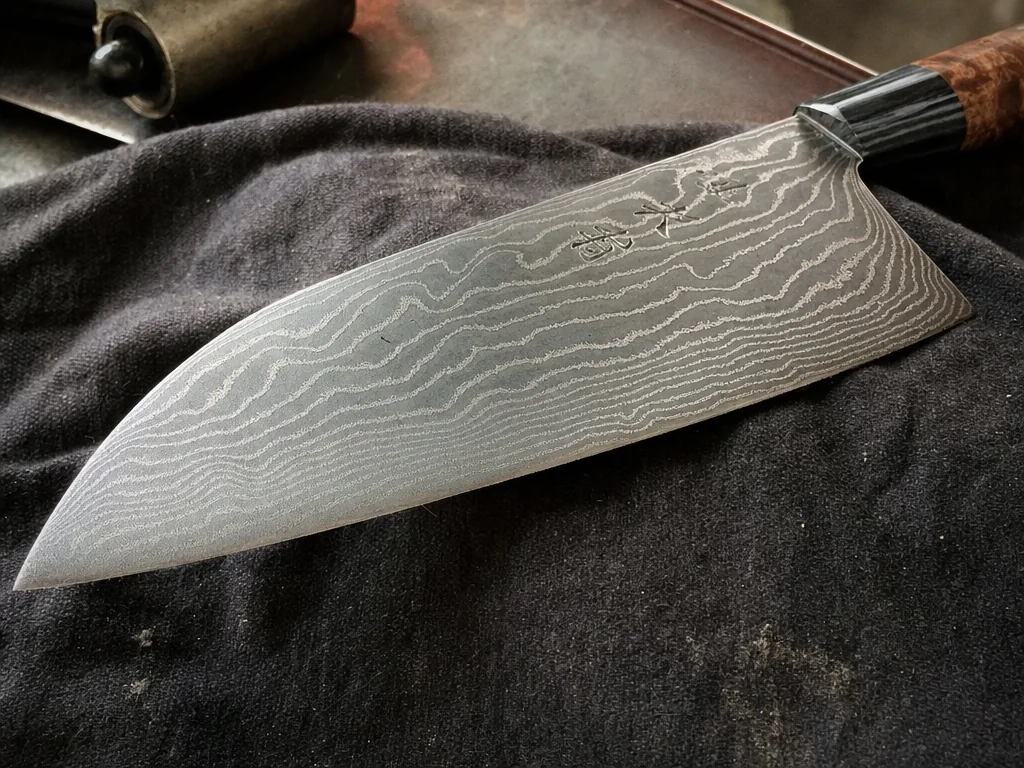
For high-end folders or chef knives, M390 and 20CV look tidy on a datasheet, then get messy once the PO reaches the grinding line. The steel name is only line one. Your margin sits in the bar-stock source, heat-treatment window, grind loss, and whether the factory can trace each blade back to a real batch number. We run 3.2 mm and 4.0 mm stock on separate wheel settings; a 0.3 mm over-grind on 800 pcs means scrap, rework, and a buyer asking why the blade feels thin in hand.
Yangjiang quotes for the same-looking knife can land 25% apart. Some suppliers price real powder metallurgy steel with traceable mill certs. Others quote an equivalent spec and hope nobody asks for hardness data, salt spray results, or carton-drop control. QC pulled one sample last year marked M390 on the blade but 58 HRC on the Rockwell tester; that line should have been 60-62 HRC. Bad sign. For a premium line that has to survive audits and returns, treat M390 OEM work as an engineering job. Commodity buying is the wrong question to ask.
What M390 And 20CV Really Mean
M390 and 20CV belong to the same premium powder metallurgy bracket, so buyers often put both grades on one RFQ. Fair enough. Our cut test gap is usually small: wear resistance is strong, corrosion resistance is solid, and the fine carbide structure lets us grind a thinner edge without making it feel lazy. Still, chasing the blade stamp is the wrong question to ask. On the grinding line, a 0.2 mm drift behind the edge can hurt real cutting more than the logo etched on the blade. You pay for better edge holding, yes, but only if the factory controls belt heat, quench timing, and final hardness on every batch.
We run these steels where the price math works: high-end folders, gentleman's knives, and premium kitchen or chef knives for buyers who accept the steel cost because the edge lasts longer. They are not forgiving steels. QC pulled samples before where one side sharpened cleanly and the other side started micro-chipping after tempering; hardness was inside spec, but the edge geometry was not. Ask for the exact grade, mill source, and intended hardness band before you approve the first sample. No shortcut here.
- Typical target hardness: 60-62 HRC for folders, 60-61 HRC for thin kitchen blades.
- Common risk: pushing above 63 HRC while leaving the edge too thin after grinding.
- Reality check: the steel name will not save poor grind symmetry or a bad temper cycle.
Where The Cost Actually Comes From
The quote gap usually starts with usable yield and finishing time. Heat-treatment risk is the third hit, and buyers miss it all the time. M390 and 20CV are expensive bar stock. They chew through 120-grit ceramic belts, so scrap hurts fast. We have seen 3.0 mm bar stock lose 14-18% before the grinding line cuts the first sharpening bevel because the nesting file left 4.6 mm between blanks instead of 2.8 mm. Bad math. A sharp OEM quote in China should state if the factory buys certified bar stock and cuts by EDM or laser. It should state whether we run a controlled cryogenic cycle at around -80°C after hardening.
For premium buyers, 'What is the steel price per kilogram?' is the wrong question. Ask this: 'What is the landed cost per acceptable blade after blank waste, QC pull-outs, and retail packaging labor?' A 0.3 mm thickness change adds one extra grinding pass on the platen grinder. We have seen it push sample timing from 22 days to 30 days and move the finished price more than the buyer expected. QC pulled one 20CV sample last month because the spine was 0.18 mm over drawing tolerance. The steel price was not the problem. The rework time was.
| Blade type | Typical MOQ | Sample lead time | Production lead time | Target HRC | FOB impact |
|---|---|---|---|---|---|
| 3.0 mm folding blade | 200-300 pcs | 20-30 days | 45-60 days | 61-62 | USD 8-15 |
| 2.5 mm slim EDC blade | 300 pcs | 20-35 days | 50-65 days | 60-61 | USD 6-12 |
| 2.0 mm chef knife | 500 pcs | 25-35 days | 50-75 days | 60-61 | USD 10-18 |
These figures move. They are close to how a serious m390 20cv knife steel sourcing manufacturer prices the order. We run the math from usable blanks, not raw kilograms. If a quote ignores waste factor or prices M390 like mid-tier stainless, the math does not work. The missing cost is usually sitting in a softer heat treat or in skipped cryo. Sometimes it is inspection loosened from AQL 2.5 to whatever passes before shipment. We have seen this go sideways when a PO said "M390 finish" but the buyer meant steel grade, so the wire EDM file sat 12 hours on hold until we had the mill cert and hardness target before cutting steel.
Heat Treat Beats Steel Name
For this steel family, heat treat beats the steel name every week on our quote desk. A clean M390 blade at 59 HRC looks good on paper, then loses bite faster than a blade held at 61.5 HRC after a proper cryo soak. Harder is not always better. Push it too far and the math doesn't work; toughness drops, then edge chips show up in the buyer's return photos, often first at the tip on a 2.8 mm stock folder. Premium OEM work lives in a tight band matched to blade geometry, and we check it on the Rockwell tester after finish grinding, not by waving the steel cert at the problem.
Ask for the austenitizing range, whether they plate quench or oil quench, how long the cryo hold runs, and the temper schedule. Short question. Big answer. If the buyer only asks, "Is it real M390?" that is the wrong question to ask. You do not need every furnace password, but you do need proof that the same cycle is used on the production lot, not just on the sample piece QC pulled for the video call, with the furnace chart or lot card to back it up. For folders, a practical target is 60.5-62 HRC. For thinner kitchen blades, 7 out of 10 export brands we ship for stay at 60-61 HRC with a safer edge angle, often 15-17 degrees per side after hand sharpening on the grinding line with a 400 grit belt. If the design is for prying or hard twisting, M390 is the wrong steel no matter how sharp the catalog copy looks.
In Yangjiang and other Chinese knife hubs, the factories that handle this properly document hardness by lot, not by one hero sample from the top tray. A hardness spread wider than +/-1.5 HRC across a lot is already a warning sign. We've had QC pull 12 blades from a 600-piece run and find the tips sitting softer than the heels after uneven fixture loading in the temper rack. If your program needs CATRA or abrasion data, put that in the spec before tooling starts. We've seen this go sideways: add test demands after the first shipment, and you burn time, add lab cost, and turn a clean 12-day approval into an 18-day argument.
What To Lock In The RFQ
A proper m390 OEM RFQ should look like the traveler we tape beside the grinding line, with the same boxes our foreman ticks in black marker. Blank tolerance windows cost money. If the drawing leaves blade thickness open, we run our house spec, often +/-0.10 mm at the spine and visual finish by golden sample. That can pass our Mitutoyo caliper and still get rejected when your premium buyer sees a wavy satin line in the first unpacking video.
- Steel callout: Write M390 only, or write M390 with approved equivalent 20CV on the PO. Tie it to melt source, mill cert, and the heat number we stamp on the production traveler before blanks go to heat treat.
- Geometry: Lock blade thickness at spine and behind-edge target, grind type with belt direction, bevel angle by side, and finish standard. A clear note reads like this: 2.5 mm stock, flat grind, satin from heel to tip, 15 degree per side edge on a folder, no over-buffing near the plunge.
- Performance target: Keep 60-62 HRC, max +/-1.5 HRC lot spread, no visible warp on the granite plate. QC checks the first 5 pcs from heat treat with the Rockwell tester, then does an edge wipe test; if the tip rolls there, the batch stops.
- Documents: Ask for mill cert and hardness report for the shipped lot, REACH or LFGB documents where needed, packaging spec with carton marks, and FNSKU if you sell into Amazon. We have seen one PO typo in the FNSKU stop 42 cartons at labeling.
- Commercial terms: Put MOQ, sample fee, lead time by calendar days, FOB port, and DDP quoted or excluded in writing. A 300 pcs trial order is not priced like a 2,000 pcs repeat run after setup, carton printing, and AQL 2.5 inspection time are counted.
The expensive mistakes look harmless on the PO. We have seen a 0.2 mm thickness change require 3 new jigs, and one missing lanyard hole note forced rework after QC pulled the sample from final assembly. Lock the acceptance criteria in the RFQ and make the factory sign them before sample approval. Ask early. The math does not work after first inspection if the drawing, carton mark, or surface finish was left for guessing.
Quality Checks That Protect Margin
Certificates only protect margin when QC checks the steel behind the paper. ISO 9001 and BSCI show the factory keeps process-control and social-compliance files. They do not prove an M390 or 20CV blade matches the melt sheet. We run incoming checks by heat number, then QC pulls 3 samples before the grinding line touches the blanks. For premium buyers in Europe and North America, the document stack must match the exact SKU, carton mark, PO number, and lot code; one buyer flagged a one-letter PO typo last year and held payment for 12 days.
Minimum evidence package
- Mill certificate tied to the heat number and incoming lot, with the steel grade printed the same way as the PO.
- Hardness report by batch, with 5 points checked on the Rockwell tester, not one sample blade from the front of the rack.
- First article photos and dimensional checks on the first run, including blade thickness in mm and edge symmetry after grinding.
- Retention samples for later dispute handling, sealed with the batch label and buyer item code.
- Third-party chemical verification on the first order if the spend is above USD 10,000.
For kitchen lines, match the paperwork to REACH, LFGB, or FDA according to the sales market. For field and tactical blades, record the finish and corrosion protection, then check the packaging spec against the signed sample. We see 7 out of 10 return arguments start with scratches, oil stains, or crushed gift boxes, not steel failure. Small things cost money. An AQL 2.5 plan is normal for major cosmetic and dimensional checks, but cracks, wrong steel, and lock failure should sit at zero tolerance. No debate. If the supplier pushes back there, this is the wrong question to ask; the inspection standard is not the issue, the supplier is.
When China OEM Runs Make Sense
Premium brands get clean costing only when the order size can carry the setup work. Our Yangjiang plant has about 240 employees, and we run roughly 60,000 units/month across mixed knife orders, but M390 is not shelf steel for a quick fill-in job. For a serious premium run, 200-500 pcs per SKU is normal. We quote 45-60 days after sample approval because the CNC profile, heat-treat slot, handle scale fit, and final bevel all need to line up before bulk starts. The grinding line needs its own fixture check. QC pulled one M390 sample last year because the bevel drifted 0.4 mm from left to right.
m390 20cv knife steel sourcing is about repeat orders, not a shiny steel name on the spec sheet. The buyer is paying for steel, yes, but also for the factory to hold the same hardness, edge geometry, and finish six months later without reopening the whole drawing pack. We ask buyers to lock the finish code, carton mark, and hardness target on the PI before deposit; one missing line creates trouble later. If the supplier can quote both FOB and DDP, explain the customs assumptions, and keep the documents stable, you have a usable China sourcing partner. If they cannot, the first shipment may pass, then the reorder shows the weak spots: one buyer flagged a PO typo where “M390 satin” became “M390 stonewash,” and that small line cost 12 days of back-and-forth.
For premium brands, the right question is simple: can this factory in China make the second order match the first one? If the answer is not a clear yes, the steel grade is the wrong question to ask. We have seen this go sideways. The math does not work once a 300 pcs reorder needs new samples, new approvals, and another round of freight quotes, especially when QC has already signed off the first-run HRC report and packaging sample.
Frequently asked questions
Not in a way that matters to most buyers. They sit in the same premium PM family and the real difference is supplier control, not the label. For a folder or chef knife, I care more about the heat-treatment curve, the grain structure, and the lot hardness than the name on the mill cert. If one supplier quotes M390 at 61.5 HRC with lot traceability and another quotes 20CV at 58.5 HRC with no documentation, the first one is the better buy. Lock the exact target at 60-62 HRC for folders and 60-61 HRC for kitchen blades, then compare samples by edge stability and grind quality.
For premium OEM work, 200-300 pcs per SKU is normal for folders, and 300-500 pcs is more realistic for kitchen or chef knives because the setup cost is higher. If you want multiple handle colors or finishes, the practical MOQ moves up. Sample lead time is usually 20-35 days, and production is commonly 45-75 days after approval. A quote that claims 50 pcs at a very low price usually means the supplier is using stock parts, not a controlled production run. For a real m390 OEM project, ask for the MOQ, sample fee, and tooling assumptions in writing before you send the first deposit.
Yes, but only when the geometry matches the steel. M390 works for premium chef knives, slicing knives, and small prep blades where the buyer values edge retention and corrosion resistance. It is not the best answer for a thick, abusive kitchen knife. For food-contact models, I would normally aim at 2.0-2.2 mm stock, 60-61 HRC, and a controlled edge angle so the knife cuts cleanly without chipping. If you plan to sell in the EU or North America, ask the factory to align the paperwork with LFGB, FDA, or REACH where applicable, because the steel choice is only one part of the compliance story.
Ask for the mill certificate, the heat-treatment record, and a hardness report tied to the production batch. For the first order, keep a retained sample and request dimensional photos, finish photos, and packaging photos before shipment. If the spend is meaningful, add third-party chemical verification on the first lot so you are not relying on a sales sheet. For Europe, confirm REACH and any food-contact requirements; for U.S. retail, make sure carton labels and FNSKU data are correct if you are using Amazon. If the supplier cannot link the paperwork to a heat number, the documentation is not strong enough for a premium program.
Usually because something important is missing. The supplier may be pricing a non-equivalent steel, skipping cryogenic treatment, using a looser hardness band, or excluding finishing and packaging from the quote. A cheap quote can also hide waste in the blanking stage or a higher rejection rate that gets spread across the good pieces. On paper, M390 may only add USD 6-18 per blade versus a mid-tier stainless, but the real price can move much more if the factory is buying poor stock or cutting corners on QC. When the quote is unusually low, ask exactly what is included, which mill supplied the steel, and what HRC range will be delivered.
Send Your Spec For A Real M390 Quote
Share the blade drawing, target HRC, MOQ, finish, and packaging standard. We will quote the real cost drivers, not a vague steel name, so you can compare suppliers cleanly.
Request a Quote