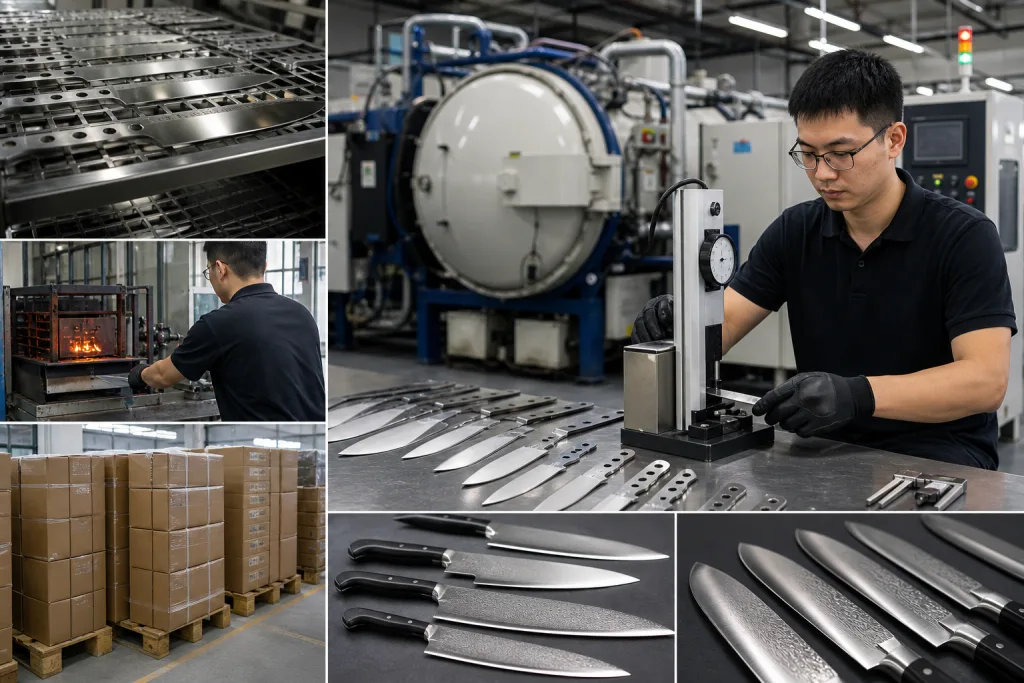
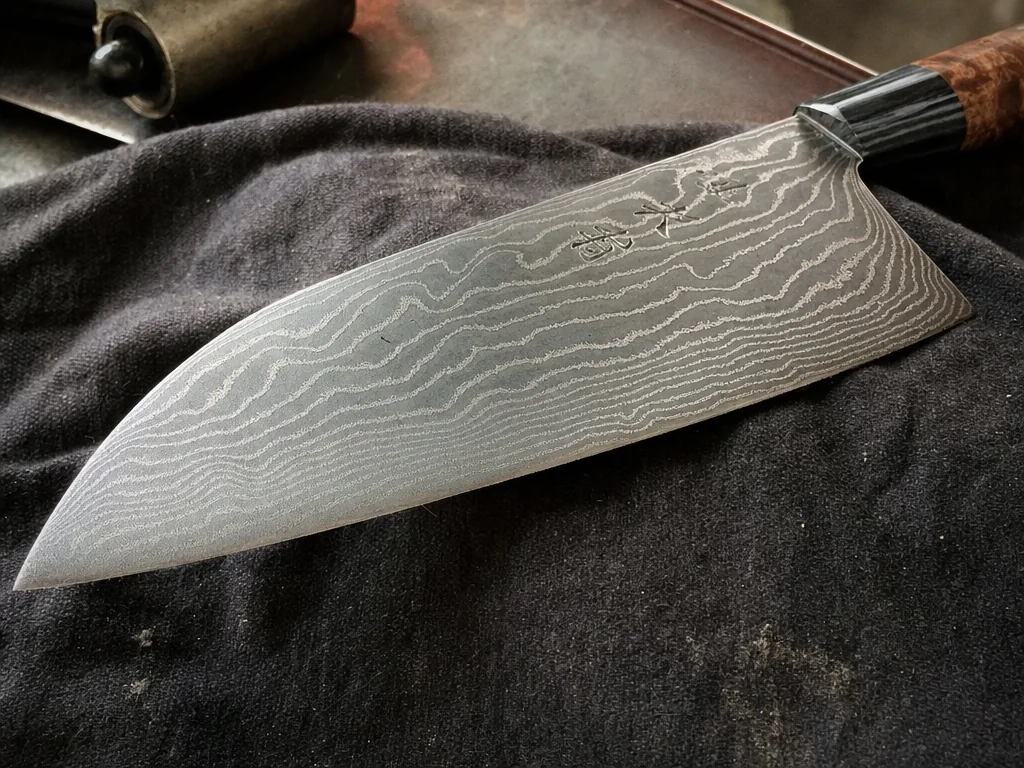
Pakkawood can look perfect in a sales sample. On our floor, we run dyed veneers through a hot press at about 140 C, then the grinding line checks panel bow with a 600 mm straightedge before any handle scale gets cut. A clean sample proves less than buyers think. If you are screening a pakkawood handle manufacturing manufacturer in China or buying pakkawood handle manufacturing through a Zhejiang trading team, color cards are the wrong starting point. Ask for the press spec. Ask for the moisture target. Then ask how they keep left and right scales within 0.2 mm before pinning.
Kitchen knives get left wet. They sit beside sinks, go through repeat washing, and take knocks in dish racks, so the handle cannot open a glue line or walk on the tang. A solid pakkawood OEM in Yangjiang, China gives numbers, not soft claims. We check incoming moisture at 8%-10%. We hold bow after machining under 0.3 mm. A 4.0 mm pin hole should stay within 0.05 mm on the drill jig. Then we talk MOQ 1,200 pcs and 35 days ex-factory. After that, lock the inspection standard. QC pulled the sample on one order because the front pin sat 0.15 mm off center, and the buyer flagged the shadow gap the moment the carton opened. This is where the math works for Europe or North America. Looser control goes sideways.
What Pakkawood Really Is
Pakkawood starts with thin wood veneer soaked through with resin, stacked in layers, then hot-pressed into dense blocks or handle scales. On our handle line, a common scale comes off the CNC at about 120 x 40 x 10 mm before contour grinding and buffing on the sisal wheel. You still get grain depth. It cuts and polishes more like engineered handle stock than plain timber, so we run it on kitchen knives and premium gift sets, especially 8-inch chef knife programs where the buyer wants a warm wood look without getting 47 humidity complaints after the goods land.
The value is stability. Natural wood moves. Pakkawood moves less, so we see fewer claims for swollen handles and shrinkage at the bolster. Lifted edges around the tang also show up less after washing. In a humid kitchen, that matters more than the story printed on the color box. A glossy finish is not the question. Ask about resin penetration, press time, pin-hole tolerance, and whether QC pulled the sample after a water soak test. We have seen cheap dark blocks crack around 3 mm pin holes after repeated washing, even when the first pre-shipment photos looked clean.
For a brand, pakkawood sits in the middle: better retail feel than injection-molded plastic, with steadier batch color than plain hardwood. In Yangjiang, China, we ship it across OEM private label programs because it gives the buyer a premium handle while we still control CNC routing on the handle line and polishing on the cloth wheel, with re-order color kept closer from lot to lot. On a 1,200-piece MOQ, that control matters. The math doesn't work if the handle scrap rate jumps from 2% to 8% after buffing. If the knife is built around a 56-60 HRC blade, pakkawood is one of the safer handle choices, as long as the block supplier and grinding line are treated like part of the knife, not just decoration.
How A Good Handle Is Made
The build order matters as much as the veneer. We sort each sheet by grain direction and color band, then check moisture with a handheld meter; anything above 8% stays out of the resin tank. No exception. After pressure impregnation, the packs cure and go into the hot press as slabs or preforms. From there we run the scales, cut the tang slot on the CNC fixture, drill 3 pin holes if the drawing calls for it, and shape the handle on the grinding line. Push the feed rate from 1.8 m/min to 2.4 m/min just to catch a shipment date and you will see it fast: chipped edges, pinhole breakout, or a handle sitting 0.3 mm proud of the full tang.
On a clean line, the machinist checks the slot before touching the outside shape. Then he confirms both scales hold thickness within about +/-0.15 mm and checks the fresh cut for torn edges under the bench light. QC pulled the sample on one PO last month because the left scale passed, but the right scale had a hairline chip near the front pin. Small flaw. Big problem after polishing. After bonding with epoxy and pins, mass-market SKUs usually get stainless pins; gift-box sets often need brass or mosaic pins because the buyer wants the handle to look more expensive on the shelf. Once the cure is finished, the handle goes through 240, 400, then 600-grit sanding, polishing, and final inspection for color drift, glue squeeze-out, and that scratch that always appears under a 600-grit wheel.
The process looks simple on paper. It is not. This is where a real pakkawood OEM separates itself from a trading-only source. A factory in Yangjiang or Zhejiang should be able to give you the curing cycle, adhesive type, press pressure, and the exact rejection rule when a batch drops below spec. A sales answer is not enough. Ask what they do when one lot comes out 12% more porous than the last, or when the buyer flagged a 0.2 mm handle gap after salt-spray packing review. If they cannot answer in plain numbers, the math does not work; we have seen this go sideways on export orders.
Specs You Should Lock Before Quotation
If the handle spec stays open, the shop will pick the fastest setup on the grinding line. We run into this every month: the buyer sends one photo, the PO says "wood handle," and the first sample comes back with a fat waist, soft corners, and no match to the brand drawing. Quote pakkawood handles from numbers, not from a showroom photo. Lock thickness and flatness in mm. Then state pin material, finish grade, moisture after cure, and how the scales must sit against the tang profile. Skip that, and the operator will shape to the easiest contour off the 120 grit belt.
For a standard full-tang chef knife, these are the starting specs we quote from:
| Item | Practical target | Why it matters |
|---|---|---|
| Handle thickness tolerance | +/-0.3 mm | Keeps left and right scales even after belt grinding on the line |
| Flatness at tang seat | Within 0.2 mm | Prevents glue gaps that QC can spot under side light |
| Moisture content after cure | Under 8% | Cuts warp risk after 30 days in sea shipment |
| Pin material | 304 stainless or brass | Matches corrosion requirements and the shelf look the buyer expects |
| Finish | Matte / satin / polished | Sets grip feel, wipe-clean behavior, and price position |
Do not treat the handle as a loose part. That is the wrong question to ask. A handle can match the drawing and still feel off after assembly on a blade that is 2.0 mm thick at the spine and hard at 58-60 HRC, because the balance point moves and the palm lands on a different shoulder. Ask for a complete sample knife, not loose scales in a polybag. We have seen this go sideways: QC pulled the sample, set it under side light, and found a 0.4 mm glue line at the tang seat after assembly. The buyer flagged it fast.
Sourcing From China Without Guesswork
Sourcing pakkawood handles is not just buying a loose part. You are buying resin color control, kiln drying records, CNC repeatability, and the discipline to ship the same handle shade in March and again in July. In Yangjiang, we run handle shaping, knife assembly, laser marking, inner-box packing, and carton labeling under one roof, so private label jobs do not bounce between 4 subcontractors. Good start. The quote is only page one. Before the PO is released, QC should pull the sample, measure the tang slot in mm with a Mitutoyo caliper, compare the handle color against the signed color board, and confirm the carton mark line by line.
A factory with about 240 employees and a monthly output around 80,000 to 120,000 knife handles or assembled knives should support OEM programs without dragging the schedule. For custom pakkawood, a realistic MOQ is often 300-500 pieces per handle color or knife model, with sample turnaround in 7-10 days and bulk lead time around 35-45 days after approval. We usually see the grinding line waiting on handle drying, not blade stock. That matters. If a supplier promises 10,000-piece flexibility on day one, this is the wrong question to ask. Ask how they control signed color boards, moisture at final sanding, CNC spindle capacity, and rework when the buyer flags shade difference under D65 light.
For Europe and North America, ask for ISO 9001, BSCI, REACH, and any LFGB or food-contact declaration that applies to the finished knife. FOB needs clean packing specs, export marks, and carton strength that survives a drop test, not a pretty unit price hiding weak K=K cartons. DDP is a different deal. Check who carries the customs risk and whether the carton labeling matches your FNSKU or retail barcode plan; we have seen shipments delayed because one PO had a single digit wrong in the barcode file. The paperwork should match the product. The product should not chase the paperwork.
What Moves The FOB Price
Pakkawood does not raise FOB just because the block looks premium. Cost sits in CNC time, drilling accuracy, and extra passes on the buffing wheel. Fit matters. We run a straight-scale handle with a standard drilling jig fast, usually 18-22 seconds per drilling cycle. A contoured Western chef handle with hidden-rivet details, a clean full bolster transition, matched left/right scale color, brass or mosaic pins, and final assembly off the in-house line eats labor. If QC pulls the sample and finds a 0.2 mm shoulder gap at the bolster, it goes straight back to the grinding line.
On a mid-market kitchen knife, a basic pakkawood handle adds about USD 0.80-1.80 to FOB. Ask for a stainless steel bolster that needs hand blending. Add a matching end cap with a tight flush fit. Put in a mosaic pin, and drilling plus alignment slow down on the bench press; one operator may finish 450 plain handles per shift but only 260-300 with mosaic pins. Then the build moves into the USD 2.20-4.50 range, driven by steel grade, finish level, and the time spent on fit-up. Special colors add cost too; resin-dyed veneer batches need tighter sorting under daylight lamps, and the buyer will flag it fast if one scale is half a shade darker than the other.
Tooling is modest next to metal molds, but custom contour fixtures still matter, and the same goes for drilling jigs and inspection gauges. A first-order sample fee of USD 40-120 per handle style is normal, especially if the project includes multiple grain directions or custom branding; we have seen one PO typo on grain direction turn 30 sample sets into scrap. The cheapest quote in China usually leaves out the handwork buyers notice on first touch, like a clean bolster blend or tight scale alignment checked with a 0.05 mm feeler gauge. The math does not work. This is the wrong place to save money.
Quality Checks That Prevent Returns
Pakkawood usually fails in the same spots. Weak curing shows up as delamination, often after 3 hot-water cycles at the QC bench in a small stainless tank. Moisture above 10% will twist the scale or open a hairline gap at the tang seam. Bad sanding is easy to catch. Run a thumb from the choil to the butt end and the low spot shows itself. Poor adhesive is where returns start. After thermal cycling and washing, the pins start to click, and the buyer flagged it in the first carton check on a 12-piece pull.
A practical QC plan starts with incoming block checks and in-process fit checks, then ends with a final audit under AQL 2.5 for major defects and AQL 4.0 for minor cosmetic issues. We run a pin-type moisture meter on each wood lot, check 20 fitted handles before polishing, then pull samples after the grinding line for hot-cold cycles and dye-bleed wipe tests with a white cotton cloth. Add a 24-hour humidity exposure test before batch release. For retailer programs in Europe or North America, appearance-only inspection is the wrong question to ask; one 1.0 mm glue gap is enough to turn a clean margin into chargebacks, and the math doesn't work.
Final inspection should stay on fit and finish where returns start, not on gloss. QC pulled the sample, checked handle-to-blade alignment on a granite plate, ran a 0.05 mm feeler gauge at the front bolster area, and rejected the lot if the glue line opened under light pressure. We also check tang seating, pin flushness within 0.10 mm, and the front and rear edges where the buffing wheel likes to round one side more than the other. A good factory in Yangjiang, China will not hide defects under gloss. Once cartons are sealed, the problem is your problem. Ask for process photos with lot coding, plus retention samples from every shipment; we have seen this go sideways when a PO typo mixed two pakkawood colors in one batch.
What To Put In Your RFQ
A clean RFQ cuts 5 to 7 days of email loops. For a pakkawood OEM job, send 1 reference knife, 1 dimensioned drawing, and 1 finish photo showing grain direction and gloss under normal shop light. Put the main sizes on the drawing in mm. Mark the no-go points: handle thickness tolerance, 5 mm pin hole, tang gap, bolster step, butt-end radius. Then list blade steel and target HRC. Add tang style, handle length, pin material, packaging format, and annual forecast. We hear the same buyer pushback nearly every month: one factory priced hand-sanded gloss, another priced machine satin, so the quotes looked 18% apart. Wrong comparison. Make every supplier quote the same finish level and carton setup, or the math doesn't work.
Put the details up front. In round one, include wood tone, gloss level, logo method, blade coating if any, private-label boxing, laser engraving, and mixed-SKU carton rules. If the program must fit EU retail shelves, say it early and give the shelf height limit or peg-hole position. QC pulled a sample last quarter where the box was 4 mm too tall, and the buyer flagged it after print approval. Bad timing. If you need Amazon-ready labeling, mark the label size and barcode position on the artwork. We ship separate packing for retail, club store, and e-commerce orders; the supplier should quote around your sales channel, not whatever runs fastest on the packing table.
Specifics win. For buyers in Yangjiang, Zhejiang, or anywhere else in China, the strongest RFQ has exact drawings and hard acceptance criteria. Call out color range, allowed tang gap, pin flushness, gloss target, and warp limit. On our grinding line, QC checks handle flushness with a 0.05 mm feeler gauge, so a note like "match sample" slows the job before the CNC fixture is even opened. A clear spec lets the factory tell you fast if the design can run, how many sanding passes it needs, and where the hidden cost sits. We have seen this go sideways: the showroom sample looked clean, but batch goods showed glue lines after 800 sets. Simple sentence, hard work: turn one polished sample into repeatable production, then ship the same knife on batch 1 and batch 10.
Frequently asked questions
It is far more water-resistant than natural wood, but it is not a magic waterproof material. Properly made pakkawood uses resin-stabilized veneer, so it handles daily kitchen moisture, wiping, and normal washing much better than plain hardwood. The problem usually appears when the factory cuts corners on curing, adhesive, or sealing at the tang. For a kitchen knife used in a restaurant or home kitchen, I would still expect the handle to tolerate repeated wet-dry cycles if the moisture content is under 8% and the glue line is clean. Do not market it as maintenance-free. Tell buyers to avoid dishwashers if you want the knife to last.
For a real OEM program, 300-500 pcs per color or handle style is a normal starting point. Below that, the factory spends too much time on setup, color sorting, and inspection, so pricing jumps fast. If you want multiple colorways, each one often needs its own MOQ. Sample lead time is usually 7-10 days, and bulk production is often 35-45 days after approval. If a supplier offers 100 pcs with no premium, check whether they are actually holding stock or just planning to mix your order into another batch. In China, especially in Yangjiang, the best price comes when the factory can batch your handle with a stable production run.
You can get close, but you cannot assume perfect repeatability unless the supplier controls resin dye, veneer selection, press cycle, and final polishing. Pakkawood is naturally variable because the grain pattern and resin uptake change from lot to lot. The right way to manage it is to approve a physical master sample, define an acceptable delta, and keep retention samples from every shipment. For a premium kitchen knife line, I would ask for batch photos under the same light source and a written tolerance for tone shift. If color consistency is critical, keep the order on one production window instead of splitting it across separate runs.
Pakkawood works best on chef knives, santoku, nakiri, slicing knives, and premium fixed-blade kitchen sets where the handle is part of the retail value. It also works on some outdoor and gift knives, but kitchen knives are where the material makes the most sense because customers want a warm grip and a premium visual. On blades around 56-60 HRC, the handle should feel balanced and secure rather than oversized. If the knife is very light or very short, a heavy handle can make it feel awkward. Ask the factory to show the balance point, not just the handle photo.
Ask for the exact material stack, curing method, thickness tolerance, moisture target, pin material, finish level, MOQ, lead time, and inspection standard. Then ask for factory certifications such as ISO 9001, BSCI, REACH, and any food-contact paperwork that applies to your market. For export, confirm whether the quote is FOB, EXW, or DDP, and whether carton labeling can match your retail or Amazon requirements. If you are buying from Yangjiang or through a Zhejiang export team, insist on lot traceability and retention samples. A supplier that answers these questions clearly is usually safer than one that leads with a low price and vague promises.
Request a pakkawood OEM quote
Send your drawing, target finish, and forecast. We will check feasibility, MOQ, lead time, and export packaging before you lock the spec.
Request a Quote