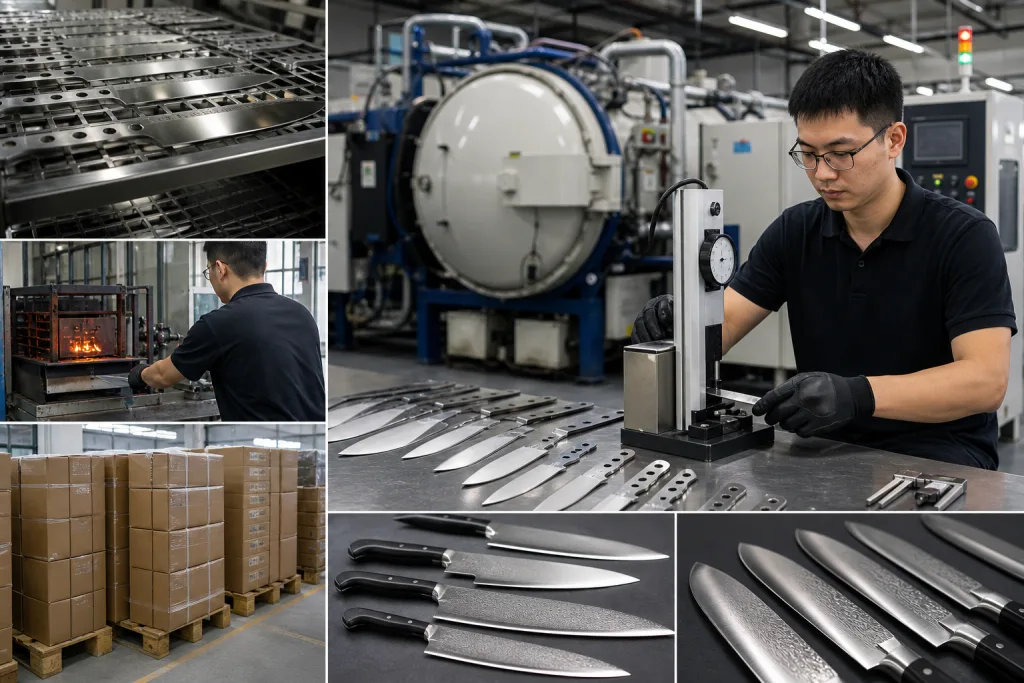
S35VN sits in the price band where the customer expects a premium blade clipped into a pocket, not parked in a display case. We ship this grade for EDC folders and slim fixed blades because buyers ask for edge retention on a thin grind, plus fewer rust complaints after 7 days of pocket sweat. Same pushback every season from sourcing teams in Yangjiang and Zhejiang: if the blade chips on the first cardboard test, the SKU is dead. Fair point. On our grinding line, 3.0 mm stock with a 0.35 mm edge before heat treat is a common starting point for this steel.
The wrong question is whether S35VN is an automatic upgrade. It is not. Final performance comes from heat treatment, blade geometry, surface finish, and whether your s35vn knife steel guide manufacturer runs the process on the floor instead of copying a spec sheet into a PO. QC pulled the sample on one OEM order last year and found the bevel drifting 0.2 mm side to side; the buyer flagged it before packaging, and they were right. If you are planning s35vn knife steel guide sourcing for a private-label or OEM launch, ask for a spec that survives production, inspection, and daily carry. Otherwise the math does not work.
What S35VN Actually Gives You
S35VN is a powder metallurgy stainless steel that cleans up two old complaints with premium grades: chippy edges and slow grinding. Wear resistance still stays solid. For an EDC buyer, that shows up as a blade that holds a clean working edge and resists rust better than 8Cr13MoV or 440C class steels, yet real users can still touch it up on a 1000/3000 grit stone. Good trade. On our grinding line, with a fresh 120-grit ceramic belt, S35VN saves about 12-18 minutes per 100 blades against harder chippy steels because the belt does not tear the shoulder at the plunge so easily. That is the commercial value, not the lab brochure.
In the field, S35VN fits folders in the 2.5-4.0 mm blade range and compact fixed blades where one knife has to break down double-wall cartons in a warehouse, trim 10 mm rope at the packing bench, then still slice lunch and handle light camp work without complaints. Most brands run 59-61 HRC because that is where the steel still forgives daily use. Push hardness too high and the buyer loves the edge-retention claim on paper, then QC pulls a chipped-tip sample from a 1-meter drop test and the returns start. Pull it too low and you waste the premium story. The math does not work.
Compared with non-powder stainless options, S35VN sits in a safer premium tier for brand positioning. It is not exotic. That helps. Asking whether it sounds rare enough is the wrong question. A distributor can explain it in two lines on a product page: US-made powder steel with balanced edge life and toughness. No long lecture needed. For Europe or North America, that supports a sensible MSRP for premium EDC without forcing the knife into a luxury-only channel. One buyer flagged this on a PO last year: line 4 said “S35VN stainless,” but the listing team wanted “CPM S35VN” because search traffic and buyer trust changed the click rate.
How To Spec It Properly
A real purchase spec should say more than S35VN. Name the bar stock or blank source. Put target hardness, blade thickness, finish, and edge angle on the PO, not buried in a WeChat screenshot. For a premium EDC folder, we usually run 2.8-3.2 mm stock, a 20-22 degree inclusive edge, and 59.5-60.5 HRC. That baseline works. On the grinding line, 3.0 mm leaves enough steel to clean the bevel after heat treat without chasing warp on every tray. One PO typo we saw last quarter said 22 degrees each side instead of inclusive, and the buyer flagged the first sample as too thick behind the edge. Fair pushback. If you want a harder, slicier blade for a small enthusiast run, sample 6-10 pcs first and cut rope, cardboard, and zip ties before approving mass production. Do not guess here. The math gets ugly after 500 pieces.
Ask for heat-treat records, not just a promise from sales. In a s35vn knife steel guide manufacturer quote, ask for the austenitizing window, each tempering cycle, the cryo step if used, and final Rockwell readings from 3 pieces per lot. QC pulled the sample on one run with a Wilson tester and found 58.7 HRC on blades sold as 60 HRC. Paperwork matters. Call out whether the blade is flat ground, hollow ground, or saber ground. Geometry changes the feel more than the steel name; a thick 58 HRC saber grind can cut worse than a thin 60 HRC flat grind. This is where buyers ask the wrong question. “Is it S35VN?” is not enough. If the handle material is heavy, the knife can carry nose-light or tail-heavy compared with your first drawing, so lock the steel spec together with the full BOM and check the balance point in mm from the pivot.
| Item | Recommended Buyer Spec | Why It Matters |
|---|---|---|
| Hardness | 59-61 HRC | Keeps edge life up without turning warranty sharpening into a fight |
| Blade thickness | 2.8-3.2 mm | Sets cut feel and how much warp the grinding line can clean |
| Edge angle | 20-22 degrees inclusive | Works on common stones and survives carton work in warehouse tests |
| Inspection | AQL 2.5 | Catches fit gaps, grind drift, and finish misses before we ship mass production |
Sourcing From China Without Guesswork
For s35vn knife steel guide sourcing, the first filter is not the country. It is the factory system. China still makes sense here because tooling cost stays workable, MOQ stays lower, and in Yangjiang you can drive 20-40 minutes between CNC, wire-cut, grinding, vacuum heat-treat, and packing vendors. Yangjiang has the densest knife chain. Zhejiang shops usually hand back cleaner finishing and better retail packing. Ask for the boring records first. Who buys the S35VN bar stock and keeps the mill lot record? Who signs the heat-treat curve after the vacuum furnace run? Does bevel grinding stay in-house on the grinding line, or does it go to a subcontractor? We have seen this go sideways: the buyer approved a clean sample, then QC pulled production blades with a 1.2 mm uneven swedge after the grinding line changed hands.
A serious Chinese OEM should turn sample development in about 15-20 days. After approval, production usually lands in roughly 35-50 days, depending on finish and complexity. For a mid-sized program, MOQ often starts around 300-500 pcs per SKU on a standard folder or slim fixed blade. Monthly output matters. By itself, that is the wrong question to ask. A capable plant in Yangjiang or Zhejiang may run 60,000-120,000 units per month across several knife categories, but you need the split: how many are S35VN or similar premium stainless builds, and how many are 3Cr13 promotion knives. We run the math by line, not by brochure. CNC handle machining hours, vacuum furnace slots, stonewash barrel count, the final AQL table, then packing speed at 18 cartons per hour. Capacity is not the same as relevant capacity.
Use the first sourcing round to test response speed and technical control. FOB price alone is cheap talk. Short emails tell a lot. If a supplier cannot answer HRC tolerance, surface finish, packaging, and traceability questions without sending five sales slogans, they are not ready for a premium EDC program. Ask for the steel invoice copy, the heat-treat record, hardness check points, and the carton spec; one buyer flagged a PO typo where "S35VN" became "S30V" in the Chinese remark line. Catch that before deposit. We have seen one wrong remark line hold a 500 pcs run for two days while the warehouse relabeled inner boxes. That is dead time. Long-term private label work needs that discipline, because the math does not work when every reorder turns into a new sample fight.
Heat Treat Changes The Result
S35VN is strong steel, but heat treat decides whether the knife feels like premium EDC or just an expensive logo. Same alloy. Two China factories. Two bench results. We once checked 30 sample blades from one S35VN batch and found the bite changed because the vacuum furnace soak, plate quench delay, and second temper window were not held the same. On our side, QC pulled the sample after grinding, wiped the ricasso clean, and checked it on the Rockwell tester before any PO moved to bulk. A proper s35vn OEM program needs sample knives, HRC records, and one real cutting test before the order is locked.
For EDC knives, the blade has to open cleanly, slice cartons without drama, and survive zip ties or packing straps without small chips along the edge. Push hardness too far with a thin edge and the lab sheet looks clean, but the buyer flags chipped edges after 12 days of warehouse use. We've seen this go sideways. Run it too soft and edge rolling shows up fast, usually near the belly after 200-300 cardboard cuts. The right call depends on blade geometry and lock type. “Highest HRC” is the wrong question if the customer is selling office carry instead of hard-use tactical EDC.
Be specific with the factory about temper count, expected hardness spread, and acceptable deviation. A sensible production spec allows a small band, not a fake perfect number. If the target is 60 HRC, I would rather sign off a documented 59-61 HRC band than hear every blade is exactly 60.0. The math doesn't work. For one 500-piece run, we checked 8 blades per carton group and wrote the HRC values beside the laser-marking sheet; procurement, QC, and distributors trust records more than showroom talk.
Pricing, MOQ, And Commercial Terms
S35VN is not the cheap stainless slot. We quote it that way. For premium EDC, the steel premium only makes sense when the handle, lock, clip, box, and inspection standard match the blade. In China, the landed cost gap versus a mid-tier stainless blade is usually US$3 to US$7 per knife, but that gap does not set your retail price by itself. Check the full BOM. On our side, a 3.2 mm blade blank is one line; G10 upgraded to titanium, a crossbar lock that needs hand fitting, two extra passes on the grinding line, a deep-carry clip, EVA box insert, and AQL table checks can move the quote faster than the steel.
In practical FOB terms, a simple premium folder using S35VN usually carries a blade-cost uplift of about US$3.20 to US$6.80 per piece over mainstream stainless, depending on geometry and finish. Stonewash after belt satin, DLC, or a 0.03 mm grind tolerance on a complex flipper or crossbar lock adds cost because we run more checks and scrap more parts during setup. Normal factory pain. If a buyer asks for S35VN with DLC on a crossbar lock and still wants 9Cr pricing, the math doesn't work. Price the full BOM, not just the steel line.
Good sourcing needs commercial discipline. Ask for sample pricing and volume breaks. Ask whether the MOQ stays at 300 pcs or drops to 150 pcs after the first production run, once we already hold the fixture, carton mark, and packaging file. If you are selling into the US or EU, write the term clearly: FOB Shenzhen, DDP, or delivery to your 3PL. We have seen one PO typo switch the term and burn US$2.40 per knife in freight, duty, and intake fees before QC pulled the sample. The best buying decision still holds margin after inspection, freight, and packaging hit the sheet.
Quality Checks Before Launch
Before you greenlight a premium EDC launch, write the test plan for the exact knife you will sell. A generic QC sheet is the wrong place to start. We run incoming S35VN checks by steel lot, then QC pulls hardness on the Rockwell tester against the HRC window signed off on the pilot sample. Check steel identity first. Then measure edge-bevel consistency in mm at heel and tip, cycle the lock, test clip fit, verify screw torque, screen the finish for defects, and run a corrosion response check. On the factory side, I want ISO 9001 discipline plus lot traceability on the traveler card, then final inspection at AQL 2.5 on the appearance and function items that actually trigger claims. Last year QC pulled one sample with 0.4 mm blade-centering drift after assembly. Small miss. Big buyer complaint. If the knife will retail in Europe or North America, lock the packaging artwork and material declarations before mass production starts, not after the first shipment is on the water. The math doesn't work then.
For performance validation, cut real material. Paper cuts are too kind. We run double-wall cardboard first, then 550 paracord and zip ties, then light food prep on the bench, because that shows more about edge stability than a polished spec line. Some buyers ask for CATRA data for internal benchmarking. Fair ask when they compare S35VN against VG-10 or D2 across several programs. Read the score with blade geometry and heat treat; a 20 dps edge and an 18 dps edge do not tell the same story. Corrosion claims need a salt spray or controlled wipe-down test, not sales wording. If the handle or liner materials are part of the premium pitch, test the full build: scales for rub marks, pivot action after cycling, washers for grit pickup, screws for backing out, liner contact, and clip finish. We have seen this go sideways when the blade passed but the black oxide clip showed red spots after 48 hours and the buyer flagged it.
If the product is for private label, lock the blade steel callout and logo method, then freeze the box insert and barcode labeling before the pilot run. Laser marking depth and FNSKU placement belong on the approval sample. So do the carton side mark and retail box color, not somebody's memory after the pilot leaves the line. One buyer flagged a PO typo where the box said S35VN but the insert said S30V. We had 3,000 inserts packed already. Fixing that after packing starts is the wrong kind of busy. If you need laser marking or FNSKU placement, and the retail packaging is custom, build it into the approval stage so the final batch does not come back for rework. Cleaner launch. Better margin.
Frequently asked questions
Yes, if your customer expects a premium blade and you can support the price. In a typical EDC build, S35VN at 59-61 HRC gives a strong balance of edge retention, toughness, and corrosion resistance. It is a better story than generic stainless, but it only pays off if the grind, heat treat, and finish are controlled. For a China OEM order, the extra steel cost is usually easier to absorb in a $80-180 retail knife than in a budget line.
For most premium EDC knives, 59-61 HRC is the safest target. That band usually gives you practical edge retention without making the blade too brittle for everyday carry. If the design is thin and slicey, stay near the middle of the range. If the blade is thicker or more hard-use oriented, you may want the lower end. Always ask the factory for batch hardness readings, not a single sample number.
S35VN is popular because it is easier to sell and easier to use than many ultra-hard options. It is not the highest-wear steel available, but it is very workable for premium EDC. For a buyer, that means fewer complaints about sharpening and less risk of brittle edges when the knife is used daily. It sits in a practical premium zone, which is why many brands sourcing in China use it for mid-to-high tier folders.
For a standard S35VN EDC program, a realistic MOQ is often 300-500 pcs per SKU, depending on blade shape, finish, and packaging. If you need a custom lock, special coating, or unusually tight tolerances, the factory may push the MOQ higher. Sample development usually takes 15-20 days, while production after approval commonly runs 35-50 days. Ask for those dates in writing before you approve tooling.
Test the knife in real use, not just on paper. Check hardness, blade centering, lock engagement, edge sharpness, and consistency across at least a small pilot batch. For premium EDC, I would also review corrosion resistance, packaging accuracy, and cosmetic finish. If the supplier is in Yangjiang or Zhejiang, ask for lot traceability and a clear inspection standard such as AQL 2.5. That gives you a more reliable launch.
Specify Your S35VN Build Now
Send your target HRC, blade geometry, and annual volume. We can turn that into an OEM spec, sample plan, and China pricing structure without wasting time on vague quotes.
Request a Quote