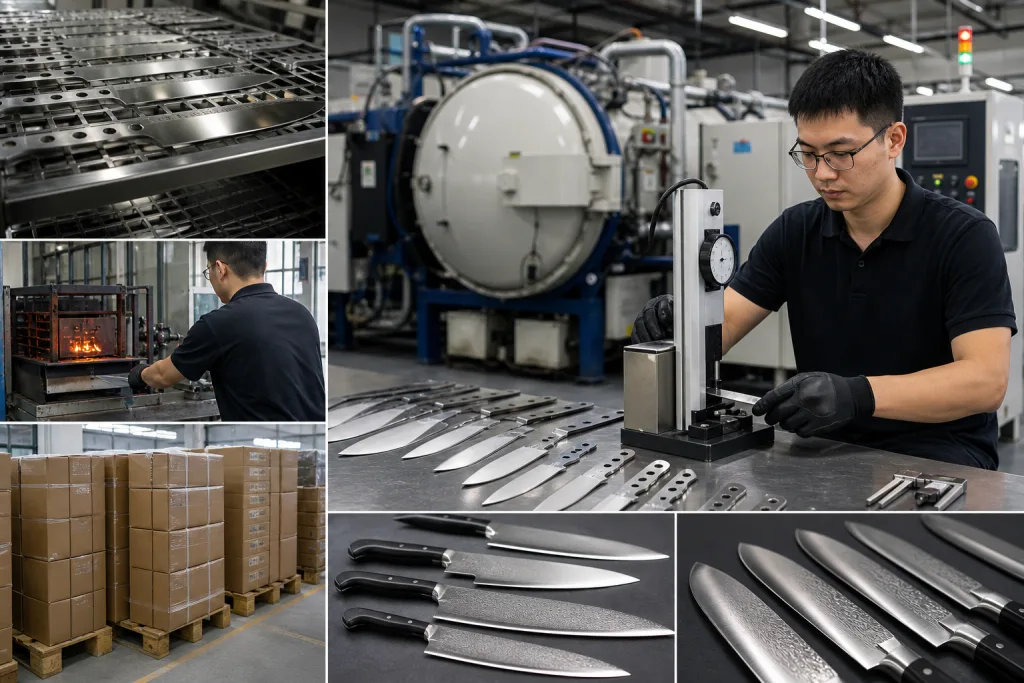
San mai knife construction looks simple on a spec sheet: hard core at the edge, softer cladding on both faces, clean story for the retail box. Too thin for buying. A kitchen blade that must hold 60-62 HRC, come back straight after heat treat, and still pass AQL 2.5 is a different order from a display knife with a shiny lamination line. Last month QC pulled one 8-inch chef sample and found 0.6 mm core drift near the tip under a Mitutoyo caliper. Pretty blade. Wrong buy.
If you source from Yangjiang, China or through Zhejiang trading channels, ask for the steel stack, bond method, grind allowance, and test plan before anyone opens the packaging artwork file. We run different grinding line settings for real san mai versus cosmetic cladding, often leaving 0.2-0.4 mm extra allowance before final polish so the core stays centered after thinning. A serious san mai knife construction manufacturer should spell out core steel and cladding steel, then give MOQ, lead time, and whether the line is set up for OEM or private label work. One buyer flagged this as “same look, lower price” on the PO. The math does not work when the edge steel is the reason you are paying more.
What san mai actually is
San mai means three layers. The middle steel forms the edge; the two outer steels protect the blade from board hits, side pressure, and sloppy cutting angles. For kitchen knives, we usually run a stainless core with stainless cladding, not a shiny laminate made only for shelf photos. On our grinding line, a 2.0 mm chef-knife blank often starts with about a 0.8 mm core, and the first caliper check at blanking tells us quickly if the stack is drifting. Performance comes first.
Start with the edge. The core does the cutting. The cladding gives the blade more forgiveness and makes grinding less punishing on the line. We run the first pass on a 120-grit belt, and the softer outer steel cleans up faster than a full-hard blade, so the operator is not fighting the platen on every blank. Drop the knife on a board or twist through a hard squash, and you get more margin before the edge chips. That is why we ship san mai in chef knives and utility knives for buyers who want bite at the edge without the brittle feel of a full-hard blade.
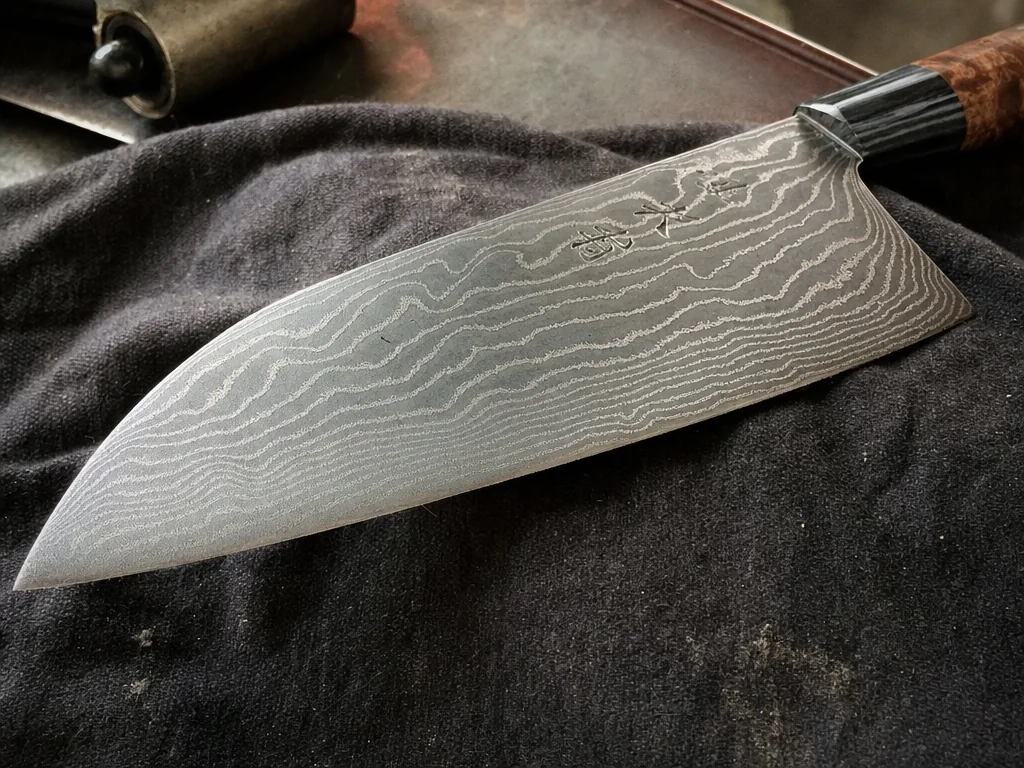
Do not confuse san mai with pattern-welded Damascus. Damascus sells the surface pattern. San mai sells the layer structure and the cutting feel behind it. A clean line at the cladding boundary is normal. QC pulled the sample after a light etch last month, and the core had drifted 0.3 mm toward one face at the heel; the buyer flagged it in photos the same day. If that line waves or the core sits too close to one side, the problem is usually grinding or bonding, and we have seen this go sideways after the steel is already cut.
For buyers in China and Europe, ask this first: do you want a blade that feels aggressive at the edge and still forgives normal kitchen abuse? If yes, san mai fits. If the target is the lowest possible cost, monosteel is easier to sell, and the math does not work on san mai at a 600-piece MOQ. One PO last quarter even came in with "sanmi" typed on the item line, but the target FOB was still monosteel money. Chasing the lowest FOB is the wrong question for a premium kitchen line. San mai gives you a cleaner upgrade story without exotic handle work or oversized packaging.
Choose the right core steel
The core steel sets the cutting feel. This is where san mai programs make money or burn it. For mid-premium lines, we run 10Cr15CoMoV on a lot of export orders because the price holds and stain complaints stay low. The 59-61 HRC range is also repeatable in batch production. After tempering, QC checks each lot on the Rockwell tester. That window gives a crisp edge without turning weekly resharpening into a fight.
VG10 still sells well when the brand wants a steel name the retail box can print, and we usually run it at 60-62 HRC. It costs more than basic stainless cores. On fine slicing, the bite is cleaner, but bad work on the 220 grit belt shows up fast at final polish. SG2 or R2 sits higher. At 62-64 HRC, it keeps working longer on 8 inch chef knives, often 18 days vs 12 days in our repeat slicing checks, but the math doesn't work unless the grinding line and heat treat stay steady. We have seen SG2 go sideways when QC pulled the sample and found the bevel running 0.4 mm thicker on one side. The buyer flagged it in the first pilot, and a performance claim turned into warranty noise.
For heavy kitchen use, I would not push hardness past the job. Wrong question. If the buyer starts with "What is the highest HRC you can do?", we slow the spec talk down and ask who will sharpen the knives. A restaurant buyer cutting vegetables for 8 hours may prefer 58-60 HRC if the knife gets sharpened every week and passed across 12 different users. Retail customers buy edge retention. Line cooks buy predictability. We once got a PO with "62 HCR" typed on it, which told us nobody had checked the real use case. Know what you are selling before you lock the steel spec on the PO.
- 59-61 HRC: the safer band for general use, and easier to resharpen when the knives move through mixed users in home or back-of-house kitchens.
- 60-62 HRC: the premium range most brands can sell without trouble, especially VG10 programs where the steel callout sits on the box front.
- 62-64 HRC: strong performance if QC stays tight; chipping complaints rise fast when grind control or tempering drifts, especially once edge thickness drops under 0.25 mm before final sharpening.
Tough cladding changes the game
The outer layers are not decoration. They decide what happens when a cook clips the board, forces the knife through kabocha, or leaves it wet beside the sink after prep. For kitchen knives, we run low-carbon steel or ferritic stainless cladding because it behaves better on the grinding line. Less wheel loading. Fewer hot spots. A 1.8 mm blank also stays flatter than hard core stock after rough grinding. The cladding should be tougher than the center steel, not harder. We check it every week with the boring kit: a surface grinder for the first pass, a dial indicator on the bench, plus a straightedge under white light.
You see that toughness in use first. QC pulled a sample last month after 30 board taps; the cladding took the scuffs, while the core edge stayed clean. It also hides wear better than a fully polished monosteel face. If your brand wants a hammered face with 0.3 mm dimples, a 400-grit brush, or a light acid etch, san mai gives enough room for that styling without making the edge section fragile. Chasing cosmetics first is the wrong question. A clean-looking blade with a weak bond line comes back in the carton, usually with an angry email and photos taken under a restaurant hood light.
For a tougher commercial spec, I want cladding that survives repeated grinding without burn-through and still comes out flat after heat treat. On a 210 mm chef knife, we watch total stock at 2.5 mm and check straightness with a 0.20 mm feeler gauge; if it moves past that, the grinding line pays for it later. Blade warpage often starts from poor flattening or a weak bond line, not from the steel grade printed on the quotation sheet. This is where a san mai knife construction manufacturer earns its margin: the outer layers have to survive the factory, the carton drop test, and a busy kitchen, not a photo shoot.
Surface treatment changes the complaint rate. Polished cladding shows scratches fast. Stonewash and a 320-grit brush hide handling marks better. We ship both, and on one 1,200-piece restaurant order the mirror face ran a 3.6% complaint rate while stonewash stayed at 1.4% because the buyer flagged tray marks in week one. For restaurants and B2B channels, the math doesn't work on a mirror look if staff stack knives in plastic trays by day three.
How a factory builds it
On the factory floor, san mai starts with bonded steel stock. Then we run blanking and rough grinding. After heat treat, the blades go to straightening, finish grinding, polishing or etching, handle assembly, and final sharpening. The bond decides the knife. If the rolling mill leaves a weak line between the core and cladding, the grinding line can hide it for a few hours, but QC still catches layer drift or a hairline split after etching under a 10x loupe. Ask where the steel billet comes from and how the mill bonded it. Then ask which station checks warp and which one checks center-line alignment.
In Yangjiang, China, a plant with about 240 employees that runs steady can support repeat OEM runs above 100,000 pcs per month once the jigs are locked and the furnace setting is fixed. If the packing spec keeps changing, output slips fast. For one SKU, 1,000 pcs is a practical MOQ. Repeat production usually runs 35-45 days after sample approval. We have seen Zhejiang traders quote 25 days on paper, then lose 12 days waiting for blade blanks because they could not name the heat treat window or the rolling supplier. One PO even had the handle finish typed wrong, and that cost 3 days on sampling because the shop card said sandblast and the buyer wanted brushed. The math doesn't work.
For kitchen knives, watch two points on the line: pre-grind allowance and post-heat-treat straightness. Final edge symmetry still matters, but this is the wrong question to ask on a sales call. It belongs in QC with a caliper and edge gauge, then a cutting test on paper. If the blade is ground too thin before heat treat, you will fight warp; QC pulled one sample last year that moved 1.8 mm off center after quench. If it stays too thick after finish grinding, the knife feels cheap in the hand and the edge takes more passes on the 400# belt to tune.
Ask for the factory process in writing. A real san mai OEM line should state furnace temperature control, quench media, straightening criteria, and rework limits without hand waving. If the answer is only "our master worker controls it," push back. We have seen this go sideways after mass production starts, especially when the straightening limit was never written down and the buyer flagged 2 mm tip lift on the granite plate at final inspection.
Spec the purchase order
Most sourcing mistakes start with a tidy PO that leaves out the shop-floor specs. For san mai kitchen knives, write the steel stack, target HRC, grind, finish, edge angle, carton spec, and compliance papers into the PO itself. If the line says only "8 inch chef knife, san mai," the factory will choose cladding thickness and final polish against its own cost target. Bad start. We once saw a buyer write VG-10 on the quote sheet and "VG10 look" on the PO. QC pulled the first sample from the hardness tester at 58 HRC, the buyer flagged it, and the argument took 12 days to close.
Use the table below as a working spec for a kitchen knife program that needs a premium shelf story but still has to pass carton drop, daily prep work, and return-rate math. Some buyers ask for the lowest san mai price first. That is the wrong question to ask before the core steel, grinding time, and defect allowance are locked.
| Spec | Target | Buyer note |
|---|---|---|
| Core steel | 10Cr15CoMoV, VG10, or SG2/R2 | Match the core to your retail price band, then state the whetstone feel you want; "VG10" alone does not tell the grinding line how the edge should finish |
| Hardness | 59-61 HRC for mid-premium, 62-64 HRC for premium | Ask for 5 batch hardness checks from the Rockwell tester across the lot, not one clean reading from a display sample |
| Blade thickness | 2.0-2.4 mm at the spine for chef knives | Keep it thin enough for clean cutting, with enough spine left for export cartons and kitchen drawer knocks; under 2.0 mm is where we see complaints climb |
| Edge angle | 15-20 degrees per side | Lock the angle across the lot; the grinding line should follow the spec sheet, not each operator's hand feel |
| Inspection | AQL 2.5 for major/minor defects | Define critical defects separately: bond failure, visible delamination, and blade warpage over 1.5 mm measured on the inspection plate |
| Compliance | REACH, LFGB, FDA as needed | Check handle material, epoxy, coating, and anti-rust oil, not only the blade steel; labs will not accept a guess from the packing room |
For commercial buyers, spell out trade terms. FOB China is easier to compare across suppliers than DDP, because freight and duty can hide the real unit price. If you need landed cost, run it on a separate sheet with carton CBM, duty rate, and local delivery. We had one buyer flag a USD 0.42 price gap, then find USD 0.68 buried in DDP freight after the carton size changed by 18 mm. The math does not work when the knife price and logistics price sit in the same foggy line.
Test the sample like a buyer
The best sample is not the one that looks clean under the light box. It is the one that still cuts on cut 50 the way it did on cut 1. We put it on a granite plate and slide a 0.05 mm feeler gauge under the edge. Core centering first. Then the cladding line from heel to tip. Look for blue burn from the grinding line, an open bond at the heel, or any twist you can feel when the spine rocks on the plate. Then cut. A proper chef knife should slice copier paper cleanly. It should skin a tomato without crushing it. After 50 passes on maple, the edge should still bite instead of skating.
If you have access to CATRA, use it. If not, we run the same knife profile on the same end-grain board at the same 15 degree per side angle for the same 100-cut cycle. Record the drop-off. First-cut sharpness is the wrong question to ask. What matters is how far the edge falls after 40 cuts, 80 cuts, and 100. A blade that lasts 20-30 percent longer in a repeatable internal test is worth paying for when the customer sells premium kitchenware at 49-89 USD retail. If you cannot measure performance, the math does not work. The factory can ship you polish and a clean cladding line.
Watch the failures that show up after handling, not on day one. QC pulled the sample after 30 hard cuts and found micro-chipping at the heel under a 10x loupe. Another piece rolled at the edge after cutting squash. One yellowed along the cladding line after a hot wash cycle, and the buyer flagged it before pilot order approval. We have also seen a 0.3 mm handle gap open after thermal cycling from 5 C storage to a 60 C rinse. Those are the complaints that hit Europe and North America, where buyers expect 500 pieces in the lot to stay stable, not one photo sample picked off the top tray. We have seen this go sideways.
For imported kitchen knives, keep the inspection standard simple enough that your QC team and the factory floor read it the same way. AQL 2.5 is normal for general defects, but bond-line failure should be critical. Reject sharp burr retention. Reject major warpage outright. We write major warpage as anything over 1 mm off flat on the plate, measured from tip to heel, and we put that same number on the PO after one buyer typed "10 mm" by mistake and the line stopped for half a shift. Then the buyer and the supplier argue over the same number, not two different ideas. That keeps a san mai line from drifting into a premium-looking but unreliable product.
Frequently asked questions
Better depends on the job. San mai knife construction gives you a hard cutting core, usually 59-62 HRC, with cladding that protects the blade from impact and some flex. That helps when the customer wants premium feel and good edge retention, especially on chef knives and slicers. Monosteel is simpler, often cheaper, and easier to sharpen consistently at scale. If you are selling to restaurants or high-turnover users, monosteel can be the safer buy. If you are building a premium retail line, san mai usually gives you a stronger value story. Expect san mai to add process complexity, more QC points, and a higher blade cost than a basic monosteel SKU.
For most kitchenware brands, 10Cr15CoMoV is the practical middle ground because it gives you good corrosion resistance, solid edge retention, and manageable cost. A proper heat treat around 59-61 HRC is realistic for mass production. VG10 is a step up if you want a sharper premium story and can support tighter process control. SG2 or R2 sits above that for higher-end lines and can run 62-64 HRC, but you need better grinding, more careful straightening, and a stricter defect standard. If your customer is a home cook, 10Cr15CoMoV is usually enough. If your customer is a premium retailer, VG10 or SG2 can justify the extra cost.
Yes, but the finish strategy matters. Laser engraving works well for logos, model numbers, and compliance marks on stainless san mai blades, and it is cleaner for repeat OEM runs than hand marking. Acid etching can highlight the cladding line, but it must be controlled so the contrast looks even across the batch. If the etch is too aggressive, the blade can look cloudy or uneven. For premium kitchen knives, I usually recommend a test on at least 10 samples before locking the final finish. If you want the visible layer line to stay crisp, ask for the exact polish level and etch depth in the sample approval, not just on the artwork sheet.
Start with the basics: hardness check, flatness, visual bond-line inspection, edge symmetry, and final sharpness. For a normal import program, AQL 2.5 is common for general defects, but you should define critical defects separately. Bond failure, severe warp, exposed core shift, and handle separation should be zero-tolerance items. If you are shipping into Europe or North America, also ask for REACH, LFGB, and FDA-related material declarations for handles, adhesives, and coatings. A good factory will document incoming steel, in-process grinding checks, and final inspection records. If they cannot show those records, they are selling samples, not a production system.
Keep the first order controlled. A practical start is 1,000 pcs per SKU if the tooling is already set, with 35-45 days for production after sample sign-off. Ask for one golden sample, one preproduction sample, and a small lot sample before mass run approval. Define the steel stack, hardness band, edge angle, blade thickness, finish, and packaging in writing. If you are comparing suppliers, quote the same term, preferably FOB China, so freight does not distort the blade price. A good san mai knife construction manufacturer in Yangjiang, China should be able to walk you through the process and show stable repeatability before you scale to 5,000 pcs or more.
Send Your Knife Spec Sheet
We can review your steel stack, hardness target, finish, and packaging before production so the first san mai run lands close to final spec.
Request a Quote