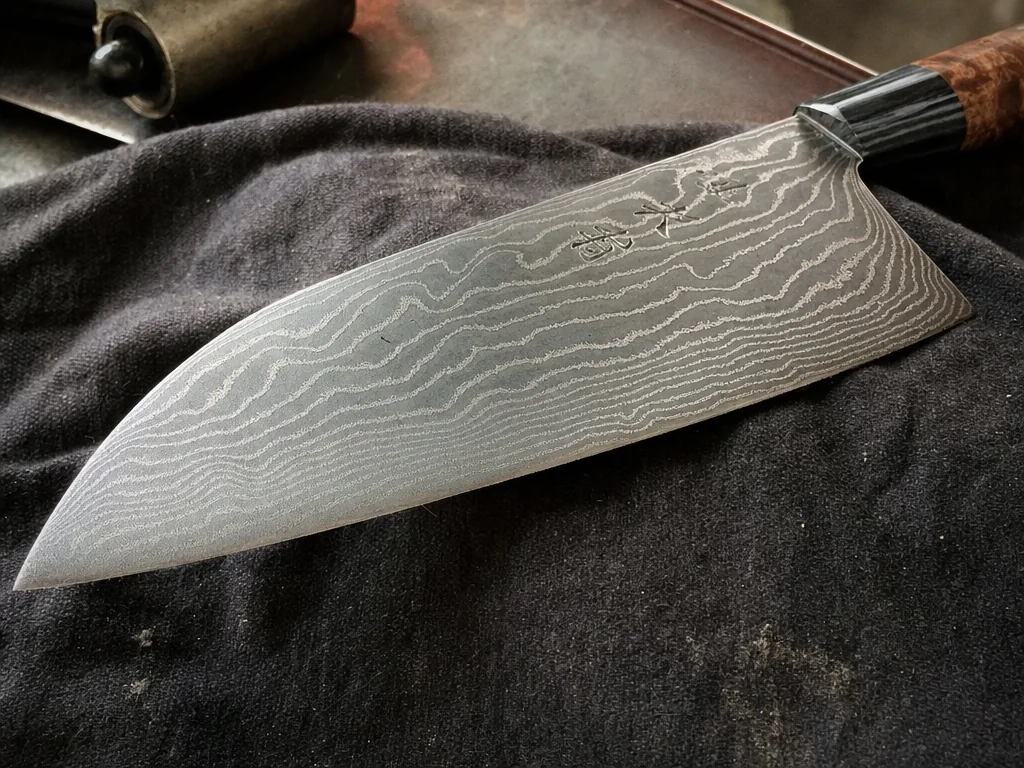
Retail buyers like to sell the santoku as the “three-use” knife in a set. Fair enough. On the factory floor, small misses show up before lunch. A 3 mm blade-height change makes the santoku look thin beside an 8-inch chef knife in the same color box. A grind that stops too high will drag through potato slices. If the dimple row sits 1.5 mm too close to the edge, QC pulls the sample because the 400# belt leaves polish burn around the scallops. For santoku knife manufacturing in kitchen sets, the spec has one job: protect cutting feel and shelf presence while still hitting the buyer’s cost target. The math does not work if the blade only looks good in the photo.
At TANGFORGE in Yangjiang, China, we handle 20 to 30 OEM and private-label set programs each quarter, and the santoku is where vague specs cause trouble. The buyer usually sends a photo first. Then we run the real checks: steel grade with the HRC band, blade length with tolerance, handle stack thickness, tray fit, and how the santoku sits beside the chef knife or paring knife after final buffing. The sample is not the spec. We’ve seen this go sideways when the PO says “same as approved sample” while the drawing still has no spine thickness callout, no dimple position in mm, and one packing note typed as “chef kinfe.” For kitchenware brands sourcing from China, a written manufacturing spec with tolerances is what the grinding line and packing team can both follow. That is how we ship granton dimples on the right line, a spine profile that stays even after buffing, and blade height that still reads premium at retail without paying for extra tooling or mirror polish.
What A Retail Santoku Must Do
A santoku in a retail kitchen set is not a shortened chef knife. It needs the Japanese-style belly, clean push cuts through cabbage, and enough control on chicken breast or fish fillet. If it cannot do that, it should not take a slot in the box. We had one 165 mm sample come back with a 1.55 mm spine and 54 mm blade height. The photo looked sharp. The drop tester ended the argument. QC pulled the sample after the tip chipped on impact. This is the wrong place to chase a thin spine. Too thin and too tall looks premium for five seconds, then the math doesn't work. Too short or too low, and the santoku gets lost beside the chef knife.
The common retail lengths are 165 mm and 180 mm. For mass-market sets, 165 mm moves faster because it fits small kitchen drawers and helps us keep the blister card or color box under the buyer's carton limit when we ship. For a premium set, 180 mm gives more working edge and stronger shelf value. Blade height matters too. A 45-50 mm height keeps the profile clean in a compact set. A 50-55 mm height looks fuller on shelf and gives knuckle clearance shoppers notice on the first onion. In Yangjiang, we see about 6 out of 20 OEM santoku drawings lose balance after heat treatment and final grinding. The grinding line may take another 0.3 mm off the heel, or the tip drops after straightening on the press. Lock the full profile early, not just the length.
For santoku knife manufacturing, define the job first. Daily home cooking? Premium retail gift box? Entry-level promotion with a hard FOB target? Steel first is the wrong question. That one call decides the steel, edge angle, finish, handle weight, tray depth, and carton layout. We've seen this go sideways when a PO says "santoku same as chef knife handle" but the thermoform tray cavity is 8 mm too narrow. The buyer flagged it at packing trial. One santoku that feels off in a tight kitchen set makes the whole set feel cheaper than it is.
Blade Height And Profile Control
Blade height is the spec buyers miss most often on santoku programs for retail sets. We hear “standard santoku” on 7 out of 10 briefs, and that is the wrong question to ask. A 5-piece gift box and a 14-piece block set should not share the same outline. On the drawing, lock down heel height in mm. Then check how much belly you want in the edge curve and how far the tip drops from the spine line against a rigid template. A santoku needs a flatter edge than a Western chef knife. Dead flat still feels odd once the user rocks through parsley. Last month QC pulled one sample with the tip 2.3 mm too low; the buyer flagged it before we even got to steel grade.
A practical retail target is a heel height tolerance of +/- 1.0 mm and a blade length tolerance of +/- 1.5 mm. Strict? Yes. It needs to be. If your set contains 6 knives, loose tolerances show up as soon as the consumer opens the box and lines them on the counter. In our Yangjiang flow, we run profile checks before grinding and again after final polishing with a rigid acrylic template, so the blade does not drift on the grinding line. The eye reads the outline first. A santoku with a clean, slightly squared-off tip and a steady spine line looks more expensive even when the material cost is modest.
For kitchenware brands, approve the silhouette against a rigid template, then confirm hand feel with a production sample. Do not approve a santoku from one angled photo. We have seen this go sideways. A render looked balanced, then the stamped blade came out thin at the heel and heavy at the tip after grinding. On a 3Cr13 batch, even a 0.8 mm shift at the heel changes how the knife sits beside the chef knife in the tray. The math does not work if the drawing is loose and the PO only says “standard santoku.”
Steel, HRC, And Edge Stability
Steel gets judged after about 30 home dinners, not on day one in a gift box. For volume retail sets, we run 3Cr13, 5Cr15MoV, 420HC, 8Cr13MoV, or Japanese/German-equivalent stainless when the buyer wants a higher shelf price and a thicker compliance file. Start with the complaint you are trying to prevent: red spots after 20 dishwasher cycles, slow resharpening in a pull-through sharpener, or edge roll after sweet potato on a 1.8 mm blade. For most retail kitchen sets, 56-59 HRC is the workable band. Under 56 HRC, the edge rolls early. Over 59 HRC, the math doesn't work unless heat treatment and the grinding line are controlled blade by blade. QC checks this on a Rockwell tester before packing, and a 1 HRC drift across a lot is enough for us to stop the line and pull the furnace record.
Do not sell hardness like a sticker number. It has to match the full stack: steel composition, heat treatment curve, blade thickness, and final edge angle. A santoku at 58 HRC with a 15-degree per side edge cuts cleanly for normal consumer use if the temper stays steady. The same 58 HRC with a deep hollow grind and loose QA can chip beside the granton recesses; we saw that on a 12,000-piece order when QC pulled the sample and the buyer flagged chips during carton sampling. Ask for the heat treatment range. The headline HRC alone is the wrong question. At TANGFORGE, we test by lot, then verify sample hardness and edge condition before mass packing.
| Retail Tier | Typical Steel | HRC | Use Case | Notes |
|---|---|---|---|---|
| Entry set | 3Cr13 / 5Cr15MoV | 54-56 | Price-sensitive programs | Easy to sharpen, lower edge retention; useful when the target FOB leaves no room for premium steel |
| Mainstream set | 5Cr15MoV / 8Cr13MoV | 56-58 | Core retail kitchen sets | Solid corrosion resistance for the cost; most supermarket programs land here after the first quote round |
| Premium set | 8Cr13MoV / higher-carbon stainless | 58-59 | Better gift sets and private label | Needs tighter process control, especially edge angle and final polishing before blister or box packing |
For kitchenware brands, the alloy name alone is the wrong question to ask. The real issue is whether your China supplier can repeat the same cutting feel across 3 lots, especially when one set includes a santoku, chef knife, utility knife, and paring knife. We have seen buyers reject a whole PO because one blade looked brighter than the other 3 under retail lighting, usually after a final polish wheel change on the night shift. Uniform performance matters. Uniform presentation matters too.
Granton Dimples That Actually Work
Granton dimples work only with a light hand. They should reduce slicing drag on sticky food, such as 2 mm potato slices or wet cucumber, without turning the blade face into a stamping sample. On a retail santoku, they also show the shopper this blade is different from the chef knife beside it in the set. Easy to overdo. We see 6 out of 10 new buyer drawings arrive with dimples punched too deep or sitting too close to the edge. A hard shoulder around the recess looks cheap under store lighting, especially after satin finishing. QC pulled one 1.8 mm blade last month with the lowest recess only 5 mm above the edge; after the first satin pass, the whole side read stamped, not finished.
For santoku knife manufacturing, keep the dimple pattern steady from heel to mid-blade and leave enough pitch so the blade face does not pick up weak spots. A practical recess depth sits at 0.15-0.30 mm depending on blade thickness and steel. If the punch die lands too hard, metal lifts around each cavity. The polishing wheel will not clean that evenly. The grinding line just skates over the high ring and leaves a shadow you can see at 45 degrees under the inspection lamp. We run into this when a buyer sends a “premium” catalog photo but skips the finish review. We have seen this go sideways. In Yangjiang, China, we run a controlled punch pattern with post-forming finishing, not oversized cavities that look loud on a catalog page and drag once the knife hits real prep.
Not every retail set needs Granton dimples. For a clean, modern utility position, a plain blade is easier to hold within tolerance and still looks sharper on the shelf after packing. If the set targets mid-market consumers, dimples help separate the santoku from the chef knife so the two pieces do not look like duplicates on the card. The wrong question is “can we add dimples?” Ask whether the price band can carry the extra punch step, the second polish pass, and 3 more inspection minutes per carton without making the math ugly. On one 2,400-set PO, the buyer flagged that labor after sample approval. That is where these programs start to wobble.
Handle, Balance, And Set Consistency
In a kitchen set, the santoku has to match the other knives in the box by eye and in hand. Put the handle profile, bolster style, tang length, and target balance point on the spec sheet, with a +/-3 mm balance tolerance checked on a simple acrylic balance jig. Not in the margin. Asking only whether the blade looks sharp is the wrong question. If the ABS handle sounds hollow on the tap test, or the knife sits 18 mm behind the heel and goes handle-heavy, the set reads cheap even with a clean polish off the grinding line. On most retail santoku orders we ship, balance lands at the heel or 5-12 mm forward, depending on whether we run molded polymer handles or move up to heavier pakkawood/stainless-clad builds.
For high-volume retail, molded handles are usually where the math works. Tooling locks the profile, and on a 10,000-piece run that keeps lot-to-lot cost from drifting. Pakkawood or full-tang scales raise the shelf price in a premium kitchen set, but they add real checks at the 240-grit sanding belt: pins flush within 0.1 mm, no white glue line at the front bolster, no scale gap you can catch with a fingernail, no moisture mark after wipe-down. Define handle material and finish as tightly as you define blade thickness. We mean the finish code too. If the santoku sits in a 5-piece or 8-piece set, the texture has to match the chef knife and utility knife; if it looks like it came from another mold family, the buyer flags it fast.
At our factory in China, we run incoming checks on handle color and fit, then measure rivet alignment within 0.5 mm because small visual defects jump out after boxing under the D65 light box. QC pulled samples last month where the santoku handle was one shade warmer than the bread knife; alone it passed, in the set it looked wrong. Brands buying from Yangjiang suppliers should ask for set-level matching standards with an approved master sample, not single-knife approval. We have seen this go sideways. A santoku can look fine on the inspection table and still fail retail presentation when the handle shade drifts one tone from the rest of the set.
OEM Sourcing From China
For santoku knife sourcing, start with process capability, not catalog count. Asking “How many models do you have?” is the wrong question. Ask how the factory controls stamping or laser-cutting tolerance on a 165 mm or 180 mm santoku blade. Ask for heat-treatment records by furnace batch. Ask how often the grinding wheel gets dressed, and what QC checks before retail packing. On our line, QC pulls 12 blades from a batch, checks blade height with a digital caliper, measures edge angle after grinding, then confirms hardness after tempering before the lot leaves the grinding line. Simple check. If a supplier cannot explain how they hold blade height and hardness from batch to batch, they are not ready for a kitchenware brand program.
For a normal private-label santoku program, MOQ often starts at 1,000-3,000 pieces per SKU. Handle tooling and packaging complexity decide where you land. A PP handle with existing mold is one case; a new pakkawood handle with brass rivets is another. Lead time is commonly 45-60 days after sample approval and deposit. A custom gift box usually adds 7-10 days, and a full bladeset can push packing approval from 12 days to 18 days if the insert fit is not locked early. Laser marking sounds small, but we have seen a simple logo laser job add 3 days when the buyer sent the artwork in RGB instead of black vector, so the file had to be rebuilt before we run the laser station. FOB China pricing swings by steel and finish, but compare landed cost, not unit price alone. Cheap FOB gets expensive fast. A blade that saves USD 0.18 at purchase but brings 2% edge-chip claims is not cheap. The math does not work.
Buyers in Europe and North America should check compliance early. For retail kitchen sets, ask for REACH-related material declarations. Ask for LFGB or FDA-related contact testing where relevant. If the supplier has ISO 9001, ask how the records are kept and who signs off the lot. Do not accept “QC checked” as an answer; ask for the inspection sheet with blade length, handle gap, carton drop-test result, and AQL 2.5 if that is your agreed standard. If the set is going through marketplace channels, lock the barcode file first. Lock the carton label and FNSKU position before production, not after packing. We once had a PO typo put the FNSKU on the inner box instead of the master carton; the buyer flagged it during pre-shipment inspection, and the re-labeling cost more than the carton print. Yangjiang has plenty of knife factories, but not every factory in China is set up for export-grade control. We have seen this go sideways. You see the gap in the paperwork and in blade consistency once QC pulls the sample.
Inspection, Packaging, And Shelf Readiness
Retail kitchen sets usually fail after they leave the plant, not on the bench. The blade may pass sharpening, then QC pulls the sample and finds a 0.2 mm burr at the heel, a shallow grind line on one face, or the logo stamped 1.5 mm off center. That looks cheap in a store box. For santoku knife manufacturing, final inspection needs more than a count sheet: check the edge burr, left-right grind, blade finish, handle fit, logo position, carton print, and the exact accessory count. We run a belt-light check at the grinding line and use a 0.10 mm feeler on handle gaps. AQL 2.5 is a common start for major defects, but if the buyer sells cut feel, that is the wrong question to ask. Carton count alone tells you nothing. Pull samples from each lot and run a use test. One clean cut test beats ten vague sign-offs.
Packaging has to protect the edge and still look retail-ready. On the packing line, we check that the santoku sits tight in the tray so the tip and edge do not walk in transit, and we watch the insert spec because 3 mm of extra play turns into scuffed steel by the time the warehouse opens the carton. We ship enough DDP orders to know how this fails. One finish mark becomes a chargeback the same day the buyer flagged it during inbound QA. We usually lock the insert material, mark inner box orientation with an arrow on the first sample, and fix barcode placement at the lower right corner in one packing spec. If the set carries three blades, the santoku belongs in the main family pack. Treating it like a spare piece is a shelf mistake.
Approve the knife together with the retail box and the master carton. We have seen this go sideways: the buyer signs off the blade at one plant and the print at another, then a PO typo changes the set code, so the carton no longer matches the blade label. Last month one PO swapped two letters in the set code on the ship mark, and the packing line stopped at 1,200 sets. On China factory schedules, that mistake costs 12 days or 18 days, not one afternoon. Keep the full retail set under one control point whenever possible. The math works better, and the factory floor stays sane.
Frequently asked questions
For most retail kitchen sets, 165 mm is the safest choice because it fits smaller hands and keeps the set approachable. If you want a more premium look, 180 mm usually sells better on shelf because it feels more substantial. Blade height matters just as much: 45-50 mm is compact, while 50-55 mm gives better knuckle clearance and a stronger visual profile. In China OEM programs, I recommend approving both length and height on a hard template, not just in CAD, because a 1-2 mm drift is visible once multiple knives sit together in one box.
No, but they help if the blade is positioned as a mid-market or premium retail item. Dimples reduce drag on sticky foods and give the knife a more specialized look. The problem is over-aggressive stamping. If the recesses are too deep or too close to the edge, they can weaken the blade and make polishing uneven. For most santoku knife manufacturing programs, a shallow, consistent pattern is enough. If your set is price-driven, a plain blade can actually look cleaner and be easier to control in production.
A practical target for retail kitchen sets is 56-59 HRC. Below 56, edge retention usually drops too much and the user notices frequent sharpening. Above 59, the knife can become less forgiving if the heat treatment and grind are not controlled tightly. The better question is not just the number, but how stable the hardness is across the batch. Ask your santoku OEM supplier in China for lot-level testing and confirm the edge angle, usually around 15 degrees per side for consumer use.
For private-label retail programs, MOQ often starts around 1,000-3,000 pcs per SKU. The exact number depends on handle tooling, packaging, and whether the blade needs custom finish or laser marking. If you are building a full kitchen set, the MOQ may be lower per SKU if the supplier consolidates production across the range. In Yangjiang and other knife hubs in China, the real cost driver is usually tooling and packaging complexity, not the steel alone. Confirm the MOQ before sample approval so you do not design a set that cannot be ordered at commercial scale.
Ask for three things: sample consistency, packing discipline, and documentation. A serious supplier should show repeatable blade height and grind, not just a nice one-off sample. They should also handle retail labels, barcode placement, and carton protection without guesswork. For Europe and North America, ask for REACH-related material declarations and any LFGB or FDA-relevant support if the set will touch food-contact compliance reviews. An ISO 9001 certificate helps, but it does not replace a real audit of the production flow. In China, the best factories make the process visible early.
Spec Your Santoku Set Properly
Send your target price, blade length, and packaging format, and we will turn it into a manufacturing spec that works for retail, not just for a sample.
Request a Quote