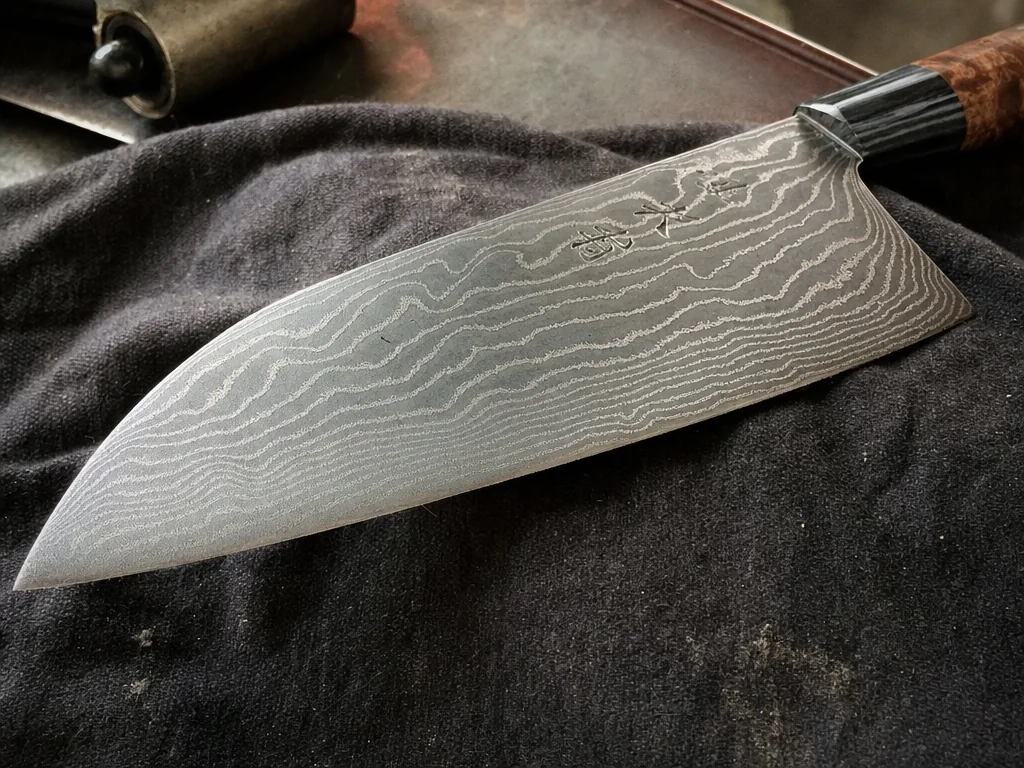
Seki City is not built for volume POs. It is a Gifu craft cluster, with blade shops on one street, sharpeners nearby, and saya makers and handle suppliers close enough that a 0.2 mm handle gap shows up on the feeler gauge before the packer seals the carton. QC sees that fast. For a premium importer, that matters more than a glossy catalog. A seki city knife sourcing manufacturer may run only 300 to 1,000 pieces per SKU, but edge finish and bolster fit stay consistent if the spec sheet reads like a factory document, with tolerance lines and process notes, not a mood board.
The wrong question is, “Can Seki match China FOB?” Usually not. In Yangjiang and Zhejiang, China, we run bigger batches. The grinding line moves faster, and a 3,000 piece PO spreads setup cost in a way Seki shops usually will not. In Seki, you are paying for heat-treat judgment and steel control, plus a retail story the buyer can repeat without sounding fake. The math does not work if HRC is still open, grind geometry is drifting, box size changes after sample approval, barcode position is loose, or AQL 2.5 inspection points are not locked on day one. QC pulled one sample where the edge angle drifted 2 degrees from left to right on the angle gauge. That is where a real seki OEM program starts.
Why Seki City Still Matters
Seki City still matters because it behaves like a knife town, not a giant export park. You speak with makers who know blade geometry, ura thinning, handle fitting, and the hand steps our QC team checks when the final edge sits under a 10x loupe. For premium importers, the product story is cleaner. The cut can be cleaner too. Buy on the maker's terms. A seki city knife sourcing manufacturer is normally a specialist workshop with 8 to 30 people, not a broad catalog factory, so send a hard brief: steel grade, edge angle in degrees, handle drawing with mm tolerances, MOQ, carton mark, and packing spec. That beats 12 rounds of polite email.
Compared with Yangjiang or Zhejiang in China, Seki trades scale for detail. China wins on unit cost and repeat volume; we run 20,000-piece programs with stamped blades, fixed jigs, Rockwell spot checks, and AQL 2.5 inspection every month. Seki wins on perceived craftsmanship, tighter fit, and a more believable origin story for high-margin retail. This is not romance. It is margin math. If your buyer wants 200 to 500 units of a hero SKU, Seki can make sense. If the forecast is 20,000 pieces with fast replenishment, the math does not work. We have seen this go sideways when a buyer treats a small workshop like a Shenzhen electronics line, then complains because QC pulled 17 samples for 0.3 mm handle gaps instead of shipping on Friday.
- Small-batch runs often sit around 300 to 1,000 pieces per SKU.
- Premium finishing is usually checked piece by piece, including spine polish, choil feel, handle gaps, and edge burrs after the grinding line.
- Lead time follows hand work and subcontractor slots; 12 days versus 18 days can depend on one polishing bench, not just machine capacity.
The sourcing choice is simple. Use Seki when craft control and brand value carry the price. Use China when volume, replenishment speed, and landed cost decide the order; we ship that kind of program every month, and the buyer flagged it fast when the PO missed the inner box barcode.
Define The Product Before RFQ
If you want a serious quotation, send a full product definition. "Premium chef knife" is not a spec. No Seki workshop should guess from that. Buyers who get a clean offer on round one send a blade drawing, handle sketch, packaging spec, target retail price, and a tolerance sheet with callouts in mm. We usually see heel thickness marked on the drawing; if it is missing, the grinding line asks within 10 minutes. Four words matter here. Define the knife first. "What is your best price?" is the wrong question to ask. In Seki, Yangjiang, or Zhejiang, the gap between a first-pass sample and 3 extra sample loops often starts with one blank box on the RFQ.
Your RFQ should cover the parts that move cost and quality. Skip one, and the factory fills in the blank from its house standard; last month QC pulled the sample because the handle seam opened to 0.8 mm, and the PO said nothing about seam tolerance. The buyer thought photo approval was enough. It was not.
- Blade type and blade length in mm, with spine thickness at the heel and target edge angle, such as 15 degrees per side.
- Steel grade with HRC target, then state monosteel or clad blade with a Damascus face.
- Handle material and bolster style, with rivet count and color finish matched to the approved sample board.
- Logo method and carton count, with insert card details and barcode or FNSKU if you sell online.
- Critical tolerances such as blade centering and handle seam, with the weight range in grams.
For a premium knife, a 0.5 mm tolerance on key dimensions is a reasonable starting point. Leave that blank, and the workshop will run to its own habits; we have seen this go sideways with a 14 g weight spread and a bolster step the buyer flagged at incoming inspection under a caliper check. That might pass for a local brand in Japan. It will not pass for a launch into Europe or North America, where 2 units get compared side by side and every mismatch shows.
OEM, ODM, And Private Label
Full custom is not for every buyer. In Seki, the buying model matters as much as the steel stamp on the blade. A real OEM program means you pay for tooling charges and grinding jigs, then the factory follows your drawing down to spine thickness in mm; on the grinding line, a 0.2 mm miss gets kicked back. Private label is simpler. We run a proven pattern and change the logo, handle color, or outer pack. ODM sits between those two. The maker starts from a blade shape or construction already in production, then you adjust handle material, blade finish, edge angle, or pack-out for your market.
Premium importers usually spot the gap on paper first. QC pulled the sample sheet off the inspection table last week, caliper notes still clipped to it, and the same issue showed up again: buyers wanted OEM pricing while approving drawings only clear enough for private label.
| Model | Best Fit | Typical MOQ | Lead Time | Buyer Risk |
|---|---|---|---|---|
| OEM | Hero SKU built to your blade profile, handle spec, and packaging file | 300-500 pcs | 45-75 days | Higher setup cost, lower copy risk |
| Private label | Fast market entry on an approved factory pattern | 100-300 pcs | 30-60 days | Less differentiation at retail |
| ODM | Premium refresh or line extension on maker-owned design work | 500-1,000 pcs | 60-90 days | Needs tighter design approval before mass grinding |
If you are testing a new market, private label is enough for the first 100-300 pcs. Move fast. Check sell-through. If you are building a premium brand that needs its own profile, stable HRC, and repeatable edge geometry, OEM is the better call. Be honest about volume and margin before the first sample invoice. We've seen this go sideways when a buyer sends a clean logo file but no blade drawing, then flags a 0.8 mm handle gap after production starts and the grinding line is already running. Seki is not the place to hide an uncertain brief behind a premium logo. The math doesn't work.
Steel And Heat Treatment Matter Most
Steel names sell on a quotation sheet. On the board, heat treatment and grind geometry decide whether you get the repeat order. In Seki quotes for premium kitchen lines, VG-10 and SG2, also called R2, are the two names we see most. VG-10 at 60-61 HRC is a clean commercial band for an 8-inch chef knife: enough edge retention, fewer complaints when the buyer’s test cook chops through chicken joints, and less drama on the grinding line when the bevel is set. SG2 holds an edge longer in our prep test, often 18 days vs 12 days for VG-10 under the same store demo use, but the blank cost jumps and the line gives you less forgiveness. QC pulled one Seki sample where 0.2 mm too much thinning behind the edge turned into micro-chips under a 10x loupe. AUS-10 is the practical choice when the target FOB is tight. Call it straight. It is not the same prestige or edge life.
Do not buy the steel name only. Ask for the target hardness band in writing, ask how they temper, and ask whether they check hardness on each batch or only on a sample coupon. Weak suppliers get exposed here. A serious workshop will tell you what quench oil they run, the temper temperature on the traveler, the Rockwell readings from the bench, and what finish they apply after grinding. An alloy code on a carton label means little. If you have bought in Yangjiang or Zhejiang, China, you already know this: a spec sheet and a real edge are two different things. We have pulled samples marked 60 HRC that tested 57.8 HRC on the bench. Same rule in Seki. The tolerance should be tighter, and if the factory cannot show batch readings, the math does not work for a premium line.
For cladded or Damascus constructions, split decoration from function before you approve the sample. Damascus patterning sells. It will not save a soft core, a thick 0.6 mm edge, or a tired final polish from a buffing wheel that should have been changed. Ask the maker for CATRA results, or at least for internal retention data with the blade angle and test count recorded on the sheet. For a premium importer, that data beats a nice catalog sentence. We have seen this go sideways: the buyer flagged beautiful samples that failed after 3 prep shifts, and the PO still had “SG-2” typed one way on page 1 and “R2” on the carton mark sheet.
QC And Compliance Are Non-Negotiable
A premium buyer should inspect Seki knives the same way we inspect an export run in China or Japan: by defect class, not by hand feel. Use AQL 2.5 as the sampling basis for general defects, with zero tolerance for critical defects. Put the limits on paper before production starts: blade chips over 0.3 mm, lock failure after 50 open-close cycles, grind drift at the heel, loose handle rivets, rust spots after wipe-down. Write it clearly. QC pulled the sample on one 1,200 pcs run and found 7 blades with burr left near the tip, right where the felt wheel had missed the last pass. After shipment, the math does not work.
For EU and North America, ask for paperwork that matches the material set. REACH applies to handle materials and coatings, especially POM, resin scales, and painted gift-box inserts. LFGB matters when the knife ships with food-contact accessories or packaging claims that need migration awareness. FDA declarations may be needed for certain market channels. If the program includes a retail pack, check carton counts against the PO, EAN or UPC placement within 2 mm of the artwork proof, and FNSKU labeling if Amazon is in the route. ISO 9001 is useful, but it does not replace your own inspection. We have seen a PO typo put 24 pcs per carton on paper while the packing line ran 36 pcs, and the buyer flagged the mismatch only after warehouse receiving.
A practical inspection pack should cover blade finish under a 600-lux light, edge alignment against a flat gauge, logo placement measured from the bolster, handle seam gap under 0.2 mm, corrosion check after wipe-down, carton drop test, and count verification. Simple tools work. We run this with a light box, caliper, flatness gauge, 3M tape for logo rub, and a printed defect board beside the inspection table. If the workshop cannot support a pre-shipment inspection, treat that as a warning sign. Premium importers should not pay for the premium-origin story and then skip the basics. This is the wrong question to ask: “Is Seki quality good?” Ask whether this batch passed.
Price, Lead Time, And Fit
Seki is rarely the cheapest option. Cheap is the wrong benchmark. For a standard premium chef knife with a decent handle and tidy finishing, we normally see USD 18 to 35 FOB on a 300-piece run. Hand-finished work or SG2 programs climb fast once gift box packing, manual buffing, and bench labor hit the cost sheet. Samples take 2 to 4 weeks in most cases. After approval, production sits around 45 to 75 days. We have seen Damascus and shaped pakkawood handles add 12 days on one PO because the grinding line had to rework a 0.3 mm spine mismatch after the 400-grit belt pass. Ask for the routing sheet. If a maker promises speed that sounds like a commodity plant in Yangjiang or Zhejiang, China, check the real path: blanking date, heat treatment slot, rough-grind pass, handle-fit bench, buffing worker, final QC stamp, packing schedule.
Capacity matters, but the headline can fool buyers. Some Seki workshops are strong at 8,000 to 20,000 units per month across mixed models. One SKU will not get that whole block. The real number is the slot for your knife. A furnace cycle plus two handle-fit benches may cap one model at 1,200 pieces in a week, even when the factory profile sounds bigger. We have seen buyers quote the monthly headline back to the maker. The math doesn't work. For 300 to 1,000 pieces of a high-margin line, Seki can make sense. For 5,000 pieces every month, a larger production base in China is usually the practical answer. We ship that kind of repeat volume from Yangjiang because the polishing tables, packing room, and carton-label checks are set up for it, down to catching a wrong EAN code on the PO before mass packing.
The best fit is simple. Use Seki when you need a premium story and hand work the customer can see, such as a cleaner choil and a handle gap held under 0.2 mm on a 210 mm chef knife. Use China when you need sharp FOB pricing and repeat shipments at 5,000 pieces every month. QC pulled the sample on one job, and the difference was plain. Seki won on finish. Our Yangjiang line won on output. The buyer flagged one tiny over-buff mark near the heel, and Seki fixed it by hand before the second sample. We have seen this go sideways when a buyer tries to force Seki into a mass-market model, then complains that it behaves like a craft district. This is the wrong fight to pick.
Frequently asked questions
For a custom or semi-custom knife, 300 to 500 pieces per SKU is a realistic starting point with many Seki workshops. Simple private label runs can begin at 100 to 300 pieces, but the unit price usually rises 15% to 30% because setup costs are spread over fewer units. If you want custom packaging, a new handle mold, or a special blade profile, expect the MOQ to move upward. A premium importer should also budget for 1 to 2 sample rounds before production, plus 45 to 75 days after final approval. If your program needs 3,000 to 5,000 units every month, Seki is usually the wrong capacity profile.
Yes, but only if you give them a usable brief. A real seki OEM program needs drawings, steel choice, HRC target, handle spec, logo file, and pack-out instructions. The workshop can usually work from your design or a clean reference sample, but do not expect them to solve an unclear concept for free. For a clean OEM run, plan on 2 to 4 weeks for sampling and 45 to 75 days for production after approval. If you want a completely new profile, you may need a tooling or jig fee. That is normal. The better the spec, the less you pay in sample churn.
For most premium kitchen programs, VG-10 and SG2/R2 are the practical options. VG-10 at 60 to 61 HRC gives you a balanced mix of edge retention, corrosion resistance, and manageable cost. SG2/R2 can offer longer edge life and a more premium sell story, but grinding and polishing cost more, so your FOB will go up. AUS-10 can work if you need a softer price point, but it will not carry the same market position. If you want objective proof, ask the maker for hardness records and, if available, CATRA or internal wear testing. Steel name alone is not enough.
For Europe and North America, ask for REACH-related declarations, LFGB or FDA support where relevant, and a clear statement of materials used in handles, coatings, and packaging. If the knife is sold with a retail box, confirm carton counts, barcodes, and country-of-origin marking. For the inspection side, use AQL 2.5 as your baseline and set critical defects to zero. If the maker claims ISO 9001, treat that as a management-system signal, not a substitute for your own pre-shipment check. Premium buyers should also keep traceability records for the blade batch, handle batch, and final packing lot.
It depends on the job. If you need a stronger craft story, tighter hand finishing, and a smaller run of 300 to 1,000 pieces, Seki is often the better fit. If you need 5,000 to 10,000 pieces per month, sharper FOB pricing, and faster replenishment, Yangjiang or Zhejiang in China usually wins. That is not a quality judgment, it is a production model choice. Premium importers should use Seki for high-margin hero SKUs and China for volume lines. If you try to force one district to do the other district's job, you usually lose margin or schedule.
Build your Seki sourcing brief
Send your target SKU, blade spec, and forecast, and we will map the right maker, MOQ, and QC plan before you spend time on samples.
Request a Quote