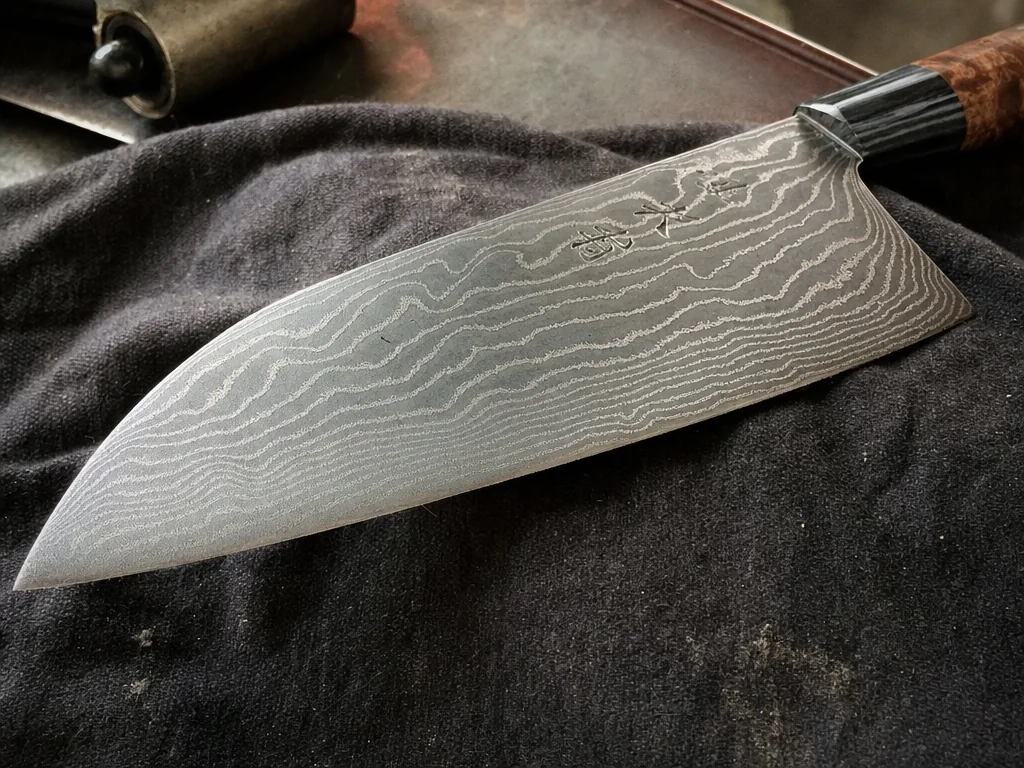
At Canton Fair, Ambiente, or Blade Show, the free sample is not the deal. The useful part is faster: before dinner you can stand at 12 booths, hold the knife, compare capacity, compliance papers, edge finish, and FOB price. For Europe and North America importers, we see that replace 2 weeks of emails with 1 afternoon on the aisle. Big difference. Photos hide burrs, late replies slow the file, and a trader often cannot tell you if the grinding line is running water-cooled belts or dry polishing wheels.
The common mistake is treating every booth like the same factory is behind it. Wrong question. A real knife factory in Yangjiang, China or Zhejiang should answer cleanly on steel grade, HRC target, MOQ, tooling cost, lead time, and AQL 2.5 inspection. They should also know whether the blade is stamped from 2.5 mm sheet or laser cut from coil stock. We see this often: the buyer asks for 56-58 HRC, the booth says "no problem," then QC pulls the sample and the Rockwell tester reads 53. After that, the math does not work. Sample cost, rework, and missed delivery all hit your margin.
Why Trade Shows Still Matter
Trade shows still beat cold email. Give us 20 minutes at Canton Fair, Ambiente, or Blade Show and we can usually tell if a supplier can build the knife, keep the same 0.4 mm edge behind the bevel across repeat lots, and ship under your carton mark rules. Put the sample in your hand. Sight down the grind line under the booth lights, press a fingernail across the handle joint, check for any step over 0.15 mm with a feeler gauge, then ask the direct question: is this booth backed by a factory or a sourcing office?
That split shows up fast. A Yangjiang manufacturer with 240 employees and roughly 120,000 units per month should be able to walk through blade forming, heat treatment, grinding, assembly, and packing checks without changing the story. We see traders talk big, then stall when QC pulls the sample and the buyer asks why the spine reads 2.8 mm on the caliper instead of 3.0 mm on the spec sheet. Start with process when sourcing knives at trade shows. Price first is the wrong question.
Shows also reveal commercial discipline. Ask how many SKU changes they can carry in one season, and make them name the cap: maybe 8 handle colors with 3 blade finishes, or 2 carton layouts before the packing line starts missing labels. Ask whether they support OEM or private label. Ask whether they can move from sample to production without reopening the 6-cavity handle mold. If MOQ or lead time shifts twice in one meeting, the math doesn't work. We have watched a booth quote 1,200 pcs per SKU, then jump to 3,000 pcs after the buyer flagged a color box and a barcode label typo on the PO; that booth is not a sourcing option.
Qualify The Booth In Minutes
Ask what the brochure leaves out. Do not ask, "Are you a factory?" Every booth says yes at Canton. Ask where blade heat treatment is done, who owns the grinding line, and what monthly output they run for the knife family you need. If they quote 80,000 pcs/month for chef knives, ask how that splits between stamped and forged, and whether the blanks start at 2.0 mm or 2.5 mm. Good answer, fast. A real plant will separate kitchen knives from pocket knives, then tell you which work is assembly only. We run those lines differently, and the belt grinder noise alone tells you which shop you are standing in.
Use a short booth script:
- What city is your factory in, and how many years have you shipped export orders?
- Which steel grades run most often on your line?
- What HRC range do you hold in production, not just on the sample card?
- What is your MOQ per SKU for OEM, packed to one carton spec?
- What is your normal lead time after sample approval, and what changes on a repeat PO?
If the answers drift, walk. If they stay sharp, ask for proof: a current packing photo, a batch code, a real export carton, or a line video showing the same knife type under the belt grinder. QC pulled one sample last year where the booth showed VG-10 copy, but the carton mark was for 3Cr13 steak knives. The buyer flagged it in 30 seconds. We have seen this go sideways. Any supplier you meet while sourcing knives at trade shows should explain in 90 seconds whether the plant is a kitchen knife shop with its own heat treat, a pocket knife shop doing spring and rivet work, or a mixed assembly shop buying half-finished parts. Consistent booth answers usually stay consistent on the second order, especially when the salesman can point to the same batch code format we print on the inner carton.
Ask straight about the price gap between plain stock items and true custom work. Traders blur it. A factory will split shelf stock from jobs that need a new logo plate, then tell you if the handle needs tooling or a new ABS mold cut on a CNC block. This is the wrong question to soften. If MOQ is 600 pcs for stock color but 3,000 pcs for a new ABS handle mold, the math changes before the buyer sends the PO. We have had buyers push back as soon as mold cost hits line 3 of the quote, sometimes because the PO says "black handle" but the approved sample was dark gray.
Read Samples Like A Buyer
At Canton Fair, about 8 of 10 buyers touch the finish first. Wrong question. Start with blade geometry, then ask whether the sample came off a normal production grind or whether one senior worker touched it up after dinner for booth display. On kitchen knives, we run HRC 56-58 when the buyer wants easy sharpening and decent edge holding; our QC clerk checks each batch on the Rockwell tester after heat treatment, before the handle goes into packing. For pocket and outdoor knives, HRC 58-60 is the usual target. Steel choice and the real cutting job still set the final range.
Check repeatability next. Look at the spine center. Check the edge bevel width. See whether the handle scales sit tight against the tang. Use your fingernail on the joint. It catches fast. Light cosmetic marks are normal on a show sample that 30 people have handled, but uneven grind symmetry or a blade center drifting 1.5 mm to one side is a production warning. If a supplier says they use 8Cr13MoV, 14C28N, 9Cr18MoV, or 440C, ask for the records they actually keep on the floor. Ask to see dated hardness checks. Ask about salt spray hours. If they quote CATRA-style edge retention data, ask for that too. Steel names alone do not ship clean orders.
| What you see | Good sign | Red flag |
|---|---|---|
| Grind line | Even off the grinding line, same height on 5 samples | Hand-polished to hide waves |
| Blade center | Centered in handle and sheath | Rubs one side after opening or after sheathing |
| Hardness claim | Stated range with test method | One marketing number, no test record |
| Handle fit | Tight joints, no gaps over 0.2 mm | Visible glue, loose scale, or movement |
Use the sample to judge quality and whether the factory can repeat it at 3,000 pcs. A mirror finish looks clean under booth lights. On the line, that finish is expensive. If it adds 12 minutes per knife and pushes scrap from 3% to 9%, the math does not work. We have seen this go sideways: the buyer approved the fair sample, then QC pulled the first bulk sample because the finish could not match without slowing the whole polishing room and backing up the buffing wheels.
Check Compliance And QA
Compliance is where 3 out of 10 show deals break later, usually after the buyer has already sent artwork and paid the deposit. For Europe, do not take “food-safe material” printed on a name card as proof. Ask for REACH status, LFGB testing for food-contact items, and the exact scope of the migration report: handle coating, rivet material, blade finish. For the U.S., ask which FDA food-contact expectation the supplier tested against. Retail packs need the same check as the knife: warning text, country of origin, polybag marks, barcode position. One miss can hold a shipment. QC pulled a blister card sample at Canton Fair because the “Made in China” print sat 8 mm under the hang tab. Small mistake. Big delay.
Quality control should have names and checkpoints. Ask how they inspect incoming steel coils, what the grinding line measures after beveling, and who signs the final inspection sheet before cartons are sealed. We run calipers on blade thickness and check bevel symmetry before packing; if the edge line is waving, the carton count does not matter. Use AQL 2.5 for major defects as a baseline on your first order, and set critical defects to 0. For a gift set or e-commerce SKU, ask for carton drop testing, barcode readability, and whether the outer cartons can carry FNSKU labels without covering compliance marks. We have seen this go sideways. A buyer approved the knife but missed the 5-layer export carton spec; the blades were fine, then the color box corners were crushed after 12 days at sea and 3 warehouse transfers.
Ask for the actual document list, not a promise from the booth counter. ISO 9001 helps, but it does not replace product-specific testing. BSCI matters if your customer checks social compliance, but it does not prove edge retention, handle bonding, or 56 HRC versus the claimed hardness. “Do you have certificates?” is the wrong question. Ask which certificate matches this SKU, this material, this finish, and this market. A serious factory knows the difference. They will not stretch one PDF across every knife on the booth wall. If the sales rep cannot explain the file name on the test report, we ask for the lab contact or stop the RFQ. We once caught a report tied to a black PP handle while the sample on the table used TPR overmold. Same shape. Different risk.
| Document | Why you need it | When to ask |
|---|---|---|
| REACH | EU chemical compliance | Before RFQ finalization |
| LFGB | Food-contact credibility in Germany | Before sample approval |
| ISO 9001 | Basic system discipline | At supplier screening |
| BSCI | Social compliance for retail accounts | At factory shortlist stage |
If the booth cannot produce a clear compliance package, move on. The math does not work. Paying for 2 extra samples and a document check is cheaper than finding the problem at customs, or worse, after 1,200 sets are sitting in your customer’s warehouse with the wrong label and a PO typo nobody caught. We have seen “stainless steal” printed on a back card. Funny for 5 seconds, expensive for 5 weeks.
Price, MOQ, And Lead Time
Trade-show pricing means nothing unless both quotes follow the same spec sheet. Ask the supplier to show unit price, tooling charge, sample cost, packaging cost, plus freight terms on the quotation itself, not buried in a WhatsApp note. We run into this at Canton every year. One buyer compared a 3Cr13 hollow-handle knife with a 5Cr15MoV full-tang sample, looked at the booth tags for 2 minutes, and decided one factory was cheaper. Wrong comparison. For custom kitchen knives, MOQ is often 500-1,000 pcs per SKU. For simpler private label pocket knives, some factories will start at 300-500 pcs if the blade pattern and the handle-clip set are already standard. If the order needs a new mold or a new sheath, MOQ goes up because CNC programming, trial grinding, plus first-piece inspection eat machine hours on the grinding line.
Lead time has to match the production route. A standard OEM order after sample approval is often 35-45 days before shipping. For a fully custom product, a 15-day promise is the wrong number to trust unless the supplier can name the open line, the heat-treat slot, and the final QC person. Ask straight. We have seen this go sideways when heat treatment moved outside without telling the buyer, and QC only caught the soft blades after the Rockwell tester showed 54 HRC instead of the agreed spec. For pricing, use FOB as your first clean benchmark. DDP comes later, after you lock carton size, net weight, customs code, and destination. Without those details, the math does not work.
Do not ignore hidden commercial friction. Ask whether the quoted price includes the laser logo, color box, instruction leaflet, silica gel, and master carton marks. Small items bite. Last April, QC pulled a 600 pcs kitchen knife order because the color box barcode had one wrong digit from the PO, and the repacking cost came out higher than the logo fee. The packaging line stopped for half a day while we rechecked every carton mark against the buyer's Excel file with a handheld scanner. If you sell on Amazon or through distributors, packaging can add more cost than the blade finish. In Yangjiang and Zhejiang, a solid supplier gives you a clean breakdown instead of one number hiding the packaging assumptions.
If a booth quote is much lower than the other 3 quotes on your list, ask what was removed: steel grade, finish steps, QC checks, or packaging protection. This is the wrong place to chase pennies. A cheap knife that arrives with rust spots, a warped handle, or no tip guard is not a deal. We ship enough export orders to know the pattern. The buyer flagged it. The warehouse rejected it. Nobody remembered the nice booth price.
Decide If They Fit OEM
Not every supplier is an OEM partner. Some booths sell stock SKU only: change the logo, swap the color sleeve, then ship. Some can make a new item, but only if it fits their current blade dies and handle molds. If you need private label, ask whether they can put custom packaging, blade etching, laser engraving, and multi-language inserts into one production plan without moving the goods to another workshop. We saw a 3,000 pcs order lose 7 days because the insert artwork needed hand folding after packing, and the packing team only had 4 people on that table. Four people. One folding jig. No buffer.
This is where sourcing OEM gets real. A factory that supports OEM manufacturing should show the route from CAD drawing to first sample, then from golden sample to repeat order. Bring a new design and ask who checks the blade profile before tooling. Ask which steel family they would choose from a steel comparison, and make them tie the answer to your target FOB, not a brochure line. Ask whether the handle material fits the price point and the market. On our grinding line, a 0.2 mm change near the heel can decide whether the edge comes out clean or needs extra rework under the bench light. Small detail. Big cost. That is the difference between a sample seller and a production partner.
For importers, the better fit is the supplier that matches your category and your forecast. If you buy chef knives, check blade flatness on a glass plate and look at grind symmetry under a 6000K bench light. Food-contact compliance matters too. If you buy outdoor knives, test lock play, sheath retention, and corrosion control after salt spray or wet packing. A supplier with 600 catalog items can still be weak in your line. Ask what product family they run every month and what MOQ they hold steady without mixing crews. The full catalog is the wrong question to ask.
When the booth answer matches your business model, narrow it fast. A good OEM partner should understand your target retail price, carton spec, and lead time window in 1 or 2 rounds, not six. We usually know after the second quote sheet. If the buyer flagged a typo on the PO and the supplier still quoted the old carton size, the math does not work. QC pulled the sample for a reason.
Turn Booth Leads Into RFQs
A booth chat is scrap paper until it turns into a clean RFQ within 48 hours. Send one RFQ sheet, not six loose emails: blade size in mm, steel grade, target HRC, finish, handle material, packaging, quantity, sales market, and compliance requirements. We run quotes faster when the spec says 2.5 mm spine, satin 400 grit, PP handle, 24 pcs/ctn, EU market, LFGB needed. If the grinding line has to guess 2.5 mm or 3.0 mm, or the PO says “ctn marke” instead of “carton mark,” the quotation can slip from 2 days to 5 days and the lead cools.
Ask for two sample stages: a development sample and a pre-production sample. The first proves the design can be made. The second proves the factory can repeat it with production tooling, final packaging, and the right QC method; on our side, QC pulled the sample and checked finish consistency under a 500 lux bench light before mass production. For container orders, ask how they will hold the same blade finish and the same carton code across 18,000 pcs, not just the first 50 pieces on the sample table. We have seen this go sideways.
Keep your internal comparison tight. Score the booths on five items only: product fit, technical depth, compliance readiness, commercial clarity, and communication speed. This is the wrong question to ask: “Who has the nicest catalog?” If a supplier in Yangjiang or Zhejiang answers the same day with 20 days for samples, MOQ 1,200 pcs for a private mold, and a clear note on which handle jig they will open, that beats a thick brochure. Good factories move fast because they already run blanking, heat treatment, grinding, polishing, assembly, and final pack-out every week.
By the last day of the show, stop counting business cards. Count three suppliers who can quote the same spec, repeat the same sample, and ship to the same deadline without changing the story. We ship programs where the buyer flagged a color box shade or a 1.5 mm logo-position shift at pre-production stage, and the stable factory fixed it before the first carton closed. That result matters.
Frequently asked questions
Ask three things: where heat treatment happens, who owns the grinding line, and what monthly output they run on your exact knife type. A real manufacturer in Yangjiang, China should answer in concrete terms, not with general claims. If they can give you MOQ, HRC range, and lead time in under 2 minutes, you are probably talking to production, not just sales. Ask for a current carton photo, a batch code, or a line video that matches the sample. Traders usually struggle with that level of detail.
For custom kitchen knives, 500-1,000 pcs per SKU is a realistic starting point. For simpler private label pocket knives, 300-500 pcs can be possible if the blade and handle are already standard. If you need a new mold, sheath, or decorated box, expect the MOQ to rise. For first orders, many importers keep the pilot run small and then reorder after confirming edge retention, packaging, and carton performance. In practice, a factory with around 120,000 units per month can still require a higher MOQ if your design is complex.
For Europe, ask for REACH and LFGB if the knife touches food. For the U.S., ask what has been tested to FDA food-contact expectations. ISO 9001 helps show system discipline, and BSCI matters if your retail customer needs social compliance, but neither replaces product testing. If you sell online, also ask about carton drop tests, barcode placement, and whether FNSKU labels can be applied without covering legal marks. Do not accept a generic 'food safe' statement without a report scope.
Not without checking the repeatability clues. Look at blade center, grind symmetry, handle fit, and surface finish consistency. A good sample should reflect a production-capable process, not a hand-tuned one-off. Ask for hardness checks, corrosion testing, or CATRA-style performance data if the supplier has it. A lot of samples from trade shows are polished to sell, not to prove repeatable production. That is why you need a pre-production sample before you place the full order.
Within 48 hours. Send one RFQ with drawings, dimensions, steel, HRC target, packaging, forecast, and destination market. Then ask for a price split: unit cost, tooling, sample charge, logo work, and freight terms. If you wait a week, the supplier may have moved on or lost the exact sample configuration you discussed. The best factories in Yangjiang and Zhejiang respond quickly when the buyer is precise, because they can turn a show conversation into a test order without wasting engineering time.
Bring Your Next Knife RFQ To Market
Send your target spec, MOQ, and compliance needs. We can help you compare OEM kitchen, pocket, and outdoor knife options from Yangjiang with clear pricing and lead times.
Request a Quote