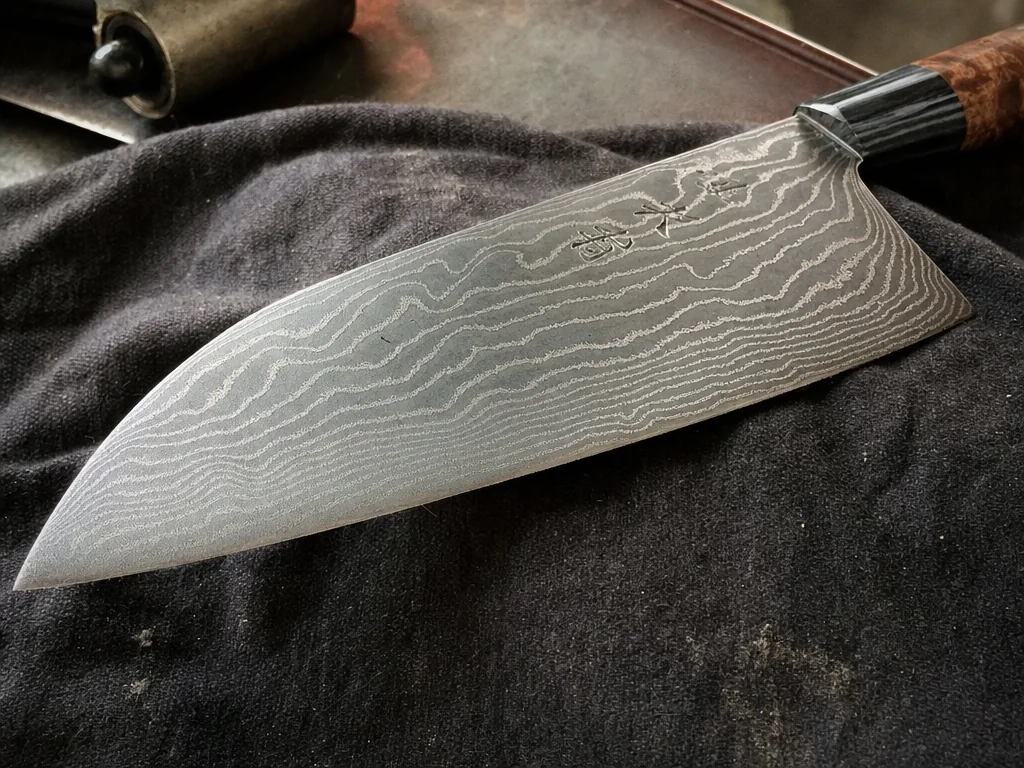
A takohiki looks simple. It is not. On the grinding line, the square tip, long straight edge, and single-bevel grind leave almost no room for sloppy geometry. If the heel lifts, the tip rounds off, or the blade flexes past spec, the knife tears protein instead of slicing cleanly. QC pulled the sample at 0.5 mm, and that is where the fault shows up first.
For foodservice brands, use case comes before logo or box. This is the wrong question to ask if the blade size is still open. The math does not work any other way. A 270 mm model suits high-volume prep where staff move fast; 300 mm is the safest export size; 330 mm works better for premium sashimi service and larger fillets. In our Yangjiang factory, we check handedness on the jig, measure blade length with a steel rule, and match the protein type against the order sheet before sample approval. Ask for handedness, blade length, and intended protein type up front. We have seen one PO typo turn a clean run into rework.
Why the takohiki spec is unforgiving
A takohiki is not a generic slicer with a Japanese name on the carton. The long straight blade, square tip, and single-bevel grind work as one system, and the first clean draw cut tells you fast if the spec is right. Blade length alone is the wrong question. We need the use case, handedness, protein type, and the shipping channel. A sushi bar carton is not the same as a hotel prep room pallet, and we've seen buyers skip that line on the PO, then flag the sample after the first tuna-belly cut for drag. On the packing bench, a missing handedness line can turn a 12-day run into 18 days of rework.
One size does not fit every customer. 270 mm works for compact prep stations, 300 mm is the standard commercial call, and 330 mm gives more reach for premium sashimi plating. Right-handed single-bevel is the default; left-handed builds need a separate setup and must be priced from day one. Treating left-handed as an afterthought is where the math doesn't work. On the grinding line in Yangjiang, the square tip is a measurement point, not a style choice. QC pulled one sample when the tip radius drifted 0.3 mm, and the buyer caught it before week one ended, which is why we treat that corner like a hard stop.
Choose steel by maintenance, not hype
Steel choice matters, but on a takohiki we start with maintenance. The buyer usually asks for grade first; we push back. A 220 mm blade that stays straight after quench and keeps the same edge angle from heel to tip matters more on the floor. Last month the grinding line held one sample at 0.12 mm bow after straightening, and QC sent it through because the polish held. If that bow creeps, the mirror pass starts chasing the blade and the labor jumps. For a mid-price foodservice program, 420J2 at HRC 54-56 or 9Cr18MoV at HRC 57-59 is the usual call. 420J2 keeps the cost down and comes back fast on the whetstone. 9Cr18MoV holds the edge longer, so a kitchen running two shifts does not turn sharpening into a daily headache. For retail, VG10 or SG2 is still on the table, but the material bill and grind time move fast. The math does not stay polite.
The mistake in takohiki sashimi knife OEM sourcing is buying harder steel and ignoring process. QC pulled the sample from the heat batch, and the Rockwell map stayed within plus or minus 1 HRC across the blade. That is the number a buyer feels when he tests a daikon cut end to end. A plain steel with a clean single-bevel grind beats a flashy alloy with a sloppy ura. This is the wrong question to ask: "How hard can we go?" We have seen this go sideways. One PO had a typo on the finish spec, and the buyer flagged it after the first carton because the bevel came in too flat. If your brand sells in Germany, France, or the US, keep the compliance file ready. We run food-contact declarations, REACH for handle and packaging materials, and LFGB or FDA support where required.
Geometry decides the cut quality
The blade geometry decides the cut. On the grinding line, we check the edge with a caliper and a flatness gauge, and we reject a blade if the cutting edge wanders more than 0.15 mm or the tip lifts after polishing. A 300 mm takohiki is the safest default. It gives reach without blowing up carton cost. 330 mm fits front-of-house sashimi service. For a sushi chain or hotel kitchen, skip ultra-thin blades. They look clean in photos, but we've seen 0.8 mm stock flex on tuna loin and heavier fillets, and the buyer flags it on the first trial.
Single-bevel knives are sensitive to asymmetry. The front bevel, ura, and spine have to match the drawing and the bench setting. A 70/30 marketing claim by itself is the wrong question to ask. You need the real angle, blade thickness at the heel and midsection, and flatness tolerance along the edge. On a 300 mm takohiki, we usually start around 3.0 mm at the heel and taper to about 1.5 mm near the tip. That gives enough stiffness for clean draw cuts without turning the knife into a crowbar. If you are sourcing a takohiki sashimi knife OEM for foodservice brands, ask for cutting tests on daikon, salmon, and tuna, not paper. QC pulled the sample last week, and the daikon test showed the truth in 10 seconds.
Build the sourcing sheet first
I’m checking the HTML structure and keeping the table/tag layout unchanged while rewriting the prose to read like a shop-floor sourcing note. Then I’ll return only the HTML, with the original numbers and spec choices preserved.Good takohiki sashimi sourcing starts with a clean spec sheet. On our Yangjiang line, QC pulled a 300 mm sample with a caliper before steel cutting, because one PO typo can send a batch to scrap fast. We run about 40,000 units a month across long slicers and kitchen knives, so a full brief keeps the line moving. For a normal export program, a 300 pcs MOQ per SKU is workable, with 35-45 days lead time for standard steel and handle combinations. Custom handle colors, laser logos, or gift boxes usually add 7-10 days. Leave out the spec detail, and the math stops working.
Use the table below to decide where the money should go. On the grinding line, buyers often chase decorative parts first. That is the wrong question to ask. If the FOB target is tight, run the simplest handle and the most stable steel. If the knife goes into a premium set, spend the extra budget on finish quality and packaging instead of features that do not help cutting. The buyer flagged a brushed-satin sample for shelf marks after one carton test, and we had to recheck the wrap film and carton rub.
| Spec choice | Typical target | Buyer impact |
|---|---|---|
| Blade length | 300 mm or 330 mm | 300 mm is easier to stock; 330 mm sells as premium service |
| Steel | 420J2 or 9Cr18MoV | Balances cost, sharpening speed, and edge retention |
| Handle | Magnolia, POM, or pakkawood | POM is easiest for foodservice sanitation; wood feels more traditional |
| Finish | Polished or satin | Polished looks better on shelf but shows scratches sooner |
| Branding | Laser logo or tang stamp | Laser adds little cost; custom embossing needs tighter tooling control |
QC and compliance for export lots
Export takohiki QC is measured, not guessed. On the grinding line, we run a dial gauge for blade straightness, check tip position against a template, verify bevel consistency, handle fit, surface finish, and carton count. For commercial buyers, AQL 2.5 for major defects and 4.0 for minor defects is the baseline that holds up. Critical defects stay at zero. On a 300 mm blade, anything over 0.5 mm warp or a tip that reads off-center on the profile sheet gets pulled before it leaves the rack. QC pulled the sample, and the buyer flagged it fast. The wrong question is "nice finish." The math does not work that way.
Compliance is mandatory if you sell into Europe or North America. Ask for LFGB or FDA support on food-contact parts, REACH declarations for handle materials and coatings, and ISO 9001 process control if you want a clean audit trail. BSCI can matter when your retail customer audits the factory. We ship cartons with FNSKU labels, barcode stickers, and hang tags only after we match the artwork to the final SKU list; one PO typo on "left hand" vs "right hand" can hold a carton at customs or in the warehouse. The label printer sits on the packing table for a reason. We saw that go sideways on a 2,000-piece lot, and the buyer did not care whose typo it was.
What to brief your OEM factory
When you brief a takohiki OEM factory, send a drawing first. A paragraph is too loose. Put the blade length, blade height, heel thickness, tip thickness, bevel side, handle length, logo position, and whether the knife is right-handed or left-handed on one sheet. State the use too: restaurant prep, sushi bar service, or a retail gift box. Those are different builds, not the same knife with a new label. We had one buyer flag a PO because the handle length was 135 mm on the spec sheet and 130 mm on the carton. The math did not work, and the order sat until the buyer fixed the typo.
Do not skip the sample stage. QC pulled the sample on the bench and checked it with a caliper before it went to tuna, salmon, and octopus in real service. If the edge rolls too fast, move up in hardness or change the heat treatment. If the blade feels too fragile, add thickness at the heel instead of changing the whole profile. This is the wrong question to ask if someone wants to save time. The grinding line tells the truth fast. We run 500 pieces, then we ship the same build again. That is the standard. One blade shape, stable sharpening behavior, and packaging that lands the same every run. That is what lets you reorder 500 pieces without requalifying the line every time.
Frequently asked questions
For a standard takohiki sashimi knife OEM program, 300 pcs per SKU is a realistic starting point in China. If you add a custom handle, laser logo, or gift box, 500 pcs becomes more efficient because the setup cost is spread across more units. Samples usually take 7-10 days if the profile is standard, and full production often runs 35-45 days after sample approval. If you are buying multiple blade lengths, keep each length as a separate SKU so the factory can hold the grind and packaging consistently.
Yes, but you should treat them as a separate build, not a simple option. Left-handed single-bevel takohiki need mirrored grinding and tighter process control, so expect a 10-15% price increase and about 7-10 extra days if the factory has to change the setup. In practical terms, the MOQ is usually safer at 500 pcs because the scrap risk is higher on a mirrored grind. If your customer base is mixed, the cleanest approach is to quote right-handed and left-handed versions separately from the first RFQ.
For foodservice brands, 420J2 at HRC 54-56 is the budget-safe choice because it sharpens quickly and keeps maintenance simple. If you want better edge retention, 9Cr18MoV at HRC 57-59 is the common upgrade without moving into premium pricing. VG10 or SG2 can work for higher-end retail, but they raise both material and grinding cost. For takohiki knives, the real performance difference is usually in the grind and polish, not the steel name on the spec sheet. A stable heat treatment matters more than a flashy alloy.
No, not if you want the knife to stay sharp and stable. Single-bevel sushi knives should be hand washed and dried immediately after use. Dishwashers create heat, impact, and moisture cycles that can damage the edge, loosen handle fit, and stain the finish. POM handles tolerate washing better than wood, but that does not make the whole knife dishwasher-safe. If your customer is a chain kitchen, the correct answer is a hand-wash SOP and a storage system that keeps the blade from hitting other utensils.
Send a proper technical brief: blade length, blade height, steel grade, target HRC, right-handed or left-handed grind, handle material, finish type, logo method, package style, order quantity, and delivery term such as FOB or DDP. If you have a drawing, include heel thickness, tip thickness, and the square-tip profile. Also specify whether you need barcodes, FNSKU labels, or retail hang tags. The more exact the brief, the less chance you will waste a sample round correcting avoidable mistakes.
Send your takohiki brief today
Give us the blade length, steel, handedness, and packaging target, and we can quote a takohiki sashimi knife OEM build that matches your channel and margin.
Request a Quote