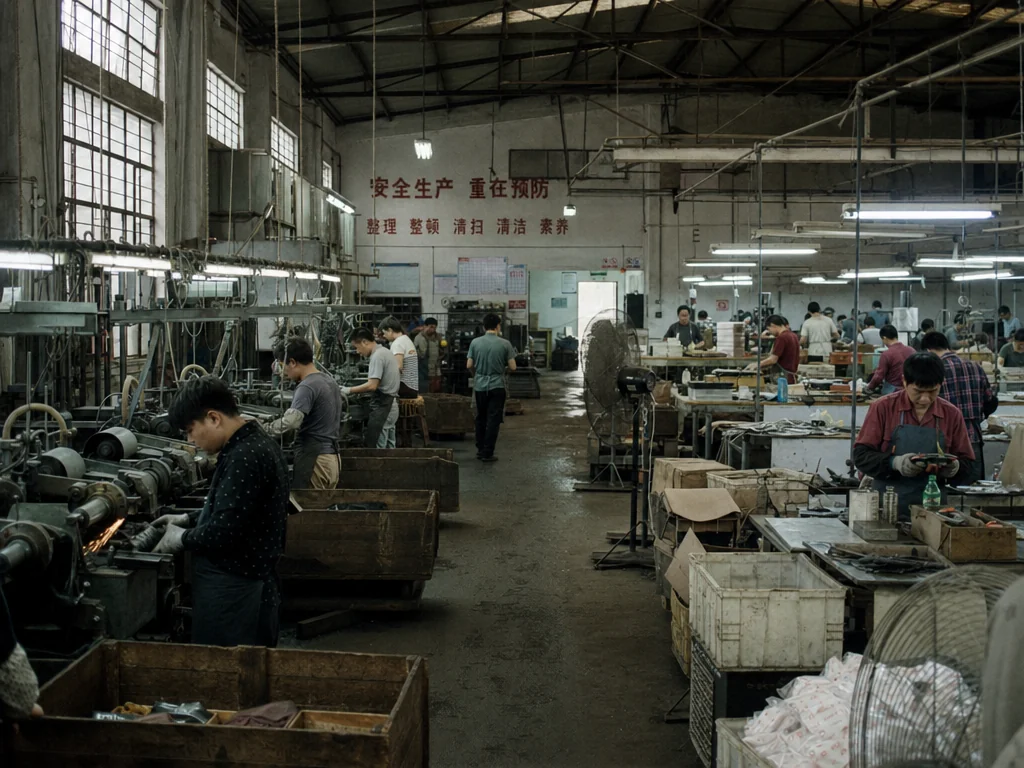
Thiers is not a carton label you buy by the carton. It is a knife cluster with old shops, split production, and buyers who care about edge finish, balance, and provenance more than sticker price. On the floor, one cell runs a belt sander on bolsters, another fits the scales, and QC checks a 0.2 mm seam gap with a feeler gauge before anything leaves the bench. If you are doing thiers france knife sourcing, you need to know which suppliers are true manufacturers, which are assemblers, and which are only set up for small-batch private label work. This is the wrong question to ask if you start with logo placement.
For premium importers, the issue is not whether Thiers can make a good knife. It can. The question is whether the factory can hold spec across 300 pieces, 3,000 pieces, or 30,000 pieces, and whether your margin survives French labor cost, slower changeovers, and tighter minimums. We have seen buyers push back on MOQ after the first quote landed, then spot a PO typo on the steel grade and lose 7 days while QC pulled the sample off the inspection table. If your plan says 12 days and the shop needs 18, the math does not work. Compared with China, especially Yangjiang, or even a Zhejiang export factory used to 80,000 to 240,000 units per month, the Thiers model is more artisanal, more expensive, and less flexible on OEM terms. That is not a flaw. It is a different cost structure, and you price it wrong if you treat it like mass production before you lock the finish and packaging standard.
What Thiers actually is
The first check on a thiers france knife sourcing manufacturer is simple: are they doing real production, or just branding and final assembly? Ask for the full flow from steel receipt to heat treat, belt grinding, and packing. We had a buyer flag a PO because the supplier could not show which line handled the 2.0 mm blank, and QC pulled the sample from the wrong bin. On the floor, that kind of mix-up shows up fast. If the answer stays fuzzy, the low quote is noise.
Thiers makes sense when the brand story and finish can carry a higher landed cost. We run factories that can hold a 12-day lead on a 200-unit run; if you need 30 SKUs next month, the math does not work. One grinding line and one QC room can cover a focused program, not a crowded one. We have seen this go sideways when a buyer pushes for retail pricing first and spec second. If your target is aggressive, this is the wrong cluster to chase.
Where premium value comes from
Do not let the word premium hide weak process control. Good sourcing means you can explain why a knife is priced at EUR 18 factory, USD 24 FOB, or above, and what is driving the cost delta.
MOQ, lead time, and pricing
When you see a price that looks too low for French production, check whether it excludes engraving, packaging, or sorting. The quote may be technically true and commercially useless.
How to qualify a supplier
The question is not whether the supplier is proud to be in Thiers. The real check is whether they can run your export program without excuses, the same standard we use on a serious China factory line. We have seen this go sideways on a 3 mm tolerance and a PO typo. QC pulled the sample with a caliper, the gap showed up in under 10 minutes, and the buyer flagged it before the carton left the packing table. If you only care about the address, you are asking the wrong question.
Laguiole-style sourcing realities
If your buyer wants French heritage, do not dilute it with generic specs. If they want price stability, do not force Thiers to behave like a mass factory in Zhejiang.
QC and export controls
Premium sourcing is not a trust exercise. It is a controlled process with proof at each stage, from sample to final carton.
Frequently asked questions
For standard premium runs, 100 to 300 pieces per SKU is realistic if you stay close to the supplier's existing platform. Once you ask for custom blade stamps, special handle materials, or gift packaging, 500 to 1,000 pieces is more common. Some smaller workshops will quote lower, but the unit price usually jumps enough that the order stops making sense. For a first program, many importers start with 200 to 400 pcs, then repeat only after they confirm finish consistency and packing quality. If you compare that with a Yangjiang or Zhejiang factory, China usually gives you more room on MOQ and mixed-model planning.
A practical first-order timeline is 45 to 90 days from approved sample to ready goods, assuming the supplier has the required materials on hand. If you need horn, specialty wood, or custom packaging, add time. Small workshops can be fast on samples but slow on repeatability because they do not run large automated batches. If your launch window is tight, you should ask for a line-by-line schedule: sample approval, material receipt, pre-production, in-process check, final inspection, and dispatch. For seasonal retail, do not assume France will move like a large export factory in China.
Not automatically. Thiers is often stronger on heritage, hand finishing, and a premium origin story, which matters if your customer pays for authenticity. China, especially Yangjiang and some Zhejiang exporters, is usually stronger on scale, price control, and engineering flexibility. If you need 5,000 to 20,000 pcs with strict pack-out and lower FOB, China can be the better commercial answer. If you need 150 collector-grade knives with French provenance and stronger retail storytelling, Thiers may be the better fit. The right decision depends on channel, target margin, and how much the origin story is worth in your market.
For premium knives, require sample approval, first-article inspection, batch traceability, and final inspection under an agreed AQL plan. AQL 2.5 is a common baseline for major defects, but premium buyers often tighten critical defects to zero and major defects to 1.5. Check blade grind symmetry, edge finish, opening tension or fit, handle alignment, logo placement, and packaging accuracy. For kitchen models, also confirm corrosion-related claims and contact-material documentation. Ask for photos or video of the inspection lot, not just a passed report. If the supplier cannot give you lot-level evidence, your risk is higher than it should be.
Yes, but the capability varies a lot. Some suppliers in Thiers are strong at private label on existing patterns, while true OEM work depends on whether they own the tooling, finishing, and assembly steps. If you want a new handle shape, custom blade geometry, or branded packaging, ask who actually controls each process. A real OEM partner should be able to quote engineering changes, sample cost, MOQ, lead time, and revision control. If they cannot explain those items clearly, they are probably better suited to a semi-custom or private label program than a full OEM launch.
Build a Thiers program that ships
If you want French origin, premium finish, and export discipline in one buying plan, define your spec first and source against that spec.
Request a Quote