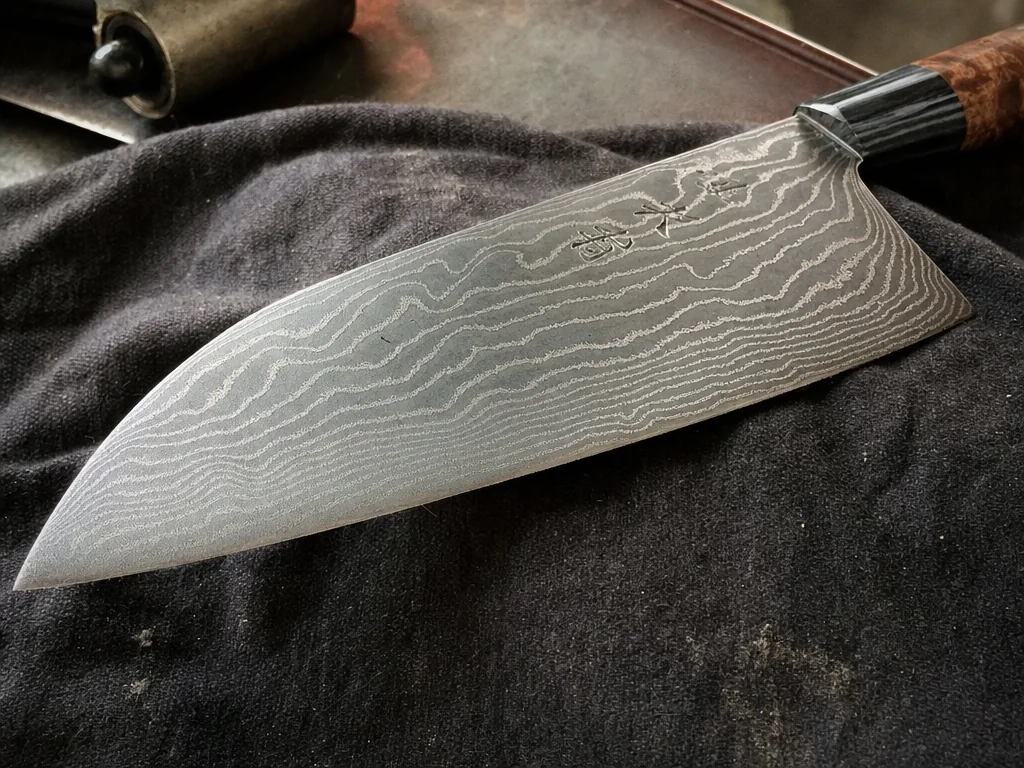
An ulu knife is not a chef knife bent into a half moon. Buyers pay for the arc, the balance point, the stand, and how the set reads from 2 meters on a retail shelf. We check the rocking feel on a 20 mm cutting board sample; if one tip bites first or the belly lifts daylight in the middle, QC pulls it. Steel alone will not save it. That is the wrong question.
For gift and kitchen brands, ulu knife OEM sourcing works only when blade geometry, surface finish, and packaging spec are locked as one job. We run the blade grinding in Yangjiang, then match handles, EVA inserts, and printed color boxes through the wider supply chain, including Zhejiang packaging vendors when the buyer wants a heavier gift-box feel. The buyer usually flags the same issue first: batch 1 looks clean, batch 2 has a 3 mm stand gap or a satin line that wanders near the logo. We have seen this go sideways on 2,000 pcs after one unchecked polishing wheel change on the grinding line. The math does not work if a trading-style answer is supposed to repeat the same shelf-ready set for 500, 2,000, or 10,000 pcs.
What Buyers Need From Ulu OEM
An ulu OEM program is a three-part job: blade, stand, and gift box. Miss one piece and the order slips. We run the grinding line with a fixed jig, and QC checks the curve before the first 20 samples leave the cell. The buyer wants a tool that sits clean on a counter, looks sharp in the box, and still handles herbs, cheese, vegetables, or small prep without wobble.
The real buyer question is simple: can the factory repeat the same curve and the same visual rhythm on every run? In Yangjiang, the better shops lock the blade arc, handle angle, and stand footprint into steel templates, because a 2 mm shift changes how the edge meets the board. Price-first is the wrong question to ask. Start with the actual program: open-stock retail, seasonal gift set, or private label promo item. Each one changes the blade finish, the insert card, and the carton count, and one typo on the PO can turn a clean set into a mismatch.
Decide early whether the line should feel collectible or practical. A collectible set can take a darker finish, a wood display base, and a more decorative box. A kitchen line needs easier cleaning, simpler textures, and a blade that does not stain if the consumer leaves it damp for 12 hours after use. We have seen this go sideways when a buyer asked for showroom looks and then flagged fingerprints. QC pulled the sample after the 12-hour damp test, and the finish still showed marks. The right supplier asks those questions before quoting, not after sampling.
Blade Specs That Sell
Blade spec is where ulu knife OEM sourcing usually goes sideways. Buyers ask for a harder blade and expect the sample to move faster. That is the wrong question. A gift or specialty kitchen ulu needs a tight HRC band, a clean belt-ground edge, and enough toughness to survive carton drops and shelf handling. It also has to take a quick tap on a display board during approval, because buyers do that in the room and then act surprised when the edge chips. For most export programs, 420J2 at 52-54 HRC or 7Cr17MoV at 56-58 HRC is where the math works. We run those ranges because they leave room in the BOM for the wood stand, color box, EVA insert, and barcode label, while still passing basic rust checks after polishing. On the line, QC will reject a blade fast if the grind line walks more than 0.3 mm.
The curve matters too. Small change, big feel. A 2.5-3.2 mm blade thickness usually gives the knife a solid hand feel without making the rocking cut heavy. At 3.5 mm, one buyer flagged the sample as “sticking” on a bamboo board after five onion cuts. Too thin is not better either. At 2.0 mm, the blade can feel like a cheap promo piece even if the mirror polish looks clean under the inspection lamp. Edge angle should usually land around 15-18 degrees per side for general kitchen use, but the final grind has to follow the customer profile and target retail price. We also watch what QC sees after the first 30 pcs come off the grinding line. If the heel and tip do not match within 0.2 mm, the sample goes back.
| Material | Typical HRC | Blade Thickness | Best Use | Notes |
|---|---|---|---|---|
| 420J2 | 52-54 | 2.5-3.0 mm | Entry gift sets | Low maintenance, forgiving in polishing, and easy to rework if QC pulls edge burrs from the first batch |
| 7Cr17MoV | 56-58 | 2.5-3.2 mm | Mid-tier retail and kitchen lines | Better edge retention with stronger rust control after salt-spray spot checks |
| Damascus-style build | 54-56 core | 2.8-3.5 mm | Premium gift programs | Needs tight polish control and repeatable pattern alignment, especially around the tip curve and spine finish |
If you want a product that photographs well and still cuts in a real kitchen, ask for a sample cut test on ripe tomatoes and cooked chicken breast with skin. Paper is not enough. QC should pull the sample, check the steel certificate, record the hardness reading, and compare grind width from left to right before mass production approval. We ship cleaner orders when the buyer signs off on those details before the PO, not after a spec sheet typo turns 2.8 mm into 3.8 mm. A 12-minute check on the sample bench saves 12 days of back-and-forth later.
Rocking Base And Ergonomics
I’m rewriting the section to sound like a shop-floor sales engineer, while keeping the existing HTML structure and the technical numbers intact. Next I’m tightening the wording to remove AI-like filler and add a few concrete production details and buyer-side pushback.The rocking motion is the signature move, so the geometry has to feel right in the first five seconds. On the test board, a tight radius makes the blade hop. A flat arc makes the edge drag and the user loses confidence. We cut two radii on the sample plate, check them with a radius gauge, then lock the tool once the arc clears the fingertips and keeps the edge riding clean. One buyer flagged a sample after a single swipe on beech. This is not the place to guess.
Handle shape matters just as much. A 95-110 mm grip suits most adult hands and gives the set a more solid feel. An 85-90 mm grip can work for compact display sets, but it still has to stay steady when the user rocks forward. Buyers sometimes ask for a shorter handle to save material. The math does not work when the palm swell drops out, and we have seen that go sideways on a 20-piece gift order. Wood gives a warm retail look. Pakkawood stays steadier when humidity swings. Resin or acrylic fits a color-led brief, not a traditional feel. We check the grip with a caliper at the center line and a quick hand fit before the grinding line moves on.
The stand is not decoration. It is a working part of the set, and shoppers handle it more than the blade during retail browsing. A stand that wobbles by even 2 mm feels cheap. Ask for a load check, a drop check, and a simple tilt test. If the knife can slide off the stand with a light bump, the set is not ready for export. QC pulled the sample, tapped it on the packing table, and the fault showed up right away. This is the wrong question to ask. A pretty base means nothing if the set fails carton shake and shelf handling.
- Hold the stand angle between 10 and 15 degrees if the set is meant for countertop display.
- Keep contact points padded or shaped so the blade does not scratch the finish.
- Match the base weight to the blade size so the set feels balanced, not top-heavy.
Gift Packaging And Private Label
Gift buyers usually lose margin on packaging, not steel. A retail ulu knife needs blade protection, a insert that explains the rocking cut, and a carton that holds up for 12 days in transit and warehouse stacking. We run a drop test on the outer box with an ISTA rig, then a corner crush check before release. If the order goes to Europe or North America, keep the file clean: REACH for relevant substances, LFGB or FDA paperwork where food-contact claims apply, plus ink and glue specs on the carton. A cheap box looks fine on screen. It fails on the dock.
Private label is more than a logo print. Blade laser engraving, a custom stand mark, a barcode label, Amazon-ready FNSKU prep, and a sleeve or hang tag all need one packaging file. The clean way is to lock the spec at sample stage and freeze it before production starts. If the buyer flags a carton size change after QC pulled the sample, the schedule slips and repack labor jumps. We saw that on a 500-piece gift order when a PO typo changed the carton code by 8 mm, so this is the wrong question to leave open until the end.
For premium sets, the box should carry the product story. A matte rigid box with a simple insert often beats a loud print job, and a 1.5 mm greyboard shell gives a better hand feel than flimsy paperboard. On the grinding line, we see the same pattern with blades: a clean finish reads better than a crowded surface. If you are selling into a gift channel, the first touch is visual, then tactile, then functional. Keep the design aligned with how the brand sits on shelf, not with whatever looks busy on a render. For buyers who need broader product context, the same packaging logic often applies to private label kitchen knife programs and broader kitchen knife product lines.
MOQ, Price, And Lead Time
For most ulu knife gift programs, MOQ tracks handle material and pack-out, not the blade blank. A plain stainless set with a basic carton usually starts around 1,000-1,500 sets. Add a wood stand, laser engraving, and a two-piece gift box, and 2,000-3,000 sets is the cleaner target. The buyer usually points at the blade cost. That is the wrong place to look. We saw a run last quarter where only the walnut stand changed, and the insert tray still had to go back to the die cutter twice before the carton passed the drop test. If you want a stable quote, start with the pack-out spec.
On our line in Yangjiang, China, we run about 80,000 knife units per month across kitchen and pocket categories, so the bottleneck is usually final packing and inspection, not blade cutting capacity. Sampling takes 7-15 days, then mass production needs 35-45 days after sample approval. If ocean freight is part of the plan, add another 10-20 days based on the destination and booking window. For FOB quotes, put carton size and target container load in the brief. For DDP, the math only works if the supplier states customs risk, local delivery, and import tax assumptions in writing. We had a buyer flag a PO typo on carton count and lose 6 days while booking was corrected. That kind of slip is easy to avoid.
QC needs to be spelled out. Use AQL 2.5 for major defects and AQL 4.0 for minor defects if the set is aimed at retail gifting. Check blade symmetry, edge burrs, stand stability, engraving depth, print alignment, and carton drop resistance. QC pulled the sample at a 1.2 mm handle gap before it left the bench, and that saved a bigger complaint later. A gift line with a crooked logo or a loose blade insert will drive returns faster than a dull edge. We have seen that go sideways. If you want a cleaner sourcing comparison, review the factory process alongside knife inspection and QC standards and the underlying steel comparison data before you commit.
How To Vet A Supplier
A serious ulu knife OEM factory should answer three questions fast: can they hold a 0.3 mm blade geometry, can they pack the set the same way every run, and can they trace the steel lot back to the carton? If they cannot put material certificates, in-line inspection records, and a photo of the packing table on the desk, you are buying promises, not production. We run this check on the grinding line every week with a caliper and a hardness tester. Good suppliers in Yangjiang will tell you why one steel is picked over another, what hardness band they hold, and how the stand is fixed so repeat orders do not drift. The math does not work if they hand-wave it.
When you compare suppliers across China, ask them to make the same sample twice. QC pulled the sample with a digital caliper and a 500 g scale, then checked blade curvature, polish, handle fit, and box closure against the first piece. Write the tolerances down if you source parts through Zhejiang, or the set drifts as soon as a handle, insert, or carton changes. The buyer flagged a PO typo once, and that one line turned into a week of rework. A good factory should spell out spare parts, replacement policy, and what happens if the first run shows a packaging defect. For gift lines, the first shipment decides the margin. Not the third. Asking for a cheaper sample is the wrong question to ask.
- Request a pre-production sample and one sealed carton from the same batch, then compare both against the signed artwork.
- Ask for a packing sheet with net weight, carton count, and outer carton test target, and make them show the scale reading from the packing table.
- Confirm the rework policy for engraving errors, stand wobble, and blade finish marks before deposit, including who pays when QC pulls a bad sample.
- Check whether the supplier can support OEM manufacturing and custom packaging in the same schedule.
Frequently asked questions
For a basic ulu knife set with a simple box, expect MOQ around 1,000-1,500 sets. If you want a wood stand, laser engraving, and a retail gift box, 2,000-3,000 sets is a more realistic starting point. The number moves with handle material, packaging structure, and whether you need a custom insert. For a branded launch, I would rather see a clean 2,000-set run than a cheap 500-set compromise that creates design drift. Always confirm whether the quote includes blade, stand, box, and master carton, because some suppliers split those costs and hide the real unit price.
For most gift and specialty kitchen programs, 420J2 or 7Cr17MoV is the practical choice. 420J2 at 52-54 HRC is easy to maintain and holds up well in retail handling. 7Cr17MoV at 56-58 HRC gives a slightly better cutting feel and better edge retention without pushing the product into a brittle zone. If you are chasing a premium look, a Damascus-style outer layer can work, but only if the core steel, grind, and polish are controlled. For an ulu knife, the curve and stand often matter more to the end user than another 2 HRC on paper.
Yes, and you should. The stand is part of the product, not an accessory. Common options include solid wood, bamboo, pakkawood, resin, or a painted display base. The box can be a sleeve, rigid gift box, or window box depending on the retail channel. For export, I would normally lock the blade, stand, foam insert, and outer carton together in one sample approval. That avoids fit issues later. If you sell on Amazon or through distributors, ask the factory to support barcode labels, FNSKU prep, and master carton labeling in the same packing flow.
At minimum, ask for material declarations, steel certificates, and test reports for the handle or coating materials. For Europe, REACH-relevant documents matter if there are coatings, inks, or plastic components. If you make food-contact claims or include contact materials, LFGB-oriented or FDA-oriented support may be relevant depending on the market and configuration. If social audit is part of your procurement policy, ask for BSCI and ISO 9001 documents as well. The key is not to collect paperwork for its own sake. You want traceability so a claim on one shipment can be tied back to a specific lot and production date.
A normal timeline is 7-15 days for samples, then 35-45 days for mass production after sample approval. If the design needs a new stand mold, special finish, or a new box insert, add time for tooling and print proofing. Ocean freight can add another 10-20 days depending on route and season. If you are working to a retail launch date, build in a buffer for pre-shipment inspection and carton retesting. A good rule is to freeze the sample at least 8 weeks before the first warehouse receiving date, especially if you need FOB or DDP coordination across multiple destinations.
Start Your Custom Ulu Knife Program
Send the blade size, stand style, target MOQ, and packaging spec. We can build a sample path that fits your retail channel and export timeline.
Request a Quote