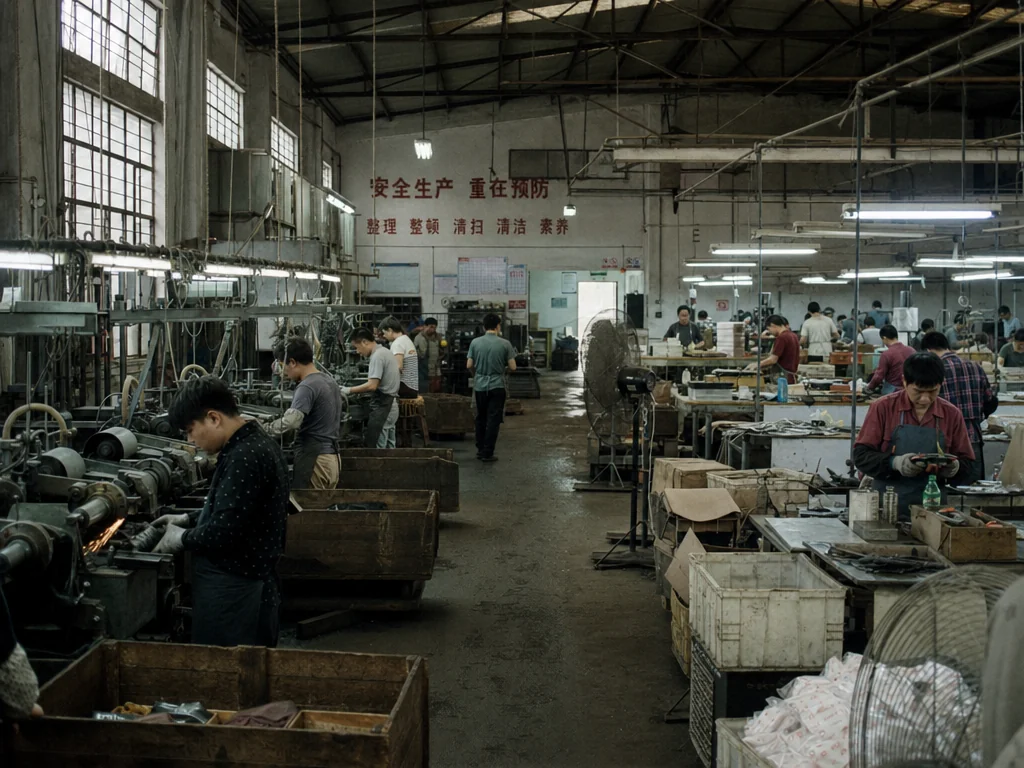
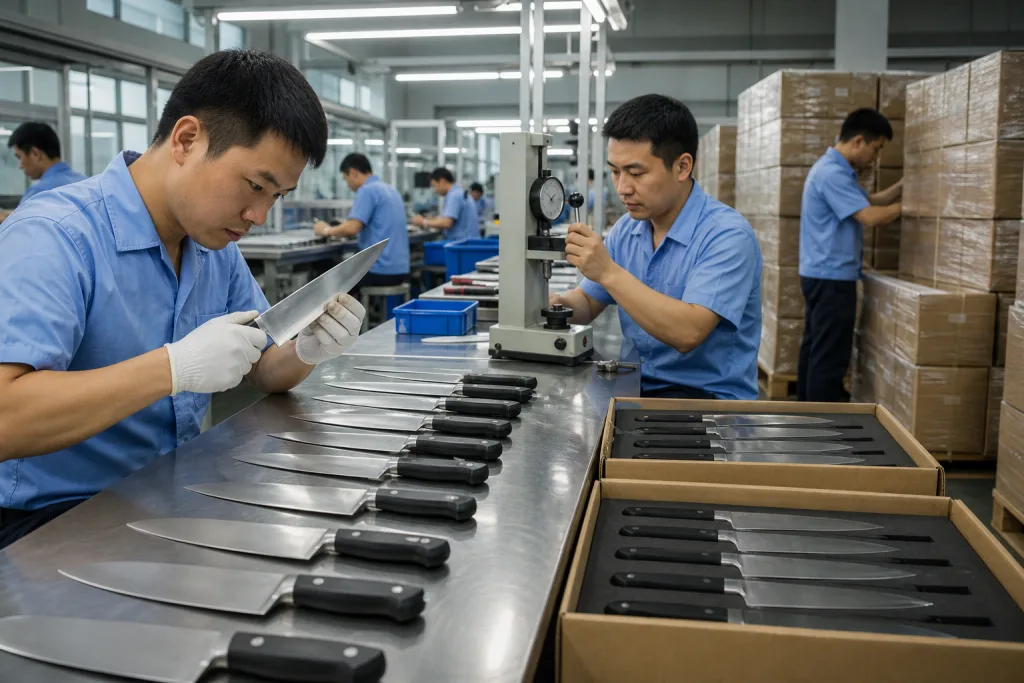
Premium buyers usually want the same result, just phrased in 4 or 5 ways: a knife that cuts clean on day one, still bites after 21 shifts on a prep table, and does not chip when a cook twists through a chicken joint. ZDP-189 and SG2/R2 can both work, but the grade has to match the edge angle, heat treat, and end user. This is the wrong question to ask if the buyer only says, "Which steel is better?" A spec sheet will not show the failure point. Last month QC pulled a sample from the grinding line; the edge looked fine until the 1000-grit belt showed a soft-looking line near the heel, 6 mm back from the tip of the choil.
At our Yangjiang factory, zdp189 sg2 r2 knife steel sourcing is a control job, not a materials shopping trip. We check mill certificates, lock the hardness target before mass production, inspect finished blades, and hold final inspection at AQL 2.5. Four checkpoints. No shortcut. If a buyer pushes for the cheapest option, we say the math does not work. We have seen this go sideways: one PO had SG2 typed as R2 in the steel column, and the buyer flagged it after sample approval. A premium kitchen line lives or dies on sample approval, FOB price, and return rate; a 0.2 mm change at the edge can move all three.
ZDP-189 vs SG2/R2 in Practice
ZDP-189 and SG2/R2 are both powder metallurgy stainless steels, but they do not behave the same after heat treat, rough grinding, and final edge setting. We run ZDP-189 at 63-66 HRC when the vacuum furnace chart is tight and the temper log has no gap. That hardness shows on fine kitchen geometry. Sharp sells. The trouble starts on the grinding line: ZDP-189 leaves little room for a hot belt pass, a blade taken below 0.25 mm behind the edge, or a user who rinses the knife and drops it wet into a drawer. SG2/R2 usually sits at 60-63 HRC. Still a top-shelf range. Our finishers spend about 6 minutes less per blade on SG2/R2, the sharpening wheel loads cleaner, and after-sale handling is easier when a distributor has 300 pcs already sitting in the channel.
That is why a zdp189 sg2 r2 knife steel manufacturer should ask where the knife will be sold and who will sharpen it before quoting. A 240 mm gyuto for a serious home cook is not the same job as a 150 mm petty in a retail gift set; we had one buyer flag the same 12 degree edge spec for both, and the math did not work. For broad appeal, SG2/R2 gives the better production and service balance. For a flagship knife built around edge-holding claims, ZDP-189 can carry the story, but the blade geometry, edge angle, insert card, and packaging all need to match the steel. Ask before sample approval. This is the wrong question to ask after the buyer signs the PPS. QC pulled 17 chipped-edge samples during 100% final inspection on one ZDP-189 trial order, most near the heel where the edge was ground too thin. We have seen this go sideways. Ignore the steel-user fit and you pay for it later in returns, not in the sample room.
Why Laminated Core Matters
The laminated core is why this category sells. We put the costly powder steel at the edge, then wrap it in softer stainless cladding. The blade takes less abuse in use, and we throw fewer rejects on the line. On one SG2 run, QC pulled 32 blades after vacuum heat treat and found 3 with a slight wave near the heel; the cladding gave us room to straighten them instead of scrapping the lot. It also hides belt marks and gives a cleaner face when the buyer wants damascus-style skin. Cladding does not sharpen the knife for you. That is the wrong question to ask. Core steel, heat treat, and grind still decide the cut, and we have seen buyers blame the jacket when the real problem was a sloppy 0.3 mm shoulder.
For premium kitchen brands, lamination is the practical answer. It lets us sell a hard core without making the whole blade feel nervous in the hand. A thin core and thin grind can feel excellent, but only when shoulder thickness, edge angle, and temper stay tight. We run calipers at the shoulder, not just a nice photo from the grinding line. A fine chef knife may run a 9-12 degree per side edge with a managed spine and shoulder profile. Push the geometry too hard and chip complaints come back fast, especially with ZDP-189; make the blade thick to hide that risk and the sales story falls apart. The look is not the main point. In Yangjiang and other China knife factories, lamination gives us a wider process window when we need to ship 500 or 2,000 premium knives that match the approved sample, and the buyer flagged it the first time the PO typo called for a thinner spine than the spec sheet allowed.
What To Specify Before Quoting
If you want a quote we can defend, the steel name is not enough. "ZDP-189 chef knife" is the wrong question to ask. Send blade length, spine thickness at heel in mm, target HRC, edge angle, lamination structure, finish, handle material, package type, target market, and MOQ. A 210 mm gyuto with a 2.2 mm spine, 63-66 HRC, and a 15 degree edge is one cost. A 67-layer laminated blade with mirror finish and pakkawood handle is another. Different setup. Different scrap risk. The grinding line prices those jobs separately because a #400 belt, buffing wheel time, and final edge chipping do not land the same. We can quote a rough blade price from one material callout, but that price often moves after sampling. Specify the stack: steel choice, heat treat route, grinding loss, and compliance files.
| Spec item | ZDP-189 | SG2/R2 | Buyer note |
|---|---|---|---|
| Typical HRC | 63-66 | 60-63 | Check finished blades with the hardness tester, not only heat treat coupons |
| Sharpening effort | High | Moderate | Match it to end-user skill and your after-sales return policy |
| Edge retention | Top tier | High | Depends on thickness behind the edge and heat treat control |
| Production risk | Higher | Lower | Watch warp rate, final sharpening chips, and finish stability |
Ask your supplier for mill certificates, hardness records, lot traceability, and a straight answer on monosteel versus laminated construction. QC should pull the sample after final polishing, not before handle assembly. We have seen 1.5 HRC drift show up after rework on a 300 pcs run, and the buyer flagged it during incoming inspection with a Rockwell mark still visible near the heel. If the project ships to Europe, ask early about REACH and LFGB for handles, adhesives, inks, and packaging. For the United States, keep the food-contact chain documented and make the final blade set match the label claim. One buyer once caught a PO typo that said SG2 on page one and R2 on page three. That cost 12 days. The math does not work if you discover this after cartons are sealed.
How A China Factory Controls The Run
Powder steel looks simple on a spec sheet. The line is not. In our Yangjiang plant, where about 240 people run these jobs, we take ZDP-189, SG2, and R2 from incoming steel check to carton seal with lot records laid on the table. Each lot gets its own heat treatment file, finished-blade hardness check, warp and edge-chip visual inspection, then packing control at AQL 2.5. QC pulled one SG2 lot last year because 11 blades out of 300 showed 0.4 mm tip lift after tempering. Small number. Big headache. If the quench fixture drifts, the Rockwell tester is off, or the carton count check slips, scrap climbs fast and the quote stops being real.
For a ZDP-189 OEM run, the approved sample has to come from the same route as the order, not a hand-built one-off from the best technician on the floor. We have seen that go sideways. One perfect prototype means little if the blanking die, quench fixture, and finish grind belt sequence are not locked for the order. The right factory separates lot IDs, keeps a hardness log, and stops the grinding line if straightness moves past the control limit. That is the hard part. In China, this is what keeps a premium knife from becoming a pretty counter sample nobody can repeat at 1,000 pcs.
If you are checking a ZDP-189 SG2 R2 knife steel manufacturer, ask how they map blades after heat treat, how many pieces they pull per lot, and whether they keep reference samples from the signed-off batch. “We check during production” is not an answer. Ask for the count, such as 20 pcs from a 500 pcs lot, and ask whether the retained sample carries the buyer’s PO number and revision on the sleeve. We once had a buyer flag “R2 mirror” typed as “R2 satin” on a PO sleeve; the shipping carton was right, but the paper trail was wrong. That kind of mismatch can burn a shipment. If the answer stays vague, the price is carrying risk.
Cost Drivers You Should Not Miss
The steel price is only line one on the quote. In premium kitchen knives, factory cost usually moves on yield loss, hand finishing hours, packaging build, and compliance checks. ZDP-189 carries more processing risk because the heat-treatment window is tight; our furnace operator watches soak time, oil temperature, and target HRC on the controller, not just the steel grade typed on the PO. If scrap moves from 3 percent on SG2/R2 to 8 or 10 percent on a ZDP-189 run, the unit price jumps fast. Add mirror polishing on the grinding line, etched cladding, laser engraving, and a rigid gift box with foam insert, and the stack grows again. The math gets ugly. We have seen buyers chase a lower material line, then flag the landed cost sheet after polishing labor changes the schedule from 12 days vs 18 days.
FOB pricing is still the cleanest way to compare a China quotation because freight, duty, and local clearance stay outside the factory number. DDP works only when your country code, tax exposure, and distribution model are fixed before the quote is issued. For retail programs, we run checks on barcode labeling, inner box strength, blade guards, and carton compression; QC pulled one sample last month because the 350 g inner box crushed at the corner after a basic drop test. For e-commerce orders, you need FNSKU labels and a packing spec that survives parcel handling, not just a clean box photo from the sample room. Small detail. Big claim. For a premium brand, asking whether ZDP-189 is expensive is the wrong question. Ask whether the cutting performance pays for the extra reject risk, harder sharpening complaints, and higher after-sales support cost in your market.
A Buyer Checklist For OEM Projects
If you are launching a ZDP-189 OEM or SG2/R2 line, send a brief we can cost from. “Premium quality” and “high hardness” do not price a blade. Wrong question. We need the blade drawing in mm, target HRC, steel grade, lamination type, bevel angle, satin or mirror finish, handle material, packaging, sales market, and 90-day forecast. Last month QC pulled a ZDP-189 sample at 66 HRC on the Rockwell tester, but the PO only said “hard steel,” so the buyer flagged edge chipping after the first cutting test. Vague specs look cheap on day one. They get expensive after sampling.
What to send with the RFQ
- Blade size in mm, spine thickness at heel and tip, plus target edge angle
- Steel choice, target HRC, and laminated or monosteel structure with the core steel named clearly
- Handle material, fastener style, and finish level, such as G10 with 3 rivets and 600 grit polish
- Packaging spec, retail carton size, and barcode or FNSKU requirements with placement marked on artwork
- Compliance target such as REACH, LFGB, FDA, BSCI, or ISO 9001 support
- Forecast volume, MOQ expectation, and target ship date, with split shipment needs stated before deposit
For a first run in China, we run 10-20 sample pieces, then a pilot order, then production at around 500 pcs MOQ per SKU once the edge, handle fit, logo, and carton are signed off. Simple plan. The grinding line needs one approved golden sample, not 6 versions sitting in WeChat screenshots. We ship smoother when the buyer confirms caliper dimensions, laser logo position, and carton drop-test requirement before deposit. We have seen this go sideways: one PO typo changed a 2.0 mm spine to 2.5 mm, and rework cost more than the mold adjustment. The math does not work if the brief is loose.
Frequently asked questions
If you want the strongest headline on edge retention and can support a harder sharpening experience, ZDP-189 is the more aggressive choice. For most premium kitchen brands, SG2/R2 is the safer commercial option because it balances 60-63 HRC hardness with better sharpening behavior and lower return risk. In practice, many brands use SG2/R2 for the main line and reserve ZDP-189 for a flagship SKU or limited run. That gives you a premium story without turning the whole range into a support issue. The right answer depends on your customer, not the steel brochure.
For ZDP-189, a finished-blade target of 63-66 HRC is common if the geometry is controlled. For SG2/R2, 60-63 HRC usually gives the best balance of cutting feel, toughness, and user satisfaction. I would not approve a program based only on coupon hardness. Ask for finished-blade checks from the same lot that will ship, and allow a tolerance window of about +/-1 HRC unless you have a very strict product story. If the blade is extremely thin, stay toward the lower end of the band unless you want a higher chip rate.
Yes, but only in the right way. The laminated core puts the high-performance steel at the edge while softer cladding helps reduce warp, handling damage, and some breakage risk during production. It does not make a bad heat treatment good, and it does not replace a sensible grind. On premium kitchen knives, lamination is often worth the extra process cost because it improves repeatability and makes thin, hard blades more practical to manufacture in China. As a rule, expect extra finishing work and a slightly higher unit cost, but also better process stability if the supplier knows what they are doing.
For a custom OEM knife program, a realistic starting point is 500 pcs per SKU, with 45-60 days after sample approval for production. If you need new tooling, custom packaging, etched cladding, or third-party test reports, add 2-3 weeks. A first sample round is usually 10-20 pieces, followed by one or two revision rounds if the grind, handle fit, or finish needs adjustment. The cheapest quote is not useful if it forces a high reject rate or a long delay. For premium brands, timing and consistency matter more than saving a few cents on the first order.
Ask for the mill certificate, heat treatment and hardness records, finished-blade inspection report, and lot traceability. If you are selling into Europe, request REACH-related declarations and, where relevant, LFGB support for handles, adhesives, and packaging inks. For the US, check food-contact documentation and retail labeling requirements, including barcode or FNSKU placement if you are using e-commerce channels. If the factory has ISO 9001 or BSCI support, that helps your due diligence, but it does not replace product-level testing. Keep the technical file complete before the goods leave China.
Request a steel trial spec today
Send your blade drawing, target HRC, and forecast volume. We will quote the right zdp189 sg2 r2 knife steel construction from China with sample timing, FOB terms, and packaging options.
Request a Quote