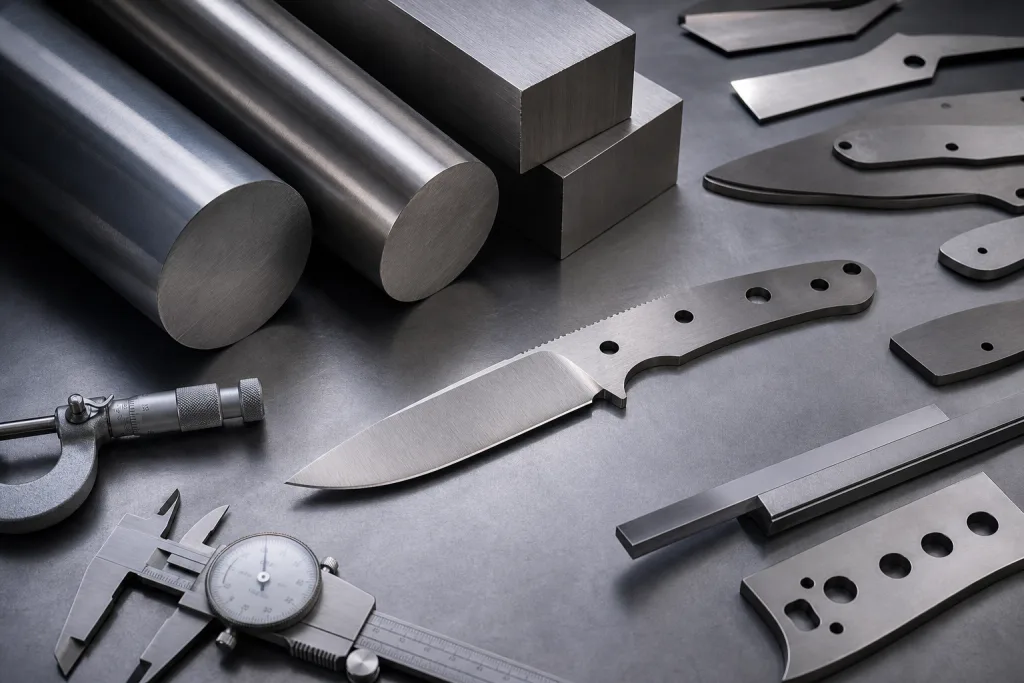
Your buyer approves a 440C folding knife because the sample hits 58 HRC on the Rockwell tester, runs 120 cuts on 20 mm rope, and still fits the FOB target. Then the bulk lot lands. Hardness reads 54 HRC. Bad sign. The edge rolls after one carton-opening demo, even with a 9 mm utility blade sitting beside it as the comparison piece, and the supplier replies, "we used 440 series steel."
That is the usual 440C-to-440A swap. Same polish, same black coating, same laser mark. Different carbon. The math doesn't work. That change narrows the heat-treat window, costs edge life after the grinding line, and shows up fast once the first 500 pcs hit retail. At TANGFORGE in Yangjiang, China, we treat this as a procurement control issue, not a trust issue, because we have seen this go sideways on a 3,000 pcs PO with one wrong steel line typed into the order. The wrong question is "is it 440?" Your purchase spec needs to say 440C, the mill cert must match the coil or bar stock we run, and QC should pull hardness and material samples before we ship from China.
The order starts with a risky quote
You are buying 5,000 pcs of private-label pocket knives for a North American outdoor channel. The approved sample says 440C, satin finish, 3.2 mm blade thickness, G10 handle, liner lock, individual color box, FNSKU label, and export carton. The supplier quote repeats 440C blade, FOB China, 45 days after deposit. Looks clean. Still, before we run the grinding line, QC checks blade thickness with a digital caliper at 3.18-3.22 mm and matches the laser mark against the sealed sample.
The price tells you where to look. If two factories quote USD 4.80 and USD 5.05 FOB, then a third quote lands at USD 3.95 with the same drawings and packaging, do not celebrate. On a small folding knife, the steel gap between 440A and 440C looks small on one piece, but across 5,000-20,000 pcs it can pay for someone’s margin. We have seen this go sideways: the buyer flagged “440C” on the artwork, but the mill cert attached to the shipment showed lower carbon 440A. Same satin finish. Wrong steel.
At our Yangjiang, China factory, a normal MOQ for a customized folding knife is 1,000 pcs per SKU, and a new OEM order with tooling, pre-production sample, packaging, and mass production usually needs 45-60 days. If a quotation is 15-25% cheaper than the market and still promises a faster ship date, ask what changed. Sometimes we run existing 3.2 mm blade stock and ship the sample in 12 days vs 18 days. Sometimes the math doesn’t work because the supplier changed the material before heat treatment.
Your first control is simple: never approve a quote that says only 440 series steel. Write the exact grade, target hardness, surface finish, blade thickness tolerance, marking text, and required documents directly into the PO and technical file. Small detail, big problem. We once had a PO typo reading “440 series” instead of “440C, 56-58 HRC,” and QC pulled the sample before mass production because that wording left too much room for games.
What 440C and 440A actually mean
440A and 440C sit in the same 440 stainless family, but carbon is the line on a knife order. On the floor, that extra carbon lets 440C run a harder HRC band and hold the edge through rope cuts and 10 mm carton-board tests. Both are martensitic stainless steels. Both need heat treatment. Both show up on knife POs. Do not swap them. QC pulled 2 blade blanks from the same grinding line where the stamp said 440C, but the mill sheet chemistry matched 440A.
For importers, the buying call is simple: use 440C when the retail claim depends on stronger edge retention or a harder blade; use 440A for entry-price stainless knives where rust resistance and landed cost matter more than cutting life. No magic here. Bad heat treatment wastes 440C. Properly heat-treated 440A works fine for low-cost kitchen knives and fishing knives, including 1,000 pc MOQ runs. The wrong question is “which steel sounds better?” Ask whether the shipment matches the approved spec. We have seen buyers approve 440C, then push back when the supplier tried to ship 440A to save roughly 8-12% on blade material; the math doesn't work once rework, air samples, and 7 days of lost packing time hit the order.
| Item | 440A | 440C |
|---|---|---|
| Typical carbon range | About 0.60-0.75% | About 0.95-1.20% |
| Typical chromium range | About 16.0-18.0% | About 16.0-18.0% |
| Common knife HRC band | 54-56 HRC | 58-60 HRC |
| Buyer risk | Sold as higher grade | Claimed but not verified |
| Best use case | Budget stainless knives | Mid-range edge retention |
The table does not replace the exact standard or the mill certificate. Chemistry ranges shift by standard and mill source, so your QC file should name a recognized material standard such as ASTM A276 where applicable, or a mutually approved Chinese equivalent with the full chemical composition range attached. We run this check before mass cutting. The inspector should match the heat number on the certificate against the coil tag before the slitter starts; one PO typo, “440C” on page 1 and “440A” on page 3, already caused a 12-day approval delay on a 3,000 pc order.
Write the PO like a QC document
A purchase order that says “440C blade” is too weak. If the shipment fails, that line gives you little grip because the factory can argue over EN/DIN naming, hardness tolerance, or which Rockwell tester was used. Write the knife PO like a compact QC sheet. We see this on the packing table: one loose line on the PO, then QC pulls 32 pcs under AQL 2.5, checks the spine with a digital caliper, and nobody can prove what steel went into the grinding line. Too late.
For a 440C order, we would write it like this: blade material 440C martensitic stainless steel; chemistry must match the approved mill certificate and agreed standard; target hardness 58-60 HRC after heat treatment; minimum acceptable 57 HRC unless approved in writing; blade thickness 3.2 mm plus or minus 0.15 mm measured at the spine with a digital caliper; no substitution with 440A, 420, 5Cr15MoV, 7Cr17, or any unspecified 440 series steel. Long sentence? Yes. Useful sentence. It cuts out the grey space that lets a supplier ship a cheaper coil and call it “440 stainless.” We run into this most often on repeat orders below 1,200 pcs, where the buyer wants 440C pricing but the quote was built around 440A stock. The math does not work.
Add the document requirements on the same PO page, not in a separate email chain. Ask for the steel supplier invoice or delivery note showing grade and heat number; mill test certificate with chemistry; batch linkage from blanking to heat treatment; furnace record with time and temperature; final hardness report with at least 5 blade readings per lot. For regulated kitchen products, write the market rule clearly: LFGB for Germany, FDA food-contact for the US, REACH or Prop 65 where your buyer requires it, and match this to the handle material. For outdoor knives, ask for carton drop test photos, barcode scan report, and country-of-origin marking check against the artwork file. The buyer flagged a wrong “Made in China” font on a PO last month, 2.8 mm too tall against the artwork file, and the whole carton batch had to be reprinted.
One practical point: require document submission before mass production starts. If the factory can only provide a mill cert after goods are finished, you are not controlling material anymore. You are collecting paperwork. We have seen this go sideways: 12 days before shipment, QC pulled the sample, the hardness tester showed 54-55 HRC on three blades, and the math did not work for a clean 440C claim.
Mill cert checks before cutting steel
The mill certificate is where buyers relax too early. We see this on roughly 3 out of 10 new 440C RFQs. A PDF with “440C” typed at the top proves nothing by itself. Before we cut, match the cert with the PO number, the heat number on the steel bundle, and the blade production plan. Last year’s generic cert goes to the trash folder. QC must be able to walk to the material rack, read the hanging tag, scan the heat number, and match it to the document before the first sheet goes under the cutting die.
Start with five checks. First, the grade line must say 440C or the agreed equivalent, not “stainless steel” or plain “440.” Second, read the chemistry line by line. Carbon matters. If carbon sits around 0.65%, that is not normal 440C, and the buyer flagged this exact issue on a 2024 sample order after our lab checked it against the supplier PDF. Third, the cert needs traceable details: heat number tied to the mill melt, lot number printed on the warehouse label, coil or plate size in mm, shipped weight in kg, and test date. Fourth, the supplied quantity must match the blade plan. If your 5,000 pcs order needs about 280 kg of blade steel including process loss, a certificate for 35 kg does not cover the job. The math doesn't work. Fifth, the steel supplier name must match the invoice or delivery note; one typo on a PO is harmless, but a different supplier name is a red flag we do not ignore.
At TANGFORGE, incoming material checks for knife orders cover document review, steel thickness measurement with a digital caliper, batch labeling, and segregation before cutting. We run about 300,000 knives per month across kitchen, outdoor, pocket, and Damascus categories, so batch control is not paperwork for show. A mixed rack of unmarked stainless sheet is not acceptable for export OEM production. QC pulled the sample, tagged the bundle, checked thickness at three points, and keeps it away from the grinding line until the cert and thickness are cleared.
If the order value supports it, request PMI or lab chemistry testing before blanking. Spend the money early. This is the wrong place to save 80 dollars. Rejecting raw steel in Yangjiang costs less than arguing over finished goods after they land in Europe or North America, especially when 8 cartons have already been opened by the distributor’s inspection team and the blade stamp already says 440C.
Heat treatment is the second trap
Even with genuine 440C, the order can still fail at heat treatment. Grade is only the starting point. Hardness, carbide control, and tempering decide how the blade feels on the customer’s cutting board. We’ve had QC pull a blade from the grinding line, put it on the Rockwell machine, and get 54 HRC on material sold as 440C. Real steel. Bad blade. The spectrometer passed. The hand feel was closer to a 2-dollar promo knife because that furnace run was not held tight enough.
For 440C knives, we usually set 58-60 HRC as the working target. Some designs need a lower target to cut chipping risk, such as a thin kitchen edge around 0.25 mm before sharpening or an outdoor knife with a thick tip. Put that in the spec sheet. Do not discover it after packing 48 cartons. 440A commonly lands around 54-56 HRC for knife production. This overlap is the trap: hardness alone does not prove the grade, but a 440C claim with 54 HRC readings is a red flag. We’ve had buyers ask, “Can we accept it if the material cert says 440C?” My answer is no. The math doesn’t work.
Your QC plan should include hardness testing after heat treatment and before final assembly. Test at least 5 pcs from the first production batch, then increase the count if the lot is large or the readings jump from blade to blade. For a 5,000 pcs order, we prefer a written sampling plan such as 13-20 blades taken from different furnace loads, with each HRC reading tied to the blade batch. We test on a flat ricasso or another clean area before handle fitting, not on a coated finished knife where the Rockwell point can give a false reading. One test is weak. If you only test one finished knife during final inspection under AQL 2.5, one bad furnace load can still slip into the shipment.
Ask for the heat treatment record: furnace date, batch quantity, quenching process, tempering temperature, tempering time, measured HRC range. A serious China factory will not treat this as a strange request for a 440C export order. We run these records by furnace load, and if the PO says “440C 58-60 HRC” but the workshop sheet shows 56-58 HRC, the buyer will flag it before shipment. We’ve seen this go sideways over one typo on a PO, where “58-60” became “56-58” and nobody caught it until QC pulled the sample.
Final inspection needs more than AQL
AQL inspection is necessary, but it was never built to prove blade chemistry. AQL 2.5 for major defects and AQL 4.0 for minor defects will catch scratches over 0.5 mm, weak grinding, loose locks, uneven coating, wrong logos, soft cartons, or missing sheath screws. Good for workmanship. Not for steel. QC pulled a satin-finished sample from our grinding line last month; after belt sanding with a 240# belt and stonewash, 440A and 440C looked the same by eye under the bench lamp. A carton can pass AQL and still carry the wrong steel claim.
For the final random inspection, run workmanship checks and material verification in the same visit. The inspector should confirm blade marking and blade thickness with a digital caliper, then check open/closed length, lock engagement, edge burrs, handle gaps, screw torque where relevant, barcode scan, carton count, and drop-test requirement. On folding knives, we usually check liner lock contact at 30% to 70% of the tang face, because buyers flag early lockup fast. We see this often on 3.5 inch folders after the pivot screw gets tightened one more quarter turn. For steel control, add portable hardness testing on selected pieces; if the claim risk is high, send retained samples for lab chemistry testing. XRF has limits on carbon, so handheld XRF alone is the wrong tool for separating 440A from 440C. Optical emission spectroscopy or another suitable lab method is better for carbon verification.
For kitchen knives, check food-contact documents such as LFGB or FDA conformity if your importer file requires them. Ask for the actual test report, not just a logo on the color box. We have seen this go sideways when a PO said “FDA” but the packing artwork showed “LFGB passed” with no report number; the buyer flagged it during pre-shipment review, 6 days before loading. Six days is nothing. For outdoor and tactical knives, check local blade length limits and assisted-opening rules before shipment, then match the destination labeling to the carton mark. Material grade is only one part of compliance, and treating it as the whole compliance check is the wrong question to ask.
Hold 3 reference samples: the approved pre-production sample with signed label, one sealed factory retention sample in the QC cabinet, and one buyer retention sample packed under the same PO. Mark each tag with date, steel grade, HRC, and sample approval status; we also write the PO number in black marker on the inner box flap to avoid mix-ups. Last season we caught one carton where “440C” was typed as “440G” on the small white sticker, while the master carton mark was correct. If a dispute starts 90 days after delivery, those samples beat memory and sales emails. The math doesn’t work if you save 2 samples and argue later.
When a downgrade is found
If the lab report says the order is not 440C, keep the claim factual and move the same day. No shouting. Ask for the steel purchase record with coil or plate number, the mill cert, the heat treatment chart with furnace lot and HRC target, the blade blank batch map, and the warehouse balance for that material. We check those papers against the PO wording line by line with a red pen on the packing desk. One buyer once had “440C or equivalent” buried in a revised PO; one small typo changed a clean rejection into a price fight. If the PO clearly blocked substitution, your position is much stronger.
There are four commercial paths. Reject the lot and remake it with correct 440C, which can mean 18 days instead of the original 12 if the grinding line is already booked. Accept the goods as 440A only with a price reduction, corrected carton labels, and written approval from your customer if that market allows it. Rework only makes sense when the issue is heat treatment, and even then QC needs to check blade thickness with a digital caliper after grinding because a 1.8 mm kitchen blade does not forgive repeated processing. Cancel the order if the supplier cannot prove control. The answer depends on destination law, open customer claims, launch date pressure, and whether the blade etching already says 440C.
Do not ship mislabeled knives and hope no one tests them. Bad bet. For Europe and North America, the loss is not just a refund. We have seen this go sideways: the buyer flagged it once, then the retailer compliance team asked for every carton photo, test report, and customs description before release. If your packaging, website copy, or blade etching says 440C, the blade needs to be 440C. Anything else is the wrong question to ask because the math does not work after chargebacks, relabeling labor at 0.06 USD per unit, and 2 pallets sitting in the bonded warehouse.
A good supplier in Yangjiang, Zhejiang, or any China knife base should be ready to put grade verification into the normal workflow. At TANGFORGE, QC pulled the sample before packing, not after the container was sealed, and we prefer one 30-minute spec argument before production to a 3-week dispute after arrival. We ship cleaner that way, with the XRF gun check logged before the master cartons are taped.
Frequently asked questions
No. After grinding, polishing, stonewashing, black coating, or laser marking, 440C and 440A can look the same. Even an experienced inspector cannot reliably separate these stainless knife steel grades by eye. Appearance inspection can confirm finish quality, blade thickness, logo, edge grind, and assembly, but not carbon content. For grade verification, ask for the mill certificate before production and use chemistry testing when the order value justifies it. Hardness helps too: 440C knives are often specified around 58-60 HRC, while 440A is commonly around 54-56 HRC. But hardness alone is not final proof because heat treatment can be adjusted or done badly.
No. 440A is not bad; it is just not 440C. For budget kitchen knives, fishing knives, promotional tools, or low-price retail programs, 440A can be a reasonable stainless choice because it offers decent corrosion resistance and easy sharpening. The problem starts when a supplier quotes 440A cost but sells the product as 440C. If your target retail position depends on edge retention, you probably want real 440C at about 58-60 HRC or another agreed steel. If your product brief is entry-level, 440A at 54-56 HRC may be acceptable, but the grade should be honestly stated in the PO, packaging, and product listing.
For a 440C order, request the mill test certificate, steel supplier invoice or delivery note, heat number, batch quantity, incoming material inspection record, and heat treatment plan. The mill cert should show chemistry, especially carbon and chromium, not just the words 440 series steel. Ask the factory to link the steel batch to your production order before blanking starts. For a 5,000 pcs order, the steel quantity on documents should make practical sense against blade size and process loss. If you need compliance support, also request REACH, LFGB, FDA, or Prop 65 documents depending on product type and destination market.
Testing every knife is usually unnecessary and can damage product surfaces if done poorly. Use a sampling plan tied to batch risk. For a 5,000 pcs order, checking 13-20 blades across different cartons or furnace lots is more useful than testing one display sample. If the factory has multiple heat-treatment batches, sample each batch. Combine hardness readings with AQL visual inspection, packaging checks, lock function checks, and lab chemistry testing for selected samples when grade risk is high. AQL 2.5 is good for workmanship defects, but it does not prove steel grade by itself.
Push the discussion back to the purchase order and approved specification. Yes, both belong to the 440 series steel family, but they are different grades with different carbon ranges and performance expectations. If your PO says 440C, then 440A is a substitution, not an equivalent, unless you approved it in writing. Ask for the mill cert, chemistry report, heat treatment record, and production batch traceability. If the goods are already finished, send samples to a qualified lab for carbon verification. Do not accept a wording change to 440 series steel after production unless you are also changing price, packaging claims, and customer commitments.
Send us your 440C sourcing spec
Share your drawing, target HRC, MOQ, packaging, and inspection requirements. We will check whether the steel spec is clear enough before quoting.
Request a Quote