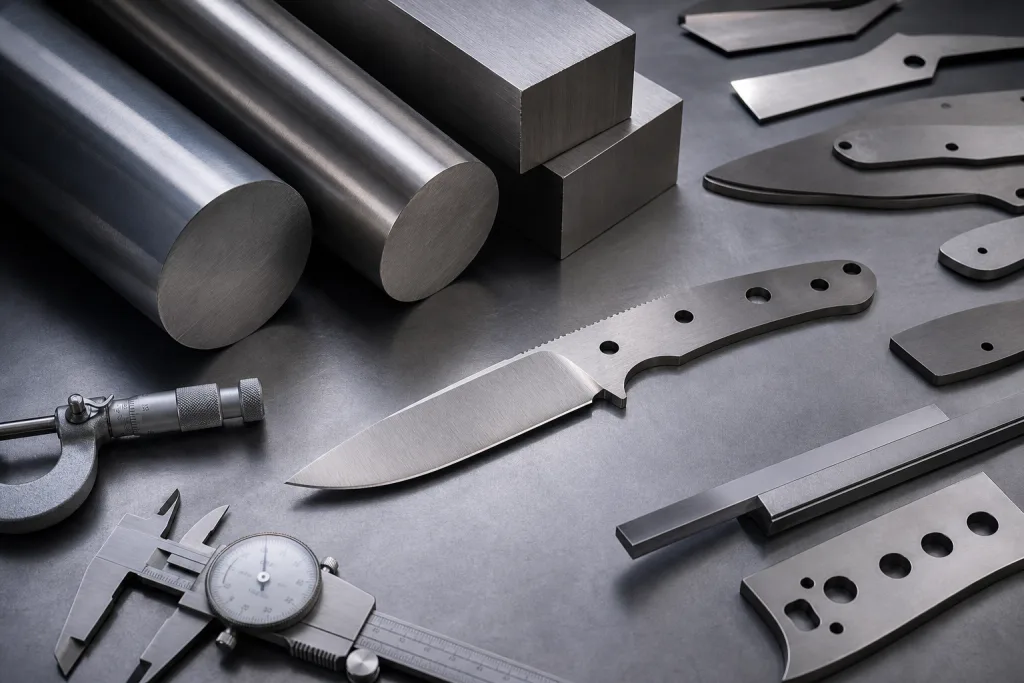
I've run the AUS-10 grinding line for 15 years. The vanadium does the quiet work—0.10–0.25% V tightens the grain enough to land 60 HRC without the micro-chipping buyers flag on VG-10. Chemistry's fine. Heat treat usually isn't. We pulled production samples at 56 HRC three weeks after the gold sample tested 60. The furnace operator shaved 15 minutes off the second temper to free the rack for a 5Cr15 order. Not a bad batch. A workflow gap nobody catches unless QC cross-checks the soak-time log against the traveler and raises the flag.
This is for the procurement manager placing 500 to 5,000 units of AUS-10 chef knives, pocket folders, or fixed-blade hunters. Real FOB Yangjiang price bands. MOQs the factory gives you on the second call—not the padded number from the first inquiry. Four inspection points that catch 90% of failures before the container seals. No sourcing fluff. Here's the spec sheet and the QC checklist we use when the buyer's spec says 58–60 HRC and we have to deliver it across 3,000 pieces.
What AUS-10 Actually Delivers at 59-60 HRC
AUS-10 is Japanese stainless from Aichi Steel—1.05% carbon, 0.50% manganese, with a vanadium addition around 0.10-0.25% that refines grain structure during heat treatment. At a target hardness of 59-60 HRC, you get edge retention that beats 440C by roughly 18-22% in CATRA testing while staying tougher than VG-10 at equivalent hardness. That means fewer micro-chips on a chef knife that clips a bone or a pocket knife twisted in hardwood. Our QC pull-test logs tell the story: 440C edges started rolling at 12 cuts on a rope-shear rig. AUS-10 at 59 HRC held clean to 15. Two cuts doesn't sound like much until you're staring at a return-rate spike on a 20,000-unit order.
The heat-treat window is narrow. Soak temperature needs to hold at 1,050-1,080°C, calibrated to blade thickness, followed by an oil or forced-air quench depending on your factory's line setup. If the furnace overshoots to 1,100°C, you get grain growth and a brittle blade that passes Rockwell but fails in the field. The sub-zero treatment—cooling to roughly -80°C for 1-2 hours after quenching—converts retained austenite to martensite. Skip it and a blade that should hold an edge through a shift dulls after 30 minutes on a cutting board. Not every Yangjiang factory runs in-house cryo. We had one buyer get a yes/no answer from three suppliers. We asked the fourth to pull the treatment log. It showed a 15-minute soak at -50°C. That's not cryo. It's a cold-water bath with a story attached. Ask for the log. If the factory won't send it, walk.
AUS-10 fits three product categories well. Western-style chef knives where edge stability at thin geometries matters—0.25-0.35mm behind the edge. EDC pocket knives where corrosion resistance and easy field sharpening outweigh max wear resistance. Boning and fillet knives that flex and need toughness over pure hardness. If you're spec'ing a hunting knife that will be batoned through kindling, this is the wrong steel. Look at 14C28N. But for the bulk of mid-to-premium kitchen and EDC applications, AUS-10 lets you hit a retail price of $49-$89 and still deliver real performance. We've shipped 12,000 units at that price point and the return rate sits under 0.8%. The math works.
Custom AUS-10 Knife OEM: MOQ, Tooling, and Lead Times
If a Yangjiang factory quotes an MOQ, treat the first number as a negotiation line, not the real floor. Trading companies and factories that hate short runs often say 1,000 or 2,000 pieces per SKU before they even check the drawing. We run about 40,000 units a month across all steel grades, with blanking and CNC grinding in-house. For a custom AUS-10 knife, we usually open at 300–500 pieces per SKU. Below 300, the laser-cutting setup, fixture calibration, and first-article check on the height gauge eat the margin for both sides. Simple as that. The math doesn't work.
Three details move that MOQ number once we quote from an actual DXF file and handle spec:
- Blade blank complexity: A straight drop-point chef knife with no jimping and no swedge carries zero tooling surcharge; the laser file is clean, and the grinder fixture usually holds within 0.15mm after first setup. A folder blade with a flipper tab, thumb stud hole, plus a tang profile that needs separate rough-grind, spine, and plunge passes is a different job. The laser nest has to be set for yield, not just speed. We have seen scrap jump from 3% to 9% when the nesting engineer rushed it. That one pushes MOQ to 500.
- Handle material: G10 and Micarta are shelf stock, so we can pull slabs from the rack and start CNC profiling the same week. Stabilized wood, carbon fiber twill, or custom-color FRN scales from an injection mold come with supplier minimums, usually 200–300 sets. The factory passes that cost straight through to the buyer. No way around it. We had one PO spell “Micata” instead of “Micarta,” and QC pulled the sample before packing because the grain finish did not match the approved board.
- Sheath or packaging: A thermoformed Kydex sheath needs a mold, with one-time cost at $180–$350 and a 2–3mm retention gap we check by hand before approval. A custom-printed retail box with magnetic closure adds roughly $0.80–$1.50 per unit at 500 pieces, and the print run takes 15–20 days by itself. That schedule is outside knife production. We had a buyer miss their ship window last year because the box vendor's laminator went down. Two weeks gone.
A first production order of 500–1,000 custom AUS-10 knives runs 35–50 days from deposit to ex-factory. Here is where the days go: 5–7 days for AUS-10 sheet. Most Yangjiang factories stock 2.0–4.5mm, but ask for 5.0mm and you add a week while the mill cuts a special run. Then 10–14 days cover laser blanking, CNC grinding with fixture checks, and heat treatment with cryo. QC checks hardness before assembly, and we usually want the reading stable across 3 blades from different trays. Handle assembly and finishing take another 7–10 days. Edge sharpening, final cleaning, and QC inspection take 5–7 days. If every blade gets laser engraving, add 3–5 days. Repeat orders usually drop to 25–30 days because the fixtures and CNC programs are proven, and the grinding line does not need to re-zero the same 240-grit belt pass.
FOB Price Bands for AUS-10 Knives Out of Yangjiang
FOB pricing for custom AUS-10 knives usually moves on four things: blade size, handle construction, surface finish, and order quantity. We run these quotes from Yangjiang, using mid-2025 OEM jobs where the buyer sent AI artwork, barcode files, and packing specs before sampling. The numbers below assume ISO 9001, in-house heat treatment, and cryo after quench, with hardness checked on a Rockwell tester, not guessed from temper color at the furnace door. No trading-company markup. Ask the wrong question and the quote looks cheap. “What is your cheapest AUS-10 knife?” is the wrong question to ask, because the math breaks once the grinding line has to keep 2.5mm stock flat across 500 pieces and QC starts rejecting blades with 0.4mm tip lift.
| Knife Type | Specs | 500 units | 2,000 units | 5,000 units |
|---|---|---|---|---|
| Chef knife 210mm | AUS-10, 2.5mm stock, G10 handle, satin finish | $6.80-$8.20 | $5.40-$6.50 | $4.50-$5.20 |
| Paring knife 90mm | AUS-10, 2.0mm stock, Micarta handle, stonewash | $3.90-$4.80 | $3.10-$3.70 | $2.60-$3.00 |
| EDC folder 85mm blade | AUS-10, 3.0mm stock, G10 scales, liner lock | $8.50-$10.20 | $6.80-$8.00 | $5.60-$6.50 |
| Hunting fixed 120mm | AUS-10, 3.5mm stock, Micarta, Kydex sheath | $9.20-$11.50 | $7.40-$8.80 | $6.20-$7.20 |
| Damascus-clad AUS-10 core chef 210mm | 67-layer Damascus over AUS-10 core, 2.5mm, wa-handle | $14.50-$17.80 | $11.80-$14.00 | $9.80-$11.50 |
Those prices cover the blade blank, heat treatment with cryo, handle material, assembly, basic edge sharpening, and either a plain white box or poly bag. Mirror edge costs extra. It adds $0.60-$1.20 depending on grit progression, and QC pulled the sample last month because one batch jumped from 800 grit to the buffing wheel and left scratch lines near the heel. Laser engraving adds $0.25-$0.50 per blade, based on logo detail and marking time on the 20W fiber laser. Custom packaging means a retail box with EVA foam insert and full-color print; at 2,000 pieces, we quote $1.20-$2.50 per unit. Need FNSKU labels for Amazon FBA? Budget $0.15-$0.30 per unit, and send the label PDF before carton artwork approval. We have seen a PO typo turn “FNSKU” into “FNSK,” then the buyer flagged it two days before carton sealing.
The Damascus-clad AUS-10 option needs its own check. Around 18 Yangjiang factories we track now quote San Mai construction with an AUS-10 core and 67-layer Damascus cladding, usually alternating 304 and 316L stainless or a nickel-manganese pattern-welded outer. The AUS-10 core does the cutting. The cladding sells the knife on the shelf and supports the retail markup. At 500 units, the $14.50-$17.80 FOB price can place a chef knife into an $89-$129 retail slot with workable margin. Check the bonding process before you approve PP samples. We’ve seen this go sideways when a supplier used pattern-rolled sheet stock instead of vacuum-forged billet; after sharpening to 15 degrees per side, the edge junction showed a 0.3mm bright line and two samples started to delaminate under a brass rod flex test.
The 4 QC Checkpoints That Catch Batch Failures
An AQL 2.5 general inspection on a 500-knife shipment catches the easy misses: blade scratches under a 600-lux bench light and handle gaps a 0.05mm feeler gauge can enter. It will not catch the problems that come back after six months in a home kitchen. Under-hardened blades roll at the edge. Bad edge geometry makes Aus-10 cut like a cheap stamped blade. Weak handle bonding opens after hot wash and cold storage cycles. We have seen this go sideways on reorders when the buyer only asked for a final inspection report. Wrong question. Four checkpoints belong in the QC protocol, with dated records tied to the grinding line belt change, furnace batch, assembly bench sign-off, and packing-table scan.
Checkpoint 1: Post-heat-treatment hardness verification. Before any blade goes to handle assembly, QC should pull a random sample of 5-8% of the batch (minimum 20 pieces for a 500-unit order) and test Rockwell hardness at three blade positions: 10mm from the tip, mid-blade, and 15mm from the heel. Acceptable range: 59-60 HRC with no single reading below 58 or above 61. Tight window. If the standard deviation across the sample exceeds 0.8 HRC, reject the batch; that usually points to furnace hot spots, mixed tray loading, or quench tank temperature drifting 6°C during the run. We run the HRC tester before scale fitting because rejected bare blades cost less than rejected finished knives. Ask for the dated test report, then match the serial numbers to the blade tray tag.
Checkpoint 2: Edge geometry and symmetry. Use a laser goniometer or a calibrated edge protractor on the same sample set. For a chef knife, the edge angle should be 15-18° per side with no more than 1° variance. Behind-the-edge thickness should match the spec sheet within ±0.03mm. The buyer flagged this on a 240mm chef knife once: the left bevel looked 1.8mm wider than the right under 3x magnification, even though the carton passed visual inspection. Off-center grinds cause returns from retail customers who know knives. Set zero tolerance for visible asymmetry under 3x magnification, and make the grinding line record the operator name plus belt grit for that batch.
Checkpoint 3: Handle adhesion and fitment. After assembly and before final packaging, put a random 5% sample through thermal shock: 60°C water immersion for 10 minutes, then immediate transfer to -20°C for 10 minutes, repeated for three cycles. Inspect for gap opening between scale and tang, epoxy squeeze-out left along the bolster, and scale material cracking around rivet holes. A 0.05mm feeler gauge tells the truth fast. For folders, add a lockup test: the liner lock should engage at 30-50% of the tang face with no vertical blade play under 5kg of downward pressure at the tip. The math does not work if the factory skips this and hopes final wiping will hide fitment issues. QC pulled the sample before packing, not after the cartons were taped.
Checkpoint 4: Packaging and labeling accuracy. This sounds boring, but it stops more shipping arguments than another polish check. Verify that every SKU's barcode scans to the correct product page, that country-of-origin marking is legible and compliant with destination regulations (US CBP requires "China" in English, EU requires "Made in China" in an official language of the importing country), and that blade coatings or oils are compatible with the packaging material. Some rust-preventative oils eat into EVA foam over a 45-day sea freight trip. We ship with a 72-hour packaging compatibility test on 5 units per SKU, plus a Zebra scanner check at the packing table. One PO typo changing "satin" to "sand" cost a buyer 312 relabels, so this checkpoint earns its place.
How to Qualify an AUS-10 Knife Factory Before You Send a PO
You do not need to fly to Yangjiang for every new AUS-10 supplier. Ask these five questions before you send the PO. "Are you a factory?" is the wrong question. Everyone says yes. We see it on 3 out of 10 RFQs: the reseller replies in 20 minutes, then goes quiet when we ask for furnace records or a 0.01mm caliper report. A production-grade factory should answer all five within 48 hours. A trading company usually dodges two.
1. "Send me a heat-treatment curve from your last AUS-10 production batch." A real factory has a data logger on the furnace and can export the time-temperature graph: soak temperature in °C, hold time in minutes, quench timing, plus the cryo cycle if they run one. Ask for the batch date. We check the curve against the hardness card on the QC desk, usually 58-60 HRC for AUS-10 kitchen blades unless the buyer spec says otherwise. Simple check. If they say they will "check with the workshop" and nothing arrives by the next shift, heat treatment is probably outsourced. No control there.
2. "What's your AUS-10 sheet supplier and what thicknesses do you stock?" Proper AUS-10 comes from Aichi Steel in Japan and enters China through approved channels. The factory should name the distributor and show a recent mill certificate with the heat number. We usually stock 2.0mm and 2.5mm sheet for kitchen programs; 3.0mm needs material booking, often 18 days vs 12 days for standard thickness. If the source sounds vague, the math does not work. You might be getting a Chinese equivalent steel that matches chemistry on paper, then shows dirty inclusions when the grinding line opens the bevel.
3. "Show me three production samples from different batches, not your gold sample." The gold sample shows what the factory can make when the boss stands beside the belt grinder. Three production samples from different months show what lands in your cartons. Check the grind line height in mm, the handle gap under a feeler gauge, and the blade finish under side light. We have seen this go sideways: one buyer approved a clean sample, then QC pulled the shipment and found 0.4mm handle step on 37 pieces in a 500-piece lot. Variation is the real QC metric.
4. "What's your in-house testing equipment list?" Minimum acceptable equipment: a calibrated Rockwell hardness tester, not a portable Leeb tester, because Leeb readings can swing ±2 HRC on thin blades; a digital caliper with 0.01mm resolution; a surface roughness tester if the spec calls for satin or mirror finish. Better factories also keep a salt spray cabinet for corrosion testing per ASTM B117 and a CATRA edge-retention tester for kitchen-knife OEM work. Ask for the calibration sticker photo. QC should send it in 5 minutes, not after a lunch break and 6 phone calls.
5. "Walk me through your non-conformance process on the last export order that had a QC failure." Every factory has failures. The factories worth using will tell you what failed, why it failed, and what changed on the line after that. A real answer might sound like this: "Buyer flagged burrs at the heel on 28 pieces, we changed the deburring wheel from 600 grit to 800 grit, then added 100% heel inspection before packing." Good answer. If they claim they have never had a QC issue, they are either lying or not inspecting. Move on.
Compliance and Documentation for EU and US Import
An AUS-10 knife shipping from Yangjiang to Rotterdam or Los Angeles needs more paperwork than 8 out of 10 first-time importers put in their cost sheet. Miss one file and the container waits at port, with demurrage running $150-$300 a day while your forwarder chases documents that should have been in the booking pack. We check the document folder before we grind the first 200 mm chef knife sample, including carton mark, SKU name, and test report date. Paperwork first.
For the EU market, your knives need to comply with the General Product Safety Regulation (GPSR) effective December 2024, including an authorized representative in the EU, traceability labeling, and technical documentation for each SKU. Food-contact knives, including chef knives and paring knives, also need compliance with EU Regulation 1935/2004 on materials intended for food contact. The blade steel usually passes. The handle is where the risk sits. G10 and Micarta pass LFGB and Italian MOCA testing cleanly in our lab files, while stabilized wood needs a migration test certificate showing no resin leaching under simulant testing. QC pulled one 8-inch sample last year where the handle batch code on the carton did not match the LFGB report. The buyer flagged it. Budget $400-$600 per SKU for third-party lab testing if your factory does not already hold valid certificates.
For the US market, FDA compliance for food-contact articles applies to kitchen knives, though enforcement is lighter than in the EU. The bigger US issue is California Proposition 65, which requires a warning label if the product contains any listed chemicals above safe harbor levels. Most AUS-10 knife components clear Prop 65, but handle dyes and brass liners with lead content above 100ppm can trigger a problem. Ask your factory for a Prop 65 compliance letter per SKU, not one blanket statement covering 30 handles. We have seen this go sideways when a PO listed "black pakkawood" but the packing team loaded dyed rosewood handles from a 500-piece leftover lot. The caliper reading looked fine at 18 mm, but the material name was wrong.
Across both markets, REACH and RoHS compliance for electronic parts is mandatory if you bundle LED-lit display boxes or USB-charged knife sharpeners with the knife. A factory holding BSCI or SMETA social compliance audit certification will not make the grinding line produce a straighter blade, but it can stop a retail buyer from rejecting the supplier during vendor onboarding. At TANGFORGE, we maintain ISO 9001:2015 for quality management and complete REACH and LFGB testing on all food-contact SKUs as a baseline, not an upsell. This is the wrong place to bargain; one missing REACH file delayed a 1,000-piece shipment more than blade rework did, 18 days vs 12 days in one case we handled. The math doesn't work when a $35 file check holds a pallet already shrink-wrapped for vessel closing.
Rush Orders and Inventory Programs for Repeat Buyers
After the first custom AUS-10 order ships clean, the question changes fast: not "can you make it," but "how soon can we refill?" We see this right after a 1,000 pcs chef knife run passes AQL 2.5, with QC checking the handle joint by 0.2mm feeler gauge and finding no gap. Then the buyer asks for 14-day restock. Fair question.
If you sell through Amazon FBA or a retail chain with stockout penalties, ask about a safety stock program. The normal setup is simple: send a quarterly forecast, then we hold 30-50% of that volume as semi-finished stock. Blades are already heat-treated to the agreed HRC range, cryo-treated in the cold tank, and rough-ground on the grinding line, but we leave off handles and retail packaging. You commit to taking that stock within 90 days. Reorder lead time then moves from 35-50 days to 12-18 days because we only need to fit handles, do final sharpening on the whetstone wheel, laser mark the logo, and pack by carton spec. Simple math. A 3-5% unit price premium covers working capital, and for 6 retail buyers we work with, that cost is still lower than one missed FBA replenishment window. MOQ matters here too; the math doesn't work if the buyer wants us to hold 80 pcs split across three handle colors.
For urgent orders, say a retailer sends a PO for 500 units of a 210mm chef knife and wants goods in 21 days, a Yangjiang factory with in-house heat treatment and packing can run a repeat SKU in 18-22 days. You will pay for it. Expect a 15-20% rush surcharge, plus air freight instead of sea freight. Guangzhou to Los Angeles or Frankfurt usually adds about $1.80-$2.50 per unit versus sea freight on that knife size, and the buyer often flags this only after finance checks landed cost. One pushback from our side: never approve a rush order that skips cryogenic treatment to save 2 days. QC pulled the sample on one rushed batch after the rope-cut test; edge retention dropped, and the returns data made the saving look stupid six months later.
Frequently asked questions
A direct AUS-10 knife factory in Yangjiang will typically quote 300-500 units per SKU for a custom knife with laser engraving. The engraving itself adds no MOQ—the laser setup takes 10 minutes. The real minimum is driven by blade blank production: the laser cutter nests multiple blades per sheet of AUS-10 steel, and running less than a full sheet wastes material. At 300 pieces of a 210mm chef knife, you're using roughly 2.5 sheets of 2.5mm AUS-10 stock, which is the practical minimum for efficient nesting. If you need multiple blade shapes within one order, some factories will let you split the 300 units across up to 3 SKUs with a small setup fee of $80-$120 per additional SKU.
Request a mill certificate from Aichi Steel with the heat number that matches the batch your blades were cut from. A legitimate factory will provide this without hesitation. For additional verification, you can have a random blade tested via XRF (X-ray fluorescence) or OES (optical emission spectroscopy) at a third-party lab like SGS or Bureau Veritas for about $80-$120 per sample. The key markers for AUS-10 are carbon at 0.95-1.10%, chromium at 13.0-14.5%, and the presence of vanadium at 0.10-0.27%. Chinese-made equivalents like 10Cr15CoMoV will have similar chromium but often lack the vanadium peak or show cobalt additions that AUS-10 doesn't have. Run this test once when qualifying a new factory, then spot-check annually.
AQL 2.5 Level II is the industry standard for mid-to-premium kitchen knives and works well for AUS-10 products. This means in a batch of 500 units, you'll inspect 50 pieces and can accept up to 3 defective units for major defects (blade play, off-center grind, handle cracks) and up to 5 for minor defects (cosmetic scratches under 5mm, slight packaging scuffs). For a premium line retailing above $80, tighten to AQL 1.5 on major defects. The most common QC failure on AUS-10 knives isn't the steel—it's handle fitment and blade centering on folders. Specify these as critical defects with zero acceptance regardless of AQL level.
From your CAD file or technical drawing to a production-ready sample, budget 18-25 days for the first prototype. This includes 2-3 days for CAM programming and laser-cutting setup, 5-7 days for heat treatment and cryo, 5-7 days for handle prototyping and assembly, and 3-5 days for finishing and QC. If the first sample needs geometry adjustments—which it usually does—add another 10-14 days for the second revision. Total development timeline from concept to approved gold sample: 4-6 weeks. Production then adds 35-50 days for the first order. Rush development with overlapping processes can compress this to 3 weeks, but it costs 20-30% more and increases the risk of a geometry error making it into production.
A growing number of Yangjiang factories now offer both monosteel AUS-10 and Damascus-clad AUS-10 (San Mai construction with an AUS-10 core) under one roof. This is ideal for a brand that wants a good-better-best product line using the same core steel. The Damascus cladding process requires vacuum forging capability and a separate billet-preparation step, so not every factory does it in-house. If you're ordering both types, ask the factory to run the Damascus-clad blades on the same heat-treatment protocol as the monosteel blades to ensure consistent core hardness. The MOQ for Damascus-clad AUS-10 is typically 200-300 units, slightly lower than monosteel because the billet size dictates the minimum rather than the sheet stock.
Send Us Your AUS-10 Knife Specs for a Quote
Get a production quote with heat-treatment protocol, lead time, and FOB Yangjiang pricing within 48 hours. No MOQ games—just real numbers from a factory floor.
Request a Quote