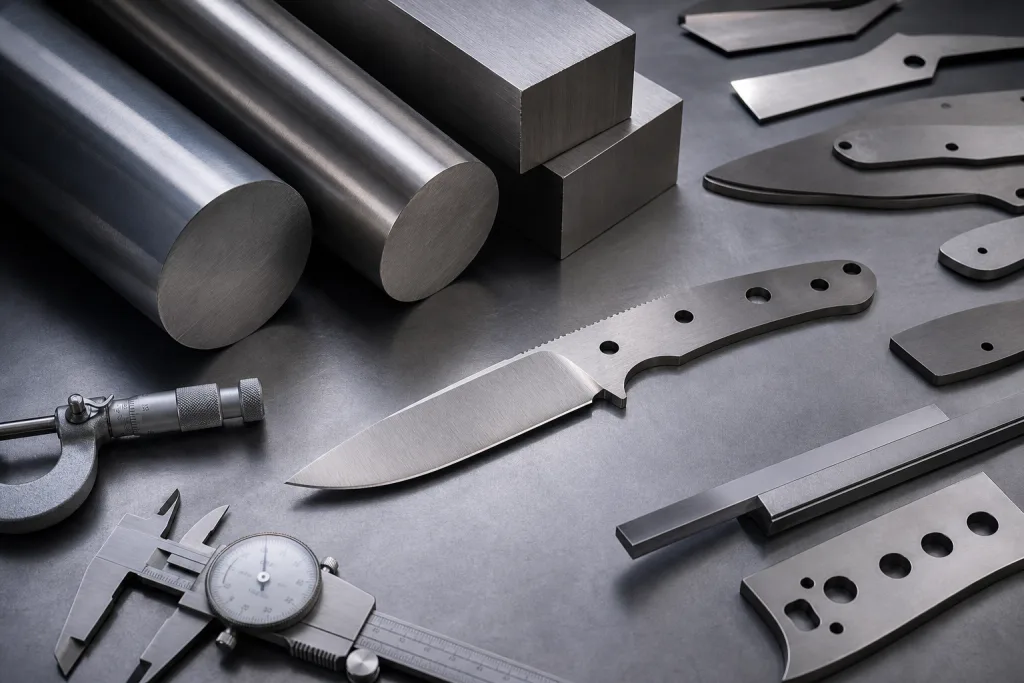
AUS-10 is a practical middle lane for private label knives: better edge holding than 3Cr13 or 5Cr15MoV, pricing that still works below VG-10, and enough selling value for Amazon and retail programs. But a line like “AUS-10, wood handle, logo, gift box” is not a spec. It is a risk note. We saw 11 RFQs last quarter written this way, and QC later pulled samples with a 2.8 mm spine when the buyer expected 2.2 mm. The wrong question is “Can you make AUS-10?” The right question is “Which AUS-10 knife are we locking for mass production?”
If you want repeatable output from an AUS-10 knife factory China buyers can rely on, freeze the working details before sampling: blade profile with spine thickness in mm, target HRC after heat treatment, surface finish, handle fixing method, logo process, box structure, and AQL 2.5 inspection points. At TANGFORGE in Yangjiang, China, we run AUS-10 as a controlled production job, not a steel name printed on the carton. Small details matter. A typo on one PO changed “satin” to “sand,” and the grinding line had to stop before 300 blades moved into final polishing.
What AUS-10 Should Mean
AUS-10 is a Japanese stainless steel we see in kitchen, outdoor, and folding knife programs when the buyer wants a clear step up from 3Cr13, 5Cr15MoV, or basic 420 series steels. The chemistry is usually around 1.0% carbon and 13-14.5% chromium, with molybdenum and vanadium doing part of the hard work. Nickel and manganese are there too, but vanadium is the part brands point to when they claim better wear resistance. Fair claim. Only if the heat treatment is right. On the grinding line, QC pulled 12 blades from one AUS-10 lot last month; 2 were under target at the heel after Rockwell testing, and those did not move to handle assembly.
For an AUS-10 knife private label specification, do not accept “AUS-10 or equivalent” unless you are ready to receive 10Cr15CoMoV, 440C, or another substitute. We have seen this go sideways when the PO had one typo: “AUS10 equiv.” instead of “AUS-10 only.” Equivalent steel is not the problem; unnamed steel is the problem. Put the exact grade in the purchase order, make it testable, and approve it before we run blanks on the waterjet. For most kitchen programs, we recommend 59-61 HRC. At 62 HRC, the math does not work if the buyer also asks for a thin 12° edge per side and expects the knife to survive frozen food or hard bone. For tactical or hunting knives, 58-60 HRC is safer because impact resistance matters more than chasing a harder Rockwell number.
Ask the factory to confirm the steel mill source, heat treatment route, and hardness test frequency before deposit. At TANGFORGE in Yangjiang, China, our standard AUS-10 control means hardness testing by production lot, visual inspection after grinding, and edge testing during final QC. Simple checks catch expensive mistakes. We run hardness checks with a Rockwell tester, inspect bevel symmetry under bench light, and flag burn marks near the tip before packing. Do not sell AUS-10 only as a luxury label; this is the wrong question to ask. It is a good working steel when the blade thickness, edge angle, and handle construction are specified together.
Build Your Buyer Specification
A good buyer spec fits on the cutting bench and still gives QC a reason to reject bad goods. Page 1 should lock the knife type, dimensions, tolerance, steel, HRC, blade finish, edge angle, handle material, logo, packaging, compliance, and inspection level. We run calipers on the first 20 pcs from the grinding line; if the drawing says “same as photo,” the inspector has nothing to measure. Reference photos alone are the wrong way to buy private-label knives.
For a custom AUS-10 knife, write blade length in mm, spine thickness, tang construction, grind type, edge angle per side, bolster choice, and target weight. A chef knife might be 203 mm blade length, 2.2 mm spine thickness, 15 degrees per side, satin finish, full tang, G10 handle, 59-61 HRC, and laser logo on the left face. A hunting knife might be 95 mm blade length, 3.5 mm spine, 20 degrees per side, stonewashed finish, micarta handle, 58-60 HRC, and Kydex sheath. QC pulled one sample last month where the PO said “8 inch chef” but the artwork showed 210 mm; that 7 mm gap becomes a real argument after heat treatment.
Branding needs numbers too. Show logo position on a 1:1 artwork file, usually AI, PDF, or DXF, with distance from spine and heel marked in mm. Laser engraving is the lowest-risk option for MOQ under 1,000 pcs; we ship it with fewer rejected blades because there is no ink rub test or coating thickness issue. Etching and stamping can look stronger, but each adds tooling and sample risk. If your importer account requires FNSKU, carton labels, suffocation warnings, or country-of-origin marks, put them into the packaging specification before the pre-production sample. We have seen this go sideways when the buyer flagged a missing “Made in China” mark after cartons were sealed with 48 mm tape.
MOQ, Price and Lead Time
AUS-10 knife MOQ is not set by the steel grade alone. The real drivers are handle material, tooling, packaging, and whether we run an existing blade blank or open a new shape. Existing blade shape, laser logo, and standard color box can start at 300 pcs per model. Once the PO asks for a new forging die, CNC handle profile, custom Kydex sheath, or retail gift box, MOQ usually moves to 600-1,000 pcs per model because the grinding line and packing line both lose efficiency. On one 8 inch chef knife order, QC pulled the pre-production sample and the buyer flagged a 0.4 mm handle step at the bolster; that small change pushed the handle fixture into a new CNC setup. For mixed container programs, we can sometimes combine 2 colors or 3 handle variants, but the steel, heat-treatment batch, and blade blank need to stay production-efficient.
Price follows geometry more than buyers expect. A thin chef knife with a simple pakkawood handle costs less than a short tactical knife with thick stock, black coating, machined G10, screws, and sheath. Chasing the lowest FOB China number is the wrong question to ask; the math does not work if the quote depends on thinner stock, softer heat treatment, or a coating that fails tape test after 24 hours. We’ve seen this go sideways when a buyer’s PO said “AUS10” but the drawing showed 4.0 mm spine thickness, full tang, 6 screws, and a molded sheath with no line item for tooling. Budget realistic ranges, then lock the blade thickness, HRC target, handle spec, packing method, and AQL 2.5 inspection level before price confirmation.
| Private label AUS-10 item | Typical MOQ | FOB China guide price | Normal lead time |
|---|---|---|---|
| 8 inch chef knife, G10 handle | 300-600 pcs | USD 8.20-13.80 | 35-50 days |
| Kitchen knife set, 3 pcs | 500 sets | USD 18.50-32.00 | 45-60 days |
| Fixed blade outdoor knife | 500-800 pcs | USD 9.80-18.50 | 40-55 days |
| Folding pocket knife | 600-1,000 pcs | USD 10.50-22.00 | 45-65 days |
At TANGFORGE, our monthly capacity is about 120,000-160,000 knives depending on model mix. Sampling is normally 12-20 days; a logo-only sample can be 12 days, while a new CNC G10 handle sample is closer to 18-20 days after the drawing is signed. Mass production starts after deposit, sample approval, and packaging artwork confirmation. Simple rule: no approved artwork, no packing. China holiday periods, especially before Chinese New Year, can add 15-25 days if orders arrive late, and we have had cartons stuck because a PO typo listed “matte balck box” while the approved dieline said matte black sleeve.
Branding and Packaging Choices
Private label work is where 7 out of 10 AUS-10 projects lose margin. The knife can pass 58-60 HRC and still get stuck because the logo file, insert card, barcode, or gift box was signed off too late. A workable AUS-10 knife OEM package needs brand assets, Pantone colors, barcode type, packaging board thickness, carton drop test target, and inner protection called out on the PO. Do not release mass production from a PDF mockup only. This is the wrong question to ask. Ask what QC can measure on the packing table: 1 physical packaging sample, 300 dpi artwork, scannable UPC/EAN, and a master carton label our warehouse team can read at 2 meters.
Logo methods should match price point and defect risk. Laser engraving is clean and holds up on most satin or stonewashed blades; we run it on a fiber laser and QC checks logo position with a 0.5 mm tolerance gauge. Deep etching gives a darker mark, but we have seen it look uneven near curved blade faces. Stamping needs tooling and must be planned before blade grinding, or thin blades can pick up a small wave near the mark. For handles, laser works on pakkawood and bamboo, while some micarta batches need a test burn first. Metal badges and mosaic pins look premium, but the assembly line needs tighter glue control and a second visual check after polishing.
Packaging should be written by sales channel, not copied from an old quote sheet. Amazon and marketplace sellers usually need FNSKU labels, readable UPC/EAN, master carton labels, and polybag warnings if bags are used; last month the buyer flagged a 1-digit typo on the FNSKU and 48 cartons had to be relabeled before loading. Retail buyers focus on color consistency, hang-hole tear strength, gift-box stiffness, and carton compression. For North America, food-contact materials may need FDA-related declarations. For Europe, REACH and LFGB requests are common for kitchen knives, coatings, plastics, and packaging inks. If you sell through distributors, put 20 spare carton labels in the shipment. It sounds small, but the math doesn't work when mislabeled cartons delay delivery 12 days instead of a 1-day logo correction.
QC Risks Buyers Miss
The biggest QC risk with AUS-10 is not fake steel, although we have seen that once from a trading-channel sample with no mill cert. The daily trouble is process control: HRC drifting from 59 to 61 across the same lot, blue heat marks on the grinding line, 1.5 mm blade warp, bevels that do not match, handle gaps after epoxy cure, coating peel on the spine, and gift box scuffs from loose inner trays. These are factory-floor problems, not catalog problems. Ask about the line, not just the steel name.
Your inspection plan should split functional defects from cosmetic defects. Functional defects include wrong steel, HRC outside tolerance, loose handle, cracked scale, unsafe tip, blade warp over agreed tolerance, lock failure on folding knives, and edge damage. Cosmetic defects include small scratches, logo shade variation, minor handle color difference, and box rub marks. For 5,000 pcs B2B orders, AQL 2.5 major and AQL 4.0 minor is a practical default. For premium retail sets above USD 30 FOB, some buyers use AQL 1.5 major. The wrong question is “does it look OK?” QC pulled the sample last month because 7 knives looked clean, but 2 handles moved under a 15 kg pull test.
Ask for control points during production, not only a final inspection report. For AUS-10, we run incoming steel certificate review, first-piece grinding approval, HRC testing after heat treatment, handle fit inspection before polishing, logo confirmation, edge sharpness check, and carton drop check for final packaging. CATRA testing is useful for benchmark projects, but most private label orders do not need CATRA on every batch. A practical factory test is cutting paper, rope, or standardized media after a fixed number of strokes, then checking the edge under a 6000K inspection lamp. Define “razor sharp” in the PO. One buyer flagged this wording after mass production, and the math did not work for re-sharpening 12,000 pcs before vessel cut-off.
Compliance for EU and North America
Knife compliance is not one form. It covers product safety, material declarations, labels, carton marks, and shipping rules, and the category drives the work. A chef knife for Germany or Canada moves differently from a tactical folder, even when both use AUS-10 from the same heat-treatment batch. Before you ask us for DDP pricing, lock the product type first: kitchenware, outdoor equipment, hunting gear, or restricted tactical item. This is the wrong question to ask after tooling starts. Last month our export desk held 312 pcs at packing because the PO said “outdoor knife” while the artwork called it “combat knife”; customs classification and local knife laws do matter.
For kitchen knives, importers usually ask for LFGB or FDA food-contact support, REACH declarations for restricted substances, and packaging material details. Stainless blades are normally clean on paperwork, but coatings, plastic handles, adhesives, printing inks, and gift-box lamination need a closer check. QC pulled the sample once because black handle paint rubbed onto a white cloth after 20 strokes, even though the blade passed hardness at 60 HRC. For wooden handles, some markets ask for FSC, fumigation records, or moisture content; we run 8–10% as the safer target before final packing. California channels also need a Prop 65 review when the material list or sales claim points that way.
For folding knives and tactical knives, buyers should define lock strength, opening method, clip orientation, blade length, and local restrictions before sample approval. Assisted opening and automatic mechanisms cause the most pushback; double-edge and dagger profiles get retail platforms nervous fast. We can make them in Yangjiang, but the math doesn’t work if 2,000 pcs are finished and Amazon or customs rejects the listing. If you sell into Europe and North America, keep one compliance file with PO, approved sample photos, steel declaration, test reports, artwork, carton marks, and inspection records. We ship through Zhejiang trading offices on some orders, while the Yangjiang factory handles grinding line records and AQL 2.5 inspection sheets, but the legal importer still owns market entry.
How to Approve Production
A tight approval process saves more money than another USD 0.08 of price pressure. Start with a technical RFQ, not a mood board. Send a spec sheet with blade drawing in mm, AUS-10 steel request, target HRC, handle material, logo method, retail box size, target MOQ, and Incoterm; we run quotes against those lines, not against screenshots from Amazon. If you ask only for the cheapest AUS-10 knife MOQ, the math does not work. You will get the factory’s cheapest reading of AUS-10, and the buyer usually flags it later when the spine comes out 0.4 mm thinner than expected.
After quotation, move to a pre-production sample. Check it like a buyer, not like someone who likes the design. Use a digital caliper for blade length and spine thickness, weigh the knife in grams, check balance point from the bolster, confirm logo position against the artwork, test carton fit, and run an HRC check if your market cares about hardness claims. QC pulled one sample last month where the logo was 3 mm too low, although the blade looked fine on video. Seal one reference sample for the factory and keep one in your office. The PO should state that mass production must match the approved sample and written spec, with tolerances listed for blade size, weight, packaging, and logo placement.
For new buyers, we recommend a pilot order of 300-600 pcs per model before scaling to 3,000-10,000 pcs. This gives your sales team real photos, customer comments, and return-rate data tied to one batch number. TANGFORGE was established in 2008 and runs about 240 employees across knife production, QC, engineering, packaging, and export support; on the grinding line, one small handle-gap issue can repeat across 800 pcs before lunch if nobody locks the sample. From Yangjiang, China, we ship AUS-10 kitchen knives, chef knives, pocket knives, hunting knives, tactical knives, and Damascus-style private label programs. The best projects are not the most complicated. They are the ones where the buyer defines the numbers that matter, then lets the factory control production around those numbers.
Frequently asked questions
For an existing blade profile with laser logo and standard packaging, a realistic AUS-10 knife MOQ is usually 300-600 pcs per model. If you need a new blade shape, custom handle tooling, special coating, molded sheath, or printed gift box, expect 600-1,000 pcs per model. Kitchen sets are often quoted by sets, with 500 sets being a practical starting point. Very low MOQ, such as 100 pcs, is possible only for sample runs or stock-based programs, and the unit price will be higher because setup, packaging, and inspection time do not shrink much.
For most AUS-10 kitchen knives, specify 59-61 HRC. This gives a good balance of edge retention, sharpening feel, and chipping resistance. If your brand targets professional chefs and uses a thin 12-15 degree edge, stay careful at the high end of the range because misuse can create edge chips. For outdoor or hunting knives, 58-60 HRC is often more practical because the knife may see twisting, impact, wood contact, and field sharpening. The PO should define both the target HRC band and the test frequency, for example 3-5 pieces per production lot.
A common 8 inch AUS-10 chef knife with G10 or pakkawood handle often falls around USD 8.20-13.80 FOB China, depending on thickness, polishing, handle machining, logo, and box. Outdoor fixed blades are often USD 9.80-18.50 because they use thicker steel, heavier handles, and sheaths. Folding knives can run USD 10.50-22.00 depending on lock, bearings, clip, screws, and assembly time. If a quote is 25-35% below the market range, check steel substitution, HRC control, handle material, packaging thickness, and inspection assumptions before accepting.
Yes. If you use an existing blade shape and handle construction, you can usually add your logo without new blade tooling. Laser engraving is the safest route for 300-600 pcs because it needs no stamping die and has low scrap risk. Handle logos may need testing because wood, G10, micarta, and plastic react differently to laser power. Printed boxes, insert cards, UPC/EAN labels, and FNSKU stickers can also be customized at low tooling cost, but printed packaging still has MOQ and color-approval requirements. Always approve one physical logo sample before mass production.
For normal B2B orders, use AQL 2.5 for major defects and AQL 4.0 for minor defects. Major defects should include wrong steel, HRC outside agreed range, loose handle, cracked handle, unsafe tip, serious blade warp, lock failure, incorrect logo, and packaging that prevents sale. Minor defects can include small scratches, slight color variation, light box marks, and minor logo shade differences. For premium retail programs, AQL 1.5 major may be reasonable, but it can increase inspection time and rejection risk. Define the defect list before production, not during final inspection.
Send Your AUS-10 Knife Spec for Review
Share drawings, target MOQ, packaging needs, and market channel. Our engineering and export team will check the specification before quoting.
Request a Quote