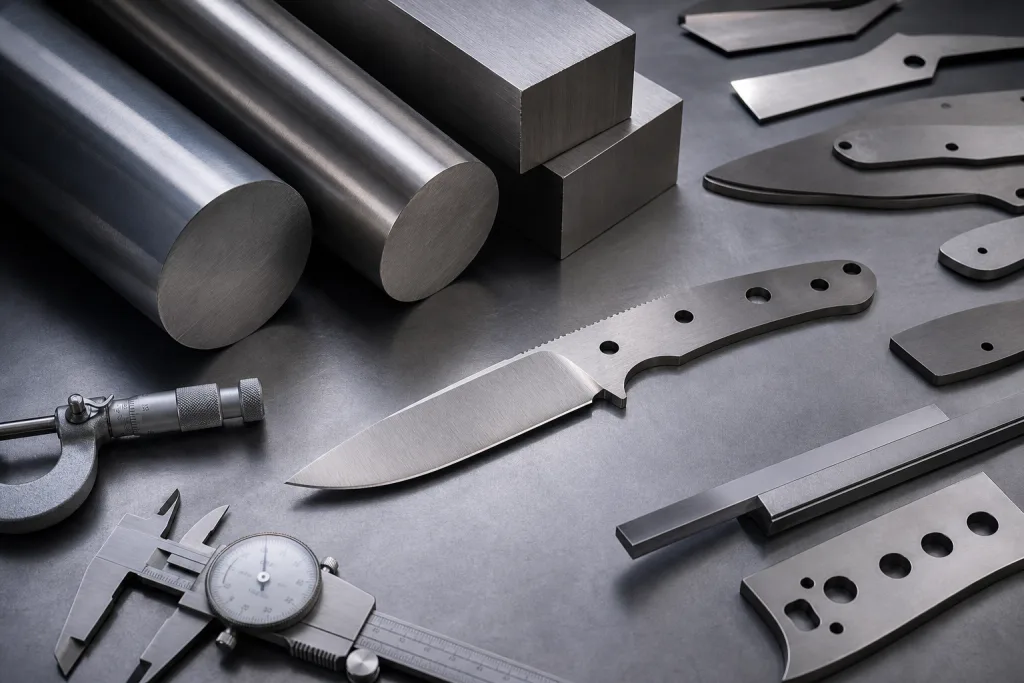
A boning knife looks simple on a product sheet: narrow blade, pointed tip, comfortable handle. On the grinding line, it is not simple. A 1.8 mm blade can feel fast in the hand or cheap after 20 strokes on the belt, depending on taper, heat treatment, grinding pressure, handle balance, and whether QC sees the same edge angle from heel to tip.
If you are choosing a boning knife OEM factory in China, a catalog quote is not enough. Lock the use case, steel grade, HRC band, MOQ, packaging, compliance, and inspection plan before tooling starts; we have seen this go sideways when a buyer approved “flexible blade” on the PO but meant 2.0 mm semi-stiff at the spine. TANGFORGE manufactures kitchen knives in Yangjiang, Zhejiang, with about 240 employees and monthly kitchen knife capacity around 180,000 units. The points below are the same issues our export sales engineers check before quoting a serious boning knife OEM project.
Start With The Cutting Job
Before you ask a boning knife factory China supplier for a quote, pin down the cutting job first. This is the wrong question to ask: “What is your best boning knife?” Poultry deboning, fish filleting, butcher trimming, and a retail kitchen set add-on need different tip shapes, belly curves, and flex. We’ve seen a 6 inch sample pass photo approval, then QC pulled the sample on the cutting bench because the tip was too wide to follow a chicken joint.
For Western retail and foodservice orders, we run most boning blades at 5 inch, 6 inch, or 7 inch, with 6 inch as the safer starting size. It covers chicken frames, pork ribs, beef trimming, and daily meat prep without feeling awkward in a hotel kitchen. Spine thickness usually sits between 1.6 mm and 2.2 mm, checked by caliper 30 mm behind the tip and again near the heel. Below 1.6 mm, the blade can feel loose unless steel strip and heat treatment are tight. Above 2.3 mm, the knife wedges in meat and starts to feel like a small utility knife.
Write the flex level in production language. Rigid works for beef and pork trimming. Semi-flexible fits poultry lines. Flexible is for fish work and fine deboning where the blade must follow bone. Do not just type “flexible” on the drawing; the grinding line cannot inspect that word. Ask the factory to confirm a bend test range, such as 12-18 mm deflection under a 1 kg load at a fixed blade point, then approve the production sample against that number.
At TANGFORGE in Yangjiang, China, we usually ask buyers to send 1 reference sample, 1 target retail price, and 1 packaging requirement before we quote. It cuts out 2-3 rounds of email. If your target shelf price is USD 14.99, the math does not work for a Damascus blade, resin handle, and magnetic box after carton packing and inland freight. For a professional butcher channel, we often push buyers toward a plain TPR handle, 56-58 HRC hardness, and edge retention that survives the first shift; one buyer flagged this after their PO called for “gift box” but the channel was meat-processing supply.
Core Specs Buyers Should Lock
A custom boning knife order should never start from a catalog photo. Lock the spec sheet first: steel grade, target HRC, spine thickness, grind type, edge angle, handle material, rivet count, tang construction, finish, logo method, inner box, and carton packing. We run quotes from a BOM, not from a picture. If those fields stay blank, the factory will price the easiest build, and your 3 supplier quotes will not be for the same knife.
For entry and mid-market boning knife OEM, we usually see 3Cr13, 5Cr15MoV, 1.4116, 420J2, and 10Cr15CoMoV on buyer POs. 3Cr13 keeps cost down and resists rust, but the edge goes dull faster after 200-300 cuts on pork ribs. 5Cr15MoV is the safer mass-market pick. 1.4116 works well for European-style kitchen knives because it gives steady toughness and passes food-contact checks when heat treatment and polishing are done properly. Higher-carbon Chinese steels can work, but the math does not work if the buyer asks for low MOQ, mirror polish, and zero rust complaints without paying for salt-spray checks.
For hardness, chasing the biggest HRC number is the wrong question to ask. A boning knife gets twisted near bones and joints; QC pulled one 61 HRC sample last season that chipped at the tip after a simple chicken joint test. A 57 HRC blade often survives normal kitchen use better. Practical ranges are 54-56 HRC for 3Cr13, 56-58 HRC for 5Cr15MoV, and 58-60 HRC for 1.4116 or 10Cr15CoMoV. We test HRC by batch on the Rockwell tester, not only on one golden sample from the showroom.
Handle choice matters more than importers expect. PP and TPR suit foodservice orders and dishwasher claims; we check the injection gate mark and handle gap with a 0.05 mm feeler gauge. Pakkawood looks stronger on retail shelves, but it needs sealing and moisture checks before packing. G10 is stable and tough, but it pushes up cost. Full tang with three rivets is familiar for retail buyers, while injection handle construction cuts unit cost and improves hygiene if the mold is clean and the tang position is controlled.
- Blade length: 127 mm, 152 mm, or 178 mm are common sizes; our export orders most often sit on 152 mm because it fits both retail blister cards and foodservice cartons.
- Spine thickness: 1.6-2.2 mm for most retail boning knives; the grinding line needs this tolerance written on the PO, not agreed by chat.
- Edge angle: 15-18 degrees per side for kitchen retail, 18-22 degrees for heavier butcher use; the buyer flagged returns once because the approved sample cut well but bulk goods were ground wider.
- Surface finish: satin or mirror finish for standard retail, black oxide, stonewash, or hammered finish only when the price level covers extra inspection for scratches and coating marks.
MOQ And Price Bands
Boning knife MOQ starts with the parts list: existing blade blank, existing handle mold, logo only, or a new build. We get the same pushback 8 or 9 times a month: “Can you do 200 pcs with new blade, new handle, Pantone handle color, color box, barcode, and carton marks?” For samples, yes. For mass production, the math does not work. On the grinding line, one blade profile change means resetting the jig and checking the first 20 pcs for tip height and spine thickness, so 200 pcs is not a stable production MOQ.
At our Yangjiang, Zhejiang facility, we run 600 pieces per SKU as a practical MOQ when the buyer uses an existing mold, laser logo, and standard packaging. For a custom boning knife with private handle color, custom box, and new blade profile, 1,200 pieces is closer to real factory planning. New injection handle tooling usually needs 3,000-5,000 pieces to spread tooling cost sensibly, unless you accept a separate mold charge of around USD 800-2,500 depending on complexity. QC pulled one trial last quarter where the TPR handle was 0.6 mm proud at the bolster; small tooling errors become expensive fast.
Below are typical FOB China ranges. Use them for early budgeting, not as a signed price. Final cost moves with exchange rate, steel thickness, yield loss, packaging, compliance documents, and inspection requirements. We once had a PO with “5Cr15MoV” in the item name and “3Cr13” in the spec line; the buyer flagged it after artwork approval, and that typo cost 6 days before production release.
| Specification level | Typical MOQ | FOB unit price | Normal lead time |
|---|---|---|---|
| 3Cr13 blade, PP handle, sleeve | 600 pcs | USD 2.40-3.20 | 30-40 days |
| 5Cr15MoV, TPR or pakkawood | 1,000 pcs | USD 3.60-5.20 | 35-45 days |
| 1.4116, full tang, color box | 1,200 pcs | USD 4.80-7.80 | 45-55 days |
| Damascus clad, premium handle | 300-600 pcs | USD 12.00-26.00 | 50-70 days |
Be careful with DDP quotes to Europe or North America. Freight, duty, customs clearance, and local delivery often hide the real product cost, then quality arguments start when a carton arrives with crushed corners or a mixed HS code. For first orders, FOB or FCA China is cleaner because the knife cost and logistics cost stay separate. We ship cleaner this way, and disputes are easier to settle.
Sampling Before Mass Production
A sample is not a sales photo. It is the production control piece the grinding line will copy. For boning knife OEM, approve two samples at minimum: one structure sample and one pre-production sample. The structure sample locks blade profile, handle grip, balance point, logo position, and packing direction. The pre-production sample must use production steel, production finish, target hardness, and the same color box or blister card we will pack later. Last month QC pulled a boning knife sample with a 2.1 mm spine against a 1.8 mm drawing; small gap, big cutting feel difference.
Sampling takes 7-12 days when we run existing molds and standard materials. A new handle mold adds 15-25 days for mold drawing, CNC machining, trial injection, and correction. If your brand needs FDA, LFGB, REACH, or California Prop 65 support documents, ask before sample approval. Do not wait until the container is ready. Material declarations, coating reports, and packaging ink information usually take 3-5 working days to collect from steel, coating, and print suppliers. We have seen this go sideways when a buyer asked for LFGB paperwork after carton sealing.
For private label, choose the logo method before sampling. Laser engraving stays clean on stainless steel, but the mark reads lighter on mirror finish than on satin finish. Etching gives a darker logo, though the acid time can shift the shade from batch to batch. Handle embossing needs tooling, so the math does not work for a 300 pcs test order. For Amazon sellers, FNSKU labeling and carton labels belong in the packing instruction before QC inspection, not as a late sticker job at the warehouse. The buyer flagged it once because the PO said “FNSK” and the packing team followed that typo.
One practical rule: never approve a sample from a studio photo only. Ask for a short video showing blade flex, spine thickness measured by calipers, net weight on a digital scale, balance point, and a paper cutting or meat trimming test. A good boning knife OEM factory should show these without drama. If the factory refuses basic measurement evidence, this is the wrong question to ask; the risk is already on the table. We ship samples with a 150 mm steel ruler in the frame when buyers need quick confirmation.
QC Risks Specific To Boning Knives
Boning knives fail in places a normal kitchen-knife inspection can miss. Blade flex is the first one. On our grinding line, a 150 mm curved boning blade can feel right at the heel but too soft 25 mm from the tip if belt pressure changes between operators. The buyer should set a flex check, for example a fixed 1 kg load at the tip with an agreed deflection range, and QC should pull samples by carton, not just approve the shape by eye.
Edge quality is the second risk. This knife works against bone, cartilage, and silver skin, so a pretty bevel is not enough. We see 5 repeat defects on OEM lots: wire burr, uneven bevel width, overheated edge, tip rounding, and micro-chipping after final sharpening. QC pulled one sample last month that passed visual check but tore copy paper near the last 15 mm of the tip. We recommend paper-cut testing for every inspection lot, with CATRA or controlled rope-cut testing when the order size can carry the lab cost. For mass retail, our internal rope test on 10 pcs per lot catches most bad sharpening before packing.
Handle hygiene is the third risk. Gaps at the bolster, proud rivets, loose scales, and unsealed pakkawood edges turn into return claims fast. We have seen this go sideways when a PO said “hand wash only” but the buyer’s customer still put the knife in a dishwasher. For food-contact products, we run a 2-hour water soak even when the gift box does not claim dishwasher safe. After soaking, QC checks swelling, cracks, and gap opening with a 0.10 mm feeler gauge. Cheap test. Good filter.
Corrosion is the fourth risk. Stainless is not stain-proof, and this is the wrong question to ask if the buyer only says “use stainless steel” on the spec sheet. Salt spray testing has a place, but a kitchen-realistic test also matters: wipe the blade with 5 percent salt solution, leave for 4-8 hours, clean, and check for spots under white light. We ship to 18 humid-market buyers a year, and black coatings, Damascus patterns, and high-carbon steels need this check before the logo is laser marked.
Use AQL 2.5 for major defects and AQL 4.0 for minor defects as a normal commercial baseline. Critical defects should be zero tolerance: loose blade, broken tip, unsafe burr, wrong steel, wrong logo, or failed food-contact material declaration. On the final QC table, we also match the carton label against the PO because one typo in steel grade can hold a 3,000 pcs shipment at the buyer’s warehouse.
Compliance And Documentation Checks
Compliance will not sell the knife by itself, but it saves margin when a retailer asks for files after goods arrive. For Europe, buyers usually ask us for LFGB food-contact support, REACH statements, packaging heavy metal declarations, and BSCI audit status on larger programs. For the United States, FDA food-contact material expectations, Prop 65 review, CPSIA checks on packaging claims, and retailer test forms may apply. Last month QC pulled 12 export files from the cabinet; 3 had missing carton ink declarations, which is exactly the kind of small gap that delays booking.
Do not assume a boning knife factory China supplier has current documents for every material mix. This is the wrong question to ask: “Do you have LFGB?” Ask which blade steel, handle resin, coating, glue, ink, gift box lamination, and blister tray were covered by the report. A 5Cr15MoV blade may be covered, but the red TPR handle on your PO may not be. We have seen this go sideways when a buyer changed black handle to red at PP sample stage, then the pigment file needed a fresh check before mass production could start.
For professional or foodservice distribution, importers often ask for ISO 9001, BSCI, Sedex, or factory social audit documents. These papers do not prove the knife cuts cleanly. They help your buyer qualify the supplier before issuing the deposit. TANGFORGE keeps export records, inspection reports, and material traceability by order number; we run it this way because European and North American customers ask for them 6 or 9 months after shipment. One buyer once sent us a PO with the model code typed as “BN-601B” instead of “BN-610B,” and the order file saved us during the claim review.
Packaging compliance needs its own line in the spec sheet. A sharp boning knife needs tip protection inside the box, not just a thin paper sleeve. If the 150 mm blade tip cuts through during a 1.2 m carton drop test, you have a safety issue and a return issue. We normally test inner pack movement, master carton strength, barcode scanning, shipping marks, and carton drop resistance before final packing. For retail orders, ask for photo records of the packed unit, inner carton, master carton, and pallet mark before the shipment leaves China; the buyer flagged missing pallet marks on 2 containers last year, and the math does not work once relabeling starts at the warehouse.
How To Brief The Factory
A clear RFQ saves more money than arguing after a loose quote. Send the boning knife OEM factory a one-page spec sheet, with must-have items separated from nice extras. The must-have list should cover blade length, steel grade, hardness range, blade thickness, handle material, logo method, packaging type, target MOQ, target FOB price, destination market, and required compliance documents. We run into trouble when a buyer writes “6 inch boning knife” but leaves out 2.0 mm spine thickness or 56-58 HRC; the grinding line then quotes one knife while the buyer pictures another.
Give the factory the commercial use case too. Is the knife for retail, foodservice, butcher supply, subscription box, promotional gift set, or a wider kitchen knife range? A distributor selling to meat processors usually needs a safer grip and a stronger working edge, not a shiny handle that slips after 4 hours on a wet cutting table. An online brand may care more about satin consistency, clean rivet alignment, and a box that survives courier drops. Same blade outline. Different build.
For new buyers, we suggest this sequence: quote from drawing or reference sample, confirm rough price band, make sample, approve sample with signed specification, place deposit, inspect first production pieces, continue mass production, run pre-shipment inspection, then pay balance. Typical production lead time is 35-55 days after deposit and sample approval. Pushing a custom boning knife order into 20 days is the wrong question to ask; QC pulled samples on rushed jobs before and found logo depth off by 0.3 mm, carton marks missing, or the PO saying “black PP handle” while the artwork file shows TPR.
Be strict, but stay realistic. If you want 58-60 HRC, perfect mirror polish, zero cosmetic marks, gift box packaging, and 500 pieces at the lowest FOB price, the math does not work. A good supplier in Yangjiang, China should tell you where the trade-offs sit: polish labor, reject rate, box cost, MOQ, or delivery time. We have seen this go sideways when everyone says yes too fast. A blunt answer early is better than 18 cartons of knives stuck at final inspection.
Frequently asked questions
For private label boning knives using an existing blade and handle mold, 600 pieces per SKU is a practical starting MOQ. If you need a custom handle color, custom printed box, barcode labels, and carton marks, expect 1,000-1,200 pieces. If the project needs a new injection handle mold, the order should normally be 3,000 pieces or more, or you pay a separate mold charge of roughly USD 800-2,500. Very small trial orders are possible for samples or market testing, but unit cost will be higher and packaging choices will be limited. For importers, it is better to test one strong 6 inch SKU at 600-1,200 pieces than split budget across five weak variations.
There is no single best steel. For entry retail, 3Cr13 at 54-56 HRC is low cost and corrosion-resistant, but edge life is modest. For mainstream kitchen retail, 5Cr15MoV at 56-58 HRC is usually the safer value choice. For European-style private label, 1.4116 at 58-60 HRC gives a good balance of toughness, corrosion resistance, and sharpening feel. For premium lines, 10Cr15CoMoV or Damascus clad steel can work, but QC must be tighter because chipping and corrosion complaints are more expensive. A boning knife works near bone, so toughness matters. Do not choose a high HRC number only because it sounds premium on packaging.
A basic boning knife with 3Cr13 steel, PP handle, laser logo, and simple sleeve packaging may land around USD 2.40-3.20 FOB China at normal MOQ. A stronger retail spec using 5Cr15MoV, TPR or pakkawood handle, and color box usually falls around USD 3.60-5.20. A full tang 1.4116 knife with better finish and premium packaging may be USD 4.80-7.80. Damascus or high-end gift versions can exceed USD 12.00. These ranges assume normal export packing and stable material pricing. If you request DDP service, FNSKU labels, inner cartons, drop-tested color boxes, or third-party inspection, those costs should be separated so you can compare suppliers fairly.
Use a pre-shipment inspection based on AQL 2.5 for major defects and AQL 4.0 for minor defects. Critical defects should be zero acceptance. For boning knives, inspection should include blade length, spine thickness, HRC records, edge sharpness, tip condition, blade flex, handle gap, rivet security, logo position, barcode scan, packaging safety, and carton drop condition. Ask the factory to provide in-process photos from grinding, heat treatment, handle assembly, sharpening, and packing. For larger orders, you can add salt solution corrosion testing, water soak testing for handles, and CATRA or controlled cutting tests. The inspection checklist should be agreed before production starts, not argued after goods are packed.
If you use an existing mold and standard materials, sampling usually takes 7-12 days, and mass production takes 30-45 days after deposit and sample approval. If you need new handle tooling, add 15-25 days for mold development and correction. Premium finishes, Damascus steel, custom packaging, or compliance testing can push the total project to 60-80 days. Sea freight to Europe or North America is separate and can add several weeks depending on port and season. The fastest realistic path is to approve the specification clearly, limit revisions to one sample round, and confirm packaging artwork early. Late barcode, carton mark, or compliance changes are common causes of delay.
Send Your Boning Knife RFQ
Share blade length, steel, handle, MOQ, packaging, and target FOB price. Our team will review the spec and reply with practical production options.
Request a Quote