A boning knife looks simple until the first private label order lands with 3 different flex levels, 24 mm handles that feel fat in a butcher’s hand, a rounded tip from the grinding line, or FBA cartons rejected after a 60 cm drop check. We’ve seen this go sideways. The root problem is usually not one big factory mistake; it is a thin spec sheet that makes the boning knife factory China team guess what your buyer, butcher, or home cook expects.
At TANGFORGE in Yangjiang, Zhejiang, China, we run into this with kitchen knife importers every month: the logo file is approved, but the blade thickness, HRC band, edge angle, handle resin grade, carton drop standard, and AQL limit are blank or buried in email. QC pulled one sample last season where the PO said “semi-flex,” while the approved sample measured 1.8 mm at the spine and the bulk ran 2.3 mm. A good boning knife private label specification should fit on 1-2 pages, stay clear enough for production to follow, and lock down the points that cause expensive arguments after shipment.
Start With The Real User
Before asking for a custom boning knife quote, decide who is holding the knife. This is the wrong question to leave open. A retail home-cook boning knife, a butcher counter knife, and a hunting meat-processing knife do different work at the board. If you copy a generic 6 inch blade, swap the logo, and approve from photos, QC may pass it with a caliper at 150 mm while the user still says the tip drags near bone.
For kitchen channels in Europe and North America, we see the safest private label spec land around a 150 mm or 6 inch narrow blade with moderate flex. Professional meat users often push for a stiffer 140-160 mm blade because they press harder around joints. Fish and poultry users usually ask for more flex and a thinner tip, sometimes under 1.0 mm at 10 mm behind the point. The grinding line needs this before sample making, not after 12 samples are already heat treated.
At TANGFORGE in Yangjiang, Zhejiang, China, our sample room usually asks three costing questions: kitchen sale or meat-processing sale, flexible feel or stiff feel, and target retail price. Short list. Big impact. Those answers change steel grade, blade grinding, handle construction, packaging, and the inspection points QC writes into the AQL sheet. We’ve seen this go sideways when a buyer flagged “outdoor” on the PO but sent a kitchen clamshell artwork file two days later.
A practical buyer brief can fit on one page. Include target market, retail price, reference blade length, packaging channel, compliance needs, and expected annual volume, with photos or a marked-up drawing if you have one. If you expect 20,000 pcs per year but want a first order of 500 pcs, say that; the math for mold cost, carton printing, and handle MOQ changes fast. Then the factory can choose tooling and process options that do not trap you later.
Blade Specs That Actually Matter
The blade is where a boning knife OEM order usually wins or gets rejected. Do not write “German steel” or “high carbon stainless” on the spec sheet. Too loose. We need the steel grade, or at least the equivalent range, then fixed hardness, spine thickness, grind and edge angle. Last month QC pulled 12 pre-production samples where the PO said “German steel,” but the buyer expected X50CrMoV15 and the mill cert showed 5Cr15MoV. That argument costs days.
For entry retail, we run 3Cr13 when price is the driver and the buyer accepts easier sharpening. 5Cr15MoV fits value programs that still need a cleaner polish on the grinding line. X50CrMoV15 or 1.4116 works for mid-market kitchen sets where the buyer asks for European steel wording on the carton. AUS-8 or 8Cr13MoV is the step up when edge retention matters but the target FOB cannot carry premium steel. For most private label boning knives, 54-56 HRC works for flexible blades, while 56-58 HRC suits stiffer blades. Asking for 59+ HRC just because it looks better on Amazon copy is the wrong question to ask; we have seen narrow tips chip after belt grinding when heat treatment and edge geometry were not held tight.
Write blade thickness at the spine, usually near the heel, and put the measurement point on the drawing. A flexible 150 mm boning knife often sits around 1.6-1.9 mm. A stiffer meat knife may be 2.0-2.4 mm. Tip thickness needs its own check, because a thick tip makes trimming clumsy, while an over-thinned tip bends during polishing or blister packing. Ask for a controlled sample and record actual digital caliper readings, not just drawing values; on one 3,000 pcs order, the drawing said 1.8 mm and QC found 2.15 mm at the heel.
Edge angle should match the user. Western kitchen programs usually run 15-18 degrees per side. Butcher-focused knives often need 18-20 degrees per side for durability. If you want a factory edge that cuts paper and still survives warehouse handling, specify deburring and final inspection. A shiny blade with a wire burr can pass a quick photo check, then come back as 47 customer complaints in the first week. We ship better when the spec says “no visible burr under 10x loupe,” not just “sharp.”
Handle, Balance And Food Contact
Handle choice hits cost and complaint rate. On a custom boning knife, the handle has to stand up to water, chicken fat, alkaline detergent, and the twisting load workers put on it when trimming around bone. Grip size matters too; last year QC pulled a 150 mm sample with a 22 mm narrow waist, and the buyer flagged it as too thin for gloved hands. Pretty is not enough. A handle that turns slick after 20 minutes on a poultry line will come back as a complaint.
We run PP and TPR overmold for supermarket and foodservice orders because they wash well and keep the unit price under control at 3,000 pcs MOQ. POM gives a classic Western kitchen look with cleaner rivet finishing, while G10 costs more but stays stable for premium or outdoor crossover designs. Pakkawood, ABS, stainless hollow handle, and wood-composite options all have their place, but the math changes fast once polishing time and reject rate are added. Natural wood sells well in gift channels, but we have seen this go sideways: 9% moisture on Monday, 13% after a wet week, then hairline cracks near the rear rivet and color shade arguments on the inspection table.
For European buyers, ask early about LFGB and REACH. For U.S. buyers, FDA food-contact expectations are common. If the handle uses pigment, adhesive, coating, or resin, the factory needs to know before production whether test samples are required; our lab usually asks for 3 pcs per color and material. Testing after mass production is the wrong habit. It can turn a USD 3.80 knife into 4,800 pcs of stock the buyer cannot legally sell, and nobody wants that PO sitting in the warehouse with a red QC hold sticker.
Balance is not decoration copy. A boning knife should not feel blade-heavy unless the spec is for heavy meat work. For most 150 mm kitchen boning knives, we set the balance point near the bolster or front handle area, then record it in mm from the heel during sample approval. Weigh the knife in grams too. “Feels good” is not a QC standard; a target like 128 g with balance at 18 mm from the heel gives the grinding line and final inspection something they can actually check.
MOQ, Price And Lead Time Reality
Buyers ask us for 100 pcs boning knives with logo, handle color, retail box, barcode, and carton marks at least 6 or 7 times a month. For a stock blade with laser logo, yes, we can sometimes run it. For real private label production, the math doesn't work. We need blade material on hand, a laser fixture that holds the spine angle steady, box printing plates, barcode files, master carton marks, and QC time before packing.
At our Yangjiang, Zhejiang factory, a practical MOQ is 500 pcs per SKU for laser logo on an existing model, 1,000 pcs per SKU for custom handle color or retail packaging, and 2,000-3,000 pcs when new tooling, mold work or a special steel batch is involved. TANGFORGE produces about 180,000-220,000 knife units per month across kitchen, chef, pocket, hunting, tactical and Damascus knives, but 12 small SKUs can block the grinding line harder than one clean 12,000 pcs order. Last month QC pulled a 1,000 pcs handle-color sample because the approved red was 2 shades off under the light box.
FOB pricing follows the exact spec, not the word “boning.” A 5Cr15MoV blade with PP handle and color box may land under half the cost of a 1.4116 blade with POM handle, full color gift box and inspection report. This is the wrong question to ask if the buyer only sends blade length and target price. We need blade thickness in mm, handle material, edge finish, packing method, and inspection standard before our costing sheet makes sense.
| Spec level | Typical MOQ | FOB China range | Lead time after deposit |
|---|---|---|---|
| Stock blade, laser logo, polybag | 300-500 pcs | USD 2.40-3.60 | 25-35 days |
| Private label box, 5Cr15MoV, PP/POM handle | 800-1,000 pcs | USD 3.20-5.20 | 35-45 days |
| Custom boning knife, 1.4116 or AUS-8, premium handle | 1,500-3,000 pcs | USD 5.80-8.80 | 45-60 days |
If your launch date is fixed, watch the packaging clock. We have seen finished knives sit 12 days because the retail box artwork still had a wrong EAN digit and the buyer flagged it after proofing. Build in 7-10 days for sample review and at least 5 days for final carton and label confirmation. Carton marks look simple until one PO says “6 pcs/ctn” and the packing list says “12 pcs/ctn.”
Private Label Branding Details
Branding is not just a logo on the blade. For a private label boning knife, we lock the logo position, “Made in China” mark, barcode data, pack copy, warning text and outer carton marks before the PO goes to production. We have seen a buyer lose 9 days because the carton label showed 6PCS while the PO said 12PCS. Small typo. Big mess. If you sell to Amazon, retail chains or distributor warehouses, a labeling mistake can cost more than a few hairline scratches on the blade.
Laser engraving is still our default for stainless boning knives. It holds up after washing, looks clean and avoids ink migration questions from the buyer’s QC team. Pad printing works on some PP or TPR handles, but we run a 3M tape pull and 500-cycle rub test before we trust it. Acid etching can look better on a premium line, but the grinding line must control depth or you get shadow marks near the heel. For laser placement, write the distance from the heel and spine in mm, for example 18 mm from heel and 7 mm below spine. “Same as sample” is the wrong spec unless the golden sample is signed, photographed and sealed in our sample room.
Packaging should follow the sales channel, not the buyer’s mood on artwork day. A foodservice distributor often only needs a blade guard, polybag, barcode label and master carton, with 24 knives per carton if the handle weight allows it. A retail brand usually asks for a color box, EVA insert, hang tab, user card and bilingual or multilingual warnings. For online marketplaces, confirm FNSKU, suffocation warning, country of origin, carton gross weight and drop-test rule before mass printing. We once had QC pull 3 cartons because the FNSKU sticker was 2 mm too close to the box edge for the buyer’s warehouse scanner.
Country-of-origin marking must stay consistent. If the knife is made in China, print “Made in China” where the market requires it and keep it there after artwork approval. Do not hide it under the blade guard or shift it to the back panel at the last minute. We have seen this go sideways during pre-shipment inspection when the inspector checked the approved PDF against the packed goods. Buyers in Europe and North America still need to confirm sharp-product warnings and age-sale rules with their local team. We can control production, laser files and carton marks; the importer of record owns market compliance.
QC Risks Buyers Underestimate
Boning knives bring QC trouble because the blade is narrow and the tip bends out of shape fast. A 8 inch chef knife can hide 0.3 mm grinding drift; a 6 inch boning knife cannot. On a boning knife, uneven spine taper or a centerline pulled off by the grinding line shows at once, and the cutter feels it when trimming around bone.
The first risk is heat treatment variation. If the HRC band is too wide, carton 3 may sharpen cleanly while carton 7 rolls at the edge after 20 cuts on pork ribs. Set a band such as 55-57 HRC and test multiple pieces from different cartons; we run a Rockwell tester on at least 5 pcs per heat lot before packing approval. The second risk is blade flex inconsistency. For flexible models, ask the factory to define a simple flex check using a set force or bending distance, for example 15 mm deflection at the marked point on a bench jig. It does not need to be a laboratory test for every order. It does need to be repeatable.
The third risk is handle bonding. Gaps between tang and scale collect water and make the knife look like a cheap promo item; QC once pulled 18 pcs from a 500 pc pilot run for 0.5 mm gaps near the front rivet. Rivets should be flush, not proud or sunken. For molded handles, check flash lines and sink marks, then rub the grip texture with a wet glove. The fourth risk is edge safety. The knife must be sharp, but weak tip protection is the wrong place to save USD 0.03. We have seen this go sideways: sharp tips cut through thin blade guards, damaged inner boxes, and the buyer flagged it as a warehouse claim before the goods even reached store shelves.
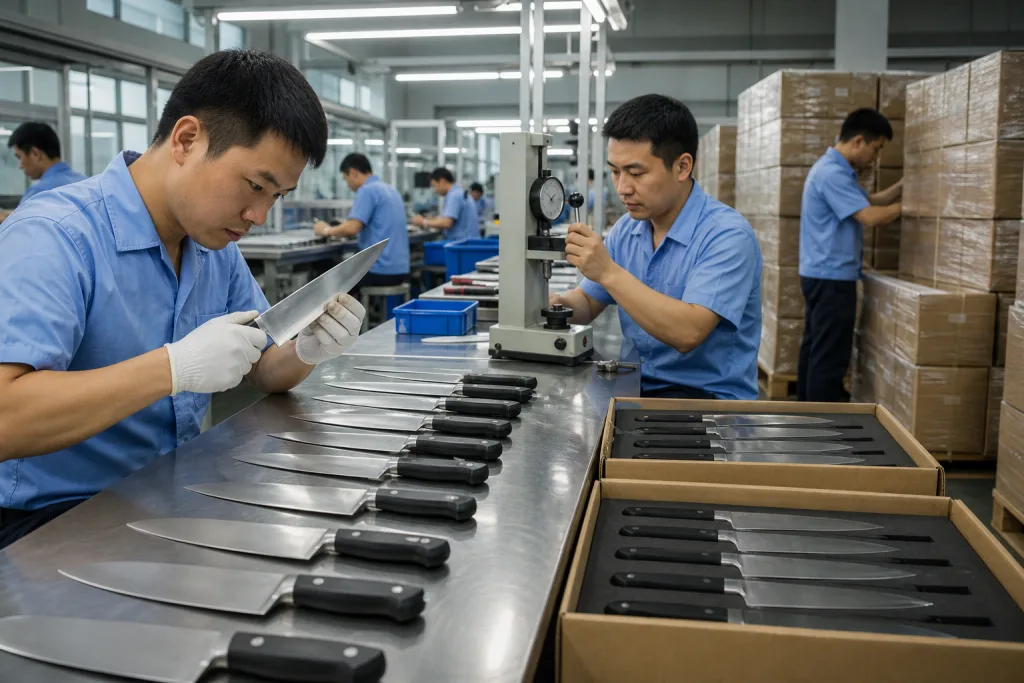
For pre-shipment inspection, we normally recommend AQL 2.5 for major defects and AQL 4.0 for minor defects, with critical defects set at 0. Critical defects include broken tips, exposed sharp edges outside packaging, wrong logo, wrong steel if confirmed by test, serious rust, and unsafe handle separation. Ask for inspection photos of blade profile and logo, close-ups of the edge and handle joint, packaging, carton marks, and random carton weight; one missed PO typo on carton color code can hold 12 days at rework instead of 2 hours during inline QC.
How To Approve The Golden Sample
The golden sample is the contract you can hold. Approve it loosely and the grinding line will copy that loose standard. For a boning knife private label specification, keep one signed golden sample at the factory and one in your office. Match the version number, approval date, drawing reference, and packaging artwork revision on both samples; last month QC pulled a sample where the PO said “V2” but the blade drawing was still “V1.3”. That caused 2 days of back-and-forth before mass production could start.
Measure before you sign. Record blade length in mm, overall length, spine thickness at heel and tip, net weight in grams, handle length, HRC target, edge angle, logo position, packaging dimensions, and carton quantity. Use calipers, an HRC tester report, and a simple kitchen scale, not just a nice photo from the sample room. Take 6 clear photos under normal workshop light. QC needs photos that match what they see beside the production line, especially when the buyer later flags a logo sitting 2 mm too close to the bolster.
If anything changes after approval, update the spec sheet and re-sign the sample. Small changes can hit production hard. This is the wrong question to ask: “Is it only a small change?” Moving from PP to POM can shift balance and mold shrinkage by 0.3–0.6 mm on the handle. Changing satin finish to mirror polish means the polishing standard must move with it, or hairline scratches will show under a 6000K inspection lamp. Switching from bulk carton to retail box also means tip guards and warning inserts need checking, plus a fresh 80 cm drop-test on the packed carton.
For first orders, a 30% deposit and 70% balance after inspection is common FOB China practice. Some buyers ask for DDP or delivered pricing, but the math does not work unless customs duty, anti-dumping risk, insurance, and last-mile damage claims are priced line by line. We ship cleaner first orders when the buyer starts with one controlled SKU instead of five colors and three packaging formats. A clean 1,000 pc order teaches more than a messy 300 pc multi-SKU trial; we have seen that go sideways when carton labels, color stickers, and barcode files arrive in 3 separate email threads.
Frequently asked questions
For an existing boning knife model with laser logo, 300-500 pcs can be possible if packaging is simple. For a real private label SKU with color box, barcode, carton marks and confirmed handle color, 800-1,000 pcs is more realistic. If you need a new handle mold, special steel batch, custom blade profile, or multiple compliance tests, expect 1,500-3,000 pcs. Very small orders can look cheaper at first, but the unit price rises because setup, artwork, inspection and export handling are spread over fewer knives.
There is no single best steel. For entry retail, 3Cr13 or 420J2 can work when price is the main driver, but edge retention is limited. For most mid-market private label programs, 5Cr15MoV, X50CrMoV15 or 1.4116 are safer choices. A typical HRC band is 54-56 for flexible boning knives and 56-58 for stiffer versions. If you want better edge retention, AUS-8 or 8Cr13MoV may be suitable, but the edge angle and heat treatment must be controlled to avoid tip chipping.
A basic stock boning knife with stainless blade, simple handle and laser logo may be around USD 2.40-3.60 FOB China at 500 pcs. A private label retail version with 5Cr15MoV steel, PP or POM handle, color box and barcode often sits around USD 3.20-5.20 at 1,000 pcs. Premium versions using 1.4116, AUS-8, G10, pakkawood, better polishing or gift packaging can reach USD 5.80-8.80 or more. Always compare quotes against blade thickness, HRC, packaging and inspection scope, not only the headline price.
The most common defects are bent tips, uneven grinding, weak edge deburring, handle gaps, proud rivets, rust spots, logo misplacement and poor blade guard fit. Because the blade is narrow, small symmetry errors are easier to see than on wider kitchen knives. For inspection, use AQL 2.5 for major defects and 4.0 for minor defects, with critical defects at 0. Check at least blade length, spine thickness, HRC spot tests, logo position, carton labels and packaging safety before paying the final balance.
You can, but it is usually a compromise. Kitchen buyers often want a thinner blade, food-contact handle materials, retail packaging and a clean culinary look. Hunting or outdoor buyers may prefer a stiffer blade, stronger grip texture, sheath option and more corrosion resistance after field use. If you sell both channels, consider one shared blade blank with two handle and packaging versions. That can keep tooling cost lower while giving each market the feel and compliance details it expects.
Send Us Your Boning Knife Spec
Share your target price, steel, handle, packaging and volume. Our Yangjiang team will review the risks and quote a practical private label production route.
Request a Quote