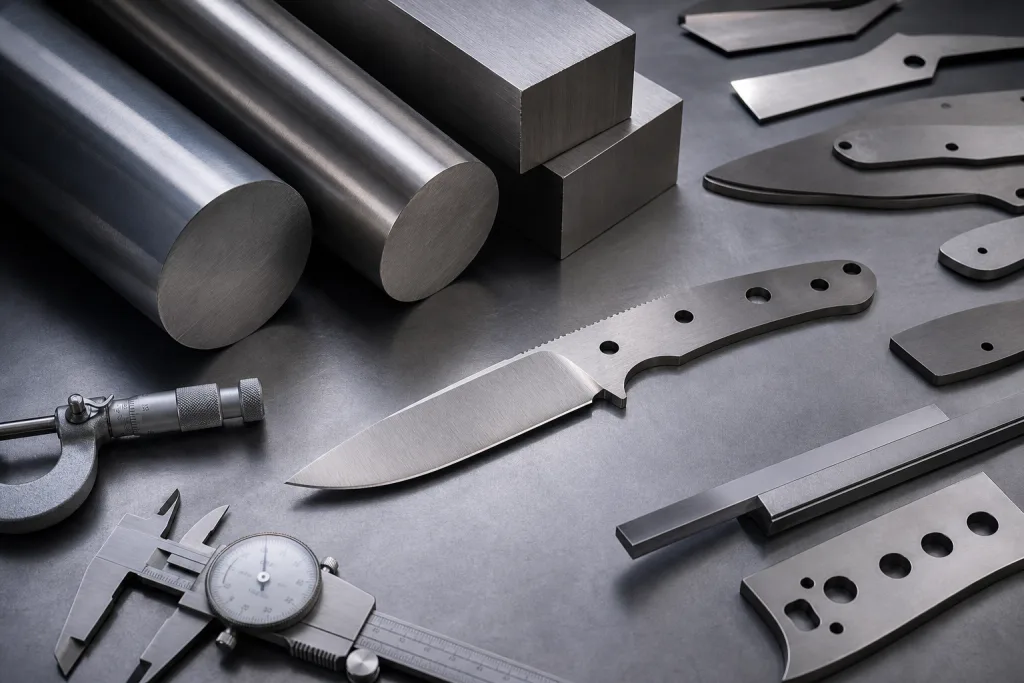
If you buy private label knives, the sample stage is where the order gets protected, or where the rework bill starts. A boning knife looks simple on a desk. Different story on the grinding line. We run into trouble when blade thickness shifts by 1 mm, the edge drops after 80 rope cuts, or the handle turns slick under wet nitrile gloves during a quick wash test. One small miss can turn a clean SKU into a return claim. We have seen this go sideways. “Does the sample look nice?” is the wrong question. The better question is whether this boning knife sample approval checklist catches the same issues our QC team will reject at 2,000 pcs.
At TANGFORGE in Yangjiang, China, we see buyers approve samples in 24 hours, then flag problems 18 days later when cartons are already booked with the forwarder. Too late. QC pulled one sample last month with acceptable HRC on the report, but the grind was off by 0.3 mm near the heel, and the PO said “black TPR” while the approved handle was dark gray PP. The math does not work once packaging film is printed and the forwarder has the CBM. A proper checklist forces sign-off on steel grade with HRC range, grind symmetry checked at heel and tip, blade flex, surface finish, packaging fit, carton marks with barcode labels, and compliance files before we run production. If you work with a boning knife manufacturer for retail private label, the job is not to admire the prototype. Prove the production knife will match your spec and your margin.
Start with the product spec sheet
Start sample approval with a written product spec sheet, not a catalog code. For a custom boning knife, “Model B-06” is too thin; we have seen this go sideways when the buyer wrote “same as sample” on the PO, then purchasing changed POM to PP to save USD 0.18. Put the knife into numbers: blade length, overall length, spine thickness, handle length, weight, target HRC, edge angle, and packing weight if retail display matters. A 5 g weight swing changes the feel on a pegboard and in a butcher’s hand. On our Yangjiang line, QC pulls the first sample against this sheet with a digital scale and 0.01 mm caliper before sales sends photos. One typo on the PO can turn a clean sample into a dispute.
Before the grinding line starts, put these points on one sheet:
- Blade length: 5 in, 6 in, or 7 in, with tolerance shown in mm on the drawing
- Steel grade: 1.4116, 420HC, AUS-8, or your nominated equivalent written exactly as it should appear on the PO
- Hardness: target HRC 56-57, with the pass band stated for Rockwell testing
- Spine thickness: for example 2.0 mm at the heel, tapering to 1.2 mm near the tip
- Finish: stonewashed, satin, polished, or black-coated, with the approved sample photo number attached
- Handle material: POM, PP, G10, pakkawood, or TPR overmold, including color code and texture note
If your boning knife manufacturer cannot repeat the same numbers on the sample report, the project is not controlled yet. Asking for a cheaper quote at that point is the wrong question; the math does not work if the drawing is still loose. A boning knife supplier should turn your spec into a pre-production drawing, tooling note, and inspection standard with the same line items. Our buyer once flagged a 6 in blade that measured 158 mm instead of 152.4 mm, and QC stopped the sample before DHL pickup. We ship faster when the spec sheet is clean. In Yangjiang, factories that work this way keep sample approval at 7-12 days for standard builds and 20-30 days for handle tooling with a new mold.
Check blade geometry and flex
A boning knife is not just a sharp blade. Geometry decides whether it slides along rib bone, lifts silver skin cleanly, or makes the operator fight every cut on poultry. Test it on the bench. Test it in hand. We measure spine taper with a Mitutoyo caliper, check the point profile against the approved drawing, then hand-bend the blade beside the grinding line before QC signs the sample card. A stiff 6-inch boning knife works for heavy pork trimming where the operator pushes into shoulder and belly meat. A narrow blade with 12-18 mm flex under moderate thumb pressure suits fish fillets and poultry joints better. If you buy boning knife wholesale for supermarket and online channels, ask for 2 geometry variants under one handle design: one rigid pork blade and one flexible fish/poultry blade. Forcing one SKU to cover pork ribs, salmon trimming, and chicken deboning is the wrong question to ask.
Hold the blade under a white LED inspection lamp and ask two things: does the tip track where your hand points it, and does the edge line stay even from heel to tip? Then bend it. QC pulled one sample last month where the blade came back with a 3 mm set after a normal hand-flex test; that is not a “slightly flexible” knife. That is bad heat treatment. For 30 private label programs we run each year, this simple flex check catches weak tempering faster than 12 emails about steel grade. Stop the approval. The Chinese boning knife factory can still adjust tempering or blade thickness before mass production, usually before the next pilot run. Once the line starts, the math does not work: a $180 sample correction can turn into a $3,000 sorting and rework bill.
Retail claims must match the geometry. If the box says flexible boning knife, the sample needs measured flex, not a nice phrase from the artwork file. If the knife is sold as rigid, confirm the blade stays firm during a 2 kg hand-pressure check, then record the result on the inspection sheet. We have seen this go sideways when the buyer approved the knife but missed one PO typo: “flexible” on the color box while the approved sample was a rigid pork-trimming blade. Customers notice fast. The online listing, carton label, and approved sample should describe the same knife; if one file says rigid and another says flexible, QC will flag it before packing starts.
Verify steel, hardness, and edge
Steel and hardness still kill 3 of every 10 boning knife sample approvals on our floor. A steel grade printed on the PI proves nothing. Ask for the heat-treatment window, not just the final HRC value. For a standard boning knife, HRC 56-58 gives the best trade-off between edge life and toughness. We run Rockwell checks on the C-scale tester after tempering, then QC writes down the blade position: tip at 57 HRC, middle at 56.5 HRC, heel at 57.5 HRC, for example. One clean number from the rack is not enough. If the sample reads HRC 53, the edge can roll after 8-10 cuts through pork skin. If it reaches HRC 60 or higher, it may feel sharp in the first test, but chipping risk goes up when the butcher works close to bone. The math doesn't work if the knife looks good in the showroom and fails on the cutting table.
Check the edge in shop-floor terms. First, inspect the bevel under a 10x loupe for waviness and burrs. Then cut real material like pork skin or beef silverskin, not printer paper. After that, resharpen it on the same stone or rod your customer uses. For general programs, we run 18-22 degrees per side. Heavy commercial trimming often needs 2-3 degrees more. Paper lies. This is the wrong question to ask if the only test is one clean slice through an A4 sheet. Ask for a simple CATRA-style comparison, or at least a repeat cutting test across 30-50 cuts. Last month the buyer flagged a sample that passed paper cutting, but the grinding line left one side at 16° and the other near 24°.
Practical steel check:
| Item | Target | Why it matters |
|---|---|---|
| Hardness | HRC 56-58 | Holds the edge without making the blade brittle when it touches bone |
| Edge angle | 18-22° per side | Controls cutting feel and lowers chip complaints during trimming work |
| Surface finish | Uniform, no pits | Shows whether polishing wheels, cleaning, and passivation are under control |
| Rust resistance | Meets customer market expectation | Reduces claims after salt-spray checks, dishwasher trials, or wet-counter storage |
If you buy from a boning knife factory in China, ask for the hardness report from the same batch used for your sample. A separate test coupon tells you little if the heat-treatment furnace is drifting by 20-30°C between racks. We have seen this go sideways: the PO said 1.4116, the sample tag said 420J2, and QC pulled the sample before packing because the hardness came back 52 HRC. The sample should prove the production process, not just the theory.
Inspect handle fit and ergonomics
Handle comfort drives more returns than buyers usually put in the budget. We had 3 clean boning knife samples fail a wet-glove pull-cut check because the handle rolled in the palm on cut one. Test dry first. Then wet. Use nitrile gloves; for cold-room trimming knives, we run a 10-minute grip trial before sample sign-off. Small handles are the wrong place to save USD 0.06. For Europe and North America, we assume the operator cuts at 0–4°C, wears wet gloves, and works in 2-hour blocks, so palm fill and a firm finger stop beat a fancy texture every time.
Check the bolster, pin holes, and handle-to-tang transition under a 10X loupe. No gaps. No rocking. No sharp ridge where the index finger sits. QC pulled one sample last month with a 0.35 mm open seam near the front rivet; the buyer flagged it before we reached AQL 2.5 inspection. If the handle is overmolded, do a light pull test and look along the bond line for lifting. For POM or PP handles, reject mirror-gloss surfaces. In meat-processing rooms, fine matte texture gives the hand better control, and the grinding line cannot fix a slippery mold finish after bulk parts are shot.
Check balance with the real production handle, not a hand-polished show sample from the sample room. On a boning knife, a handle 18 g too heavy makes the tip feel slow; a handle 12 g too light makes trimming cuts feel jumpy. Ask the boning knife manufacturer to send the same POM, PP, TPR, or riveted handle planned for mass production, including final mold texture and pin diameter. At TANGFORGE, we run samples and bulk handles from matched material batches when the MOQ allows it, because a pretty prototype can hide a weak bulk result. We have seen this go sideways in Yangjiang when the PO says “black matte” but the sample room uses glossy black stock.
Audit logo, packaging, and labeling
Eight out of 10 private-label teams we work with approve the blade first and leave the box for the last week. Wrong move. Sample approval has to cover logo position, carton artwork, barcode scan, insert card, and country-of-origin mark before the buyer signs the sample board. QC should scan the FNSKU and UPC with a handheld Zebra scanner at 300 dpi print, not just eyeball the label under a desk lamp. If your SKU goes to Amazon or a retail chain, label rules can be tighter than the knife spec. The blade can pass, then the launch stalls because the FNSKU, UPC, warning text, or “Made in China” line is off by 2 mm.
Check logo depth and consistency if the mark is laser-engraved. On the grinding line, we usually see 0.03-0.05 mm depth hold up cleanly on sample knives; lighter marks can fade after 5 dishwasher cycles, while a deep burn leaves a dirty shadow around the edge. If you are using pad printing or etching, confirm abrasion resistance with a 3M tape pull and 50-rub alcohol wipe. QC pulled one sample last month where the logo looked fine at 30 cm, but the alcohol wipe lifted the black ink on the second pass. Then inspect packaging for the correct SKU, language, blade protection, and quantity per inner box and master carton. For boning knife wholesale programs, carton count hits freight cost fast. A packaging change that drops one unit per carton can push landed cost up by 3-6% on a dense program, and the math does not work just because the box looks nicer.
Request a packaging pre-proof before mass production. We ship better when the approved knife sits in the approved sleeve, with the PE tip guard, insert card, and master carton label checked as one set on the packing table. A clean production sample in the right box is worth more than a loose sample in the wrong sleeve. We've seen this go sideways from a PO typo like “6 pcs/inner” while the artwork says “12 pcs/inner.” Tie packaging sign-off to product sign-off, not after it.
Use a pre-production control checklist
Once the sample is approved, we open the pre-production control checklist before releasing the line. Not for show. It locks the bulk order to the approved knife: steel grade, heat-treatment target, grinding wheel setting, finish, handle material, and packing table setup with the blade guard tray. We have seen this go sideways. One PO typo changed “black POM handle” to “black PP handle,” and QC pulled the signed sample only after the first 600 pcs were already shaped on the grinding line. Too late. For a boning knife order, this checklist keeps the factory tied to the purchase order, not to someone’s memory from last Friday’s meeting.
Your checklist should cover these points before production release:
- Final approved sample signed and dated by both sides, with one tagged sample kept in the QC room cabinet
- Material declaration showing blade steel grade, handle material, plus adhesive brand when the handle uses glue
- Heat-treatment target with HRC range, checked on the Rockwell tester before mass grinding starts
- Artwork and label files locked, with logo size in mm and carton mark spelling checked against the PO
- Packing method confirmed, including blade guard or insert tested on the packing table
- Inspection standard confirmed, normally AQL 2.5 for major/minor defects
- Pre-production sample or golden sample retained at the factory for line comparison during QC patrol
For a 5,000 pcs order or bigger, ask the boning knife factory to run a pilot batch before full production. We normally suggest 50-100 units from the same grinding line, same logo jig, and same packing material, then QC checks them under the caliper and light box. That short run catches problems early: 1.5 mm edge-height drift, a logo sitting 3 mm off center, or a blade guard scratching the satin finish inside the carton. One extra day. Not 12 days vs 18 days. The math works. Good China factories do not treat this as buyer trouble; we run it because private label programs need the same hand feel across 5,000 to 20,000 units.
Confirm inspection, compliance, and shipment terms
Sample approval is not closed until the production lot inspection standard and shipping plan are written on the PO or QC sheet. Ask for an acceptance standard, not a sales promise. For retail private label, lock defect classes and AQL rules before the PO is issued. We once had a buyer flag “matte logo” on the PO while the approved sample showed glossy laser marking; QC pulled the pre-production sample with the logo film still taped to the bench. Critical defects need plain wording: blade wobble over 1 mm at the handle joint, broken tip, rust spots after wipe-down, handle cracks, wrong logo position by more than 2 mm, incorrect edge grind, or carton artwork mismatch. General defects can use AQL 2.5 on most retail orders. Food-contact and safety failures need zero tolerance. No debate there.
Compliance follows the sales market. For Europe, ask for REACH-related material restrictions and food-contact expectations where they apply. For some handle materials and retail packaging sets, buyers ask for LFGB or FDA-related documents based on the channel and end use. Last quarter one supermarket buyer held shipment because the color box printed “dishwasher safe” without test support, and our packing table already had 6,000 boxes folded. Painful lesson. On FOB China terms, the buyer normally controls freight and import clearance. DDP works only when HS code, duty rate, importer details, and document responsibility are clear. If those pieces are fuzzy, the math does not work, and we have seen this go sideways at customs.
Below is the sourcing snapshot we run with 8 retail buyers when checking whether a factory is ready for boning knife production. The buyer usually asks for it after QC checks the first 20 pcs from the grinding line:
| Item | Typical benchmark |
|---|---|
| MOQ | 1,000-3,000 pcs per SKU |
| Lead time | 30-45 days after sample approval |
| Factory output | Approx. 240 employees, 100,000+ units/month capacity depending on mix |
| Inspection | AQL 2.5 major/minor, zero critical |
Work with a boning knife manufacturer in Yangjiang, China that can show stable grinding-line control, signed inspection records, and clean shipping terms before mass production starts. Then sample approval becomes a real production gate, not a stamp on a file. We ship better lots when the caliper reading, logo film, carton mark, and Incoterm are checked before the deposit balance is chased. If the carton mark says 24 pcs but the PO says 12 pcs, the buyer will catch it.
Frequently asked questions
At minimum, include blade length in mm, steel grade, target HRC, edge angle, blade thickness, handle material, logo method, packaging, and defect limits. For private label programs, add the approved artwork, barcode, and carton count. A practical checklist also includes wet-hand grip, flex behavior, and sharpness testing on real product such as poultry or pork. If you are buying from a boning knife factory in China, require a signed golden sample and a pre-production sample match before bulk release.
For a standard custom boning knife, one golden sample is not enough. You should review at least 3 pieces: one for appearance, one for functional testing, and one retained as the control sample. If the SKU uses a new handle, new coating, or a different steel, I would ask for 5-10 units so you can test consistency. On larger retail programs, a pilot run of 50-100 units is better because it reveals line variation that a single hand-made sample cannot show.
Most commercial boning knives sit around HRC 54-58. That range is practical for trimming meat, flexing around bone, and still holding an edge long enough for retail and foodservice use. If the hardness is below HRC 54, edge retention may suffer. If it is above HRC 58, chip risk rises unless the steel and geometry are carefully controlled. Always ask the boning knife manufacturer for the tested batch report, not just a target number on the drawing.
Lock the spec sheet, approve the golden sample, and require the factory to match the same steel lot, same heat-treatment range, same handle material, and same packaging structure. Then add a pre-production checklist with signed artwork and inspection criteria. If possible, inspect the first 50-100 units from the line. Mismatch usually happens when the sample was hand-finished, but production was made from a different tool setup or lower-cost material substitute.
For retail private label, use AQL 2.5 as a starting point for general defects such as cosmetic marks, minor packing errors, or small finish issues. For critical defects like loose handles, broken tips, rust, or incorrect labeling, set zero tolerance. You should define these thresholds before production starts, not after inspection. A good boning knife supplier will accept a written inspection standard and use it to control the lot before shipment from China.
Send your checklist, get a real sample
If you are sourcing a custom boning knife from Yangjiang, we can review your spec, flag weak points, and build a sample that is ready for pre-production sign-off.
Request a Quote