Retail private label teams often brief a bread knife like it is a plain SKU: 203 mm blade, serrated edge, handle, color box. Too thin. That shortcut makes quotations drift. A 203 mm bread knife in 5Cr15MoV with a basic PP handle is not the same build as a 230 mm German steel blade with full tang, pakkawood handle, retail gift box, plus insert card. On the grinding line, even a 1.2 mm serration pitch change means we swap the wheel setup, check tooth depth with a caliper, and recost the knife before we quote.
As a bread knife wholesale factory in Yangjiang, Zhejiang, China, TANGFORGE sees this 5 or 6 times a week: a buyer asks three factories for prices, then the buyer flagged it because each factory quoted a different construction. The USD number is the wrong question to ask first. Lock these before price comparison: blade steel, serration pitch in mm, handle material, packaging spec, MOQ, testing standard, and Incoterms. Last month QC pulled one sample with the right 230 mm blade, but the PO typo said PP handle instead of pakkawood; after carton artwork approval, the math did not work.
Start With The Real Retail Spec
A bread knife looks simple on the grinding line. It is also easy to ruin on a PO. Start with blade length. For North American and European retail, we usually quote 203 mm for compact blister packs, 216 mm for a standard shelf look, and 230 mm for larger sourdough or gift-box sets. A 203 mm blade keeps the carton close to 340 mm and protects the opening price point. A 230 mm blade feels more professional, but steel usage rose about 11% versus 203 mm on our last costing sheet, and one buyer flagged the outer carton because it missed their 395 mm shelf tray. Small change. Real cost.
Lock the blade profile early. A straight spine with a slight upward tip is still the safest retail choice because shoppers understand it from the front card. Offset bread knives move better for bakeries and premium kitchen lines, but the pack needs a cutting-angle photo, or customers ask why the handle sits “too high.” We run the first handle check with a 150 mm digital caliper against the chef knife sample, then compare the butt curve by eye under the bench light. If the range already includes chef knives and santoku knives, keep the handle geometry consistent. The knife has to look like it came from the same set.
Serration is where 7 out of 10 private label briefs arrive too loose. Define tooth pitch, tooth depth, single-side or double-side grind, and gullet polish. A typical retail bread knife uses 3.5-5.0 mm tooth pitch. Wider scallops cut crusty bread smoothly, but they can slide on tomato skin during demo testing. Fine teeth feel sharp at first; if the blade is 2.0 mm at the spine and not thinned well behind the edge, they tear soft sandwich bread. QC pulled one sample last month because the gullet polish left black compound in 6 teeth. That is the kind of small defect a retail inspector circles in red.
For a custom bread knife, send the target retail price and sales channel before asking for “best quality.” That is the wrong question to ask. A $14.99 supermarket SKU and a $49.99 DTC knife should not use the same steel, handle, carton, or QC tolerance. We had one PO typed as “$19.99 DTC” when the buyer meant “$49.99,” and the first sample used a lighter handle and thinner color box because the math pointed that way. A good bread knife manufacturer will push back when the spec does not match the target margin. That pushback saves money later.
Steel, Hardness, And Serration Choices
Bread knives do not need extreme hardness. The teeth do the work through bite pitch and gullet shape, not a polished chef-knife edge. Push hardness too far and the tips chip when someone drops the knife into a dishwasher basket or saws on a ceramic plate. Too soft is no better. The points roll over; QC pulled 1 returned sample last year where the scallops had flattened after 4 months of café use. Dead knife.
For mainstream bread knife wholesale programs, we quote steel by price lane: 3Cr13 or 420J2 for entry retail, 5Cr15MoV for stronger private label, X50CrMoV15 when the buyer wants a European-style spec sheet. At TANGFORGE in Yangjiang, Zhejiang, China, our usual HRC band for bread knives is 54-58 HRC, depending on steel and target FOB. For budget knives, 3Cr13 at 52-54 HRC works if the buyer accepts the limit. For stronger private label lines, 5Cr15MoV or X50CrMoV15 at 55-58 HRC gives cleaner bite life without pushing chip risk too high. We run the Rockwell C tester on first-piece blades before serration; 1 wrong heat-treat batch can turn a USD 2.80 knife into a 600-piece complaint.
Blade thickness matters more than buyers expect. We check it with a digital caliper at the spine, usually 30 mm from the handle. A 1.8 mm blade cuts soft sandwich bread cleanly and keeps cost down. A 2.5 mm blade feels stronger in hand, but it can wedge in crusty loaves if the hollow or flat grind is lazy. For most retail bread knives, 1.8-2.2 mm at the spine is the safe range. Asking for “the thickest blade” is the wrong question to ask; the grind has to match the bread, and the grinding line cannot fix a bad spec after mass production starts.
| Spec Item | Budget Retail | Mid-Range Private Label | Premium Retail |
|---|---|---|---|
| Blade steel | 3Cr13 / 420J2 | 5Cr15MoV | X50CrMoV15 / VG10 clad |
| Hardness | 52-54 HRC | 55-57 HRC | 57-60 HRC |
| Blade thickness | 1.6-1.8 mm | 1.8-2.2 mm | 2.0-2.5 mm |
| Typical FOB range | USD 1.60-2.80 | USD 3.20-6.50 | USD 7.50-18.00 |
Damascus bread knives are possible, but be careful. They photograph well for Amazon A+ pages and gift-box listings, but serrating layered steel adds setup time on the grinding line and raises reject risk at the tooth tips. We saw this go sideways when a buyer approved Damascus for a 3,000 pcs promo order, then flagged uneven layer exposure after final inspection. The PO even had “Damascas” typed in the item line, which slowed artwork approval by 2 days. For retail gift sets, Damascus can make sense. For high-volume bread knife supplier programs, mono steel is steadier and the math works better.
Handle And Construction Trade-Offs
The handle is where the buyer judges the knife before the first slice. For bread knives, full tang construction photographs well and matches chef knife sets. It costs more. No magic. A 1.8 mm full tang eats more steel, then the grinding line has to deal with two handle scales, three rivets with clean heads, edge polishing around the spine, and extra bench time at the buffing wheel. A welded bolster or hollow handle can look premium, but QC has to check the seam with a 10x loupe and confirm the drain path. If water sits inside after the dishwasher test, the joint can start moving after 6 months.
For budget bread knife wholesale runs, PP or ABS handles still make sense. We run these on the injection line every week. They pass 70°C dishwasher cycles, hold black and ivory color within the signed Pantone tolerance, and keep MOQ at 1,200 pcs instead of forcing a fresh mold. The weak point is perceived value. If the carton says professional grade, a 42 g plastic handle works against the claim. TPR overmold gives better grip for supermarket sets and promo SKUs, but lock the mold charge and Pantone number before steel cutting starts. We have seen buyers approve the grip pattern, then argue about a 0.3 mm parting line after T1 samples.
Wood handles sell, but the care label has to be honest. Pakkawood moves less than walnut or beech because the resin blocks moisture movement. Natural wood looks warmer on the shelf, but color spread is real. QC pulled the sample on one PO because the buyer flagged every handle 2 shades darker than the signed-off board, and the math doesn't work if that rule appears after trimming starts. Put the acceptance range on the sample tag, such as 2 shade boards plus 1 boundary board, or the factory and inspector will judge from different standards.
Balance matters too. A 230 mm serrated blade with a thin stamped tang and light handle can feel nose-heavy. Some buyers like that for fast slicing. Others call it cheap. We've seen this go sideways with a 145 g target and a 180 g sample printed on the same carton spec. Ask your bread knife factory for 2 handle prototypes, then set total weight targets before production. This is the wrong question to ask if the buyer only says “make it feel premium.” Weight changes steel use, freight, and complaint rate, so we put the gram range on the pre-production sample before we ship bulk cartons.
MOQ, Pricing, And Quote Structure
A factory quote should never be one line saying “bread knife USD 3.20.” That price is empty unless it shows MOQ, packaging, steel grade, HRC, blade length, handle material, logo method, inspection standard, payment terms, and Incoterm. We’ve seen this go sideways. One buyer compared our 8-inch 5Cr15MoV bread knife, laser logo, color box, and PET insert tray against a trading quote that skipped the tray. Same product name. Different cost sheet. On our costed BOM, that missing tray moved the price by 0.18 USD per set.
At TANGFORGE, the practical MOQ for an OEM bread knife is usually 1,000 pcs per model when we run existing tooling and standard materials. For custom handle tooling, color matching, or an unusual blade shape, 2,000-3,000 pcs is the cleaner number because the injection mold setup and first-off checks eat time. Last month, QC pulled a PP handle color chip that was 2 mm off the approved Pantone swatch, and the buyer flagged it before mass production. Good catch. For a private label kitchen knife range, mixed-container planning cuts pressure because the same carton spec and barcode label can run across 6 to 12 SKUs.
Typical lead time after sample approval is 35-55 days for standard bread knives and 60-75 days for new tooling or premium gift packaging. Sampling usually takes 7-15 days if the design uses existing components, and 20-30 days if new molds or special handle materials are required. We run the grinding line in batches, so a 10-inch serrated blade with a new tooth profile cannot jump ahead of an 8-inch run already in heat treatment at 56-58 HRC. Our Yangjiang, Zhejiang facility has about 240 employees and can support roughly 80,000-120,000 assorted knives per month depending on seasonal mix. The buyer asked why a “simple knife” needed 18 extra days. The math doesn’t work that way once steel cutting, heat treatment, serration grinding, polishing, packing, and AQL 2.5 inspection are booked.
Ask for FOB pricing first. FOB Yangjiang or FOB Shenzhen lets you compare factory cost without hidden freight guesses. DDP works later for Amazon FBA or retail distribution, but it can blur the product price, and this is the wrong question to ask before the spec is locked. For payment, 7 out of 10 China knife factories we deal around use 30% deposit and 70% balance before shipment. Larger repeat programs can negotiate better terms after 2-3 clean orders, especially when the PO has no barcode typo and the carton mark is confirmed before printing. We ship faster when the paperwork is clean; one wrong digit on a carton label can stall a full carton line for half a day.
Branding, Packaging, And Compliance Details
Private label teams should split the blade logo and the retail box into two work orders. On the knife, we run fiber laser engraving, chemical etching, mechanical stamping, or a small handle badge based on handle material and blade finish. Laser is usually the clean choice for MOQs around 1,000 pcs; our fiber laser marks a 25-35 mm logo area without new tooling, and QC checks the logo position with a steel ruler before packing. Stamping looks more permanent, but it needs a die. If the buyer repeats the bread knife only once a year, the math doesn't work.
Packaging eats margin. Fast. A simple white box with label may cost USD 0.12-0.25. A full-color tuck box with insert may be USD 0.35-0.80. A magnetic gift box can be USD 1.20-3.50 before freight impact, and we have seen buyers push back after the carton CBM jumped by 18%. For bread knives, blade protection is not optional. We ship with a tip guard, paper sleeve, PET tray, pulp insert, or fitted sheath matched to the retail pack, because a serrated edge will cut through a thin box during the truck ride to the port. The grinding line sees this first. A sharp 8-inch bread knife punishes cheap packaging.
If you sell in Europe, ask for LFGB, REACH, and food-contact declarations for handle materials, coatings, printing inks, and adhesives. For the United States, check FDA food-contact expectations and California Prop 65 risk if it applies to your channel. A bread knife supplier should not claim every material is compliant without test reports on the desk. Compliance follows the exact material code, pigment batch, surface coating, glue, and printed packaging. Last month QC pulled one PP handle sample because the color masterbatch code on the PO did not match the lab report; one wrong digit stopped the sample approval.
Barcode and retail handling details belong in the purchase order, not in a late-night WhatsApp message after packing starts. If you need EAN, UPC, FNSKU, suffocation warning, country of origin, carton marks, inner pack quantity, or retailer routing labels, send the artwork before mass production. Do not wait until goods are finished. We've seen this go sideways. Changing carton marks after packing 3,000 pcs means opening cartons on the floor, re-labeling each shipper, re-taping with the 48 mm tape gun, and losing 1-2 days for no good reason.
Quality Control Before Shipment
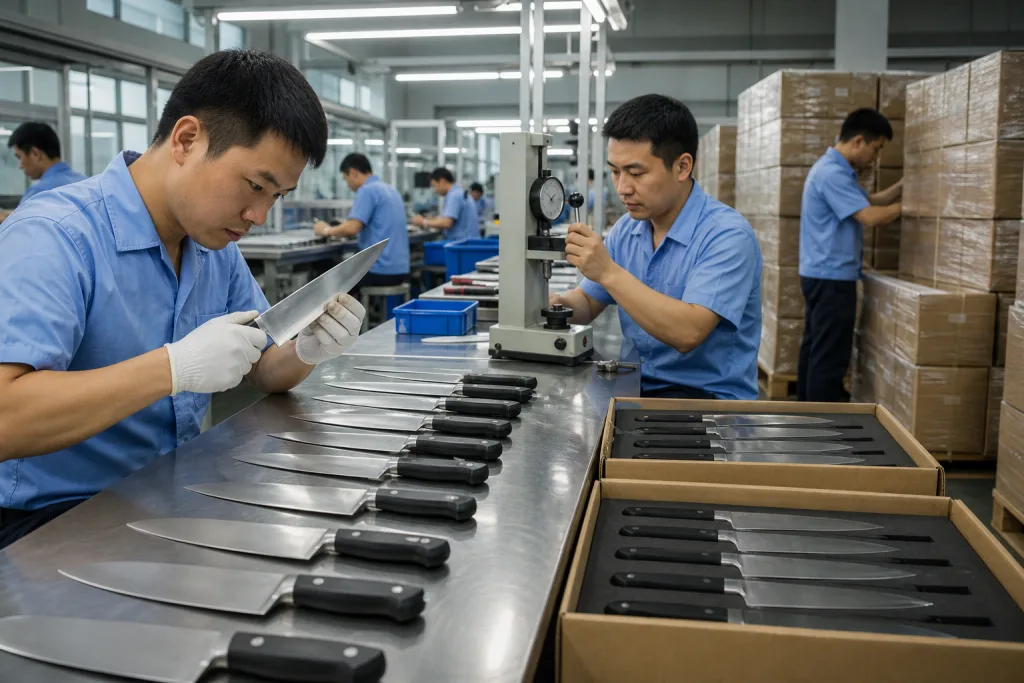
Bread knife QC is not a paper-cut show. On our line, QC sets the 203 mm blade on a granite plate, checks straightness with a 0.10 mm feeler gauge, then records serration pitch and tip lift before the knife goes near packing. After that we check handle gaps, proud rivet heads, logo position, rust dots under the bolster, burrs on the scallops, scuffed sleeves, barcode scan, and carton drop result. A serrated knife can slice paper cleanly and still fail retail inspection if the PP handle has a 0.4 mm gap or the tip punches through the inner box. We have seen this go sideways on 1,200 pcs after the buyer flagged the inner tray.
For private label orders, we run AQL 2.5 for major defects and AQL 4.0 for minor defects unless the retailer’s manual sets a tighter table. Critical defects get zero tolerance: loose handle, cracked blade, wrong steel, exposed sharp point through packaging, incorrect barcode, or mixed SKU carton. Write the defect list before mass production starts. Not later. Do not wait until the inspector is already in the packing area with 42 cartons opened and a PO showing item code BK-203S typed as BK-230S.
Sharpness testing for bread knives should match how the knife is used in a kitchen. CATRA testing works for development and benchmarking, but the math doesn't work for every wholesale production order if the buyer only needs routine shipment release. For daily QC, set a bench test we can repeat: the knife must slice a 30 mm thick soft bread piece without crushing over the agreed width, then cut tomato skin within two forward strokes. Simple wins. QC pulled the sample from the grinding line, not from a hand-picked display tray, and the same test fixture stays beside the packing table.
Ask for pre-production samples, inline photos, and final random inspection, but connect each request to a real checkpoint. If your order is above 5,000 pcs or uses new tooling, book inline inspection at 20-30% completion. We run this check before the batch is sealed because it catches wrong serration depth, handle color drift against the Pantone chip, or a packaging typo before 300 master cartons are packed. One buyer caught “stainless steal” on a back card at inline stage; fixing 60 cartons took 4 hours, fixing 300 would have killed the ship date. A bread knife manufacturer that pushes back on inspection is the wrong factory for retail orders.
How To Request A Clean Quote
A clean quote starts with a tight RFQ. Send blade length in mm, steel grade, target HRC, blade thickness, serration pattern, handle material, logo method, packaging type, order quantity, destination port, compliance requirement, and retail channel. Photos cut sample-room guessing. If you have a reference sample, put it on a caliper and scale: overall length, blade width, spine thickness at 3 points, handle weight, carton size. Last month QC pulled a buyer’s sample marked 203 mm on the PO, but the actual blade was 198 mm. That 5 mm gap changed the grinding line setup and pushed the sample room back by 2 days.
State the target price. Hiding it is the wrong question to ask. A bread knife factory can read the price tier from the handle, box, and steel choice. If your target FOB is USD 3.80, say it. Then we can cost it straight: 5Cr15MoV instead of X50CrMoV15, pakkawood instead of walnut, 203 mm instead of 230 mm, color box instead of magnetic box. We’ve seen this go sideways when a buyer pushed for walnut at USD 3.80; the math didn’t work after the handle shop quoted the blank at USD 0.92.
Ask what the quote covers. Does the unit price include logo setup, sample cost refund, inner cartons, master cartons, polybag, desiccant, inspection support, export carton marks, and palletizing? Are prices valid for 15 days or 30 days? Is the stainless steel surcharge fixed? We run these checks before PI because small gaps become loading-day arguments. Our export clerk once caught a PO typo where “palletized” became “not palletized,” and the buyer flagged a USD 180 warehouse repacking charge at loading.
If you are new to sourcing from China, start with 1 or 2 bread knife models before opening a full range. TANGFORGE can support OEM and ODM programs from Yangjiang, Zhejiang, but strong projects start with clear specs and one signed golden sample. That sample sits in the QC room beside the thickness gauge and carton drop-test record. It becomes the factory standard and inspector reference when production reaches 1,000 pcs, 5,000 pcs, or a full container.
Frequently asked questions
For a standard private label bread knife using existing tooling, expect about 1,000 pcs per model as a realistic MOQ. If you need a custom handle mold, exclusive blade profile, special color matching, or premium retail packaging, 2,000-3,000 pcs is more practical. Some factories may accept 500 pcs, but the unit price will be higher and customization options will be limited. For mixed kitchen knife programs, you can often combine bread knives with chef knives, utility knives, or gift sets to improve production planning. Always confirm whether MOQ applies per model, per handle color, per packaging version, or per shipment.
A basic bread knife may quote around USD 1.60-2.80 FOB with 3Cr13 or 420J2 steel, plastic handle, and simple box. A stronger private label SKU with 5Cr15MoV steel, 203-230 mm blade, full tang, and pakkawood handle is more often USD 3.20-6.50 FOB. Premium versions with X50CrMoV15, forged bolster, Damascus cladding, or magnetic gift box can reach USD 7.50-18.00 FOB. The quote changes quickly with blade length, HRC target, handle material, packaging, logo method, and order quantity. Ask for FOB Yangjiang or FOB Shenzhen first, then calculate freight and duty separately.
For most retail private label bread knives, 5Cr15MoV at 55-57 HRC is a sensible balance of cost, corrosion resistance, and durability. X50CrMoV15 is a good step up for European-style kitchen ranges and usually works around 56-58 HRC. Budget programs can use 3Cr13 or 420J2, but you should not market them as premium chef-grade knives. VG10 or Damascus construction is possible, but it increases cost and serration production risk. Bread knives do not need extreme hardness like 61 HRC; a slightly tougher blade often performs better in real kitchens.
For standard OEM bread knives, production usually takes 35-55 days after sample approval and deposit. If the project needs new handle tooling, special steel sourcing, custom color matching, or complex gift packaging, plan for 60-75 days. Samples normally take 7-15 days when existing components are used, and 20-30 days for new tooling. Add time for third-party inspection, booking, customs, and sea freight. For North America and Europe, many buyers plan 90-120 days from RFQ to warehouse arrival for a first order. Repeat orders are faster because the golden sample, carton marks, and QC checklist are already fixed.
Use a written QC checklist with AQL 2.5 for major defects and AQL 4.0 for minor defects, unless your retailer requires stricter standards. Critical defects should have zero tolerance: loose handles, cracked blades, wrong barcode, exposed sharp points, wrong steel, or unsafe packaging. Check blade straightness, serration pitch, burrs, logo position, handle gaps, rivet polishing, rust spots, carton strength, and barcode scanning. For cutting performance, define a repeatable bread and tomato test instead of vague “sharp enough” wording. For orders above 5,000 pcs or first-time tooling, add an inline inspection at 20-30% production completion.
Send Your Bread Knife RFQ Today
Share blade length, steel, handle, packaging, MOQ, and target FOB price. TANGFORGE will review the spec and return practical factory-direct options.
Request a Quote