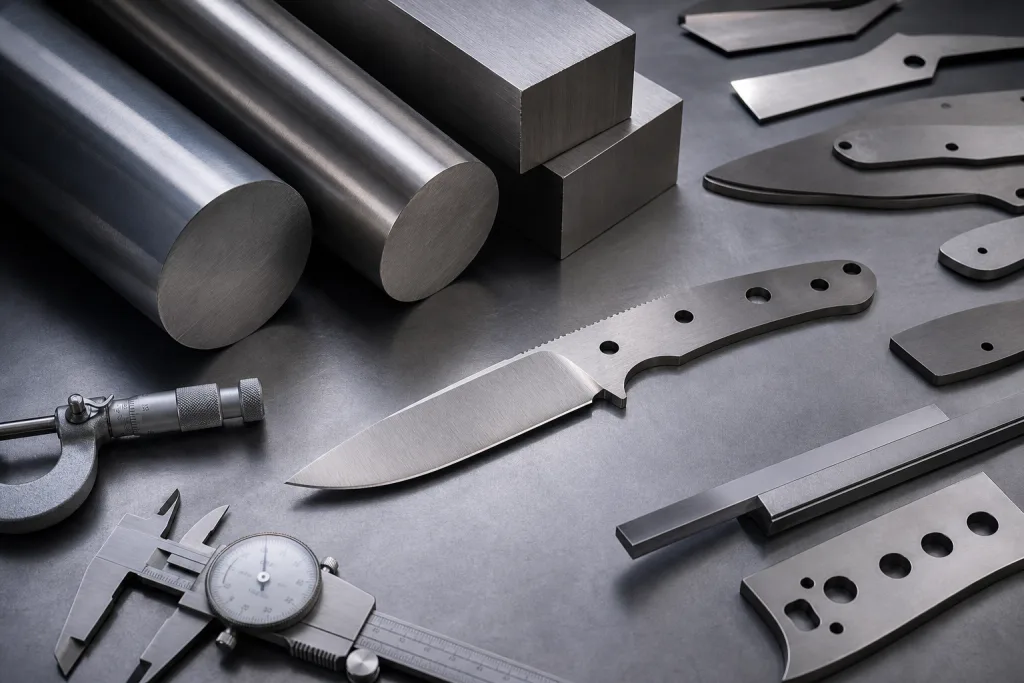
A bushcraft knife looks simple on a catalog page. At scale, it is not. Steel grade, full tang build, handle material, sheath, finish, and carton spec all hit the quote, and the first bad PO we saw this year had a “bushcraft” line item with no blade thickness at all. That kind of gap turns into delays fast. The real fight is not the knife design; it is locking the MOQ, tolerance band, and inspection points before production starts.
If you are comparing a bushcraft knife OEM program in Yangjiang or another China knife hub, think in batches, not samples. A factory like TANGFORGE, based in China with about 240 employees, can run custom and standard outdoor knife programs, but the math changes the moment you move from 3 mm to 4.5 mm stock, from 58 HRC to 60 HRC, or from PU sleeves to molded sheaths. QC pulled the sample on one run because the sheath fit was loose by 1.2 mm, and that killed the launch week. The buyer who gets the cleanest result asks for the spec sheet first, then uses that sheet to set MOQ, QC level, and lead time. The wrong question is “what is your best price?”
What buyers mean by bushcraft knife
I’ll rewrite the section in a more grounded factory-sales voice, keep the HTML exactly as-is, and fold in concrete buyer-side details without changing the structure.In sourcing terms, a bushcraft knife is a fixed-blade outdoor knife built for fire prep, carving, food work, feather sticking, and light camp tasks. We usually see buyers land on 90 to 110 mm blade length, full tang, 3.0 to 3.5 mm stock, and a handle that still grips after the QC guy wipes it with wet gloves. If the spec drifts into tactical or hunting geometry, the factory will quote a different category, and the math changes fast.
The main mistake is treating “bushcraft” like a style word. We see three buying buckets on the desk. The first is the low-cost item for promotions and entry retail, often 3Cr13 or 5Cr15MoV with a simple plastic or TPR handle. The second is the mid-market custom bushcraft knife in 14C28N, D2, or 9Cr18MoV, usually with a better sheath and cleaner finish. The third is the premium run using 80CrV2, 1.4116, or Damascus, and that one needs tighter HRC control and more scrap allowance. If you want a bushcraft knife factory China quote that holds up, define the use case first. Marketing words do not set MOQ.
For Europe and North America, the spec we ship most often is a 100 mm blade, 3.2 mm stock, flat or Scandinavian grind, 58-60 HRC, and a sheath that survives retention and drop checks. That is not flashy. It sells. We have seen buyers push for a polished hand-finished look, then complain when the unit price jumps because the grinding line needs two extra passes and the operator time doubles in Yangjiang or Zhejiang.
MOQ and price bands
I’ll rewrite just this section, keep the HTML structure intact, and make the pricing read like it came from a buyer-facing sales engineer.MOQ is where most first-time buyers burn weeks. For a bushcraft knife OEM job, we run 300 pcs for an existing shape with a new logo, 500 pcs for a moderate custom spec, and 1,000 pcs when the buyer wants a new mold, new sheath tool, or a full ODM build. We’ve seen 100 pcs on a full custom order, but the math does not work well; setup time gets spread too thin, and the unit price usually comes back 25-40% higher than a normal MOQ run.
As a FOB China reference, a simple bushcraft knife usually lands around USD 6.80-9.50 at 500 pcs. A mid-grade 14C28N or D2 model with better finish and sheath sits around USD 9.80-14.50. Premium stainless or Damascus-style programs can reach USD 15.00-28.00, especially when the buyer asks for stonewash, satin polishing, laser marking, or premium packaging. On the packing line, one carton spec typo once pushed a shipment back 2 days, so freight and paperwork are not side items; they can move landed cost by 8-18%. FOB Ningbo or FOB Shanghai is common for Zhejiang-based export flows, while buyers sourcing from Yangjiang often quote FOB Shenzhen or FOB Guangzhou depending on logistics.
The table below gives a sourcing view, not a catalog promise. QC pulled the sample at AQL 2.5 on a 500 pcs run before we signed off the sheath fit.
| Spec tier | Typical MOQ | FOB China price | Typical lead time |
|---|---|---|---|
| Entry level 3Cr13 / 5Cr15MoV | 300-500 pcs | USD 6.80-9.50 | 35-45 days |
| Mid-grade 14C28N / D2 | 500-1,000 pcs | USD 9.80-14.50 | 40-55 days |
| Premium stainless / Damascus | 1,000 pcs+ | USD 15.00-28.00 | 50-70 days |
If your procurement model is tight, ask the factory to split pricing by 500 pcs, 1,000 pcs, and 3,000 pcs. That gives you the real break point where steel cost, grinding line labor, and packaging stop moving the needle. The buyer flagged it before with a 700 pcs PO, and the lower tier price was already too optimistic.
Specs that move cost
I’ll rewrite the section in-place, keeping the HTML and the existing numbers/specs intact while making the prose sound like a factory sales engineer wrote it.On a bushcraft knife, a few dimensions move cost faster than almost anything else. Blade thickness is one. Go from 2.8 mm to 3.8 mm and the steel bill rises, the grinding line slows down, and symmetry starts to slip if the fixture setup is weak. Same story with blade length: a 95 mm blade is easier to control than a 120 mm blade, and QC pulled the sample twice when the plunge line wandered near the tip.
Steel choice is the next big lever. 3Cr13 is cheap and easy to run, but edge retention is basic. 14C28N and 9Cr18MoV sit in a better export price band. D2 cuts well, but the heat treatment has to be tight, and this is the wrong question to ask if a buyer only wants a claimed HRC number. Ask for hardness reports. For bushcraft knife MOQ and price guide work, the usual target is 58-60 HRC for stainless and 56-58 HRC for carbon steels like 80CrV2, depending on how the customer will use the knife.
Handle material changes price and warranty risk at the same time. G10, micarta, and stabilized wood cost more than PP or TPR, but they lift the retail story. A molded sheath usually runs cheaper at volume than a stitched leather sheath, while leather can support a higher shelf price if the stitching, retention strap, and belt loop all pass inspection. We’ve seen this go sideways when a buyer flagged a PO typo on the sheath color code, and the whole shipment had to be rechecked. Buyers in Yangjiang and Zhejiang often compare the same knife in three handle options and find the factory gap is only USD 0.70-2.30, while the retail effect is much bigger.
- Blade thickness: 2.8-4.0 mm is the common commercial range
- Hardness: 58-60 HRC for stainless outdoor blades
- Grind: Scandi or flat grind is easier to sell for bushcraft
- Sheath: Kydex, PU, or leather each has different QC risks
QC risks you should price in
I’ll rewrite the section in-place, keep the HTML structure intact, and make the copy sound like a factory-side sales engineer with sharper, more specific QC detail.The cheapest quote turns expensive once defects hit the field. Bushcraft knives fail in the same places every month: grind line drift, blade warp after heat treat, weak edge retention, loose handle scales, sheath fit that is too tight or too loose, and rust spots from sloppy post-polish handling. On a 5,000-piece order, even a 3% defect rate can wipe out the margin. If you ship to Europe or North America, these are not cosmetic issues; they trigger returns, chargebacks, and one-star reviews.
At TANGFORGE, a normal export inspection setup for this category checks dimensions, hardness, finish, logo placement, and packaging against the approved sample, then runs AQL 2.5 for major defects and AQL 4.0 for minor defects unless the buyer pushes for tighter control. We also ask for a first-article sample after heat treatment, not before. A blade can look clean in soft state and still pull after quenching and tempering, and QC pulled the sample on a 60-62 HRC run last quarter for exactly that reason. The math does not work if you skip that step.
Common QC traps are easy to spot if you know where to look:
- Heat treatment drift: claimed 59 HRC drops to 55-56 HRC on production pieces
- Fit and finish: 0.3-0.5 mm gaps between tang and handle scales, or pins that sit off-center
- Edge geometry: bevel angles wander from one grinder station to the next
- Sheath retention: blade rattles, or falls out under movement
- Compliance: packaging, coating, or handle material needs REACH or LFGB review before you ship
If you are buying for a private label program, ask for in-line photos at the grinding line, assembly, and packing stages. We have seen this go sideways when a buyer approved the pre-assembly shots and ignored a PO typo on handle color, then found 800 units packed wrong. Sorting at destination costs more than the cartons. Always does.
How to brief your factory
I’ll rewrite the section in place, keeping the HTML tags intact and tightening the sales-engineer tone with concrete factory details.A clear brief cuts out back-and-forth. If you want a custom bushcraft knife, send a dimensioned drawing, target steel, target HRC, blade thickness, handle material, finish, sheath type, logo method, packaging spec, and carton quantity. Leave those out and the factory in China will drop in standard parts, which is often the wrong fit for your price band.
Use a spec sheet with blade length, overall length, spine thickness, edge angle, tang style, handle length, weight target, and surface finish. A clean example is 100 mm blade, 225 mm overall, 3.2 mm spine, full tang, 58-60 HRC, stonewash finish, G10 handle, Kydex sheath, laser logo, printed kraft box, 1 pc polybag, 50 pcs master carton. On our grinding line, that kind of sheet lets us quote labor and steel without guessing, and the math stops wobbling.
Ask for these documents before you approve mass production:
- Pre-production sample with agreed hardness range
- Material certificate for steel if you are buying a named grade
- Packing spec and barcode format if the product goes to retail
- Photo sample of laser logo, sheath fit, and blade finish
- Lead time split by sample, bulk, and packing stages
If you also need artwork or market-specific changes, a combined OEM and ODM workflow works better than sending a vague target and hoping the factory reads your mind. We’ve seen that go sideways fast, especially when a buyer flags a PO typo on carton quantity after QC has already pulled the sample.
Lead time and payment terms
I’ll keep the HTML intact and rewrite the four paragraphs in a sharper factory-side tone, with concrete numbers and one shop-floor detail per paragraph.For most bushcraft knife runs, the real lead time is 35-55 days after sample approval and deposit, with 50-70 days for premium or heavily customized builds. If the line is already loaded, the first choke point is usually materials, not the CNC. Steel mill supply, handle slab availability, sheath molding, and carton printing can each push the ship date by 7-10 days.
Standard payment terms for China export are usually 30% deposit and 70% before shipment, though bigger buyers may push for 20/80 or LC terms once the account is stable. We had one buyer try to save cash with a tiny deposit, then the PO had the wrong handle color code. This is the wrong question to ask. If the sample is off, better payment terms do not fix the run.
For importers, landed cost starts way beyond the factory quote. Add carton, inner box, barcode sticker, FNSKU if you sell on marketplaces, inspection fee, inland freight, ocean or air freight, duty, and any destination compliance work. A knife quoted at USD 9.20 FOB often lands around USD 13.50-16.00 in a warehouse in Europe or North America. QC pulled the sample on a 2.8 mm spine once and found the edge grind drifting 0.4 mm. What matters is whether the shelf price still leaves margin after returns and promo discounts.
A practical way to cut risk is to lock the sample, then order 300-500 pcs for the first production batch and watch the defect trend before you scale to 2,000 pcs. We run that first batch like a dry test, with AQL 2.5 on the table and the packing line checked twice. Jumping straight to a big order on an untested design is where we’ve seen things go sideways.
What good sourcing looks like
I’ll rewrite this section in-place, keep the HTML intact, and make the copy sound like a factory-side sales engineer wrote it.The best bushcraft knife programs are boring in the right way. The dimensions stay on print, the hardness lands in the agreed band, the sheath locks in without rattle, and the carton comes off the line with no corner crush or label drift. You should be able to reorder the same model 6 months later and get the same result. That is the job.
We run a lot of these builds in Yangjiang, where the grinding line is stacked with OEM work and everyone talks lead time before they talk branding. In Zhejiang, buyers usually press harder on export papers, carton drop standards, and repeat-order packing discipline. The cheap quote often hides a missed step. A factory that can tell you why the price is USD 11.30 instead of USD 9.90, then back it up with steel spec, handle labor, and QC sheets, is the one worth talking to.
If you are sourcing a bushcraft knife OEM program for an outdoor brand, ask for three things: a sample made on the same process as mass production, a quote that shows material and labor line by line, and an inspection plan with clear numbers. QC pulled the sample, measured the blade at 3.2 mm, and found the sheath retention was off by a small margin on the first pass. This is the wrong question to ask: “Can you make it cheap?” The math does not work. Ask whether the factory can hold the spec on batch 2 and batch 20. That is what keeps the design commercial instead of turning it into a one-off sample.
Frequently asked questions
For a standard bushcraft knife OEM order, the usual MOQ is 300-500 pcs for logo-only changes, 500-1,000 pcs for moderate custom work, and 1,000 pcs or more if you need new tooling, new sheath molds, or a full ODM build. In China, the MOQ is tied to setup time, heat-treatment batches, and packaging print runs. If you ask for a fully custom knife at 100 pcs, some factories in Yangjiang or Zhejiang may still quote it, but the unit price often rises 25-40%.
A realistic FOB China price is usually USD 6.80-9.50 for entry-level steel and simple handles at 500 pcs, USD 9.80-14.50 for mid-grade materials like 14C28N or D2, and USD 15.00-28.00 for premium or Damascus-style builds. Final cost depends on blade thickness, finish, sheath type, packaging, and order size. If you are comparing quotes, make sure every supplier is quoting the same steel, HRC band, and sheath spec, or the price comparison is not valid.
For export programs, 14C28N, 9Cr18MoV, D2, and 80CrV2 are common choices, depending on whether you want stainless convenience or carbon-steel character. A practical hardness target is 58-60 HRC for most stainless options and 56-58 HRC for carbon steels. If your customer base values easy maintenance, stainless is safer. If they want traditional bushcraft feel and easier sharpening in the field, carbon steel is often better, but you must control rust risk in packaging and storage.
The main risks are heat-treatment drift, uneven grind, handle looseness, sheath retention problems, and logo or finish defects. For a good export program, ask for AQL 2.5 on major defects and a first-article sample after heat treatment. Also confirm hardness with a handheld tester on production pieces, not just a lab sample. If the knife is meant for Europe or North America, check REACH, packaging, and barcode requirements before mass production, because those issues are cheaper to fix before shipment.
Yes, if you keep the blade shape, tang style, and sheath platform close to existing factory tooling. A new logo, different handle color, alternate sheath material, or packaging change usually adds little cost. New blade geometry, new mold, or complex sheath tooling can add USD 300-1,500 in setup and raise MOQ. The best strategy is to start from an existing outdoor knife platform, then change only the features that matter to your market. That keeps price lower and reduces schedule risk.
Send your spec and target MOQ
We can quote your bushcraft knife OEM program with steel, HRC, sheath, packaging, and QC targets locked before production starts.
Request a Quote