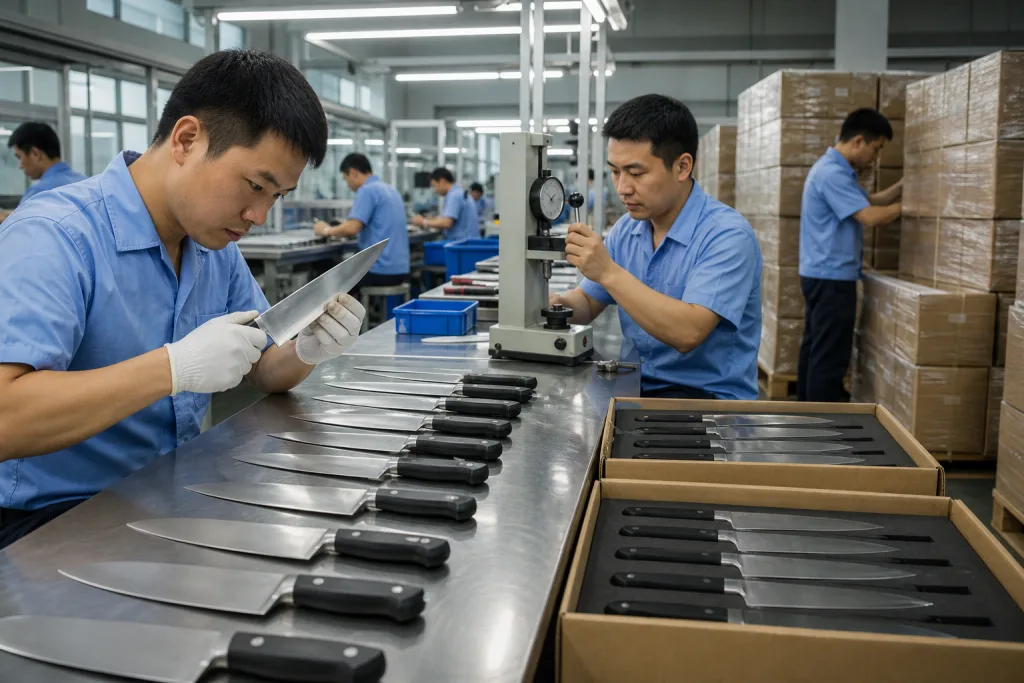
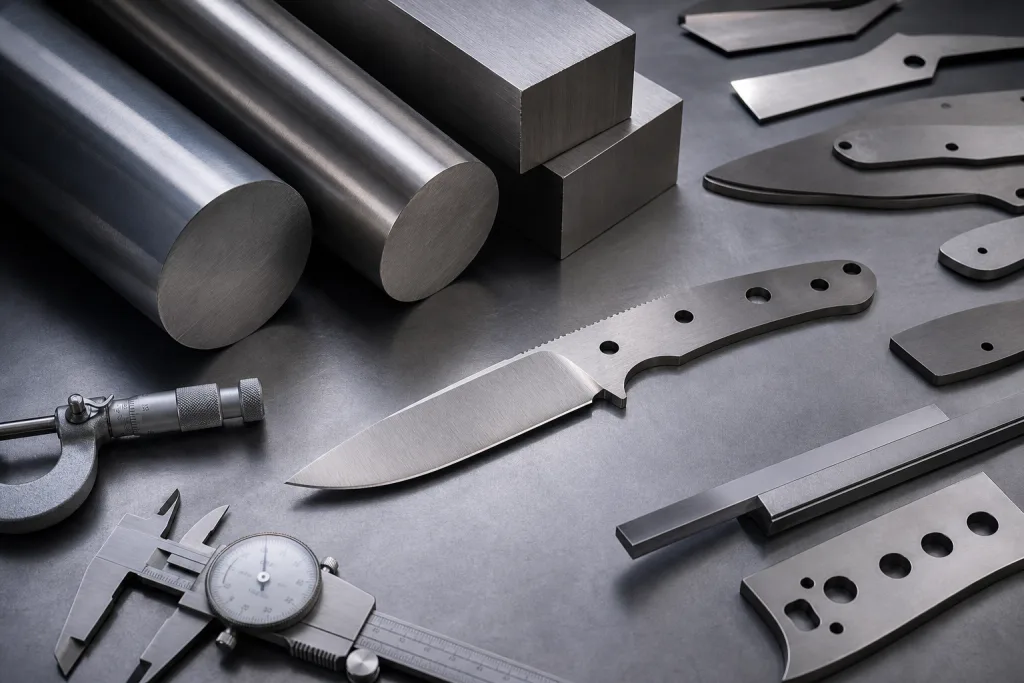
A bushcraft knife sample can pass a desk check and still fail outside. We’ve seen it: Kydex sheath retention drops after 50 pull tests on the bench jig, one G10 handle scale shows a 0.4 mm liner gap under the feeler gauge, the grinding line pushes the bevel off-center near the tip, or a blade laser-marked 58 HRC comes back 55 HRC on the Rockwell tester. Pretty sample, bad signal.
If you are sourcing from a bushcraft knife factory China buyers need to approve the sample as a production control document, not as a display piece. At TANGFORGE in Yangjiang, Zhejiang, China, we run the signed sample, spec sheet, packaging file, and QC checklist as one locked package; when a buyer changes “black stonewash” to “dark stonewash” on the PO, QC flags it before mass production. For outdoor knives, our normal trial MOQ starts around 300-500 pcs per model, with sample lead time usually 12-18 days after drawings and deposit are confirmed. Asking only “does the sample look good?” is the wrong question to ask.
Start With a Real Use Case
Before you ask a factory for a custom bushcraft knife sample, decide what the knife must do in the buyer’s hand. A weekend camping knife is a different product from a school knife used for 200 baton strikes through dry beech, or a tender item where the distributor asks for a test report with every lot. “Make it strong and sharp” is not a spec. We heard that line on a PO last month, and QC had no target for tip strength, edge angle, or handle pull test.
For most bushcraft programs, we ask you to confirm five points first: blade length in mm, steel grade with target HRC, full tang or hidden tang, handle material with color code, and sheath system with belt-loop direction. A practical blade length is 95-125 mm. Blade thickness is commonly 3.2-4.5 mm. If you push to 5.0 mm, the knife looks tough, but the cutting feel gets heavy and freight weight rises by carton. Drop below 3.0 mm and the math does not work when a buyer later claims batoning or side-load failure. We check this on the grinding line with a digital caliper, not by eye.
The tang choice matters. Full tang construction is easier to inspect and easier for your customer to understand. Skeletonized full tang saves weight, but the drawing must control the cutout radius; QC pulled one sample where a 1.5 mm internal corner became the first crack point after side pressure. Hidden tang looks cleaner and trims weight, but handle assembly needs tighter control on glue fill, pin position, and gap at the guard. We have seen this go sideways when the buyer approves only the outside photo.
At our Yangjiang, Zhejiang, China facility, we recommend a first sample pack of 3-5 pcs: one reference sample for your desk, one for internal cutting, one for packaging fit, and one or two for destructive checks. The packing sample matters; a 2 mm shift in the EVA tray can rub the sheath mouth during vibration testing. Yes, it costs more than approving one pretty sample. That is the wrong place to save money. A bushcraft knife OEM project fails when the sample becomes a photo prop instead of the production standard we run against.
Define Blade Specs Before Appearance
Outdoor knife buyers often open the sample meeting with handle color chips and logo placement on the ricasso. We get it; that is what the sales photo shows. But for bushcraft knives, starting there is the wrong question to ask. Lock the blade spec first, or returns will land after the first wet weekend. Last month QC pulled a sample that looked perfect in the light box, but the 3.8 mm blade was ground off-center by 0.6 mm at the tip.
We run 8Cr13MoV, 9Cr18MoV, D2, 14C28N, AUS-10, 440C, and Damascus for gift sets. For working bushcraft SKUs, 6 out of 10 buyers we quote choose D2 or 14C28N after price review. D2 holds an edge and gives a clear price story, but it is semi-stainless, so the satin line, stonewash media, and anti-rust oil step matter. 14C28N handles rain, sweat, and sheath storage better, but the FOB price climbs; on a 1,000 pcs MOQ, the math does not work if the target retail is too low.
Do not approve a steel grade without a hardness band. One HRC number is a trap. Write 58-60 HRC, 59-61 HRC, or another band that fits the steel and blade geometry. If a factory promises 62 HRC on every budget steel order, ask how many points they test per batch and where the test marks sit. We normally test heat-treated blades before handle assembly with a Rockwell tester, 5 pcs per furnace lot, then keep the lot card with the grinding line paperwork.
Edge geometry needs numbers too. A 20° per side edge survives baton work better than a thin kitchen-style edge. Scandi grind sells well in bushcraft, but bevel width, centerline drift, and tip symmetry need caliper checks, not just a photo. If you want a true zero Scandi edge, write it on the sample sheet. If you want a micro-bevel for durability, specify the angle and width. We have seen this go sideways when the pre-production sample cut feather sticks cleanly, then bulk came back with a 0.3 mm micro-bevel nobody approved.
- Blade thickness: 3.5-4.0 mm is the mainstream range we ship most often; QC checks the spine with a digital caliper before polishing.
- Hardness: D2 commonly targets 59-61 HRC; 14C28N often targets 58-60 HRC, with test marks kept near the tang area before handle assembly.
- Edge angle: 18-22° per side suits most bushcraft SKUs, but write the target on the PO so the grinding line does not copy an old sample.
- Surface: satin, stonewash, black oxide, or coating needs salt-spray and scratch checks; the buyer flagged one black oxide lot after sheath rivets left bright rub marks.
Check Handle and Sheath Fit
On custom bushcraft knife samples, the fight is usually not the steel grade. It is the handle bite, palm comfort, and sheath pull. We had 7 sample rejections last quarter where the blade passed HRC and edge checks, but the buyer flagged a hot spot after carving pine stakes for 10 minutes. A sheath that feels tight on the first bench check can loosen after 100 draw cycles, a 12-day sea leg, or a 35°C warehouse.
For handle scales, tell the factory to control the gap between scale and tang. Our QC uses a 0.2 mm feeler gauge at the main contact area; any visible open gap above 0.2 mm gets pulled from the sample board. Rivets, tubes, or screws should sit flush or within a set tolerance, such as ±0.15 mm, because proud hardware rubs the index finger fast. For G10 and micarta, we check edge chamfer and color lot under the same light box. For pakkawood, walnut, or TPE, the risk changes: wood movement after humidity, TPE odor, and migration complaints from EU buyers.
Approve the handle by hand. Not only by caliper. If your brand sells in Europe and North America, run at least three hand sizes through the sample, including one glove test with a 2 mm liner glove. A grip circumference of 85-100 mm works for many outdoor users, but this is the wrong question to ask if your customer wears winter gloves; check pinch points at the front guard and butt swell instead. Jimping should give thumb control without chewing skin, and the grinding line needs to leave sharp spine edges only where the ferro rod actually strikes.
Sheath approval needs its own checklist. Kydex needs retention and scratch checks after dust gets inside; leather needs stitching strength plus dye transfer after a wet cloth rub; nylon needs seam strength and snap quality, because cheap snaps fail before the blade does. For a molded sheath, test 100 draw cycles and confirm the knife does not rattle excessively afterward. For belt clips, define belt width, screw torque, and whether the clip is removable; we once saw a PO typo list 45 mm belts while the artwork showed 40 mm, and the math did not work at packing. A good bushcraft knife factory China team will not object to these tests; they will ask you to define the pass/fail line before bulk production.
Sample Cost, MOQ and Lead Time
Buyers usually ask for bushcraft knife MOQ in the first email. Fair question, but it is the wrong question to ask without the spec sheet. MOQ changes with steel coil or plate purchase, CNC fixture time on the tang slots, handle material minimums, sheath tooling, logo method and export carton style. We run a plain full tang outdoor knife with stock black G10 from 1220 x 2440 mm sheets at 300 pcs per model. A new molded sheath or custom handle color often moves the number to 500-1,000 pcs because the grinding line and sheath supplier both need a stable run.
Sample cost does not follow the bulk unit price. A working sample may cost USD 80-250 per design when CNC setup, laser programming, hand grinding or sheath adjustment is needed. If a new mold is involved, tooling can range from USD 300 to over USD 1,500 depending on ribs, belt clip structure and drain-hole position. We have seen this go sideways when a PO says “black handle” but the approved sample used OD green G10. Some tooling cost can be refunded after a confirmed bulk order, but write that line into the quotation before the deposit leaves your account.
Below is the sourcing range we use on bushcraft knife OEM projects from China. It is not a promise for every design. It is a quick check against quotes that look too cheap or too fast. On our costing sheet, QC still writes blade thickness in mm and hardness lot number by hand before sales sends the offer.
| Item | Typical Range | Buyer Note |
|---|---|---|
| Sample lead time | 12-18 days | After drawing, steel, logo and deposit approval |
| First bulk lead time | 35-55 days | After signed sample and packaging files |
| Trial MOQ | 300-500 pcs | Higher for custom sheath or special materials |
| FOB unit price | USD 6.80-18.50 | Varies by steel, finish, sheath and packing |
| Hardness testing | 3-5 pcs per heat lot | More if your inspection plan requires it |
For Amazon or distributor programs, add time for barcode labels, FNSKU, carton drop tests and retail packaging approval. Good knife, bad box. The math does not work if the tip cuts through the insert in transit; QC pulled one sample where the point pierced the paper tray by 6 mm after a 1.2 m drop test. Build the schedule around the signed sample and packing approval, not a launch date guessed by marketing.
QC Risks Buyers Miss
A bushcraft knife looks simple on the table, but the QC traps are not generic. Heat treatment is the first one. If blades from 3 heat lots get mixed after quenching and tempering, the approved sample can pass while the shipment cuts softer or chips harder. Ask for lot cards, furnace batch numbers, and HRC readings from the Rockwell tester, not a WhatsApp promise. At TANGFORGE, we track outdoor knife heat treatment by batch, and our current capacity across knife categories is about 300,000 units per month, so batch control beats memory every time.
Grind inconsistency is the next place buyers get caught. A 0.5 mm centerline drift near the tip sounds small until a customer puts the knife on a sharpening stone and sees one side climb faster than the other. For Scandi grinds, we run caliper checks at the heel, middle, and near tip, then QC pulls the sample again after polishing because the grinding line can hide a bad bevel with a clean satin finish. If the bevel jumps, the knife looks cheap even when the steel is right.
Packing safety gets missed too often. Sharp is not enough. The point needs a guard, and the sheath needs retention after carton vibration, not just on a clean sample at the meeting table. We once had a buyer flag a sheath that looked fine, but the knife dropped out after 6 light upside-down shakes during pre-shipment inspection. That is a critical defect, not a minor complaint.
Compliance paperwork is another risk, and this is where the wrong question gets asked. Buyers ask, “Do you have documents?” The better question is, “Which document matches this SKU, handle material, coating, carton, and market?” For Europe, REACH and packaging material compliance may be requested. For food-contact positioning, some buyers ask for LFGB or FDA-related declarations, even though bushcraft knives are not kitchen knives. For North America, warning labels, state-specific requirements, and retailer protocols should be checked against the PO, especially when the logo file name says “US” but the carton mark says “CA.” If you sell through large retail chains, BSCI or ISO 9001 factory documentation may also be part of vendor onboarding.
Use AQL 2.5 for major defects and AQL 4.0 for minor defects if your order volume is standard. Do not put critical safety defects into a normal AQL bucket. The math does not work. Edge cracks, broken tips, loose handles, failed sheath retention, wrong steel, and wrong logo should be zero-tolerance items, and QC should write them on the inspection checklist before the first carton is opened with the 18 mm cutter. That is the practical difference between inspection and risk control.
How to Approve the Golden Sample
The golden sample should never be a casual “looks good” email. Treat it as the control piece for mass production. We ask buyers to sign off photos from 4 angles, key measurements in mm, steel reference, packaging PDF, and a written deviation list. If the spine is 0.2 mm thicker or the sheath snap sits 3 mm low and you accept it, write it on the approval sheet. Otherwise QC may “fix” it in bulk, then the buyer flags that production does not match the sample. We have seen this go sideways.
A solid approval package covers the blade drawing with tolerance, steel grade, HRC band, surface finish, logo size with X/Y position, handle material, fastener spec, sheath material, packaging artwork, barcode rules, carton marks, and the inspection checklist. Do not leave the legal text to the last week. For private label outdoor knives, confirm whether the manufacturer name, country of origin, batch code, or warning text goes on the blade, color box, hang tag, or instruction card. Our packing table once stopped 1,200 boxes because the PO said “Made in Chian.” Small typo. Big delay.
For logo approval, laser engraving is clean and repeatable, but the contrast changes with bead blast, satin finish, or black coating. On a coated blade, the laser mark often shows the base steel color, so approve that look before we run 500 pcs. Acid etching gives a deeper brand feel, but the process window is tighter and the grinding line can expose uneven tone near the bevel. On handle scales, pad printing wears faster than engraving or inlay. If brand presentation matters, approve the logo after 50 dry rubs, oil contact, and a light scratch check with a 1 mm test pin.
Ask the factory to keep one signed sample and ship you one signed sample. Both pieces need the same approval date and version number, such as BF-2407-V2. For bulk inspection, the inspector must compare against this version, not an old render from the sales chat or a catalog photo. In Yangjiang and across China, about 8 out of 10 outdoor knife factories can make a decent first piece. The real test is whether the second, third, and 5,000th piece stay inside the same standard. If the standard is loose, the math does not work.
Pre-Shipment Checks Before Release
Run pre-shipment inspection when at least 80% of goods are packed and 100% are finished. Inspect at 50%, and you miss PE bag scratches, barcode mix-ups, and weak export cartons. Inspect 1 day before vessel closing, and the math doesn't work. For a first order, leave 3-5 days between inspection and planned shipment release; we usually block 4 days because one PO typo on carton marks can burn a full morning on the packing line.
The inspector should check dimensions, weight, blade hardness records, finish, sharpness, handle fit, sheath retention, logo, packaging, carton strength, and quantity. Use calipers on blade length and handle thickness, then match hardness records to the heat-treatment lot, not just the sales sample. Sharpness can be checked by paper cut or a tighter method such as BESS or CATRA if your market requires data. For most B2B outdoor knife orders, a defined paper cut test plus edge visual inspection works; premium brands should run controlled edge testing during development, before the grinding line makes 2,000 pieces.
Carton details matter. A 25 kg carton of outdoor knives is rough on warehouse staff and can fail handling. Keep master cartons closer to 12-18 kg where possible. Use tip guards, desiccant if needed, and inner partitions for heavier knives; QC pulled one sample last season where the blade tip punched through a thin sheath and marked 6 inner boxes. If selling through e-commerce channels, run a simple 1.0 m drop test on packed units before mass shipment.
After inspection, separate rework from approved stock. Simple rule. Reworked knives do not go back into cartons without rechecking the affected points. If sheath retention failed, recheck retention with the same pull angle. If logo alignment failed, recheck logo against the approved artwork and 1 mm tolerance. The goal is not to win an argument with the factory; the goal is to stop a container of knives turning into 300 after-sales emails in your market.
Frequently asked questions
For a new bushcraft knife OEM project, a realistic trial MOQ is usually 300-500 pcs per model if you use available steel, standard G10 or micarta colors, and an existing sheath structure. If you need a new molded sheath, special handle color, custom screws, or retail gift box, MOQ often moves to 500-1,000 pcs. The lowest MOQ is not always the best deal because setup cost is spread over fewer units. For a first order, we suggest one model in 2 colorways rather than 4 different models. That gives better QC control and cleaner sell-through data.
One sample is not enough for a serious custom bushcraft knife order. We recommend 3-5 pcs: one visual reference, one packaging fit sample, one for your field testing, and one or two for destructive or stress checks. If the order is over 2,000 pcs or uses new tooling, approve a pre-production sample after the first sample revision. The signed golden sample should include a version number, approved date, steel grade, HRC band, handle material, sheath type, logo method, and packaging file reference. Bulk inspection should compare against that sample, not against a rendering.
There is no single best steel. For budget outdoor programs, 8Cr13MoV or 9Cr18MoV can work if heat treatment and edge geometry are controlled. For mid-range bushcraft knives, D2 and 14C28N are common choices. D2 usually targets 59-61 HRC and offers good wear resistance, but it needs care against corrosion. 14C28N often targets 58-60 HRC and has better corrosion resistance, which is useful for wet outdoor use. If your market expects easy sharpening in the field, avoid chasing only high HRC numbers. Geometry and heat treatment consistency matter more.
Critical defects should include wrong steel, blade cracks, broken tips, loose handle scales, failed sheath retention, exposed sharp edges in packaging, wrong safety labeling, and any defect that can injure the user. These should be zero-tolerance, not sampled under AQL 2.5. Major defects can include visible grind asymmetry, logo misalignment above the approved tolerance, handle gaps over 0.2 mm, coating scratches, and poor stitching. Minor defects can include small cosmetic marks that do not affect safety or function. Define this before production, not after the goods are packed.
You can often use the same knife construction, but packaging and compliance details may differ. Europe may require REACH-related material declarations, local language warnings, and packaging waste information depending on your sales channel. North America may require specific warnings, retailer carton labels, UPC or FNSKU labels, and different liability wording. If the knife is marketed for food preparation outdoors, some buyers also request LFGB or FDA-related material statements. Approve one physical knife sample, but keep separate packaging versions if your distributors in Europe and North America have different requirements.
Send Your Bushcraft Knife Spec Sheet
Share blade drawing, target price, MOQ, steel, handle and sheath requirements. Our Yangjiang team will reply with sample cost, lead time and QC suggestions.
Request a Quote