Catalog steel names do not tell you the full cost. Chipping, fast dulling, and extra metal loss at every regrind do. On the grinding line, we see the same thing again and again: a blade that looks good on paper can go soft at the edge or crack after a few passes through the sharpener. For OEM buyers, the steel grade that stays usable after repeated sharpening and holds up in cold rooms is the one that keeps complaints down. Harder is not always better.
At our Yangjiang factory, QC pulled the sample, checked the edge under a loupe, and the result was plain: a slightly softer steel with proper heat treatment often beats a harder blade with poor tempering. For meat plants, hospitality distributors, and retail brands, the right butchery knife material is the one matched to the job, not the brochure. A 56-58 HRC window, the right edge geometry, and a stable supply plan from China matter more than chasing the hardest blade on paper. If your MOQ is 1,000-3,000 pcs per SKU and your lead time is 35-45 days after sample approval, you should spec for regrind life first. The math does not work any other way.
What butchery knives really endure
Butchery knives get abused. They cut sinew, fat, silver skin, and connective tissue, then hit cartilage or a light rib scrape when the operator is chasing speed on a 10-hour shift. We see it on returns: 0.2-0.4 mm edge chips near the belly, usually from twisting, not from the steel “being soft.” That is why butchery knife steel selection is the wrong place to copy a kitchen slicer spec. You need a blade that resists micro-chipping, holds a working edge through 6-8 cartons of meat, and comes back on the grinding line without losing 1 mm of width every service.
The load changes by pattern. Boning knives flex and get torqued at the tip, so QC checks flex rebound with a simple 30 mm bend test before packing. Breaking knives take heavier impact when the edge meets joints. Trimming knives do short repeat cuts, and buyers tell us their teams steel them 4-6 times before a full regrind. In this use, the best butchery knife materials sit in the middle: enough hardness to keep bite, enough toughness to forgive a bad cut, and enough stainless performance for wash-down rooms where sanitizer residue sits overnight.
- Toughness first: A knife that chips in week two brings chargebacks faster than a knife that needs sharpening after 4 shifts instead of 6.
- Edge stability: Meat-room operators need a stable 0.35 mm apex behind the edge, not a thin demo edge that looks good on paper.
- Maintenance reality: If a customer sharpens every 3-5 shifts, the steel must regrind cleanly on a 400 grit belt and not crumble at the burr.
- Corrosion control: Wet rooms, sanitizer, and cold storage push the spec toward stainless heat treated steel; high carbon numbers alone do not pay the claim.
For Europe and North America, we ship better programs when the PO states cutting use, target HRC, edge angle, and regrind interval instead of only the alloy name etched on the blade. We have seen this go sideways when a buyer asked for a premium steel but skipped the wash-down requirement; QC pulled orange spotting from the sample rack after 48 hours.
Steel grades that work in butchery
No steel grade wins every butchery program. For OEM work, we match alloy cost against toughness, then check how many regrinds the knife can take before the blade gets too narrow. A supermarket private-label set at 3.0 mm spine thickness does not need the same steel as a slaughterhouse supply program that sees belt sharpening twice per shift. We run these samples through the grinding line first; if QC sees blue burn near the heel after a 240-grit pass, the grade is not ready for volume. The table below is the starting point we use for China production and Europe-facing distributor lines.
| Steel grade | Typical HRC | What it does well | Where it fits |
|---|---|---|---|
| 420J2 / 5Cr15MoV | 54-56 | Tough, fast to grind, low cost | Entry butcher sets, training knives, 20,000-piece promotion runs |
| 1.4116 | 56-57 | Good corrosion resistance, steady edge life | Daily boning knives and general butcher SKUs |
| 14C28N | 56-58 | Fine edge, clean regrind after 8-10 sharpening cycles | Premium value lines and users sharpening every week |
| AUS-8 / 440A | 56-57 | Simple heat treatment, predictable batch results | Price-sensitive retail packs and distributor SKUs |
| 440C / N690 / VG10 | 58-60 | Better wear resistance, 18-day edge life in light slicing versus 12 days on softer grades | Premium butcher knives and slicers with controlled use |
My blunt view: asking for the hardest steel is the wrong question to ask. 420-class steels are fine when abuse is expected and the buyer is fighting for a USD 0.18 cost cut on the PO. 1.4116 and 14C28N give fewer after-sales arguments because the edge comes back clean on a water-cooled belt, and QC pulled fewer chipped samples from our last 5,000-piece boning knife run. 440C / N690 / VG10 can work, but the heat treatment and edge angle need tight control; we have seen this go sideways when a buyer pushed 15° per side on a heavy breaking knife. In Yangjiang production, the lowest return rates usually come from balanced stainless steels, not the hardest ones.
Heat treatment changes everything
Two blades on the same alloy can cut like different products when the heat treatment is off. That is the part buyers miss. We have seen a 1.4116 sample at 54 HRC come back from QC with a soft edge, then the same steel at 56.5 HRC, after clean tempering and tight grain control, hold up much better on the bench test and the boning line.
For butchery knives, the target changes with abuse. This is the right way to spec it:
- 54-56 HRC: Heavy-duty breaking knives, utility knives, and programs that take impact first.
- 56-58 HRC: General boning, trimming, and everyday butcher knives.
- 58-60 HRC: Premium slicing or fine-trim models where edge holding matters more than rough use.
Heat treatment also changes regrind life. A proper quench and temper cycle gives a finer carbide structure, so the edge comes back more evenly on stones or belts. We run into this every month on the grinding line: one buyer wants 30 sharpenings, then sends a PO with a 2.2 mm spine and wonders why the edge chips around cartilage. The math does not work. If the steel is too hard for the geometry, the edge looks good on day one and then chips. If it is too soft, the edge rolls and the knife feels cheap. The clean OEM answer is to match HRC, blade thickness, and cut profile before the first sample.
Regrind life is a geometry problem
Buyers often start with steel grade, but regrind life is a geometry problem. On the grinding line, we see it every week. Every sharpening takes metal off the blade. If the section behind the edge is too thin, or the bevel angle is too steep, the knife ships sharp and then burns through useful life fast. That is the hidden cost in butchery knife materials.
For most butcher jobs, an edge angle of 15-20 degrees per side is a workable range. Heavy-duty knives can sit closer to 18-22 degrees per side when the user runs tougher product or wants fewer touch-ups. Blade stock matters too: a 2.0-2.5 mm spine on a boning or trimming knife gives enough backbone without turning the knife into a pry bar. Go thinner and you get a cleaner first cut, but QC pulled the sample after a few regrinds and the life math fell apart.
- Harder steel is not always better: A brittle edge chips, and then the grinder has to remove more steel just to clean it up.
- Microbevels help: A small secondary bevel can stretch service life without killing cutting feel.
- Steeling is not sharpening: Steels and honing rods realign the edge; they do not replace edge restoration.
- Regrind budget matters: A knife expected to last 3 years should be built for at least 15-25 sharpening cycles.
For OEM buyers, the right question is not which alloy looks best on paper. It is how much steel you can afford to remove each time the customer sends the knife back into service. We have seen this go sideways when a PO asks for "as sharp as possible" and ignores regrind allowance.
Match steel to the knife and buyer
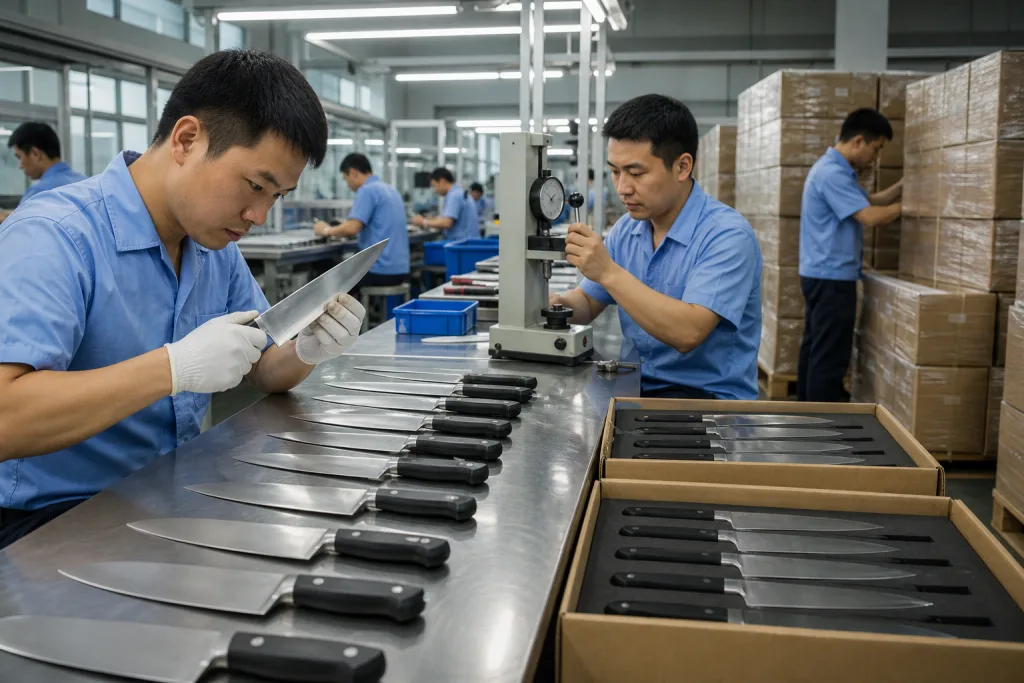
Product development gets cleaner when you stop treating one steel as the answer for every knife. On our 240-employee line in Yangjiang, we run about 300,000 knives a month, and the hardness tester still gets checked SKU by SKU. For butcher programs, MOQ is often 1,000-3,000 pcs per item, with first samples in 7-15 days and mass production in 35-45 days after approval. That timeline works, but only if the steel choice matches the knife and the buyer's use case.
This is the split we run on the grinding line. If a buyer wants one alloy across every SKU, that is the wrong question to ask.
- Boning and trimming knives: 1.4116 or 14C28N at 56-57 HRC for easy touch-ups and a cleaner regrind on the belt.
- Breaking and heavy utility knives: 420J2 or 5Cr15MoV at 54-56 HRC when the knife hits bone and cost per piece matters more than edge life.
- Premium retail or chef-butcher crossover: 440C, N690, or VG10 at 58-60 HRC when the buyer wants a sharper shelf hit and steadier edge retention.
- Wet-room or wash-down use: Prioritize stainless performance and polished finishes over exotic alloy claims.
For buyers sourcing through Zhejiang or other China trading hubs, the expensive misses are usually in packaging, labeling, and hardness drift, not the steel choice itself. QC pulled the sample, and the first thing we check is whether the 57 HRC callout still reads 57 HRC after heat treat. If you want fewer returns, pick a conservative steel, lock the HRC band, and set the regrind target before tooling starts. We have seen this go sideways when a PO typo changed the carton label from 57 HRC to 55 HRC.
Specify testing and compliance early
Good steel still fails when the heat treat and grinding line drift. We see it. For procurement teams, the low-risk move is to lock the test plan before mass production, not after the first 500 pcs are packed in inner cartons. Ask for the steel mill certificate with coil or plate heat number, the HRC report from a calibrated Rockwell tester, and a sampling plan matched to your sales channel. For appearance and fit, AQL 2.5 is common. For critical dimensions or hardness control, 7 out of 10 buyers we run with tighten the first two lots, often adding 3 extra HRC points per heat lot after QC pulled one 57 HRC sample from a 56-58 HRC order.
A practical acceptance package should include:
- HRC checks: Spot test each heat lot on the Rockwell C tester and record the target band, such as 56-58 HRC.
- Edge and grind inspection: Confirm left-right bevel symmetry with a 10x loupe, check burr removal by cloth wipe, and record tip shape against the approved golden sample.
- Performance tests: Run simple cut tests on double-wall cardboard or chilled protein; for premium programs, compare against a CATRA-style control blade from the signed sample set.
- Compliance: REACH for Europe, LFGB or FDA for food-contact use, plus ISO 9001 or BSCI when the buyer needs factory discipline written into the vendor file.
In China, stronger factories do not hide behind alloy names. They show the inspection points, the hardness range, and the rework rules on the QC sheet before we ship. The wrong question is “what steel is best?” The better question is “what happens when 2 blades in a 125 pcs carton miss the spec?” That answer keeps OEM butcher knives consistent when shipment volume moves from 1,200 pcs to 18,000 pcs and the buyer stops checking every sample by hand.
A practical spec you can order
If you need a safe starting point for a private-label butcher line, keep the spec tight and boring. Boring sells. We run 1.4116 or 14C28N at 56-57 HRC for this range, with a 2.0-2.5 mm spine, 15-18 degree edge per side, and a satin finish from the brushing wheel that hides belt marks and daily counter wear without looking cheap.
For the handle, pick a material that can take detergent, oil, and chilled storage without swelling at the rivets. QC pulled one sample last year after 48 hours in a 4°C cold room because the handle gap opened by 0.3 mm. For packaging, lock the barcode, item number, and carton count before production. If the end market is North America, confirm FNSKU, UPC, or master carton labeling. If it is Europe, confirm language, compliance marks, and whether the buyer needs a display box or an industrial sleeve; one PO came in with “carton 24 pcs” while the artwork said 12 pcs, and that kind of typo burns days.
My advice is simple: start with the version that gives you the lowest complaint rate, then tune the price. On a butcher knife, an extra 5 cents spent on heat treatment control, bevel consistency, or packaging beats a headline alloy upgrade most of the time. The math doesn't work if the buyer flags 6 uneven bevels during AQL inspection and delays shipment from 12 days to 18 days. That is how repeat orders happen, not one noisy launch.
Frequently asked questions
Ask for the steel grade, the target HRC band, the edge angle, and the allowed tolerance on hardness. Then ask how the factory checks each heat lot, whether they can share mill certificates, and what inspection standard they use, such as AQL 2.5. For Europe, confirm REACH and LFGB or FDA food-contact compliance. For bigger programs, ask about MOQ, lead time, and whether they can produce consistent packaging and barcode labels. A serious Yangjiang, China supplier should answer these without vague language and should be able to show sample reports before mass production.
Request a steel spec that lasts
Send us your target use case, MOQ, and market. We will suggest a butchery knife steel selection that balances toughness, maintenance, and regrind life.
Request a Quote