For a promotional product buyer, chef knife export packaging is not decoration. It decides two things fast: damage claims and retail acceptance. We saw this on a 1,000-piece run: an 8-inch chef knife from a Yangjiang factory lost the order because the 350 gsm color box crushed at one corner, and QC pulled the sample when the PET tray shifted 6 mm off center. The knife passed. The packing failed.
At TANGFORGE, we build packaging around chef knife wholesale orders that need to arrive retail-ready, not just “packed in a box.” We run the PET tray fit, printed sleeve tolerance, inner carton drop strength, and 5-layer master shipper layout against the buyer’s market, price point, barcode file, and compliance request before mass production. A 1.5 mm paperboard insert, a 5-layer K=A master carton, or a blade tip guard can move the damage claim from 3% to under 0.5% on a 1,000-piece shipment. The wrong question is “what is the cheapest box?” We ask whether the pack protects the blade, sells the brand, and keeps landed cost under control after ocean freight and warehouse handling. On the packing bench, that is the only math that holds.
What export packaging actually does
Good chef knife export packaging has four jobs: hold the edge still, make the brand look shelf-ready, fit the carton plan, and cut after-sales claims. Buyers will spend 30 minutes on blade steel, HRC, and handle material, then type “color box” as the last PO line. Wrong move. On our packing bench, we run the same 210 mm chef knife through two pack-outs and the market position changes fast: a plain white tuck box reads like a $3.80 promo item, while a rigid color box with a formed insert and clean spot UV supports a $14.00 retail item.
Protection comes first. A 210 mm chef knife with a sharp edge needs immobilization, not dead air, so QC pulled the sample and checked whether the tip could shift more than 2 mm inside the insert. Presentation comes next. For retail shelves, e-commerce parcels with courier drops, or corporate gifting where the buyer opens one sample in a meeting room, the consumer sees the carton before they touch the knife. Logistics is not decoration work. Export packaging changes carton count per master, pallet height in mm, and CBM per 1,000 pcs; a clean pack-out can improve container utilization by 8-15%. That is real money on a 40HQ shipment leaving Yangjiang, China, and we check it on the stacker before the line signs off.
For promotional buyers, the usual mistake is underpacking. A thin paper sleeve may pass local delivery, but we have seen it go sideways after two courier transfers and one damp outer carton; last year the grinding line had to rework 312 pcs because tips rubbed through the inner sleeve. On the other side, a heavy magnetic gift box can push the landed cost out of target. The math does not work when the buyer needs 5,000 sets under a tight retail price. This is the wrong question to ask. Ask whether the pack survives the trip from the chef knife factory to the DC, then still looks clean on the final store shelf.
Choose the right pack format
Start with the sales channel. On our packing floor, chef knife export packaging usually lands in 4 formats, and the right call is the one that still leaves margin after the carton drop test and freight quote. For promo runs, a printed color box with a molded pulp tray or PET blister stays in the safe cost band; our packing table checks blade tip clearance at 3 mm with a steel ruler before sealing. For premium retail, a rigid gift box with EVA or paper insert sells better on shelf. For entry-level chef knife wholesale, an inner sleeve plus master carton is enough when we pack 2-piece or 3-piece bundles. We run this every week.
- Paper sleeve: lowest cost, usually USD 0.05-0.15, used for bulk packing or as secondary protection inside a master carton.
- Color box: common retail choice, often USD 0.18-0.55 depending on paperboard grade, lamination type, print coverage, and whether the buyer wants barcode stickers applied at our line.
- Rigid box: higher shelf value, usually USD 0.80-1.80, better for gift sets where the buyer wants clean presentation.
- Blister pack: good product visibility with tamper resistance, often USD 0.20-0.60, but the sealing edge needs a clean 5 mm margin or the heat press leaves wrinkles.
If you are sourcing a custom chef knife program, match the pack to the blade value. A 67-layer Damascus knife should not sit in the same sleeve we use for a budget 420J2 utility knife; the math does not work when the buyer expects gift-box handling. In a chef knife supplier workflow, the box spec also changes QC time because deep EVA inserts, tight PET cavities, and loose paper trays fail for different reasons. QC pulled 32 samples last month where the insert slot was 1.5 mm too narrow, and the handles rubbed the box wall during assembly. That is the wrong question to ask if someone says packaging is “just a box.” Simple wins. For Yangjiang export factories, simple structures mean steadier output, fewer rework tickets, and less arguing between the grinding line and packing side.
Use this rule on the first quotation. If the retail price is under USD 12, keep packaging below 10% of the ex-factory target. If the retail price is USD 25 and up, you can pay for 0.2 mm embossing, 1-color foil, or a magnetic closure without breaking channel economics. We have seen this go sideways when a buyer asks for a USD 1.20 rigid box on a USD 3.80 knife, then flags the FOB price on the revised PO; one PO even listed “magnet clousre,” and purchasing still expected the cheaper sleeve price. The numbers do not lie.
Packaging spec by channel
Packaging has to match the sales channel. A supermarket buyer wants a shelf box with a clean front panel and a hang hole that still holds after 3 pulls on the hook. An Amazon seller asks about drop test results first, then whether the FNSKU scans on the first pass. Mix those up and the math doesn't work. We repacked 6,000 sets once because the PO said “FNSKU on carton” and the buyer meant “FNSKU on each color box.” Bad day on the line. In China, a chef knife manufacturer can run retail, e-commerce, gift, or bulk packs, but the RFQ needs the channel spec before the die line and insert mold are opened.
| Channel | Typical pack | Key requirement | Common MOQ |
|---|---|---|---|
| Retail shelf | Printed color box + insert | Barcode that scans at checkout; hang hole tested on the sample; shelf-facing artwork checked on a 300 dpi proof | 1,000-3,000 sets |
| E-commerce | Mailer box + inner protection | Drop resistance; FNSKU on the selling unit; scannable labels; zero blade movement after packing | 500-2,000 sets |
| Promotional gift | Rigid gift box | Brand story on the lid or sleeve; unboxing feel; spot UV or embossing; foam or EVA cut to the blade profile | 3,000+ sets |
| Wholesale bulk | Plain sleeve + master carton | Low cost; fast pack-out on the packing table; pallet efficiency; clear item code on the outer case | 300-1,000 sets |
For North America orders, check how the receiving team reads carton labels and scans inbound cases. If your customer uses Amazon or a 3PL, lock the final carton dimension and case pack before mass production. Do it early. A 215 mm chef knife in a rigid box can shift your carton size by 20-40 mm, and that small change can cut one layer from a pallet. Last month QC pulled the packed sample and measured 392 mm instead of the approved 370 mm because the foam insert was changed after artwork approval. The buyer flagged it on the photo report before we ship. For buyer teams working with a chef knife supplier in Yangjiang or Zhejiang, that detail often decides freight cost more than the knife itself.
Retail readiness starts with the consumer box, then moves to the master carton and pallet stack. Warehouse handling comes later, but it is not a side issue. The outer case still needs to survive a 1.0 m drop test without edge crush or blade movement. We run this with packed cartons, not empty samples. If the blade tip rattles against the insert after the first corner drop, the buyer will flag it during incoming inspection. We have seen this go sideways when a 2 mm thinner insert saved cents and cost a full rework. That is export packaging, not gift wrapping.
Build in compliance from the start
Packaging compliance is where about 3 out of 10 first-time buyers lose time. The chef knife passes sharpness and satin-finish checks, then the carton gets held because the artwork misses the origin statement, the barcode fails on our Zebra reader, or the carton icons do not match the importer’s warehouse SOP. We run packaging artwork like a controlled drawing with version numbers and sign-off dates, not as a loose AI file in the sales folder.
For Europe, check REACH-related material requirements for every ink, coating, foam pad, and plastic insert used in the box. If food-contact accessories or knife guards touch prep surfaces, ask for the material declaration; we see this most with 0.6 mm PE blade guards and EVA inserts cut on the packing table with a steel rule die. For the US, 7 out of 10 retail buyers ask for packaging that supports FDA-oriented expectations for food-contact use, even if the knife itself is not regulated like a utensil. If the set includes a sharpening steel or peeler, the documentation scope changes, and the buyer usually wants separate declarations by item.
Lock these package details during prepress, before the grinding line finishes the batch:
- Country of origin mark: “Made in China” or the local legal equivalent, checked against the shipping label proof before cartons are ordered.
- Barcode format: EAN-13, UPC-A, or FNSKU based on the sales channel, with a scan test on the Zebra reader at 100% print size.
- Carton marks: SKU on two sides, quantity per case, gross weight, net weight, and case dimensions measured after the drop-test carton is packed.
- Warning text: blade sharpness notice, age restriction, and hand wash guidance where the buyer’s market or retailer manual requires it.
In Yangjiang, China, we ask buyers to approve final artwork before mass production, because one text error on 10,000 boxes is expensive to fix. QC pulled a sample last year where the PO said “stainless,” but the gift box printed “stainles”; the buyer flagged it after packing had started. Reprinting packaging can cost USD 0.12-0.45 per unit plus delay, turning a 12-day packing schedule into 18 days. The math does not work. Catch it at proof stage, not at the port.
Test the pack before mass production
Do not sign off packaging from photos. Photos hide a loose fit. Ask for physical samples and a one-page test plan before the grinding line releases mass production packing materials. A chef knife export packaging set has to survive the trip from our Yangjiang packing bench to your warehouse, not just look clean in a render. On a 2,000-set or 20,000-set order, the first sample tells us whether the EVA slot grips the spine, whether the tip guard shifts, and whether the printed sleeve scuffs after 30 seconds of hand rubbing with a white cotton cloth. For a custom chef knife with a 240 mm blade or a handle that is 160 g heavier, the balance point moves, so the knife can knock the inner wall during transit. We had one buyer flag a 2 mm gap at the tip. Small miss, fast claim.
Ask the chef knife manufacturer for these checks:
- Drop test: 1.0 m for retail box, 1.2 m if the product will move through rougher distribution.
- Vibration check: run a truck-transport simulation and open the box to see if the insert has walked out by 2-3 mm.
- Compression check: master carton should hold stack load without panel collapse; QC should check the top carton after 24 hours under weight.
- Blade restraint: no edge contact with the inner wall, even after shaking by hand for 60 seconds.
For quality acceptance, 8 out of 10 import buyers we work with use AQL 2.5 for appearance defects on printed cartons and AQL 1.0 for functional damage such as crushed corners or broken trays that let the knife move. If you are working with a chef knife supplier in China, tell them whether the sample is a pre-production sample for fit checking or the golden sample that the packing line must match. A shipping sample is another control point, pulled after real cartons and real inserts are on the bench. We have seen this go sideways when a buyer approved a golden sample with matte lamination, then the PO had a typo calling for gloss lamination. One extra word on the PO, and the packing line builds the wrong pack.
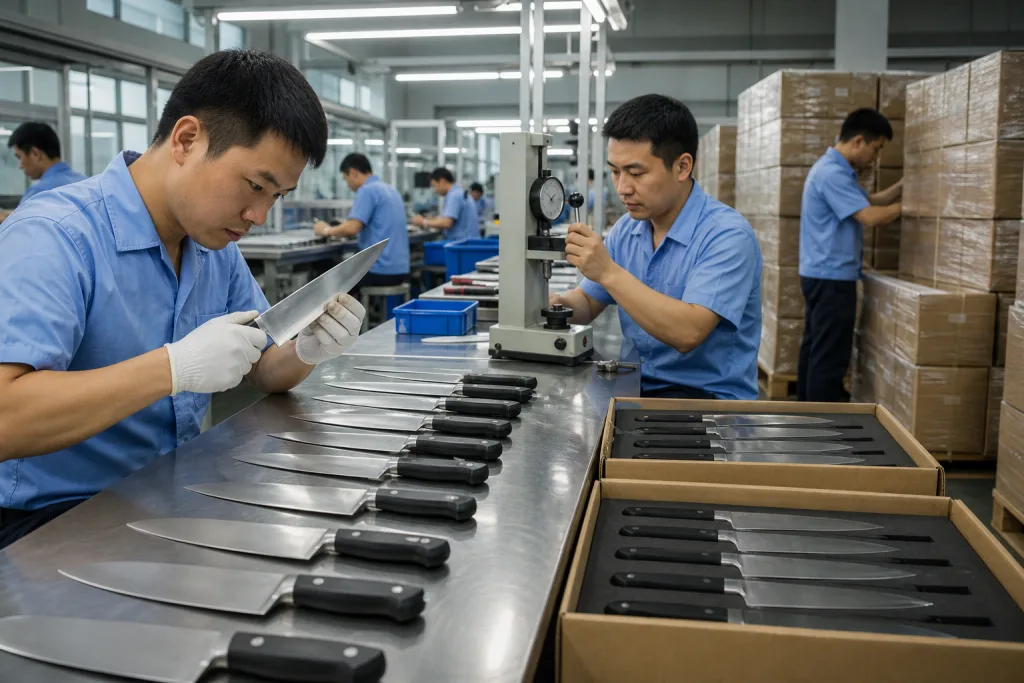
A practical factory metric: a medium-size chef knife factory with around 240 employees can often pack 8,000-20,000 units per month depending on structure and print complexity. The pack is not decoration; it eats line time. A plain sleeve may add 1-2 days; a custom rigid box with multiple inserts can add 5-7 days to the order schedule, and QC pulled the sample once because the magnet box gap measured 4 mm on one side. Asking “is the box nice?” is the wrong question. The math does not work. We run the numbers on the packing bench, not on a mood board.
Keep freight and carton math under control
Packaging changes freight cost before most buyers see it. We had one 6-piece chef set jump 30% in carton count because the color box carried 22 mm of empty headroom; QC pulled the packed sample from the sealing table, and the caliper told the story. For chef knife wholesale retail distribution, ask for carton L×W×H, gross weight per master carton, and the pallet pattern before artwork approval. Put those numbers on the quote sheet. Not after the grinding line has finished the blades.
Use this basic sourcing logic:
- Light retail sets: keep gross carton weight under 15 kg, or warehouse staff will complain after the first 40 cartons.
- Mixed gift sets: target master carton weight below 18 kg when possible, and have QC check the PET tray fit with the actual handle sleeve before mass packing.
- Heavy premium sets: confirm stacking strength with the master carton sample, add corner protection where the block or magnetic box loads one side, and read the drop-test result before booking space.
For FOB China shipments, packaging efficiency changes container loading fast. For DDP programs, oversized cartons trigger dimensional weight charges, so the freight bill can move even when the knife price stays flat. On export runs out of Yangjiang and Zhejiang, we often cut box height by 5-10 mm or move the PET tray rib 3 mm instead of touching the knife spec. That saves freight cleanly. Changing the blade to fix a carton problem is the wrong question to ask.
If your buyer is a promotional product distributor, confirm the final stop: store shelf, warehouse rack, or fulfillment center with parcel sorting. The packaging spec changes for each one. Shelf-ready cartons need display panels that survive retail handling. Warehouse cartons need clear EAN/UPC labels and stack strength; we have seen buyers flag a 1 mm barcode quiet-zone error on the PO proof. E-commerce cartons need shock absorption with low void space, usually checked with a simple shake test before the 1.2 m drop test. One box does not fit all, and the math goes sideways when sales teams pretend it does.
Work with the factory like a buyer, not a designer
You get cleaner results when you send the chef knife manufacturer a spec sheet, not only a logo file. A working chef knife factory can price blade steel against MOQ and match the handle to the packing method, but the buyer still needs to fix the commercial line: target retail price, sales channel, master carton limit, and packaging budget per piece. We run into trouble when a PO says “premium gift box” but gives no drop-test requirement or carton CBM target. The math does not work after artwork is approved, and the packing table cannot guess whether the buyer expects 5-layer K=K carton or a lighter B-flute color box.
Inputs we can put straight into the costing sheet:
- Knife type: 8-inch chef knife, santoku, utility, or set; tell us blade length in mm if your market uses a fixed planogram, because a 203 mm blade and a 210 mm blade do not sit the same in a tray.
- Steel and hardness band: for example, 5Cr15MoV at 54-56 HRC or X50CrMoV15 at 55-57 HRC; QC checks the HRC range before packing approval.
- Handle material: ABS, pakkawood, G10, or stainless; the grinding line needs to know if the handle must pass a 1.0 mm gap check at the bolster.
- Pack format: sleeve, color box, gift box, or display pack; buyers often flag this after seeing how the knife sits in the PET tray, so we prefer to check one packed sample on the bench first.
- Print needs: 1-color, 4-color, matte lamination, spot UV, foil; send the Pantone code, not a screenshot from the buyer’s catalog.
Ask for an open sample or pre-production sample before mass order approval. For private label packaging, approval usually takes 3-7 days if artwork is ready. Tooling for custom inserts, dies, or specialty boxes can take 7-15 days. Tight launch? Keep the first version simple and upgrade the packaging on the repeat order. We have seen this go sideways when a buyer changed the insert after QC pulled the sample with a caliper check; it turned a 12-day packing plan into 18 days.
At TANGFORGE in China, we see fewer claims when buyers treat packaging as part of the product spec. The knife, carton, and label need to be checked together, down to barcode position and outer carton wording. One PO typo on “6 pcs/ctn” versus “12 pcs/ctn” can stop a shipment at final inspection. We ship cleaner when that gets fixed before production leaves Yangjiang, before the cartons are taped and stacked on the pallet.
Frequently asked questions
It depends on structure. Printed color boxes often start at 1,000-3,000 sets, while rigid gift boxes usually need 3,000 sets or more because of tooling and print setup. Plain sleeves can be lower, sometimes 300-1,000 sets if the factory already has standard sizes. If you want custom inserts, embossing, or foil, expect higher setup cost and longer lead time. For chef knife wholesale programs, the packaging MOQ is often separate from the knife MOQ, so confirm both before you issue the PO.
For most chef knife export packaging, the added cost is about USD 0.18-0.55 for a printed color box, USD 0.20-0.60 for blister, and USD 0.80-1.80 for a rigid gift box. If you add molded pulp, EVA, spot UV, or foil stamping, the price goes up. The real question is not only unit cost, but whether the packaging supports your retail price. On a USD 9.99 promo knife, an extra USD 1.20 package can be too much. On a USD 24.99 retail set, it is often justified.
At minimum, the master carton should show SKU, product name, quantity, gross weight, net weight, carton size, country of origin, and handling marks. If you are shipping to Amazon or a 3PL, add the FNSKU or warehouse label format before production. For Europe, EAN-13 is common at retail level; for North America, UPC-A is still widely used. If the box is going into direct fulfillment, make sure the barcode contrast and print size are tested by scan gun before shipment.
Yes, if you specify the format early. A chef knife manufacturer can pack for retail shelf, Amazon FBA, or distributor warehouse, but the label, carton dimensions, and outer protection must match the channel. For Amazon, the unit pack usually needs a scannable barcode, suffocation warning if polybagged, and a stable box that survives transit. For retail stores, shelf appeal and hanging display matter more. Ask the chef knife supplier for a pack plan before production, not after the knives are already packed.
Use a proper inner tray, keep the knife from touching the box wall, and make the master carton strong enough for stacking. For export shipments, we usually recommend drop testing at 1.0-1.2 m, AQL 1.0 for damage-related defects, and carton compression checks for pallet loads. If the knife is heavier than 250 g or has a long blade, upgrade the corner protection and reduce empty space. In China, many damage claims are caused by loose inserts, not by the knife steel itself.
Request a retail-ready packaging quote
Send your knife size, target market, and artwork file. We will match the pack structure, carton spec, and labeling to your channel and budget.
Request a Quote