If you are sourcing a chef knife OEM program, the first question is not whether the knife looks good. This is the wrong question to ask. The math has to work first: target landed cost, chef knife MOQ, and launch date must still hold after steel, labor, packaging, and QC hit the sheet. On our grinding line, we check bevel consistency with a 0.1 mm gauge before we quote a repeat run, because a sample price tells you almost nothing about production cost.
At our 240-employee factory in Yangjiang, Zhejiang, we see buyers ask for chef knife private label branding, LFGB or FDA-ready materials, and a shelf-ready finish, then push back when handle tooling adds 12 days and carton print adds 3 more. QC pulled the sample and found the edge angle drifting 2 degrees after heat treatment. The math does not work if you ignore edge geometry, handle tooling, and pack-out timing, and we have seen that go sideways more than once.
What OEM Actually Changes
In a chef knife OEM program, you pay for steel grade, heat treatment, grind, handle, logo, and carton. On an 8-inch chef knife, a basic OEM stainless build may land at USD 3.20-5.80 FOB China at 1,000 pcs. If you move to a private label spec with tighter grind control, bolster work, and gift packaging, the quote can climb to USD 6.50-10.00. We run this every week on the grinding line, and if a price looks too low, the buyer flagged it for a reason: something was cut out.
The cleanest way to compare offers is to ask the chef knife supplier to split the quote into steel, heat treatment, blade grind, handle, logo, packaging, and test cost. QC pulled the sample, checked the bevel under a 20x loupe, and that is where the tradeoffs show up. In Yangjiang, Zhejiang, the factories that do this well already know how claims happen in export work. One vague quote can turn into rework, delay, or a chargeback after inspection. That is the wrong question to ask if you only want the cheapest number.
For a real OEM project, lock the spec before you ask for the second quote. Blade length, spine thickness at 2.5 mm, edge angle, steel family, handle material, finish, and carton setup all need to be fixed first. Once those points are set, price talks make sense. Before that, the math does not work. One PO typo on carton count can push the shipment plan from 12 days to 18 days, and we have seen that go sideways fast.
Steel And Geometry Decide Performance
Buyers ask about steel first. On the shop floor, geometry tells the truth. For a Western-style chef knife, 55-57 HRC with a 15-20 degree edge per side is a solid production target, because it keeps edge life up without turning the blade into a chip magnet when QC pulls a sample after the grinding line. Push hardness higher and the quench, temper, and chipping risk all need tighter control. A flat, thick grind can feel dead even on good steel. That is the wrong question to ask.
| Spec | Common target | Buyer check |
|---|---|---|
| Blade steel | 1.4116, X50CrMoV15, 420HC | Ask for material cert and heat-treatment record |
| Hardness | 55-57 HRC | Check random production blades, not only samples |
| Edge angle | 15-20 degrees per side | Confirm on the line, not just in the drawing |
| Handle | PP, ABS, POM, pakkawood | Test grip, wash resistance, and REACH or LFGB needs |
If you want sharper out-of-box cutting, grinding consistency usually matters more than one extra HRC point. A knife at 59 HRC with a poor taper can cut worse than a 56 HRC knife with a clean distal grind, and we have seen a buyer flag that exact issue on a 2 mm spine sample. Ask for CATRA data if the factory has it, but treat it as one check, not a sales story. For China export runs, we match the steel to the job instead of asking one blade to cover every use.
Set A Realistic MOQ And Timeline
The chef knife MOQ is where a lot of projects go off the rails. The wrong question is, "Can you do 300 pcs?" For a standard private-label chef knife on existing tooling, 500-1,000 pcs per SKU is the starting line, not the finish line. Once you ask for a new handle mold, custom bolster, or forged construction, MOQ jumps to 2,000 pcs or more because the factory has to cover steel setup, die work, and the grinding line changeover. If we keep the blade platform unchanged and only swap the logo, box, or insert card, QC can run the same sample and the order stays on the lower side.
Lead time is where buyers get burned. A practical schedule is 7-10 days for revised samples, 3-5 days for packaging proof, 15-25 days for production setup and mass manufacturing, and 45-60 days total after final sample approval. Add 20-35 days for ocean freight, depending on where you ship. The packaging desk can print a proof on the sample printer in one morning, but the main line still needs clean sign-off before we run. We had a buyer flag a PO with a holiday promo date that was 12 days too tight; the math does not work. Plan backward from the dock date, not the PO date.
In Yangjiang, Zhejiang, a 240-person factory can usually handle a stable OEM run faster than a heavily customized program because the job sheet is cleaner and the grinding line stays on one setup. We ship faster when we hold it to one knife profile, one handle color, one logo method, and one carton size. Add a second handle color or a different carton insert, and changeover eats a day. Every extra variation adds risk, and it can push you past the sell-in window in Europe or North America. We've seen this go sideways on a four-SKU launch after one typo on the PO forced two extra rounds of artwork.
QC That Prevents Claims
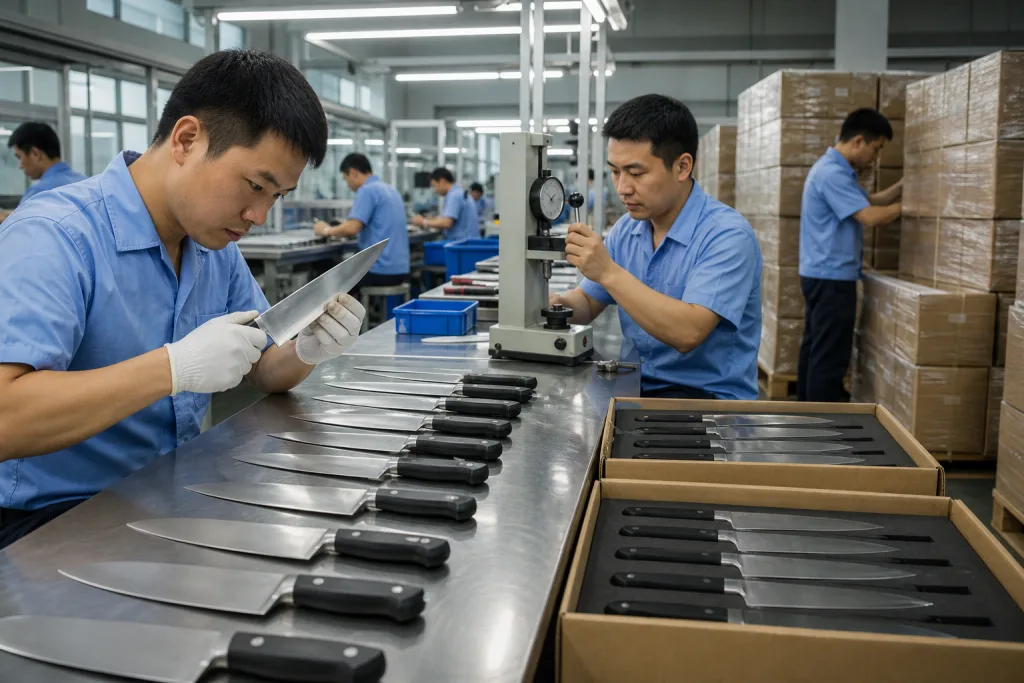
For kitchen knives, QC is not a paperwork exercise. You need controls that catch the defects buyers actually complain about: crooked blades, loose handles, rough edges, rust spots, misprinted logos, and damaged packaging. On the grinding line, QC should be pulling samples with a straightedge, a caliper, and a light box. A sensible export standard is AQL 2.5 for major defects and AQL 1.0 for critical defects, with zero tolerance for blade crack, handle breakage, or unsafe edge conditions. If the factory cannot explain its inspection points, walk.
A useful control plan starts with first article approval, then in-process checks at grinding and assembly, then a final inspection before carton sealing. Ask for straightness within a tight visual tolerance, a consistent edge bevel, and a blade surface free from burrs or stain. We run a profile projector at the grinding station, and it catches a 0.3 mm bevel drift before it turns into claims. For stainless chef knives, a 24-48 hour salt spray screen can help you catch obvious finish problems, but it does not replace correct steel or passivation. For handle materials, check odor, discoloration, and joint gaps after heat and water exposure. This is where the buyer flags it first, so do not treat it as a small issue.
ISO 9001 matters because it shows the system exists, but the real test is whether the factory can share inspection records, retain samples, and batch traceability. We have seen a PO typo on carton count turn into a shipment delay, and the records were the only thing that sorted it out. If you are supplying retailers, ask for carton drop testing and barcode verification. For EU buyers, REACH and LFGB-related documentation should be ready before shipment, not after the first complaint. If the factory dodges batch codes, that is a bad sign.
Private Label That Looks Expensive
Chef knife private label work is mostly about the details a buyer notices in five seconds. On the line, we check laser depth, etched blade marks, polished spine, handle seam, and whether the carton survives a 1.2 m drop. A laser logo typically adds only USD 0.05-0.20 per piece, while a custom color box may add USD 0.30-0.80 and a molded insert can add USD 0.40-1.20. Small money. Big change on shelf and online.
If you sell through retail or e-commerce, map the unboxing path before the first carton is printed. We run SKU labels, product claims, FNSKU labels, suffocation warnings, and master carton marks together, because one typo on a PO or one label mismatch can slow receiving at the warehouse. Carton size matters to freight math, and a 2 mm change can shift pallet count. This is the wrong question to ask if you only compare box cost.
Good branding should support the knife, not hide weak manufacturing. A plain blade with disciplined finish usually outsells a flashy knife with sloppy fit and finish. QC pulled the sample, checked blade polish and logo repeatability, then sent pack-out photos before the goods left Yangjiang, Zhejiang. We have seen this go sideways when the artwork looked premium but the handle gap was still 0.5 mm.
Choose The Right Supplier Fit
Not every chef knife supplier is built for the same job. Some run low-cost volume, some are set up for private label, and some do ODM drawings from the start. Match the factory to the launch plan. For a stable retail program, ask for monthly output, sample room capacity, QC headcount, and export records. A 240-employee factory with one owner on the grinding line is easier to manage than a bigger shop that cannot keep the same edge angle on 2 batches in a row. We have seen that go sideways fast.
Your RFQ should force straight answers. Ask for blade length, steel family, HRC range, handle material, edge angle, packaging spec, MOQ, lead time, payment terms, and test reports. Ask which changes need a new mold, which changes stay cosmetic, and how many sample rounds are included. Two or three sample rounds is normal; 4 rounds usually means the spec is still moving. QC pulled the sample and found a 0.3 mm handle gap once, and the buyer flagged it on the PO the next day.
When you compare suppliers in China, look for numbers, not sales talk. If a factory says it can do everything but cannot quote a clean MOQ or inspection standard, that is the wrong question to ask. A shop that tells you the cost split on steel, labor, and packing, then explains what changes when you move from a 35 mm handle to a 38 mm handle, is the one you can build with. We ship better with that kind of honesty.
Frequently asked questions
For a standard chef knife private label run, 500-1,000 pcs per SKU is realistic if the factory is using an existing blade platform and simple packaging. If you need a new handle mold, forged bolster, or special insert tray, MOQ often moves to 2,000 pcs or more. The lowest-cost path is to keep the blade size, steel, and handle platform fixed, then change only the logo, box, and carton marks. That is usually how importers in Europe and North America get their first launch off the ground without tying up too much cash.
A practical budget for a stainless 8-inch OEM chef knife is often USD 3.20-5.80 FOB China at around 1,000 pcs for a basic commercial build. If you want cleaner grind lines, better packaging, and a stronger private label presentation, expect USD 6.50-10.00 or more depending on handle material and packing method. Shipping, duties, and destination handling are separate. If a quote is much lower than this, ask what was excluded, because the missing cost usually shows up later in QC, freight, or claims.
Ask for AQL 2.5 on major defects and AQL 1.0 on critical defects, with zero tolerance for cracks, broken handles, or unsafe blade conditions. You should also ask for first article approval, in-process checks, final inspection, and batch traceability. For export programs, ISO 9001 is useful as a system reference, but the real value is in the actual inspection report, retained sample, and defect photo log. If you sell in the EU, also make sure REACH and LFGB-related documentation is ready before shipment.
Only if the design is simple and the packaging is already decided. A normal schedule is 7-10 days for sample revision, 3-5 days for packaging proof, 15-25 days for production setup and manufacturing, and 45-60 days after final sample approval. Add 20-35 days for ocean freight if you are shipping to Europe or North America. A 45-day launch is possible for a repeat order or a very simple private-label build, but it is risky for a first-time OEM project with custom tooling.
For many first-time buyers, 1.4116 or X50CrMoV15 is a safe starting point because it balances corrosion resistance, sharpenability, and price. A hardness target of 55-57 HRC is usually practical for a working chef knife. You do not want to chase very high hardness before the factory has proven its heat-treatment consistency. If your brand wants a sharper feel, improve the grind, taper, and edge geometry first. That is often a better commercial decision than switching to a more expensive steel before the market has tested the line.
Start your chef knife sourcing with real numbers
Send your target price, MOQ, blade length, and packaging spec. We will map the OEM path, flag the risk points, and tell you whether China can meet the launch window.
Request a Quote