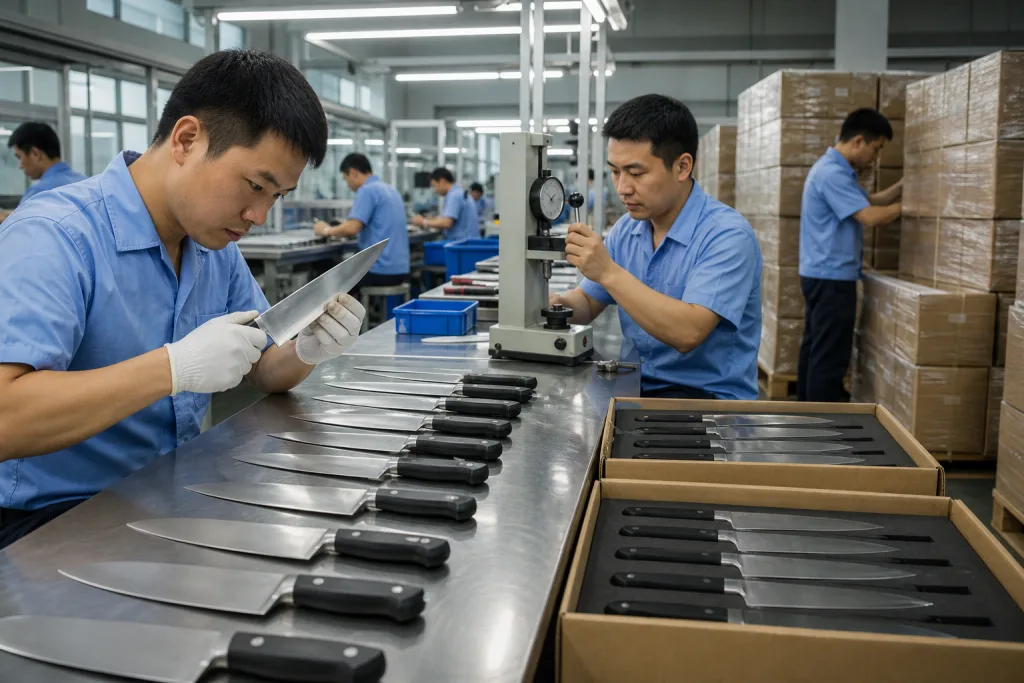
Buying a custom chef knife for a brand program? Do not treat every chef knife factory like the same shop. They are not. A real chef knife supplier should give steel data, HRC target, blade tolerance, edge angle, and a production schedule your purchasing team can book without guessing. We run this check before quoting: QC pulls the sample, tests it on a digital Rockwell tester, then measures spine thickness in mm with a caliper before any salesman promises a ship date.
In Yangjiang, Zhejiang, China, a 240-employee plant should tell you monthly output in units, not say “large capacity.” Ask for MOQ, sample timing, carton spec, and the gap between OEM production and chef knife wholesale stock. If the answer stays soft, the math does not work. We have seen this go sideways after a PO typo changed an 8-inch chef knife to 7-inch, and the vendor still replied “no problem.” Wrong answer. That is a brochure, not a sourcing partner. The checklist below separates a dependable chef knife manufacturer from a vendor that gets difficult once the order gets real.
What a real supplier proves
Before you compare a chef knife manufacturer with a chef knife supplier, ask for proof, not catalog photos. Photos are cheap. A real OEM partner should confirm the steel grade, heat-treatment range, edge angle, handle construction, surface finish, and the approved sample number that production must follow. In our shop, QC writes those points on the sample card after checking spine thickness with a Mitutoyo digital caliper and testing hardness after heat treatment. Normal factory work. For Yangjiang OEM orders shipping to Europe or North America, this is the baseline, not a bonus.
Ask for spine thickness in mm, grind type, balance point from the bolster, and full tang or hidden tang construction. Then ask for monthly capacity in units. A supplier that says “high quality” but cannot give a number like “240,000 pieces per month” or “MOQ 500 pcs” is not ready for brand work. We have seen this go sideways: a buyer approved a 2.2 mm spine sample, then QC pulled the bulk sample at 2.6 mm because nobody locked the drawing. The buyer flagged it. Fair. A chef knife wholesale vendor can move stock fast, but an OEM project needs the same hand feel across a 12-month reorder cycle.
The strongest signal is paperwork matched to the sample: a drawing with tolerances, a sample sheet with material notes, and a signed golden sample before the first production run. We run that golden sample past the grinding line, polishing bench, packing table, and final QC. One missed handle rivet tolerance, even 0.3 mm, can turn into 3,000 pcs of rework. If the supplier pushes back on this step, the math does not work. Expect the same argument later when you ask for a correction. Good OEM work comes from technical clarity, not sales language.
Write the spec before you quote
A quote means something only when every factory prices the same knife. Write the spec first, then ask for price. We have seen buyers send one photo and get back 2 prices: one based on a 1.8 mm spine, the other on 2.5 mm. Same photo, different blade. The low line looked better in Excel, but the grinding line was not cutting the same part, and the caliper reading at the heel told the real story.
Minimum spec items
- Blade length in mm, overall length in mm, blade height at heel in mm, and spine thickness at heel or mid-blade, measured with a digital caliper
- Steel grade with target HRC band, such as 1.4116 at 56-58 HRC or VG-10 at 60-62 HRC, with hardness checked on the Rockwell tester
- Edge geometry with a fixed angle, for example 15 degrees per side or 12 degrees per side, so the sharpening jig is set once
- Handle material, rivet pattern, tang style, logo position, and logo method such as laser mark or silk print, matched to the approved handle sample
- Packaging details covering insert type, barcode size, gift box paper spec, and master carton count, because the packing table needs the same instruction as the sales file
Leave those open and you end up negotiating definitions, not price. That is the wrong question to ask. A clean chef knife factory should turn your brief into a 2D drawing and a sample plan, then quote from that file every time. We run this on custom chef knife lines for 4 sales channels, and an Amazon FBA box with barcode placement is not the same job as a retail gift box with foam insert. QC pulled one pre-production sample last month. The blade was right, but the carton count was 24 pcs instead of the buyer’s required 12 pcs. Specs stop that miss before tooling, print plates, and packaging inserts are booked.
One simple rule: if the supplier cannot repeat your spec back in one email without guessing, the project is not ready to price. We see this on POs too; one buyer typed “8 inch santoku” where the drawing said 8 inch chef knife, and the buyer flagged it only after the sample was packed on the bench beside the tape machine.
Steel and heat treatment
For chef knives, steel and heat treatment decide most of the user experience. A blade can pass the mirror-polish check on the buffing wheel, then fail on the cutting board if it comes out at 52 HRC. Too soft. Push the same pattern to 60 HRC and the buyer may see chips after a home cook twists through chicken joints or taps a ceramic plate. On a 2.5 mm spine, we run a balanced window around 56-58 HRC, checked on a Rockwell tester after tempering, with the target tied to the steel grade, blade grind thickness in mm, and retail price point.
Ask the chef knife manufacturer how it controls quenching temperature and tempering time for each production lot, then ask how hardness is tested. You want a supplier that can state the test method, sample size, and accepted deviation, not one hardness number copied from a catalog page. On our side, QC pulled the sample from the grinding line last month after 7 knives in a 200-piece lot tested 1 HRC below spec. We held the lot. For stainless kitchen knives, 1.4116 gives easy sharpening and decent stain resistance, 5Cr15MoV keeps cost down, 9Cr18MoV needs tighter heat control, and AUS-8 sits in the middle for export sets. Steel choice is a sourcing decision, not a branding decision.
If you sell into Europe, ask how the handle material and coatings line up with REACH and LFGB requirements where relevant. If you sell into North America, confirm the food-contact position and packaging marks before the first PP sample; we have seen a PO typo on “food safe sticker” delay carton artwork by 12 days. The buyer flagged it on a Friday, and that kind of slip eats a whole shipping week. In Yangjiang, China, the better factories do not hide behind steel names. They explain the tradeoff between edge retention and toughness, then price the stain resistance honestly so you can choose the right HRC band for your market. Chasing the hardest number is the wrong question to ask.
If the factory can provide CATRA results or internal edge-retention data, good. Ask for the cutting media, stroke count, blade angle, and whether QC took the sample before final honing or after the 1000-grit belt. We have seen this go sideways when a sales sheet shows one clean number but the test blade was not from mass production. The math does not work if the test knife came off a hand-finished sample table and not the line. Without those test conditions, the number is just marketing.
Capacity, MOQ, and timing
Price is the wrong first filter. Capacity comes first. If a supplier guesses on MOQ by SKU, sample lead time with logo work, or production lead time after signed sample approval, your retail launch is exposed. We ask for the schedule by process: blade blanking on the 160T press, heat treatment, grinding line, handle fitting, laser engraving, box packing. A practical chef knife factory in China separates sampling from mass production and knows whether a 40 mm blade logo, a printed gift box, or a new POM handle color adds 3 days or 12 days.
| Item | Good baseline | Red flag |
|---|---|---|
| MOQ | 500-1,000 pcs per SKU | No clear minimum by SKU |
| Sample lead time | 7-15 days | "Depends" with no process schedule |
| Production lead time | 30-45 days after sample approval | Clock starts after deposit, not approval |
| Monthly capacity | 200,000-300,000 pcs | Cannot state a tested output number |
If you are buying chef knife wholesale for a distributor program, ask whether the line can take rush orders without changing your spec. We run into this every quarter. A factory with proper planning can explain what changes when the PO moves from 3,000 pieces to 20,000 pieces, and whether the handle mold, heat treatment furnace, and packing line can keep pace. The buyer flagged it once because the black POM handle approved on the sample became dark grey in mass production; QC measured the handle gap at 0.6 mm on 18 pieces. The cheap quote looked good. The math did not work after the missed sailing.
Good suppliers tell you when the calendar is tight. If a plant says it can do everything in 10 days, push back. QC pulled the sample, checked the edge angle with a goniometer, and still needed time for salt spray, carton drop test, and barcode checking. Ten days usually means they are skipping a check, or your order is sitting behind only 2 other jobs on the packing line.
Compliance and packaging
Compliance is where 7 out of 10 first-time buyers lose time. A chef knife supplier that mainly ships domestic orders can miss your carton mark format or put the EAN barcode on the short side instead of the front panel. Your importer gets a problem before the goods leave the warehouse. For a brand program, ask for ISO 9001 and BSCI on day one, then request contact-material test reports tied to the handle, coating, and blade finish. We had a buyer flag a PO typo: 24 pcs per carton written on the PO, 36 pcs shown on the artwork. QC pulled the sample with a 150 mm caliper and carton scale, and that saved 7 days. Ask early. If you sell in Europe, check LFGB or REACH support where required; if you sell into the US, confirm FDA food-contact positioning and packaging rules through your importer.
Packing is not an afterthought. A 4-color gift box versus a plain tuck box changes carton size, freight cost, and damage rate. We run both on the packing line, and the math changes fast once the outer carton goes up by 8 mm. If you sell on Amazon or through distributors, ask whether the factory can print FNSKU, apply retail stickers, and pack to your case-packing plan with the exact inner quantity shown on the PO. The buyer flagged it once: 6 inner boxes requested, 4 inner boxes packed. Small mistake. Big chargeback. Good packaging protects the edge too; one loose blade tip inside a PET tray becomes 36 returns after a courier drop from 80 cm.
A reliable chef knife manufacturer in Yangjiang, China should show you an export carton spec, the drop-test logic for packed goods, and its moisture-control method for ocean shipping. We use 5 g desiccant bags and a PE carton liner when the route is 30 days or more, because we have seen rust claims go sideways after a wet container floor. Get your trade terms straight too. FOB works when you already control freight. DDP can work, but only if the factory and forwarder understand landed-cost math, duty codes, and who pays when customs asks for a revised invoice. If they cannot explain that split clearly, the math doesn't work. You are not talking to a mature export team.
Samples, QC, and contract control
The last filter is QC. Before the first mass run, ask for the golden sample with signed tag, the pre-production sample from real steel, the in-line checkpoints on the grinding line, and the final inspection standard. For a chef knife, we check blade symmetry with a 0-150 mm digital caliper, grind line height within 0.5 mm side to side, handle gap under 0.3 mm, edge sharpness, logo position, satin finish direction, and carton count. Sharpness matters. If the order is for a retail program, write AQL 2.5 for critical and major defects into the purchase order. An email thread will not save you when QC pulled 18 dull blades from a 200-piece carton check.
A workable supplier should tell you how lot numbers are recorded and what happens after QC pulls a bad sample. You want photo reports showing the order number, carton mark, defect close-up, and inspector's date stamp. No excuses. If the blade finish turns from satin to cloudy, the ABS handle color shifts by one shade, or the EVA box insert is cut 2 mm short, the factory needs a containment step: hold the lot, sort 100%, rework, then send new photos. We run this on the packing table before cartons are sealed. That is basic export discipline, not premium service.
For brand programs, the contract should cover revision control, spare cartons, replacement policy, and who pays when the approved sample is missed. We have seen this go sideways when a buyer approved Rev. B artwork but the PO still said Rev. A. One typo did it. The math doesn't work after 3,000 pcs are packed and carton marks are printed. A strong chef knife factory is not the one promising zero defects; it is the one that records the process, catches deviation on the grinding line, and fixes it before the container booking.
If the supplier has solid records, you will see it in 5 minutes: numbered samples in the sample rack, signed approval sheets, and inspection photos tied to the order. If it only has soft promises, move on. This is the wrong place to gamble.
Frequently asked questions
For a normal OEM chef knife program, 500-1,000 pcs per SKU is a realistic starting point if you are using an existing handle shape and standard packaging. If you ask for a new mold, special coating, or a complex gift box, the MOQ can rise to 2,000 pcs or more. For sampling, 2-3 pieces is usually enough to verify geometry and finish. If a supplier accepts 100 pcs with no surcharge, ask how it is making the numbers work. Very small orders can be fine, but they usually carry higher unit cost, slower scheduling, and less room for revision.
There is no single best steel. For many export kitchen lines, 1.4116, 5Cr15MoV, 9Cr18MoV, and AUS-8 are common because they balance stain resistance, sharpening, and cost. What matters is the full system: steel grade, heat treatment, blade geometry, and the target HRC. For a practical brand program, 56-58 HRC is often the right range. If your customer wants easier sharpening and lower risk of chipping, stay conservative. If you want better edge retention, you may move harder, but only if the steel and grind support it. Ask the factory to explain the tradeoff in plain terms.
If the design is straightforward and the factory already has the right steel and handle material, sample lead time is often 7-15 days. After you approve the golden sample, mass production usually takes 30-45 days. If you need a new mold, custom color, printed retail box, or special compliance document set, the timeline can stretch to 45-60 days. Do not forget freight planning. Ocean transit to Europe or North America can add 20-40 days depending on route and season. A good supplier will give you a complete calendar, not just a production promise.
Ask for the business license, export records, ISO 9001 or BSCI status if available, and a live factory video showing the grinding, heat-treatment, polishing, and packing areas. Then ask for monthly capacity in units, not vague descriptions. A real factory in Yangjiang, China should be able to explain how it controls lot numbers, inspection, and packing counts. You should also request photos of recent orders with blocked customer names if needed. If the plant cannot show process flow, sample retention, and QC records, treat it as a trading office until proven otherwise.
Choose OEM when your brand needs a specific look, repeatable quality, and control over packaging, labeling, and margins. Choose wholesale stock when speed matters more than differentiation and you can accept a generic product. OEM usually needs more setup work, but it gives you a real product asset. Wholesale can ship faster, but it is harder to protect pricing and harder to build a brand story. For most kitchenware brand owners, OEM wins once the target is above 1,000 pcs per SKU and you want the knife to feel like yours, not like a catalog item.
Send Your Knife Spec For Quotation
Share your blade size, steel, HRC target, MOQ, and packaging needs. We will turn it into a clear OEM quote and sample plan.
Request a Quote