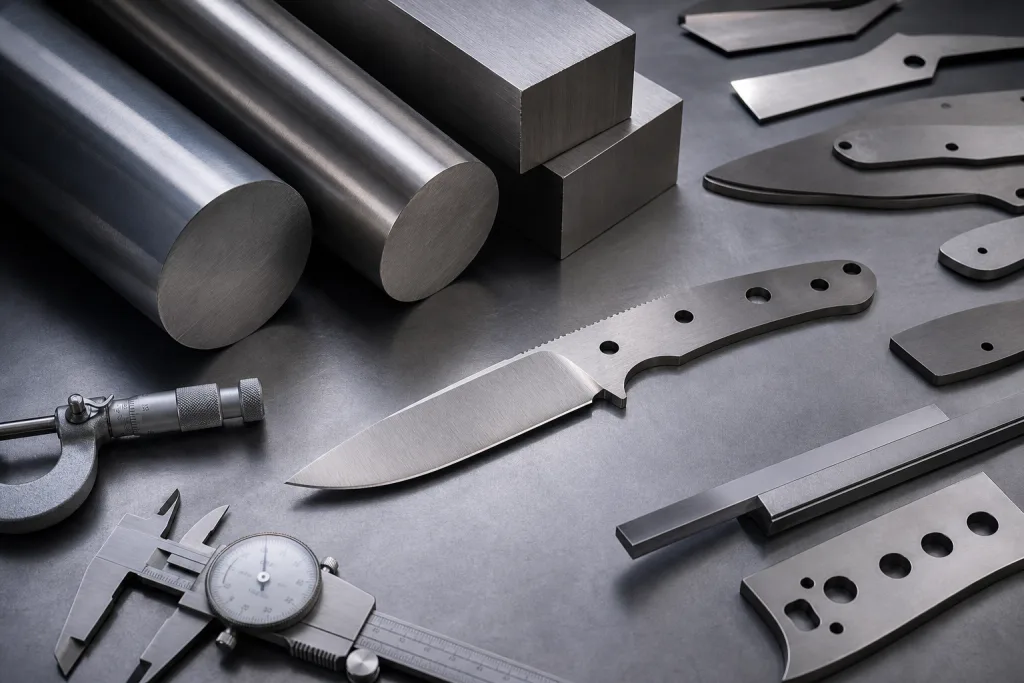
A chef knife sample is not a factory souvenir. It is the control piece for your bulk order, inspection plan, packaging, claims handling, and sometimes your brand reputation for the next 12 months. We run this check every week on the QC bench, with a Mitutoyo caliper and Rockwell tester within reach. Small shifts matter. A 0.2 mm change at the spine or behind the edge can turn a clean approval sample into a production headache.
If you buy chef knife wholesale for retail private label, write the approval rules before mass production starts. At TANGFORGE in Yangjiang, Zhejiang, China, we see the same miss on roughly 6 out of 10 sample approvals: the knife looks fine, but the buyer did not lock HRC, blade thickness, logo position, carton drop standard, or AQL level. Then QC pulled the sample after 3,000 units were packed, and the buyer flagged the laser logo 1.5 mm off center. The math does not work.
Start with a signed specification sheet
Your chef knife sample approval checklist starts before we cut steel. A verbal request like “8-inch German steel chef knife with pakkawood handle” is too loose for a custom chef knife. It leaves open the steel grade and target HRC, then leaves the grinding line guessing on spine thickness, taper, bolster shape, rivet material, surface finish, logo process, and inner box structure. Bad start. We see it on the belt sander: one sample comes out at 2.5 mm spine thickness, the buyer expected 2.0 mm, and nobody has a signed sheet to point to.
For retail private label teams, we run a one-page technical specification sheet with drawings or marked photos. The sheet should lock the SKU code, blade length in mm, steel grade, target HRC, spine thickness, edge angle, handle material, and handle color tolerance. It also needs the finish, logo artwork, packaging dieline, barcode format, carton quantity, and inspection standard, each with the exact file name or revision date. If you sell in Europe or North America, list REACH, LFGB, FDA food contact, Prop 65 review, or retailer packaging rules. QC pulled the sample last week because the barcode format on the proof did not match the PO, and the carton label printer was already set.
At TANGFORGE, our normal MOQ for a private label chef knife is 600 pieces per SKU when tooling is simple, and sample lead time is 7 to 15 days after artwork and steel choice are confirmed. Mass production lead time is commonly 35 to 55 days, based on handle complexity and packaging. These dates are not decoration. If you cut the sample stage by 3 days, you can lose 30 days later when the first batch needs rework for handle gaps over 0.3 mm or a wrong logo depth from the laser station. The math does not work.
Ask your chef knife manufacturer to stamp or label each sample with a sample version number, such as S1, S2, or PP sample. When you approve S2, write “approved for mass production” on the final specification sheet and make both sides sign it. Do it in ink. That document beats a long email chain when the buyer flags it during AQL 2.5 inspection. We have seen a PO typo turn “S2” into “S3”, and that one character caused a dispute over which blade finish was approved.
Inspect blade geometry and cutting performance
Do not approve a chef knife sample by shine and weight alone. Shelf buyers do not buy that story. They feel the cut, check edge life, squeeze the handle, then line up 6 knives on the display to see whether the profiles match. We check the caliper first, then the cutting board; last month QC pulled a sample with a clean mirror finish but a 1.4 mm heel-to-tip profile drift across 10 pcs.
For an 8-inch chef knife, measure blade length, spine thickness, distal taper, heel height, handle length, and total weight with a digital caliper and scale. We run 2.0 to 2.5 mm at the heel on a western chef knife. A Japanese-style gyuto usually lands around 1.8 to 2.2 mm, depending on steel grade and how the grinding line took down the stock. “Can you make it thinner?” is the wrong question. The math does not work if the buyer later flags tip bend, micro-chipping, or a loose feel in the hand after 15 minutes on a test board.
Check the edge angle. Most retail chef knives ship at 15° to 18° per side. A blade at 58 to 60 HRC can hold a finer edge, but for entry-level home cooks, a tougher edge beats a flashy demo cut. We ask the factory for the sharpening method, belt grit sequence, and final honing or buffing step. On our grinding line, one missing 600-grit pass showed up as a ragged edge under the QC light.
Run simple cutting tests on the approved sample: printer paper for bite, tomato skin for edge grab, onion dice for steering, carrot cross-cut for wedging, and cooked protein slicing for drag marks. Then wash the knife and check for burrs, edge rolling, rust spots, and handle water marks after 24 hours. If you need formal testing, CATRA edge retention testing can be arranged, but for 8 out of 10 private label launches, an in-house side-by-side test catches the problem faster. We’ve seen this go sideways: the sample passed paper, then failed tomato skin after 30 cuts.
Lock steel, hardness, and heat treatment
Steel choice is where a private label chef knife project can drift before the first carton is taped. We quote 3Cr13 or 5Cr15MoV when the buyer is chasing entry FOB, 7Cr17MoV or 1.4116 for supermarket runs, and AUS-10, VG10, 14C28N, or Damascus-clad blades when the retail ticket can carry better steel. “Which steel is best?” is the wrong question. Ask what you are selling at the target FOB, then lock the HRC the buyer will accept after QC pulled the sample beside the grinding line and checked the blade on the Rockwell tester.
Ask for the target HRC band, not just the steel name. 5Cr15MoV chef knives usually run 55 to 57 HRC, 1.4116 sits around 56 to 58 HRC, and AUS-10 or VG10 lands near 59 to 61 HRC when the furnace recipe is set right. At TANGFORGE in China, we hold production tolerance at ±1 HRC from the approved band, with Rockwell checks on batch coupons before final assembly. Simple rule. If the sample tests 59 HRC and the shipment comes in at 56 HRC, the math does not work. We have had buyers reject 300 pieces over that gap.
| Sample item | What to confirm | Typical acceptance |
|---|---|---|
| Steel grade | Mill certificate or supplier declaration | Matches PO and spec sheet |
| Hardness | Rockwell C test on sample or batch coupons | Target band, often ±1 HRC |
| Surface finish | Satin belt line, mirror polish, stonewash, or Damascus etch depth | Same as golden sample |
| Corrosion check | Salt water wipe or 24-hour wet towel check | No abnormal staining |
For Damascus chef knives, confirm whether the blade is true pattern-welded, stainless clad with core steel, or an etched pattern. We have seen this go sideways on the first pre-shipment inspection, when the buyer flagged the blade after cutting open 2 cartons with a utility knife at the packing bench. A PO typo on “Damascus” can turn into a claim fast, so the retail copy, customs papers, and sample approval need the same wording.
Check handle fit, balance, and safety
The handle is the first place a buyer judges the knife. On a sample, we run a 0.05 mm feeler gauge around both scales, press each rivet head by thumb, check for a proud tang, scrape any glue smear near the bolster with a brass pick, then do a bench twist test with a cut-resistant glove. No click. No movement. A 0.3 mm gap by the bolster looks small on one sample. On a 5,000-piece PO, it turns into a water trap and a return claim.
Handle material must be locked on the PO before sampling. Pakkawood and G10 take different polishing pressure on the buffing wheel; ABS and PP shrink differently after molding; Micarta costs more belt time on the grinding line; natural wood and stainless handles need separate QC limits. Natural wood changes color and grain from piece to piece, so approve a range with 3 to 5 reference pieces, not one showroom sample under nice lighting. If the buyer writes dishwasher-safe on the PO, we push back. The math does not work for most wood and pakkawood handles: they survive a quick sink rinse, then start lifting or whitening after 12 wash cycles in real kitchens.
Balance point matters. On an 8-inch western chef knife, we usually accept balance at the bolster or 10 to 25 mm forward, measured on the QC table with a steel ruler. A 145 g blade with a heavy full-tang handle can look premium in photos, then tire the wrist after 30 minutes of prep. North American retailers often ask for full tang and three rivets because it sells on the shelf. European buyers push harder on hygiene, heel transition, and no dirt line near the bolster. Trying to cover both markets with one handle spec is the wrong question to ask.
Safety checks need to cover the point, heel, spine rounding, choil comfort, and sheath or blade guard fit if the set includes one. QC pulled the sample, slid it into the gift-box insert, and found the edge cutting the paperboard after 6 pulls; that is not a cosmetic issue. If the knife ships in a gift box without a proper edge protector, the blade scuffs the box and puts warehouse hands at risk. We have seen this go sideways on a 2,000-unit order. For private label, this is a liability problem, not a packing detail.
Approve branding, packaging, and barcodes
We see sample approvals fail at this station about 3 times in 10: the knife passes, then the pack gets rejected. Wrong gate. Your chef knife sample approval checklist should treat the retail pack as part of the product, not a late artwork job. For one 8-inch chef knife program last month, QC pulled the sample with knife, blade guard, care card, warning text, barcode, FNSKU if needed, carton label, inner carton, and master carton structure all laid out on the stainless bench beside the 0.01 g scale. That is the right way to check it.
For logo marking, choose one route based on surface and target price: laser engraving, etching, pad printing, hot stamping, or a metal badge. We run laser engraving on blade steel often because it stays clean after washing, but the artwork size and position must be locked before the grinding line starts bulk work. Check the logo distance from the spine, heel, and cutting edge in mm with a caliper. If the mark sits 2 mm too low, it can fall into the sharpening zone, and the buyer will flag it the first time the sample comes back from use. We have seen this go sideways on a 60-62 HRC blade after final sharpening, when there was no clean way to move the mark without remaking the sample.
Retail packaging needs a real drop test, not a paper approval. For a single chef knife gift box, we usually set the carton test from 76 cm for standard export cartons, based on weight and the retailer spec. Last quarter, a buyer pushed back on a magnetic box after the corner crushed in parcel transit; the math does not work if the pack looks good on a desk and fails on the packing line. Check the dieline, flute direction, insert grip, and barcode panel before sign-off if you sell through Amazon or a major chain. QC pulled one insert because the blade tip had 4 mm of movement inside the tray after three drops.
Barcode work needs a live scan, not a PDF thumbs-up. Scan the EAN, UPC, or FNSKU on at least two devices, including one warehouse scanner if you have it. Then check country of origin marking like “Made in China,” importer address, warning language, and food contact icons if used. We ship orders that get held at the warehouse for one missing carton mark even when the blade is perfect, and losing 7 days over a label is a bad buy. Last month one PO had “Mede in China” on the carton artwork; the buyer caught it before mass print, but only because the sample pack was reviewed line by line.
Set inspection standards before the PO
Sample approval is not the finish line. Control starts there. Before you release the PO, put the inspection method into the order: defect grades with reference photos, AQL sampling level, gap tolerance in mm, and the exact next step if final inspection fails. Be blunt. “Acceptable” is the wrong word to leave open. We have seen both sides argue over the same 2 mm handle gap after cartons were sealed, with the knife held under a desk lamp and nobody happy.
For most retail private label chef knife orders, buyers use ANSI/ASQ Z1.4 with AQL 2.5 for major defects and AQL 4.0 for minor defects. Critical defects should be 0 accepted. A cracked blade, loose handle, sharp burr on the handle, wrong steel, unsafe packaging, or missing legal warning belongs there. Major defects include a logo position more than 1 mm outside tolerance, visible handle gap, poor sharpening, bent blade, rust spot, or carton barcode error. Minor defects cover small cosmetic scratches inside the agreed limit or slight color variation against the approved sample. We had a buyer flag a PO typo on the barcode suffix once; QC pulled 32 packed cartons, opened the master boxes with a carton knife, and the whole lot got held. The math does not work if the spec is fuzzy.
At our Yangjiang, Zhejiang factory, monthly capacity for kitchen and chef knives runs about 180,000 to 220,000 units depending on SKU mix, but capacity does not replace inspection discipline. We run first-piece inspection, in-process checks after grinding and heat treatment, pre-packaging inspection, and final random inspection. The grinding line knows the drill. For a new custom chef knife, ask for a pre-production sample made with actual mass production steel, handle scales, rivets, and logo process, not only a hand-finished sales sample. QC pulled the sample twice on one VG-10 order because the hand-finished edge hid a 0.3 mm handle mismatch at the bolster.
Ask your chef knife manufacturer for inspection photos from production: blade blanks on the rack, heat treatment batch tags, grinding marks before polishing, handle assembly, logo marking, sharpening, and packed cartons. These photos do not replace third-party inspection, but they catch problems while rework is still possible. We ship those shots before carton sealing, usually 12 days before ETD instead of fighting it 2 days before loading. Buyers spot issues faster than they do on a PDF. One crooked logo photo saves a week.
Control approval changes and production risk
The fastest way to lose control is a buyer saying, “just a small change.” We’ve seen a handle color swap require a new ABS color chip, a revised paper insert need a fresh cutting die, and a barcode revision kill already-printed carton stock. One satin finish adjustment can push a 10-day blade batch into 18 extra days on the grinding line because the belt grit and polishing sequence change. Price cuts are not harmless either. A lower target price often means thinner steel, a different foam tray, or a packing sequence that slows the line by 6 cartons per hour. Treat every post-approval change as an engineering change request. No shortcuts.
Use a revision log and keep it tight. Record the date, SKU, requested change, reason, cost impact, lead time impact, and whether QC pulled a new sample with calipers, a Rockwell tester, or packing photos from the line. If the change touches safety, cutting performance, compliance, or carton structure, approve a fresh sample. If it is only a carton text fix or a typo on the care card, photo approval is usually enough. We had one PO with “dishwasher safe” typed wrong after approval. The buyer flagged it 9 days later, and the log saved both sides from arguing over who approved the file.
Before mass production, confirm the commercial terms again: Incoterm such as FOB Ningbo, FOB Shenzhen, CIF, or DDP; payment schedule with deposit and balance timing; production lead time in calendar days; inspection date with AQL terms; shipment booking cut-off; and spare packaging allowance, usually 1% to 2% for retail cartons. For private label retail, check whether the factory keeps the approved golden sample, artwork files, packaging dielines, and QC standards under your SKU code. We keep sealed approval samples and production records at TANGFORGE China, with blade thickness notes in mm and handle color references taped to the sample bag. That is why repeat orders stay on spec instead of drifting by 0.3 mm or one shade on the handle.
A good chef knife manufacturer will not argue with a strict checklist. It cuts rework and keeps the launch calendar honest. If a supplier pushes back on basic measurements, HRC confirmation, packaging approval, or AQL terms, slow down before the deposit goes out. We’ve seen this go sideways. The math does not work when QC finds a 58 HRC blade after cartons are already printed and the booking cut-off is 48 hours away.
Frequently asked questions
Approve at least 2 final golden samples. One stays with your team and one stays sealed at the chef knife factory. For high-value retail launches, approve 3 samples: buyer office, factory QC room, and third-party inspection reference. Each sample should be labeled with SKU, revision number, approval date, steel grade, HRC target, packaging version, and signature. If the knife and packaging were approved at different times, do not rely on the old blade sample alone. Ask for a complete pre-production sample with final knife, logo, insert, retail box, barcode, and carton mark.
Common practical tolerances are blade length ±2 mm, spine thickness ±0.2 mm, total weight ±8 to 12 g, logo position ±1 mm, and HRC within the approved band, often ±1 HRC. Handle color tolerance should be defined with approved physical samples or Pantone reference where possible. Edge angle is harder to inspect at scale, so define a target such as 15° to 18° per side and verify through cutting tests and random checks. Do not set impossible tolerances for handmade polishing or natural wood grain; instead, define acceptable visual ranges.
For first orders above 1,000 pieces or any new private label range, yes, third-party final inspection is sensible. Use ANSI/ASQ Z1.4 sampling with AQL 2.5 for major defects and AQL 4.0 for minor defects unless your retailer requires stricter rules. Inspection should cover blade dimensions, sharpness, handle assembly, logo, packaging, barcode scan, carton marks, quantity, and drop test where required. Factory QC is necessary, but an independent inspection gives your retail team leverage before final balance payment and shipment release.
Request a new physical sample when the change affects steel, HRC, blade thickness, grind, handle material, handle shape, balance, logo method, packaging structure, sheath, or safety warnings. Photo approval is usually acceptable for small text corrections, carton mark changes, or care card layout if the printed color is not critical. For a chef knife sold under your brand, any change that affects customer feel or legal compliance deserves a new sample. The extra 7 to 15 days is cheaper than rejecting finished cartons.
Include signed specification sheet, approved golden sample, steel grade, HRC band, blade dimensions, handle material, edge angle, surface finish, logo artwork, packaging dieline, barcode files, compliance requirements, AQL standard, defect list, carton quantity, Incoterm, lead time, and inspection date. Also confirm who pays for failed inspection rework, replacement packaging, and retesting. For retail private label teams, the checklist should be attached to the PO, not hidden in email history. A clear checklist keeps the chef knife supplier accountable and makes repeat orders easier.
Send Us Your Chef Knife Sample Checklist
Share your target price, steel, packaging, and inspection standard. Our Yangjiang team will review feasibility and quote a practical OEM or ODM production plan.
Request a Quote