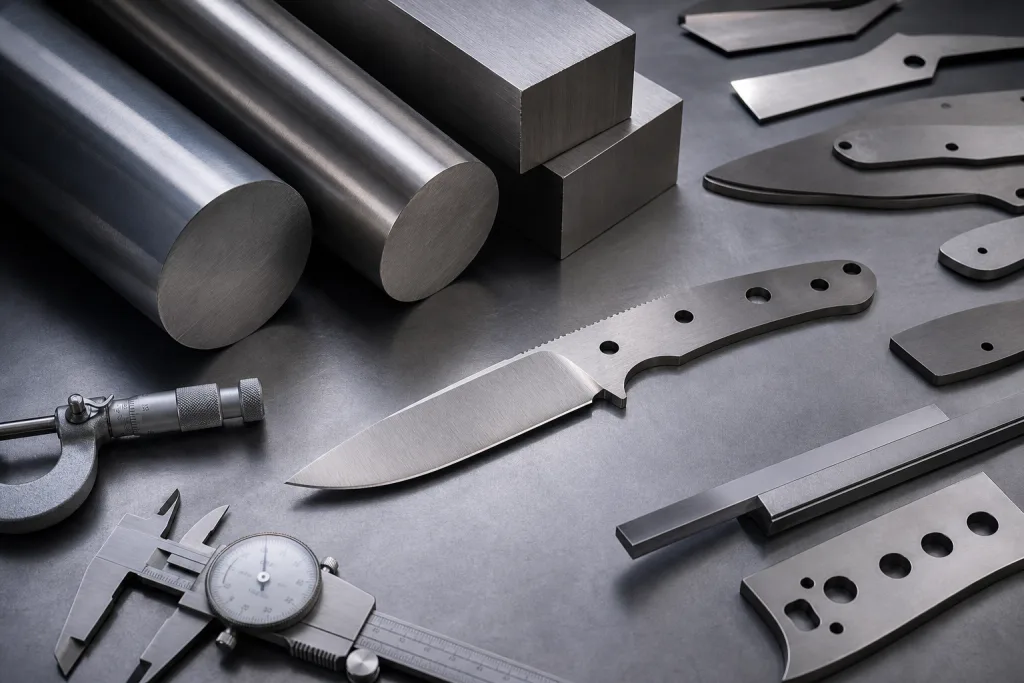
A cleaver looks simple on the bench: blade, handle, rivets, carton. Compliance is where orders get expensive. If you import into the EU, UK, US, or Canada, check food contact materials, steel claims, origin marking, retail labeling, packaging rules, and knife sales restrictions before we run the grinding line. QC once pulled a 180 mm sample with “German steel” printed on the belly, while the PO said 3Cr13; that mismatch alone can hold a shipment.
At TANGFORGE in Yangjiang, Zhejiang, China, we see the same mistake on about 7 out of 20 new cleaver projects: the buyer approves the sample first, then asks for compliance documents after mass production. Wrong order. We’ve seen this go sideways. Lock the cleaver compliance checklist before tooling, artwork, and purchase order confirmation, especially when MOQ is 600-1,000 pcs per SKU and lead time is normally 35-55 days after deposit and artwork approval. One buyer flagged FDA wording only after cartons were printed, and the math didn’t work—reprinting labels added 6 days and pushed the vessel booking.
Start With The Destination Market
Cleaver compliance starts with the selling market, not the factory address on the invoice. A cleaver for Germany, California, Ontario, or the UK can share the same 180 mm blade drawing, while the compliance file changes by market. Before asking for a quote, lock the destination country, confirm whether it goes to retail shelf or online listing, and tell us if it is a budget houseware item or a chef-grade SKU. We have seen this go sideways when a PO said “EU” on line 7 but the carton artwork was built for a US retailer.
For EU markets, food contact rules point to Framework Regulation (EC) No 1935/2004, GMP Regulation (EC) No 2023/2006, plus national requirements such as LFGB testing for Germany. The blade steel is only one part. QC also checks coatings for migration risk, handle resin or wood sealer, rivet plating, anti-rust oil residue, and any ink on sleeves that sits against the blade during shipping. For the US, FDA food contact expectations apply in most buyer files, while California Proposition 65 can change warning labels and material declarations. Canada has its own food safety and consumer product rules, and 2 of our larger retail buyers add private test sheets on top of the law.
Do not ask only, Can you pass food contact? That is the wrong question to ask. Ask which parts need testing, the exact standard, the lab name, the food simulant, and the time-temperature setup. A 950 g coated cleaver with a pakkawood handle, brass rivets, printed sleeve, and anti-rust oil needs a different review than a plain 3Cr13 stainless cleaver with a PP handle; last month QC pulled the sample after spotting oil transfer on the inner paper sleeve.
At TANGFORGE in Yangjiang, Zhejiang, China, we prefer to review the compliance route before final quotation. It stops false savings. A cheaper coating, glue, or ink can save USD 0.08 per unit and create a USD 2,000 testing or relabeling problem later; the math does not work when the grinding line has already run 3,000 blades and the buyer flags the label wording.
Food Contact Rules For Cleaver Materials
For cleavers, the blade gets the headline, but food contact rules go past steel. We map every part that can touch food, brush food in normal use, or shed something into food. That means blade steel, coating, polishing residue, anti-rust oil, handle, rivets, adhesive, sheath liner, and even printed packaging if the knife sits against it. On our line, QC pulled a sample that still had wax on the heel, and that batch had to go back through wash and wipe. This is the wrong question to ask if someone only checks the blade.
Common cleaver steels include 3Cr13, 5Cr15MoV, 7Cr17MoV, German-type 1.4116, and higher-carbon grades tied to the price point. Typical hardness bands are 52-56 HRC for economy stainless cleavers, 56-58 HRC for mid-range chef-style cleavers, and 58-60 HRC for selected premium SKUs. We run hardness checks at the grinding line with a Rockwell tester, and a 2 HRC swing is enough to trigger a buyer complaint. Hardness is a performance claim, not a food contact certificate, but a bad HRC number still turns into a labeling fight.
Carbon steel cleavers need tighter control. They can be food-safe, but only if you manage anti-rust treatment, user instructions, and rust expectations from the start. If the carton says low-maintenance stainless and the blade is reactive carbon steel, the buyer flagged it before we even shipped sample carton no. 3. That is not just a return risk; the math does not work because it becomes a misleading claim. Damascus cleavers need plain material declarations too, since pattern welding does not give food-contact approval by itself.
For handles, PP, ABS, TPR, POM, pakkawood, G10, stainless, and wood each come with different paper trails. Natural wood only needs FSC claims if you actually print that claim, but some retailers still ask for migration or extractives data. Pakkawood and resin-stabilized handles should be checked for formaldehyde, heavy metals, and restricted substances when the market asks for it. If you import into the EU, REACH and food contact are separate checks; we have seen this go sideways when a buyer assumed one report covered both. A PO typo on the handle code can also send the whole file back for correction.
Testing Documents Buyers Should Request
A compliance file only works when it matches the knife on the line. A three-year-old report for a different cleaver does nothing for customs or a retailer audit. Before you import, ask for tests tied to the exact SKU: same blade steel, same finish or coating, same handle compound, same adhesive, same packaging contact condition. We have seen the buyer flag a report because the handle resin changed from PP to TPR at the sample stage. That kind of miss costs time.
The report should list the applicant, manufacturer or supplier, sample description, model reference, material description, test standard, test method, result, issue date, and lab accreditation. For higher-risk retail programs, buyers usually ask for SGS, Intertek, TUV, BV, or another recognized third-party lab. If the retailer gives an approved lab list, send it to the factory before sampling. On our side, QC pulled the sample and the paperwork still failed because the lab name was not on the buyer's list. Re-testing for that reason is a wasted week.
Below is a practical sourcing view, not legal advice. Your importer of record or compliance consultant should confirm the final test plan. We run this check against the packing list and the PO, because one typo in the importer address has already held a shipment in our forwarder office.
| Market | Common check | Typical lead time | Buyer note |
|---|---|---|---|
| EU | EC 1935/2004, LFGB, REACH where relevant | 7-12 working days | Match report to exact materials |
| US | FDA food contact, Prop 65 if California exposure | 5-10 working days | Check warning need before artwork |
| UK | UK food contact rules, REACH-style checks | 7-12 working days | Importer address must be correct |
| Canada | Food safety and bilingual label review | 5-10 working days | English/French may affect packaging |
Also ask for the bill of materials and the controlled material list. You do not need a 40-page engineering file for a standard order, but you do need enough proof that the tested sample is the same as mass production. At TANGFORGE, we lock materials at order review because our monthly capacity of about 300,000 knives means nothing if a shipment fails over an unapproved handle resin. The grinding line can turn out product all day, but the paperwork has to hold up first.
Knife Labeling That Avoids Customs Delays
Knife labeling is where 7 out of 10 otherwise clean cleaver orders start to drag. Compliance teams chase lab reports, while the warehouse clerk and customs broker look first at labels, cartons, barcodes, and declarations. We have shipped cleavers that passed food contact testing, then sat 12 days instead of the booked 5 because the origin mark on the blade did not match the packing list. Small miss. Big delay.
At minimum, check the blade mark, handle mark if used, retail box, insert card, master carton, shipping mark, and online listing copy. Origin marking must match the commercial invoice, packing list, product, and packaging. If your market requires Made in China marking, do not cover it with a weak paper sticker; we have seen those lift after 18 days in sea freight, especially on matte gift boxes. If your brand wants a cleaner premium look, discuss etched origin marks at 0.15 mm depth, back-label placement, or carton-only rules with your customs adviser before we run mass production.
Common label fields include brand and product name, model or SKU with material description, country of origin, importer or responsible person address, barcode or FNSKU, batch or PO number, care instructions, age warning where needed, sharp blade warning, and recycling marks. For Amazon programs, FNSKU and carton labels must scan cleanly; QC pulled one sample last month where the barcode failed because the supplier printed it 22 mm wide instead of the required 38 mm. For retail chains, carton side marks usually need PO number, item number, case pack, gross weight, net weight, carton size, and destination DC code.
Be careful with material and performance claims. If the box says German steel, VG10 core, hand forged, dishwasher safe, non-stick, antibacterial, or 60 HRC, you need backup. The wrong question is “Will customs notice?” The better question is whether the buyer, retailer, or lab can ask for proof after the PO is placed. We have seen this go sideways over one typo: “VG-10” on the artwork, but “5Cr15MoV” on the approved spec sheet from the grinding line.
Safety, Age, And Sales Restrictions
Cleavers are kitchen tools, but a customs desk still sees a wide sharp blade first. Before we quote a launch market, we check consumer product safety rules and local knife sales limits against the buyer’s channel. On 4 of the last 10 new cleaver programs we handled, the platform asked for extra image review because the blade looked too aggressive at 180 mm. QC pulled one sample last month and the carton label said “camp knife,” which was enough to slow the broker.
Product design changes the answer. A 180 mm vegetable cleaver with a rounded spine and a white food-use sleeve is not the same item as a black-coated 220 mm heavy cleaver shown beside firewood. We run spine radius checks with an R gauge on the grinding line, because a sharp back edge makes the product feel less like kitchenware during review. If the channel is supermarkets or kitchenware distributors, keep the copy on food preparation. Do not use combat, tactical, weapon, self-defense, or survival language unless the channel is actually outdoor or tactical and the local rule has been checked. We’ve seen this go sideways.
Packaging needs a sharp blade warning. Most of our EU retail buyers now ask for “keep out of reach of children” and “remove protective packaging carefully”; 8 out of 12 recent cleaver POs had that wording typed into the artwork notes. For some markets or retailers, age 18+ sale controls still apply even when the product is a kitchen knife. In the UK and parts of Europe, online knife sales can face strict delivery checks and age verification. In the US, rules change by state and platform policy, so one national answer does not cover every channel. One buyer flagged a PO typo where “kitchen cleaver” became “knife weapon set.” Fix it before print.
Physical safety is part of compliance too. Edge protection should stay on after a carton shake test, and tip protection needs enough clearance so the blade cannot punch through the tray. We check sheath fit by pulling the guard on and off 20 times at the packing table. A cleaver that cuts through its retail box during transit can create a warehouse injury claim and a retailer chargeback. For heavy cleavers over 350 g, we normally recommend a fitted blade guard or locked pulp tray plus 5-ply export carton for bulk retail shipments from China. The math does not work if the buyer saves USD 0.08 on packing and then gets one pallet rejected.
Factory Controls Behind Export Compliance
Export compliance is not paperwork we print after the carton is sealed. It starts at material purchasing and stays on the line through production, inspection, and packing. If a supplier cannot lock the steel grade, heat-treatment recipe, handle resin, logo method, and carton artwork revision, the file looks clean but the shipment is exposed. We have seen this go sideways over one PO typo: “5Cr15” written on the order while the approved sample card said “5Cr15MoV.” Audit the process enough to see where a substitution can slip in.
For cleavers, we run control at incoming steel verification, blanking, heat treatment, hardness testing, grinding, polishing, handle assembly, cleaning, anti-rust treatment, laser engraving or stamping, final inspection, and packing. The grinding line cannot guess hardness from steel name. A 5Cr15MoV cleaver specified at 56-58 HRC needs recorded HRC readings from production lots, taken with the Rockwell tester after heat treatment and before mass sharpening. Edge angle, blade thickness in mm, and weight tolerance also need written limits because they drive safety and complaint rates. Small numbers matter.
Quality inspection has to cover function and compliance details in the same pass. At TANGFORGE, a typical export inspection plan may use AQL 1.5 for critical defects, AQL 2.5 for major defects, and AQL 4.0 for minor defects, depending on buyer requirements. Critical defects include unsafe loose handles, cracked blades, severe contamination, wrong product, or exposed sharp edges outside protection. Major defects include wrong label, wrong barcode, incorrect country of origin, failed sheath retention, visible rust, or hardness outside agreed band. Last month QC pulled a sample where the barcode scanned right, but the color box still showed the old COO line.
Ask whether the factory has ISO 9001, BSCI, Sedex, or retailer audit experience if your channel needs it. These audits do not replace product testing, but they show whether the supplier understands controlled production. A small trial order can still fail if the factory treats compliance as a document request instead of a production discipline. This is the wrong question to ask: “Can you provide the certificate?” Ask who controls the approved sample, the packing BOM, and the 2 mm blade-thickness tolerance before we ship.
Pre-Shipment Checklist For New Markets
Before your first cleaver shipment leaves China, run a pre-shipment compliance check on documents, labels, product inspection, and logistics data. Do not hand this to the forwarder. Freight companies move cartons; they do not check food contact rules, knife labeling, or market claims. On our side, QC pulled the sample off the grinding line and matched it against the golden sample before anyone booked space.
Your checklist should cover approved artwork, final bill of materials, food contact reports, REACH or restricted substance reports where needed, Prop 65 review if selling into California, importer address check, barcode verification, carton mark approval, commercial invoice description, HS code review, and photo records of packed goods. For most kitchen cleavers, buyers talk about HS code 8211 categories, but your customs broker should confirm the final classification from the exact product and set build. We have seen a PO typo turn an address check into a 3-day delay.
Inspection should compare the golden sample to mass production. Measure blade length, blade thickness, total length, net weight, handle fit, HRC band, logo placement, edge sharpness, packaging contents, and labeling. If you use CATRA sharpness testing for premium programs, set that requirement at quotation stage because not every factory lab runs the same machine. For normal OEM orders, a practical sharpness cut test and edge visual check usually do the job, but the acceptance standard must be written. The buyer flagged a 0.5 mm handle gap once; the math did not work, and we stopped the line.
Keep a shipment file for the period your market or retailer expects. Put the PO, invoice, packing list, test reports, inspection report, production photos, artwork approvals, and material declarations in one folder. When customs, a retailer, or a marketplace asks a question six months later, a clean file saves hours. Compliance is not glamorous. It is cheaper than blocked inventory, relabeling, or customer returns. We ship with a physical sample card and a signed carton photo sheet for a reason.
Frequently asked questions
Ask for a final bill of materials, food contact test reports, restricted substance reports where relevant, material declarations, artwork approvals, and a pre-shipment inspection report. For EU orders, check EC 1935/2004, LFGB where required, and REACH depending on materials. For US orders, review FDA food contact expectations and Prop 65 if selling into California. The report should match the exact blade steel, handle material, coating, adhesive, and packaging contact condition. A report for a different knife with a different handle is not enough. For first orders, request these files before deposit or at least before mass production starts.
No. Stainless steel is commonly suitable for food contact, but compliance depends on grade, finish, coating, contamination control, and the test standard used. A plain 5Cr15MoV blade may be straightforward, while a black-coated cleaver or decorative Damascus blade needs closer review. The handle, adhesive, rivets, anti-rust oil, and packaging can also matter. For EU or LFGB testing, labs may check migration or extractable metals under specific conditions. For the US, FDA expectations and retailer requirements may differ. Treat stainless steel as a good starting point, not automatic approval.
The most common mistakes are wrong country of origin, missing importer address, incorrect barcode, mismatched SKU, unsupported steel claims, and inconsistent carton marks. For example, if the invoice says 5Cr15MoV cleaver, the box says German stainless steel, and the test report says 3Cr13 knife, your compliance file looks weak. Retailers may also reject cartons if PO number, case pack, gross weight, FNSKU, or destination labels are wrong. We recommend checking label artwork before printing and again during final inspection under AQL 2.5 for major label defects.
For a new cleaver SKU, start testing after the final production materials are confirmed, not after shipment is booked. Typical third-party testing takes 5-12 working days depending on market and scope, but failures, lab queues, or retailer reviews can add 2-4 weeks. If your MOQ is 1,000 pcs and production lead time is 35-55 days, you should lock the test plan during sampling. Do not test a prototype handle resin and then switch to a cheaper resin for mass production. That breaks the link between the report and the goods.
One core file can support multiple markets, but it usually needs market-specific additions. The bill of materials, inspection report, and factory declarations can be shared. Food contact testing, label language, importer address, Prop 65 review, UK responsible party details, bilingual Canadian packaging, and retailer requirements may differ. If you plan to sell the same cleaver across four markets, tell the factory at quotation stage. It is easier to design one compliant packaging system early than to create four emergency sticker sets after 5,000 units are packed.
Send Your Cleaver Compliance Checklist
Share your target market, SKU list, materials, and retail channel. We will review the factory-side documents, labeling points, and production controls before quotation.
Request a Quote