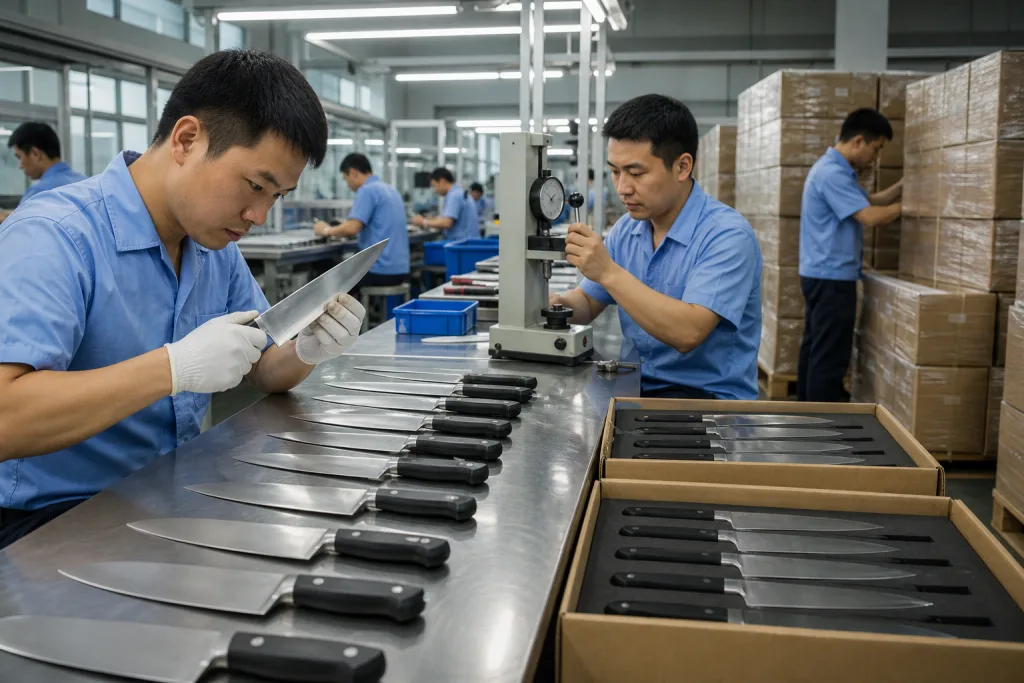
Cleaver knives look clean in product photos. Bulk QC is where the mess shows. For one 180 mm cleaver with a 2.5 mm spine, full tang handle, gift box, FNSKU label, and Amazon-ready carton, we run 9 checks before the goods leave China. Last month, QC pulled a sample with a 0.4 mm handle gap after the grinding line had already signed the batch card. That gap fails fast when the buyer checks it with a 0.02 mm digital caliper.
If you sell on Amazon or run a DTC cutlery brand, a nice PDF is the wrong thing to trust. You need a checklist the factory can run beside the belt: calipers on the blade spine, carton drop notes on the packing table, AQL records signed before loading. At TANGFORGE in Yangjiang, Zhejiang, China, we run cleaver knife bulk order quality control during production, not as a final-day argument. Our normal OEM MOQ starts from 500 pcs per SKU, lead time is 35-55 days after sample approval, and inspection points sit inside each stage. We have seen this go sideways: one buyer flagged a PO typo where “matte box” became “black box.” Two words. Rework on 38 cartons.
Define the cleaver before QC starts
Cleaver knife bulk order QC often fails before the first steel strip hits the shear. A buyer sends one photo, the supplier quotes in 20 minutes, and nobody fixes tolerance. Then 1,000 pcs arrive with a blade 35 g over target, a handle that goes wine-red after polishing, or a color box missing the Amazon FNSKU at 38 mm × 19 mm. Too late. Heat treatment is finished, the grinding line has passed it, and final packing is already stacked 8 cartons high. Rework takes 18 days instead of the planned 12 days. The math doesn't work.
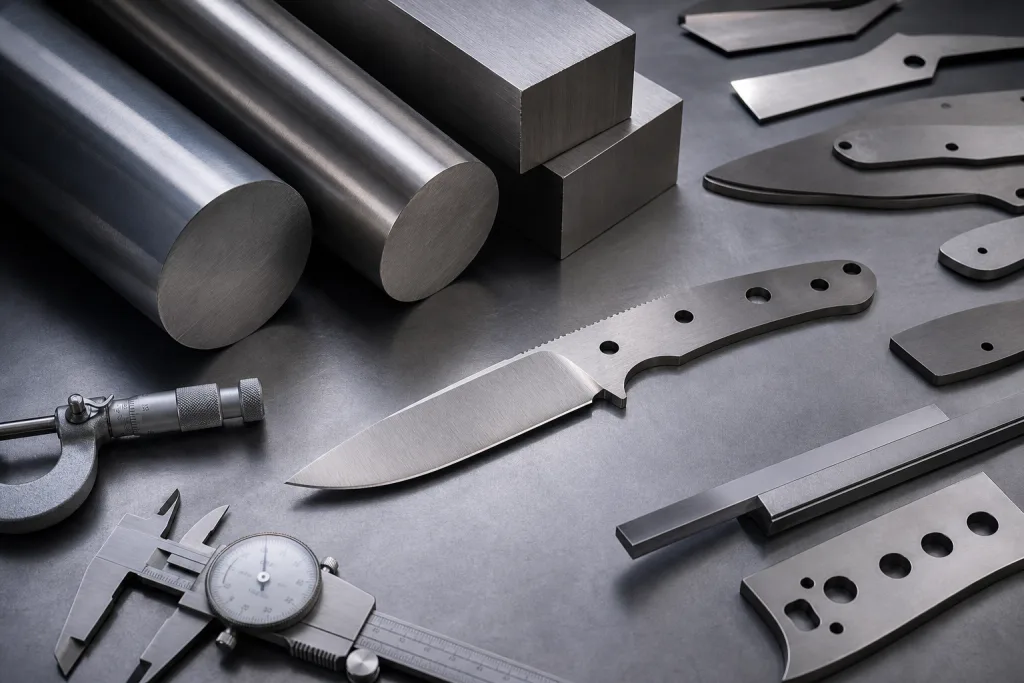
For a custom cleaver knife, put a technical spec sheet behind the purchase order. Write the numbers: total length, blade length, blade height, spine thickness, blade steel, target HRC, surface finish, edge angle, handle material, rivet material, logo method, packaging, carton marks, inspection standard. Better yet, add tolerances such as blade height ±1.5 mm, spine thickness ±0.2 mm, and weight ±15 g. Do not leave “same as photo” on the PO. We have seen one buyer type 180 mm in the email and 185 mm on the PO; QC pulled the sample only after 600 pcs were already ground. Painful lesson. If you sell through a DTC product page, lock the exact knife weight too, because customers complain fast when a listed 350 g cleaver lands at 410 g.
A Chinese vegetable cleaver for home cooks may run 175-180 mm long, 80-90 mm tall, 2.0-2.5 mm at the spine, and 310-390 g. A meat cleaver is a different tool: 4.0-6.0 mm spine, 600-900 g weight, with a thicker primary grind on the belt sander. If you ask a cleaver knife supplier for a “heavy duty cleaver” without numbers, this is the wrong question to ask. The factory will choose from its current mold, steel stock, and whatever grinding habit that shift is running that week.
At TANGFORGE in Yangjiang, China, we freeze a golden sample before mass production. This approved sample controls blade geometry, handle color, logo depth, packaging fit, and hand feel. We run digital calipers on blade height, check spine thickness in mm, and compare the handle under the same LED light used at packing inspection. For Amazon and DTC sellers, we suggest two sealed samples: one kept by you, one kept by the factory QC team. When the buyer flags a dispute, both sides compare against the same reference, not a phone photo from three weeks ago.
Set inspection levels and defect rules
For a cleaver knife wholesale order, write the defect rules before we run production. “Good quality” means nothing at the QC table. AQL gives the buyer, the cleaver knife manufacturer, and the third-party inspector the same pass/fail numbers. For 8-inch mid-range cleaver orders, we usually set AQL 0 for critical defects, AQL 2.5 for major defects, and AQL 4.0 for minor defects. Put it on the PO, not just in WeChat or email. Last quarter one PO had “AQL 2.5” typed only in the email thread, not on the signed order; QC at the packing table stopped 37 cartons until the buyer confirmed the rule.
Critical defects are safety or legal failures. Think loose blade, cracked handle, exposed sharp point through packaging, wrong steel declaration, missing country-of-origin mark when required, or packaging that breaks Amazon FBA rules. Major defects hurt cutting use or bring customer complaints: warped blade over 1.5 mm, poor edge sharpness, wrong HRC, handle gap over 0.3 mm, deep grinding-line scratches, loose box insert, or unreadable barcode. Minor defects stay cosmetic: tiny polishing marks, slight color shift in natural wood, small carton scuffs. QC pulled the sample last month, scanned 12 barcodes, and found 2 labels with weak print. That is a major defect. No debate.
Do not call every small issue a major defect unless your retail price supports that level. The math does not work. A $19.99 promotional cleaver cannot be checked like a $99 gift-set product with mirror polish and walnut handle. Define the complaints your customers actually send back, then tighten those points. For Amazon sellers, sharpness and handle security come first; rust resistance, barcode accuracy, and packaging protection usually beat a 6 mm polishing line near the spine. We have seen this go sideways: one buyer rejected 1,000 pcs for minor sanding marks but missed 18 cartons with loose inserts, and the insert failed a simple shake test on the packing bench.
| Order size | Suggested sample size | Major AQL | Minor AQL | Typical use |
|---|---|---|---|---|
| 500 pcs | 50 pcs | 2.5 | 4.0 | New SKU trial order |
| 1,000 pcs | 80 pcs | 2.5 | 4.0 | Amazon launch batch |
| 3,000 pcs | 125 pcs | 2.5 | 4.0 | DTC replenishment |
| 10,000 pcs | 200 pcs | 1.5 or 2.5 | 4.0 | Retail or distributor program |
Ask your inspector to sample under ANSI/ASQ Z1.4 or ISO 2859-1. Send 8 to 12 photos of acceptable and rejected defects before production starts. A cleaver is a hand-feel item, so photos matter. Written tolerances plus defect photos cut down arguments when the inspector is standing beside 200 open cartons with a 0.01 mm caliper, barcode scanner, and edge tester on the table.
Check steel, hardness, and heat treatment
Steel choice sets landed cost, edge life, rust claims, and the review score you see after 90 days. For cleaver knife bulk order quality control, asking only for a steel name is the wrong question. Ask for the confirmed steel grade, the mill certificate if the mill issued one, the heat-treatment target range, and the hardness test method. On our grinding line, QC checks HRC with a Rockwell tester before polishing; a cleaver knife factory should show in-process HRC records, not one tidy PDF made after 24 cartons are already strapped with PP banding.
Common stainless cleaver steels start with 3Cr13 for price orders, then move to 5Cr15MoV or 7Cr17MoV for mid-range retail, 8Cr13MoV or 9Cr18MoV for better edge holding, and AUS-10 or VG-10 laminated blades when the shelf price can carry it. Carbon steel cleavers may use 65Mn, 1095, or similar grades, but they need clear care cards because rust complaints jump fast when the end user expects stainless behavior. We had one buyer flag brown spots after a 72-hour salt-spray style misuse test in their office sink. For Amazon and DTC, stainless is the safer call unless your brand sells straight to knife enthusiasts.
Hardness has to match the job. A thin vegetable cleaver in 7Cr17MoV might run 56-58 HRC, measured near the spine before final edge grinding. A high-carbon slicing cleaver can be 58-60 HRC. A heavy bone chopper should not be chased too hard; toughness beats a shiny HRC number on the spec sheet. If you request 60 HRC on a 3.5 mm chopping cleaver and customers hit frozen meat, the math doesn't work. Your return rate will prove it.
At TANGFORGE, typical kitchen cleaver HRC control stays within a 2-point band, such as 56-58 HRC, checked before final grinding. We use batch records because heat treatment variation across a furnace load can create mixed performance, even when every blade looks the same on the packing table. For a 1,000 pc order, request hardness checks from at least 5-10 pieces across different cartons or production lots; QC pulled the sample from carton 3 only is not enough. If the factory refuses HRC testing, walk carefully.
Check decarburization and brittle edges after heat treatment, then check blade straightness on a flat plate with a 0.2 mm feeler gauge. A warped blade may look fine in a phone photo, but it rocks on a cutting board. We've seen this go sideways. The buyer approved photos, then rejected 300 pcs after their inspector found tips drifting left by 1.5 mm.
Inspect grinding, edge, and sharpness
Cleaver performance starts with geometry. We run the same 5Cr15MoV blank at 56-58 HRC and still get two different knives if the grinding line leaves 0.35 mm behind the edge on Monday, then 0.55 mm on Friday. Same steel. Different cut. For bulk order QC, this check belongs beside the belt grinder with a Mitutoyo micrometer in hand, then it needs to pass again when SGS or your own inspector opens cartons at AQL 2.5.
Use a 6000K inspection lamp before anyone argues about sharpness. The cutting edge should run clean from heel to tip: no chips, no rolled sections, no flat shiny spots, no blue heat marks from the wheel. No burr catching a cotton swab. The bevel should stay even unless your drawing calls out a grind change near the tip. For a vegetable cleaver, we usually run 15-18 degree angle per side. For heavier chopping, 20-25 degrees per side gives more safety margin. If your product page says “razor sharp,” the sample has to prove it; QC pulled 8 pieces for one buyer last season, and all 8 tore A4 paper instead of slicing it.
Sharpness checks should be repeatable, not fancy. CATRA testing works for development and benchmark comparison, but the math doesn't work for every production batch of 3,000 pcs unless the buyer budgets it before PI approval. On routine QC, we run controlled paper slicing with the same 80 gsm sheet, tomato skin cutting on 2 sample units per carton pull, then burr inspection under side light at the packing table. For higher-price programs, request BESS testing on sample units, for example requiring a median score under 250 for kitchen cleavers. Confirm it before quoting because it adds process control, operator time, and cost.
New buyers often miss thickness behind the edge. “Is the cleaver sharp?” is the wrong question to ask. Ask what the micrometer reads 1 mm above the edge after final polishing. A cleaver at 0.6 mm behind the edge feels strong but wedges badly in carrots. A cleaver at 0.2 mm cuts cleanly but can chip if the listing shows bone chopping. Define the use case honestly. If you want one SKU for vegetables and bones, expect compromise, return claims, and at least 12 days of sample tuning instead of the usual 7.
Check spine and choil finishing too. DTC customers pinch-grip a Chinese-style cleaver, and one sharp spine corner can create a bad review even when the main edge passes every cut test. We had a PO typo once that said “mirror polish spine” but missed “deburred choil”; the buyer flagged 42 pcs during incoming inspection. Specify the finish in plain inspection language, such as “spine edges lightly eased, no sharp burrs,” then put the same wording on the QC checklist.
Control handle fit and user safety
The handle is where weak QC shows first. Buyers almost never write “steel chemistry” on a return form. They send close-up photos: a proud rivet, a 0.5 mm bolster gap, a split wooden scale, or a grip that gets slick after one sink wash. On a cleaver, the complaint comes faster because a 180-220 mm wide blade puts more load into the handle during chopping. We have seen this go sideways on repeat orders: QC pulled the sample under the bench lamp, the blade passed, but the buyer flagged two raised rivets in a 20-piece pre-shipment check.
For full tang cleavers, check scale alignment against the tang line and measure rivet height with a 0.05 mm feeler gauge. Check epoxy fill on both sides, exposed tang burrs, and the radius on the handle edges. Our working tolerance is no open gap over 0.3 mm between scale and tang, rivets flush within 0.1-0.2 mm, and no sharp handle corners. Simple rule. If the operator on the grinding line leaves a square edge near the rear pin, the knife feels cheap even when the blade is 58 HRC and polished well. For pakkawood, G10, PP, TPR, walnut, or micarta handles, approve a color board and one texture sample before mass production; natural wood can shift by 2-3 shades, while molded plastic should stay close from carton 1 to carton 500.
For traditional wooden handle cleavers with a hidden tang or inserted tang, pull strength and crack inspection matter more than cosmetic shine. The handle must not rotate, rattle, or separate during normal use. We run a basic pull check on sample lots with a fixed clamp, and if the ferrule moves after the first pull, the math does not work for export. If your cleaver knife supplier uses wood that is not dried to the right level, shrinkage can show up after 28-35 days of ocean freight plus warehouse storage. Ask for moisture control, especially for North America and Europe where indoor humidity drops in winter; last season one buyer pushed back after 3 handles cracked near the ferrule in a 120-piece incoming inspection.
Safety tests should stay simple and repeatable. A handle torque check and packed-unit drop check catch most handle problems before we ship. For dishwasher-safe claims, add visual inspection after dishwasher simulation plus a wet-hand grip check with a soap-water wipe. Be careful with dishwasher claims. This is the wrong place to oversell. About 8 out of 10 wood, pakkawood, and Damascus handle SKUs should not be sold as dishwasher safe. If your marketplace listing promises too much, QC cannot save the review score. We had a PO typo list “dishwasher safe” on a walnut handle SKU; the buyer caught it at artwork approval, which saved 3,000 printed sleeves from the scrap bin.
For compliance, handle materials and coatings need REACH, LFGB, or FDA food-contact documentation depending on market and construction. A cleaver knife manufacturer in China should confirm which documents are ready before you print packaging claims. Do this before deposit, not during final inspection. We usually match the test report name, material code, and SKU on the spec sheet line by line because one wrong resin code on a PP handle can hold a shipment for 7-10 days.
Verify branding, packaging, and FBA labels
Amazon and DTC sellers lose margin when the cleaver passes blade QC but the box gets stopped at receiving. We check packaging like we check edge angle and handle fit: same checklist, same signoff sheet, same red pen on the packing table. A cleaver knife wholesale order can carry 1 laser logo file, 1 color box, gift box, sheath, blade guard, insert card, barcode, FNSKU, suffocation warning, carton label, and pallet spec. Miss one line on the packing sheet and you get a receiving hold or a 1-star photo review with the blade poking through the carton. Last month QC pulled a sample where the carton label showed 24 pcs but the PO said 36 pcs.
Laser logos need checks for position, size, darkness, spelling, and batch match. Use a caliper. We run the first 5 blades against the approved drawing before the grinding line continues. On a brushed blade, a 0.18 mm deep dark mark looks clean. On mirror polish, the same laser power can burn the surface or leave a cloudy edge around the logo. Etching and stamping have their own limits, so do not approve from a phone photo. Keep logo artwork in vector format, usually AI, PDF, or SVG, and confirm dimensions in mm. “Make it like the picture” is the wrong instruction because the grinding line cannot measure that.
Packaging has one job first: protect the cutting edge. The blade should not rattle in the box. Cleavers are heavy, and the wide blade hits the insert harder in transit, so thin paper trays fail after 2 or 3 drops. For DTC shipments, we run a blade guard with molded pulp, EVA, or a tight cardboard insert based on MOQ and target cost. If you ship direct to Amazon FBA, test the packed unit with a simple 60-80 cm drop check on corners and edges. A stronger insert costs less than returns from cut boxes and exposed blades. The math is not close.
Barcode QC is basic, but factories and buyers still miss it. Scan every printed code during pilot packing, then sample scan during mass packing, for example 32 units per SKU under AQL 2.5. FNSKU labels should sit flat, scan in one pass, and match your fulfillment plan. If the product carries both a retail UPC and FNSKU, cover or remove the code Amazon should not scan. Master carton labels should match SKU, quantity, carton number, gross weight, net weight, and country of origin. We have seen a shipment delayed because one label had “Made in Chian” on the print file. The buyer flagged it in 10 minutes.
In Zhejiang and Yangjiang export production, we see 8 out of 10 small brands spend two weeks approving blade finish and only one day checking packaging. That is the wrong question to ask. Packaging is product experience and logistics compliance. QC should open real cartons with a cutter knife before the container booking is locked, not after the forwarder has already sent the SI cutoff. We ship enough cartons to know this goes sideways fast.
Use staged inspection before balance payment
A final inspection after 100% packing has value, but using it as the only gate before balance payment asks the wrong question. For cleaver knife bulk order quality control, we run staged checks: incoming blade stock measured with 0-150 mm digital calipers, first-piece approval against the golden sample, in-line checks beside the grinding line, then packing inspection before shipment booking. Catch the issue while the handle epoxy is still wet. Once 20 cartons are sealed, rework moves from 2 hours on the bench to a half-day with carton knives and repacking tape everywhere.
Incoming checks cover steel thickness, handle material grade, rivet fit, retail boxes, inner inserts, and shipping labels against the PO. QC measures blade stock in mm, checks rivet head height with a depth gauge, and scans the printed label against the PO; last year one buyer’s PO had “693” typed as “639” in the barcode file, and the warehouse would have rejected 1,000 boxes. First-piece approval proves the line can match the golden sample before we run the batch. In-line inspection catches grinding drift, handle gap over 0.8 mm, polishing scratches near the bolster, and logo position errors before 1,000 blades are finished. Packing inspection checks the knife, box label, barcode, and SKU code as one set. Pre-shipment inspection confirms the final lot before you release balance payment.
For a 1,000 pc order, a practical setup is 100% visual check by packing workers, QC spot checks at each production stage, and a third-party or buyer-appointed inspection when at least 80% is packed and 100% is produced. Simple rule. Do not inspect only cartons. If the order is a repeat SKU with 3 clean shipments, third-party inspection can move to every 2 or 3 shipments. For a new custom cleaver knife, skipping inspection to save USD 200-350 is bad math; we have seen this go sideways when the buyer flagged a 1.5 mm handle gap after arrival, and QC pulled the retained sample from our rack the same afternoon.
Ask for a QC report with photos and measurements, not just a pass statement. The report should show sampled quantity, defect list with counts, HRC readings from the Rockwell tester, blade dimensions in mm, weight range, barcode scan result, packaging photos, carton drop notes if performed, and shipment readiness. We like reports that show the caliper screen, the Rockwell tester reading, and one clear photo of the carton mark, because those details stop arguments later. If defects exceed AQL, agree on rework scope and re-inspection method before paying the balance; “ship first, fix next order” is how small problems become debit notes.
TANGFORGE has about 240 employees and monthly knife capacity that can reach 300,000 units across kitchen, outdoor, and custom programs depending on complexity. Capacity helps. It also makes bad parts faster if the process is loose. On a busy week, we ship 40-foot containers while the grinding line is still feeding the next PO, so written limits matter: blade thickness tolerance, handle gap limit, logo position, carton mark format, and the AQL level on the PO. Whether you buy from us or another cleaver knife factory in China, insist on staged QC and written acceptance criteria.
Frequently asked questions
For most Amazon and DTC cleaver orders, use critical defects AQL 0, major defects AQL 2.5, and minor defects AQL 4.0. Critical means unsafe or illegal: loose handle, exposed blade through packaging, wrong country of origin, or missing required label. Major means the customer will likely complain or return it: poor sharpness, blade warp, wrong HRC, handle gap over 0.3 mm, unreadable barcode, or severe finish defect. Minor means small cosmetic issues that do not affect use. For premium retail cleavers above USD 50 landed cost, some buyers tighten major defects to AQL 1.5, but expect higher inspection and rework cost.
A common inspection plan under ANSI/ASQ Z1.4 general inspection level II uses around 80 samples for a 1,000 pc lot, depending on the exact standard table and chosen AQL. That does not mean the factory only checks 80 pieces. The factory should perform in-line checks and 100% visual checks during packing, then the independent inspection samples the finished lot. For a new custom cleaver knife, we suggest checking HRC on at least 5-10 pieces across different cartons or production batches, scanning barcodes from multiple cartons, and measuring blade length, thickness, weight, and handle fit on the sampled units.
It depends on use. A vegetable cleaver in 7Cr17MoV or 8Cr13MoV commonly works well at 56-58 HRC. A thinner slicing cleaver or higher carbon steel model may target 58-60 HRC. A heavy chopping cleaver for bones should often stay tougher rather than harder, because edge chipping creates returns. Do not chase a high HRC number for marketing unless the blade geometry and customer use match it. Your purchase order should state a range, not a single number, such as 56-58 HRC, and your cleaver knife manufacturer should record hardness checks before final grinding.
For a first order, new SKU, new packaging, or order above about USD 5,000, third-party inspection is worth considering. A typical pre-shipment inspection in China may cost around USD 200-350 depending on location, scope, and travel. Factory QC is necessary, but it represents the factory’s internal process. Third-party inspection gives you an independent view before balance payment. For repeat orders with stable defect history, you can inspect every second or third shipment, but keep factory in-line reports mandatory. Amazon sellers should be especially strict on barcode, FNSKU, carton label, and packaging checks because receiving errors can freeze inventory.
Ask for a proforma invoice, packing list, product specification sheet, steel information, hardness record, QC report, and packaging artwork confirmation. Depending on your market, you may also need REACH, LFGB, FDA food-contact statements, Prop 65 review, or BSCI and ISO 9001 factory documentation. For Amazon, confirm FNSKU label files, carton labels, product dimensions, carton dimensions, gross weight, and country-of-origin marking before production packing starts. If the knife uses wood, pakkawood, coating, or special surface treatment, request material declarations early. Do not wait until the container is ready in China to ask for compliance files.
Send us your cleaver QC checklist
Share your target price, drawing, packaging plan, and inspection standard. TANGFORGE can review manufacturability and quote OEM or ODM cleaver production.
Request a Quote