Restaurant-supply cleavers are work tools, not gift-box display knives. Buyers judge them by edge life, wet-hand grip, blade thickness, food-contact files, carton crush strength, and whether reorder No. 2 matches the first 12 cartons. Pick the wrong cleaver knife private label manufacturer and QC catches it fast: chipped edges after a 3 mm bone test, 0.4 mm handle gaps under the feeler gauge, satin finish drifting between SKUs. Then returns start. The pretty question is the wrong question to ask.
TANGFORGE has made knives in Yangjiang, China since 2008 for importers, distributors, and private label brands. Our Zhejiang-linked export team works with buyers who need custom cleaver knife programs written in clear specs, not “same as sample” guessing on a PO. We run cleaver MOQ from 600 pieces per model, production lead time is usually 35-55 days after sample approval, and our working hardness band for commercial cleavers is 54-58 HRC depending on steel and use case. Last month QC pulled the sample at the grinding line because the buyer flagged a 2 mm spine request; their old supplier had shipped 2.6 mm. Catch that after packing and the math doesn’t work.
Define the Cleaver Before Asking Price
A cleaver knife supplier cannot quote cleanly from “send your best cleaver price.” Wrong question. We see 4 cleaver families mixed in buyer RFQs: Chinese vegetable cleavers for cabbage and boneless pork, poultry cleavers for chicken joints, butcher cleavers for portion cuts, and heavy bone choppers for pork ribs or marrow bone. In catalog photos they all look like a rectangle with a handle. On the grinding line, the difference shows up fast: 2.0 mm spine versus 6.0 mm spine, 15 degree edge versus 28 degree edge, narrow primary bevel versus thick chopping bevel, plus target HRC that matches the job. Last month our caliper check caught a sample marked “Chinese cleaver” at 5.8 mm spine. That was not a slicer.
For a private label program, start with the work on the board. A Chinese chef cleaver for vegetables and boneless protein can use a thinner blade, usually 1.8-2.5 mm at the spine, with a broad flat profile and a fine edge. A meat cleaver for poultry joints needs more mass, often 3.0-4.5 mm thick, with a stronger edge angle. A bone chopper may run 5.0-7.0 mm thick and should not be sold as a fine slicing cleaver. We had one PO call the item “slicer” while the drawing showed 6.0 mm at the spine; QC pulled the sample before packing because the math did not work. Short version: name it correctly. If your catalog wording is wrong, your end customer will use the knife incorrectly and blame your brand.
At TANGFORGE in Yangjiang, China, we ask buyers to lock 5 numbers before decoration talk starts: overall length in mm, blade length in inches or mm, blade thickness at spine, target weight, and hardness. For example, a 7 inch Chinese cleaver at 360-430 g behaves differently from an 8 inch heavy chopper at 650-850 g. Big difference. A buyer may like the heavier feel in hand, but a 220 g weight jump across 3,000 pcs adds about 660 kg before inner boxes and master cartons. That changes carton gross weight, freight brackets, and repeat-order complaints. We run the first weight check on a 0.1 g bench scale, then confirm again after handle assembly because rivets and pakkawood moisture move the number.
You should also decide if the product is for open stock, a restaurant starter kit, or cleaver knife wholesale replacement volume. Open stock needs tougher color box board and tighter finish consistency because shelf returns hurt; QC will catch small scratches near the logo, but retail customers catch them faster. Kit items can accept a simpler satin finish from the belt grinder, but carton labels, EAN barcodes, and “left/right logo position” on the PO need clean control. We have seen this go sideways over one digit in a barcode. One buyer flagged a “690” prefix typo after 18 master cartons were sealed, so we had to reopen and relabel at the packing table. The specification drives the price. The logo comes later.
MOQ, Pricing, and Lead Time Reality
Restaurant supply distributors ask for low MOQ because they want to test shelf pull before cash sits in slow stock. Fair point. We hear it every week; last month one buyer typed “300 pcs too heavy” in the PO remark box for a first cleaver run. Private label still takes setup work: blade fixture adjustment on the grinding line, handle mold color trial, laser logo file check, color box artwork, barcode label layout, plus export carton marks with the importer address. We can run a trial. Below 300 pieces for full customization, the line usually loses money because 2 operators still stop for 1 fixture change and QC still opens the same inspection sheet.
For TANGFORGE, a standard private label cleaver MOQ is 600 pieces per model when we run existing blade and handle structures. If the order needs a new handle mold, special blade profile, or unique packaging insert, 1,200-3,000 pieces is the number I would quote without pretending. Our monthly knife capacity is about 300,000 units across kitchen knives, outdoor fixed blades, pocket folders, plus Damascus programs, but capacity does not erase machine changeover cost. The math doesn't work when we reset a fixture for 180 pcs and QC still checks spine thickness, edge angle on the gauge, and handle fit with the same 0.02 mm caliper routine.
| Program type | Typical MOQ | FOB China range | Lead time after approval |
|---|---|---|---|
| Existing cleaver with laser logo | 300-600 pcs | USD 3.20-6.80 | 30-40 days |
| Private label cleaver with custom handle color | 600-1,200 pcs | USD 4.50-9.20 | 35-50 days |
| Custom cleaver knife with new profile | 1,200-3,000 pcs | USD 6.80-12.50 | 45-65 days |
| Gift-boxed or set program | 1,000-3,000 sets | Depends on box and accessories | 50-70 days |
Sample timing is normally 7-15 days with existing tooling, or 20-30 days for a new profile. Do not approve mass production from a catalog photo. Bad idea. Ask for weight, blade thickness, HRC, handle material, logo position, carton dimensions, and packed gross weight; if the supplier cannot send a spec sheet with mm and grams, push back. QC pulled one cleaver sample at 428 g against a PO that said 450 g, and the buyer caught it before carton printing. For distributors, packed data changes pallet count and landed cost; 3 out of 10 new buyers underestimate this on their first container.
FOB is the cleanest term for most importers. DDP fits some smaller distributors, but it hides duty, brokerage, and freight assumptions inside one neat number. If you ask a cleaver knife manufacturer for DDP, require the HS code, duty rate used, delivery zip code, and a clear note on whether customs clearance runs under your company or the forwarder’s account. We have seen this go sideways from one PO typo in the delivery zip code; the forwarder rebilled the buyer after dispatch.
Steel and Hardness for Restaurant Use
Start with the kitchen shift, not the steel chart. Restaurant supply buyers are buying for line cooks who split poultry backs, slap the blade through ribs, and scrape poly boards between tickets. At 9 p.m., somebody will hit a half-thawed chicken whether the manual allows it or not. A cleaver run too hard chips at the heel. Last month QC pulled 12 samples after the buyer flagged 0.6 mm corner chips from a frozen chicken test on a 180 mm blade. Too soft is no gift either. The edge rolls. The sharpener gets blamed, and the reorder sits in purchasing for 18 days instead of the normal 12. For most commercial cleavers, we run 54-58 HRC.
For entry-level wholesale programs, 3Cr13 or 420J2 stainless works when the FOB price is tight and the carton copy says light-duty use. We normally hold these steels at 52-55 HRC, checked after heat treat on the Rockwell tester before the grinding line starts. For better restaurant supply ranges, 5Cr15MoV or 7Cr17MoV gives cleaner edge life and better rust resistance without blowing up the target cost. These often run 55-58 HRC. Carbon steel cleavers cut well, but the buyer has to accept drying and oiling instructions on the insert card. Skip that sentence, and rust returns become your distributor problem after 30 days in humid kitchens. We have seen 48 pieces come back with orange spots near the handle rivets because the insert card was “cleaned up” by marketing.
Damascus patterns sell in retail photos. They are not my first pick for restaurant supply distributors. Pattern-welded or Damascus-clad cleavers cost more, need clearer care instructions, and make institutional buyers nervous when they only want 24 pieces per carton with the same grind every time. If your customer base is independent chefs and specialty stores, it can work. If you sell cafeteria and hotel replacement volume, a satin stainless cleaver with stable grinding is safer. We have seen this go sideways when a PO said “Damaskus” and the buyer expected a low-cost printed pattern; the sample room made real cladding, and the unit cost jumped by USD 1.85.
Ask your cleaver knife factory to state hardness tolerance, not one pretty number. A useful spec is 56±2 HRC, checked by Rockwell tester on each production batch, with the test mark kept off the logo face. For heavy bone choppers, we may keep hardness lower on purpose and make the edge geometry stronger, for example a thicker 0.8-1.0 mm edge before final sharpening. QC should measure that with a digital caliper before buffing, because the buffing wheel can hide a weak edge until the first bone test. A 60 HRC bone cleaver sounds premium on a sales sheet, but this is the wrong number to chase for real kitchens. The math does not work. It becomes a chipping claim waiting to happen.
Handle, Balance, and Safety Details
The handle is often the first part to fail on a low-cost private label cleaver. We had PP handles loosen after 90 days in restaurant supply accounts; a light blade scratch would have passed, but a loose scale killed the repeat order. Real use is rough. Users wash these knives 20–30 times a day, drop them into wet bus tubs, then blame the brand when water gets under the handle. Build the handle material and fixing method for wet abuse, not for the lowest line on the quote sheet. Cheapest handle cost is the wrong question.
Common handle choices include PP and ABS for price-point volume, POM for a firmer feel, pakkawood for a warmer shelf look, rubberized TPR for wet grip, stainless hollow handles for easy wipe-down, plus full-tang riveted construction for heavier ranges. PP and ABS work for wholesale, but the mold texture has to be clean, and the injection gate mark cannot sit under the palm; QC pulled one sample last year with a 1.2 mm sink mark near the rear rivet area. POM holds shape better under hot washing at 70–80°C. Pakkawood needs proper sealing and should not be sold as dishwasher-safe unless you like return emails. TPR overmold handles suit butcher-style cleavers, though the tooling bill and MOQ jump fast.
For restaurant supply, we run full-tang or strong hidden-tang structures on mid-range cleavers. Rivets must sit flush, not proud, because raised rivets trap grease and rub the index finger; our grinding line checks this by hand after polishing, not only by caliper. Handle edges need enough rounding for pinch grip and hammer grip, usually a 1.5–2.0 mm radius on the contact edge. If the cleaver is heavy, a thin handle makes the blade feel like it is dragging the wrist forward. The math doesn't work.
Write the balance point into the sample request. A vegetable cleaver can balance near the heel or 10–20 mm forward for faster chopping. A heavy meat cleaver needs more forward weight, but it still has to stop cleanly when the user lifts it from the board. For a private label range, ask for two sample weights before final approval; a 40 g difference is easy to feel on a cleaver, and buyers have flagged it during one-minute showroom handling. We mark the balance point with masking tape on the first sample so the merchandiser and the engineer are arguing about the same spot.
Safety details rarely sell the line on a catalog page, but they cut returns. Check spine rounding, choil smoothing, edge protection, tip exposure inside packaging, and whether the blade can slice through the inner sleeve during transit. We ship test cartons with the blade guard facing both directions because a PO typo once changed the packing layout from 1 pc/box to 6 pcs/inner, and two tips punched through the kraft sleeve. For North American distributors, clamshells are less common for professional cleavers; blade guards and reinforced color boxes work better. We've seen this go sideways when the carton drop test passes but the inner sleeve still gets cut.
Logo, Packaging, and Carton Specifications
Private label is not just a logo burned onto steel. The buyer sees the blade mark first. Then comes the handle mark, care card, barcode label, inner box, and master carton at receiving. We ship cleavers to restaurant supply distributors every month, and the first complaint is almost never “the box is not pretty.” It is “the carton arrived crushed” or “the warehouse picked the wrong item code.” Last month QC pulled 20 cartons from a cleaver run and found 3 with rubbed corner labels after the vibration table ran for 2 hours. That matters more than a fancy sleeve.
Logo method depends on the surface, not the sales photo. Laser engraving works on the blade with low setup cost and clean edge lines. Acid etching gives a deeper mark, but the grinding line must hold the face finish steady or the logo looks dirty. Packaging screen print is cheap for cartons. Handle stamping needs pressure control, and metal badges fixed into the scale need a clean pocket cut on the CNC router. For cleavers, laser engraving on the blade is still the safe choice: low setup cost, clean edge lines, no tooling headache. Black laser marks read clearly on satin blades; we check them at 300 mm under the inspection lamp. Deep etching costs more, but it gives a heavier premium feel if the 0.3 mm line width is controlled. Handle logos look good in photos. Pad printing can wear off after 30 dishwasher cycles, and the math does not work for small runs if a new handle mold is needed.
For packaging, decide early: retail shelf or warehouse speed. A kraft box with one-color print keeps cost down and holds up if the paper is thick enough; we run 350 gsm for basic cleaver boxes. A full-color box lifts perceived value, but artwork mistakes get expensive fast, and the MOQ usually moves from 500 pcs to 1,000 pcs. For Amazon or marketplace supply, confirm FNSKU labels and suffocation warnings before mass printing. Then check carton weight limits, EAN or UPC barcode size, and scanner readability at 300 mm. For restaurant supply branches, large item codes and clean carton marks cut picking errors. We have seen this go sideways when a PO typo changed “CC-180” to “CC-108.”
We advise distributors to set export cartons at no more than 15-18 kg gross weight where possible. Cleavers are dense. Overpacked cartons split at the tape seam, especially when the blade boxes sit loose inside. Ask for 5-ply cartons for heavy items and confirm drop-test expectations if your channel is rough; our packing bench normally tests 1 corner, 3 edges, and 6 faces from 80 cm for heavier cleaver cartons. Inner blade protection needs to stop edge chips and keep the warehouse worker’s hand safe during unpacking. This is the wrong place to save 0.03 USD.
Artwork approval is a production document, not a design chat. Confirm Pantone colors, logo size in mm, barcode data, and country-of-origin wording before the print file goes to the box supplier. Warning text and care instructions need the same check; one buyer flagged “hand wash only” after 4,800 boxes were already printed. On our side, the prepress file name, carton mark, and PO number must match, or QC blocks the packing line. If your cleaver knife wholesale order is going to Europe, check language requirements with your importer of record. China factories print what you approve, but claims such as “dishwasher safe” or “professional grade” sit on the buyer’s side of the table.
Quality Control and Compliance Checks
A cleaver knife factory should accept inspection points you can measure with a caliper, Rockwell tester, and carton drop checklist. “Good quality” is not a QC standard. Write it down. For private label cleavers, the PO should state critical defects, major defects, minor defects, and the AQL level before we cut steel. A normal export setup is AQL 0 for critical defects, AQL 2.5 for major defects, and AQL 4.0 for minor defects. We have had buyers write “standard QC” on the PO, then argue over a 0.4 mm blade-thickness difference after QC pulled the sample with a Mitutoyo caliper. That goes sideways.
Critical defects mean safety or legality: exposed sharp edges outside protection, cracked handles, broken rivets, unsafe packaging, wrong steel if verified by material test, or contamination found during packing. Major defects affect saleability: wrong logo, blade thickness outside tolerance, uneven grinding, loose handle feel, rust spots, severe scratches, wrong barcode, or carton labeling errors. Minor defects cover small cosmetic marks within agreed limits, slight color shift, or tiny print defects that do not affect shelf display. Put the tolerance in writing: blade thickness 3.0 mm ±0.2 mm, logo position ±1 mm, handle gap under 0.15 mm. The buyer flagged it once because “stainless steal” was printed on 600 color boxes after the packing team had already built the export cartons. One typo stopped the shipment.
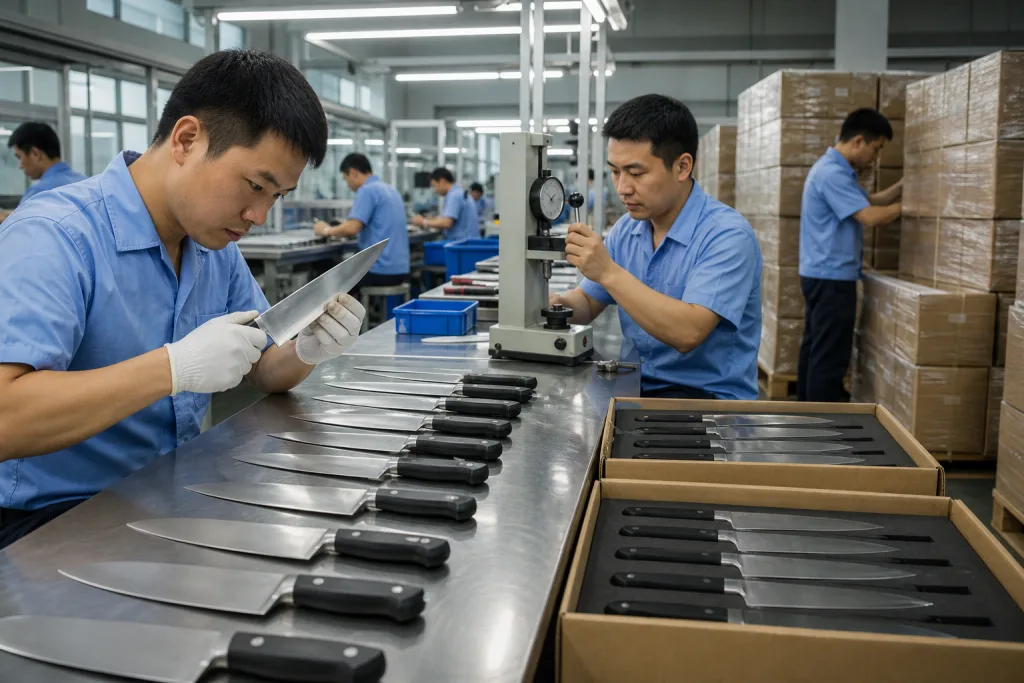
Factory inspection should cover incoming steel checks, blanking or forging control, heat treatment records, grinding inspection, handle assembly pull checks, sharpening inspection, cleaning, packaging, and final random inspection. At TANGFORGE, we provide hardness readings by batch and pre-shipment inspection photos for private label orders. For larger programs, third-party inspection before balance payment makes sense and should be booked 3-5 days before shipment, not the night before loading. We run hardness checks after heat treatment, then the grinding line confirms blade profile against the approved sample gauge. For a 2,000 pcs order, waiting until cartons are sealed to raise a grinding issue is the wrong question to ask; open 5 pcs during line inspection instead.
Food-contact compliance depends on your market. For the EU, buyers ask for LFGB or EU food-contact declarations, plus REACH checks for restricted substances. For the United States, FDA food-contact expectations matter for materials touching food, especially coatings and plastics. For wood or bamboo packaging, fumigation or proper treatment applies when the destination asks for it. If you sell to institutional buyers, ISO 9001, BSCI audit status, or social compliance documents often sit in the customer’s vendor file even when the law does not require them. Our office has seen a customs broker ask for the bamboo tray treatment mark 2 days before vessel closing, while the SI cut-off had already passed. The math does not work if the document is missing.
Edge testing can be simple or formal. CATRA testing fits higher-end ranges, but not every wholesale cleaver program needs it. At minimum, agree on sharpening angle, burr removal method, paper-cut test standard, and edge visual inspection under light. For heavy cleavers, do not demand razor-thin edges that chip under impact. Wrong target. Quality means fit for use, not the sharpest possible edge on day one. For a bone cleaver, we often run a stronger 25°-30° per side edge and check for wire burr under a 10x loupe. Paper cuts are fine for kitchen cleavers; impact cleavers need chip resistance first.
How to Start a Private Label Order
Start with a clean RFQ, not a “send best price” WhatsApp message. Put the buying basics on one sheet: target market, annual volume estimate, target FOB price, delivery term, blade type, size, steel, handle material, packaging, logo file, compliance needs. Add shop-floor details: 180 mm blade length, 58±2 HRC target, MOQ per SKU, carton weight limit, and whether each carton needs an Amazon FBA label. If you have a sample from your current supplier, send it with red-pen notes on the blade belly, handle gap, edge angle, and box printing. A real sample cuts 10 emails. Last month QC pulled a cleaver where the buyer wrote only “same as old one.” The old one had a 1.5 mm handle step, and nobody caught it until the grinding line checked the fit with a feeler gauge.
Keep the first order lean. For restaurant supply distributors, we run cleaner launches with 2-4 cleavers: one 7 inch vegetable cleaver for prep tables, one 8 inch chef cleaver for heavier kitchen work, and a meat cleaver only if your customers buy bone work. Do not open 9 SKUs just to make the catalog look full. The math doesn't work. Keep one handle style and one packaging direction across the range, such as a shared POM handle mold and kraft color boxes from the same size family. That cuts tooling cost, keeps the PO clean, and makes the sales team’s sample case easier to carry. We have seen a buyer flag a 0.3 mm logo height difference between two SKUs because two designers prepared the artwork files.
Sample approval needs writing. Confirm the approved sample code, photos, dimensions, weight, HRC, logo position, packaging, and allowed deviations before the deposit moves into bulk production. If you approve a sample with a handmade adjustment, ask whether that same adjustment can repeat on 3,000 pieces through normal fixtures, belt grinding, and polishing. One perfect sample proves little. A sample maker can spend extra hand work on one cleaver, but that finish may not survive mass production. We run this check with a digital caliper, hardness tester, and a 5 kg bench scale before locking the golden sample. Short note: “sample looks good” is not approval. We have seen this go sideways when the buyer later said the handle rivet should sit 0.2 mm lower, but that note never appeared on the signed sample card.
Payment terms for new buyers are commonly 30% deposit and 70% before shipment after inspection. Established buyers can negotiate better terms after 3-5 clean orders with no overdue balance and no carton artwork changes after production starts. Production lead time is normally 35-55 days after deposit and final artwork approval for standard private label cleavers. Around Chinese New Year, add at least 20-30 days buffer because Yangjiang and other China manufacturing areas face labor shortages and tight freight space. Real timing matters: a normal 40-day run can become 58 days if the handle supplier closes early or the forwarder misses the vessel cut-off. We ship by carton count and CBM, so one typo on a PO, like 12 pcs/ctn instead of 24 pcs/ctn, can change freight planning fast.
As a cleaver knife supplier, we prefer a simple path: start with a specification sheet, approve samples that match mass production, inspect against written standards, then reorder with small improvements. Less drama. It also keeps warranty noise down. This is the wrong question to ask: “Who is cheapest?” Ask who can hold the edge angle, handle fit, logo position, and carton packing the same after the first 500 pieces. On our side, QC checks production against the signed sample, AQL 2.5 if the buyer requires it, and the carton mark on the master carton before loading. That is how distributors build a private label cleaver line they can reorder without holding their breath.
Frequently asked questions
For an existing cleaver model with your logo, a realistic MOQ is 300-600 pieces. For a private label cleaver with custom handle color, printed box, barcode labels, and carton marks, expect 600-1,200 pieces per model. If you need a new blade profile, new handle mold, or special packaging insert, the MOQ usually moves to 1,200-3,000 pieces. Very small trial orders can be possible, but the unit price will be higher because setup, artwork, sample, and machine-change costs are spread over fewer pieces. For restaurant supply distributors, we usually recommend testing 2-4 models instead of launching 10 slow-moving SKUs.
For most restaurant supply cleavers, 5Cr15MoV or 7Cr17MoV stainless is a practical middle choice. It gives better edge retention than entry-level 3Cr13 while keeping the FOB price manageable. A typical hardness band is 55-58 HRC for vegetable and chef cleavers. Heavy meat cleavers or bone choppers may be kept closer to 54-56 HRC with a thicker edge to reduce chipping. Carbon steel can cut well and sharpen easily, but it needs clear care instructions because rust claims are common when users leave knives wet. The best steel depends on your selling price, customer skill level, and intended cutting task.
If you use an existing TANGFORGE cleaver structure, samples usually take 7-15 days and mass production usually takes 35-55 days after deposit, artwork approval, and sample confirmation. A new blade profile or handle mold can add 15-30 days before mass production starts. Packaging artwork delays are a common hidden problem, so confirm dielines, barcode numbers, country-of-origin wording, and warning text early. During Chinese New Year, add 20-30 days buffer. If your distributor promotion has a fixed launch date, work backward from the required warehouse arrival date, not from the factory ship date.
Yes. Common private label options include laser engraving on the blade, etched logos, printed color boxes, kraft boxes, care cards, UPC or EAN barcodes, FNSKU labels, and custom export carton marks. Laser engraving is the most efficient logo method for cleaver knives because it is durable and has low setup cost. Custom packaging normally needs final artwork in AI or PDF format with Pantone colors and exact dimensions. For a simple logo plus box program, MOQ is commonly 600 pieces per model. More complex packaging, such as rigid gift boxes or molded inserts, may require 1,000-3,000 pieces depending on supplier MOQ.
Use written inspection criteria. A practical setup is AQL 0 for critical defects, AQL 2.5 for major defects, and AQL 4.0 for minor defects. Check blade length, thickness, weight, hardness, grinding symmetry, edge condition, handle fit, rivets, logo accuracy, packaging, barcode scanning, carton marks, and gross weight. For food-contact markets, request relevant declarations such as LFGB, FDA-related material information, or REACH attention depending on destination. For larger orders, third-party inspection before balance payment is reasonable. Book it 3-5 days before the planned ship date so the factory can repack and correct issues if needed.
Send Your Cleaver Specification for Review
Share your target size, steel, handle, packaging, MOQ, and market. TANGFORGE will return a practical private label quote and sample plan.
Request a Quote