Cleaver sourcing looks easy until you put two samples on the bench. A 7-inch stainless cleaver can be a thin vegetable knife, a bone chopper, or a retail headache if the weight lands wrong for daily home use. On our grinding line, a 0.3 mm change at the edge or a few grams on the spine can flip the feel fast.
If you buy for a kitchenware range, “send me your best price” is the wrong question to ask. At our Yangjiang, Zhejiang, China factory, QC pulled the sample, then we check blade geometry, steel, hardness, handle build, packaging, compliance, and whether the sample repeats before we quote. TANGFORGE has run OEM cleaver and custom cleaver programs since 2008, with about 240 employees and monthly output capacity around 300,000 knives across kitchen, outdoor, tactical, pocket, and Damascus lines.
Start With The Real Cleaver Use
The first mistake in cleaver sourcing is asking for “a cleaver” without defining the job. On the grinding line, we ask one simple question first: what is this knife cutting on day one? A Chinese-style vegetable cleaver, a butcher cleaver, and a heavy bone chopper are different builds. They can share a rectangular profile, but the blade thickness, edge angle, balance point, and heat treatment should change with the use.
For a retail kitchenware category, most demand sits in three lanes. The first is the vegetable or Chinese chef cleaver, usually 170-210 mm blade length, 80-100 mm blade height, and 1.8-2.5 mm spine thickness. It needs to slice cabbage, herbs, boneless meat, and garlic cleanly. The second is the all-purpose household cleaver, usually 180-200 mm long and around 2.5-3.5 mm thick, built for heavier chopping but not sold as a bone axe. The third is the true bone cleaver, often 5.0 mm or thicker with a wider edge angle and heavier head weight. QC pulled the sample, checked the spine with a caliper, and the spec gap showed up fast.
If your sales channel is supermarkets or online marketplaces, do not push exaggerated product claims. A thin vegetable cleaver should not be photographed smashing frozen ribs. Buyers copy the image, chip the edge, then the buyer flagged it in reviews two weeks later. We have seen that go sideways enough times to say it plainly: this is the wrong question to ask. A good cleaver supplier should push back on unrealistic use cases, not just accept the artwork.
For category planning, define the end user before defining the FOB price. Restaurant buyers may accept a plain handle and bulk sleeve if the blade performs. Gift and retail buyers need cleaner polishing, tighter handle fit, and stronger hang-sell or shelf impact. The same 7-inch blade can become three different SKUs depending on positioning. On a 1,000-piece order, a gift box can add 8% to landed cost, so the math needs to work before the PO goes out.
Set Specifications Before Asking Price
Price is the wrong question to ask before the spec is locked. A USD 3.20 cleaver can be honest if it is 3Cr13 with a hollow handle; a USD 6.80 cleaver can also be honest if it is 5Cr15MoV, full tang with two rivets, packed in a 350 gsm color box. We see this go sideways on RFQs: one PO said “cleaver, black handle,” but the buyer expected 2.5 mm spine and we quoted 1.8 mm because nothing was written. Fix the blade steel, handle build, spine thickness, edge angle, finish, packing, MOQ, and inspection level first. Then ask price.
For mainstream stainless cleavers, we run 3Cr13 and 4Cr13 for promotion orders, 5Cr15MoV for mid-shelf retail, 7Cr17MoV for buyers asking for harder edges, and X50CrMoV15 when EU customers want a familiar steel name on the carton label. For entry-level promotion, 3Cr13 at around 52-54 HRC can work if the buyer accepts lower edge retention; our Rockwell tester usually checks 3 pieces per heat-treatment lot before mass grinding. For stronger retail reviews, 5Cr15MoV or X50CrMoV15 around 55-57 HRC is a better value point. Higher carbon stainless is fine, but the math does not work if the factory cannot hold heat treatment within 2 HRC points or explain basic corrosion care on the insert card.
Blade geometry matters as much as steel. A 2.0 mm vegetable cleaver with a 15-18 degree per side edge feels sharp and quick on cabbage, and the grinding line can check it with an angle gauge before buffing. A 5.0 mm bone cleaver needs 22-28 degrees per side so the edge does not roll or chip when buyers test it on pork ribs. Surface finish changes cost fast: belt satin is economical, mirror polish adds hand labor at the polishing wheel, and hammered or Damascus patterns need cleaner process control because QC pulled samples before for uneven pattern depth near the heel.
| Cleaver type | Typical spine | HRC target | Common retail position |
|---|---|---|---|
| Vegetable cleaver | 1.8-2.5 mm | 55-58 HRC | Everyday slicing and prep |
| All-purpose cleaver | 2.5-3.5 mm | 54-57 HRC | Home chopping and cutting |
| Bone cleaver | 4.0-6.0 mm | 52-56 HRC | Heavy-duty meat prep |
Match Handle And Balance To Buyers
The handle is where 7 out of 10 custom cleaver projects lose margin. Buyers start with a solid blade idea, then spec a handle that belongs on a higher retail shelf. Before choosing pakkawood, G10, PP, ABS, TPR, stainless hollow handle, or full tang riveted construction, check the sales channel, target FOB, return rules, and carton drop-test requirement. We had one PO list “G10 look” in the remarks column, then the buyer flagged the cost after sampling. That is the wrong question to ask at that stage.
For supermarket and value retail, molded PP or ABS handles make sense. We run these on injection molds with color chips checked against the approved sample before packing, so the shelf looks clean across 3,000 pcs. They wash well and keep color consistent. If the cleaver targets online DTC or specialty kitchenware, pakkawood or stabilized wood gives a warmer hand-feel and better photos, but it needs moisture control below 12% and EPE sleeve protection in the gift box. G10 is tough and stable. The math often does not work for a basic kitchen cleaver once the buyer adds platform fees and return allowance.
Balance is not trim. A vegetable cleaver usually feels better when the balance point sits near the heel or 10-25 mm forward of the handle, which gives control for push cutting. A bone cleaver can carry more weight toward the nose because it chops by momentum. On the grinding line, we check this with a simple balance rod after handle assembly. If a 190 mm cleaver is too handle-heavy, it may look premium in photos but feel weak on the board. We have seen this go sideways in reviews.
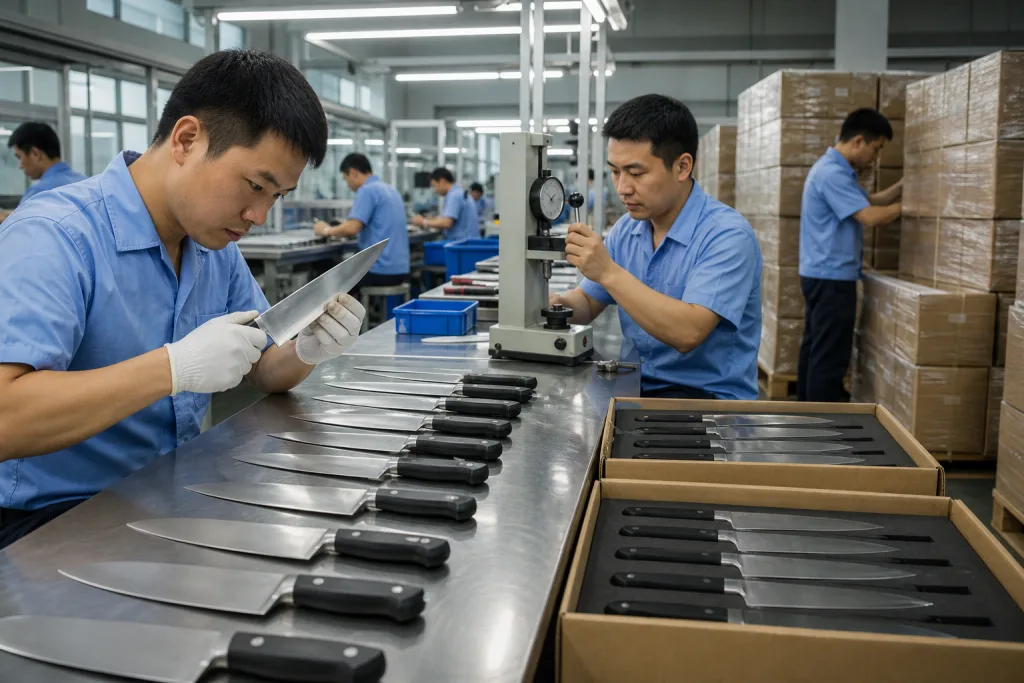
At TANGFORGE in Yangjiang, Zhejiang, China, we ask buyers to approve measured weight and hand feel during sampling. QC pulled the sample, weighed it on a 0.1 g digital scale, then marked the balance point with calipers before we signed the sample card. For example, a 7-inch vegetable cleaver may target 300-380 g, while a heavy-duty bone cleaver can reach 650-900 g. A tolerance of ±15 g is realistic for many production runs, but natural wood handles may vary more. Put this in the spec sheet before mass production. After shipment is too late.
Build A Clean OEM Cleaver Brief
A clean OEM cleaver brief cuts the usual sampling chat from 18 days to about 6 days. Put the basics in one sheet: blade length, blade height, spine thickness, steel grade, hardness band, edge angle, surface finish, handle material, logo method, packaging type, compliance requirements, target FOB, annual forecast, and launch date. We run this against a digital caliper, Rockwell tester, and a 1 g scale before quoting, because a 3.0 mm spine and a 3.8 mm spine are not the same knife. Send a reference sample if you have one. Photos alone are the wrong shortcut. They hide thickness, taper, weight, balance point, and the small handle swell that decides whether a cook likes the cleaver after 30 minutes on the board.
For private label and custom cleaver programs, lock logo placement before we cut samples. Laser engraving on the blade is the safest daily option; it holds up through washing and does not need a separate plate. Etching can give a deeper look, black printing works for low-rub areas, and a handle badge needs tooling plus a clean tolerance on the handle slot. We have seen this go sideways when a buyer approved a blade logo, then the PO said “logo on handel” with the typo left in, and QC pulled the sample because the artwork file and PO did not match. If you sell through Amazon or other marketplace channels, confirm FNSKU labels, carton labels, barcode placement, and insert cards before mass production starts.
Packaging should fit the channel, not someone’s desk preference during a video call. For B2B restaurant supply, a white box or kraft box usually does the job at 600 pcs per SKU without wasting carton space. A magnetic gift box looks cleaner on a shelf, but the math does not work for every program: it adds cost, shipping volume, and corner damage during sea freight. A hanging color box can suit retail chains, but the blade needs a PET guard, inner tie, or molded tray strong enough for drop testing. Simple check. Shake the box. If a sharp 600 g cleaver moves inside, the buyer will flag it after the first claim.
For first orders, a realistic MOQ is often 600 pcs per SKU for simpler stock-based customization and 1,000-1,200 pcs per SKU for new handle molds, custom packaging, or special finishing. Sample lead time is commonly 7-15 days if existing tooling is used, and 20-35 days if new tooling or complex Damascus patterns are involved. On the grinding line, a stock 7 inch cleaver with an existing PP handle moves fast; a new pakkawood handle mold waits for CNC work, logo fit checking, and at least one pre-production sample pull. We ship better first orders when the buyer gives target FOB and launch date together, not after the sample is already approved.
Control Compliance And Food Safety
Kitchen cleavers are food-contact products, so we check compliance before the first sample leaves the grinding line. For Europe, buyers usually ask for LFGB food-contact testing, REACH declarations, and packaging material compliance. For North America, FDA food-contact expectations and California Proposition 65 screening may apply depending on material and sales territory. We have seen a buyer approve the blade steel, then QC pulled the sample and found the real problem was the wood handle varnish or the ink on the box.
A better sourcing habit is to build the material list before production starts. Put down blade steel, handle material, rivets, adhesives, coating, oil, sheath, inner tray, color box, and printing ink, then mark which parts need testing. At the sample bench, this is the question to ask: what touches food, what touches hands, and what sits inside the pack. If the handle is natural wood with coating, do not assume it passes. If you run a black blade coating, confirm abrasion resistance and food-contact suitability, not just the color chip.
Factory audits matter for larger importers. Some retailers ask for BSCI, ISO 9001, Sedex, or customer-specific social compliance files. Not every cleaver supplier has every certificate, and some small workshops in China send polishing or handle assembly out to another shop down the road. That is not a deal breaker, but you need to know where the work is actually done. We have seen this go sideways when the buyer flagged a subcontracted packing line and the supplier had no paper trail for the carton area.
TANGFORGE operates as a direct manufacturer, not a trading desk. For cleaver sourcing, that matters because heat treatment, grinding, polishing, handle fitting, logo work, and final inspection all need to stay in one schedule. If you are importing 5,000 pcs for a seasonal reset, you do not want week six to be the first time anyone notices the handle coating will miss your retailer’s test protocol. That kind of delay turns 12 days into 18 days fast, and the math does not work.
Inspect What Customers Actually Notice
Cleaver quality inspection should start with the complaints we get back from buyers, not with what is easiest on the factory floor. End users notice edge sharpness, handle gaps, rust spots, warped blades, loose rivets, poor logo alignment, scratched surfaces, and damaged packaging. Category managers watch return rate, review score, and whether the second PO ships like the first one. On the packing line, QC pulled a sample at 9:30 and caught a logo shift before the carton closed. That is the real work.
For mass production, use a written inspection plan. AQL 2.5 for major defects and AQL 4.0 for minor defects is a common starting point. Critical defects get zero tolerance: exposed sharp points outside protection, loose blade-to-handle assembly, cracked blade, severe rust, wrong material, or unsafe packaging. We run straightness checks on the grinding line with a steel plate and a gauge; for cleavers, that matters because the wide blade makes a 1 mm bend easy to spot. If a buyer says a loose rivet is "small," the math does not work.
Sharpness can be checked in a few ways. CATRA testing is useful for controlled comparisons, especially for higher-end programs, but not every shipment needs lab work. Factory checks often use paper cutting, rope cutting, tomato slicing, and edge burr inspection under a lamp. We keep the golden sample on the QC desk and compare every lot against it before packing. The buyer wants the same bite on carton 1 and carton 500, not a nice report after the ship leaves.
Carton quality should not be ignored. A 10 kg carton of cleavers handled through ocean freight, warehouse sorting, and courier delivery needs proper inner protection. For retail packaging, we normally recommend blade tip guards, edge guards, molded pulp or EVA support when needed, and export cartons tested by drop or compression checks. In the packing room, we once saw a sample box split at the corner because the blade punched through the insert first. A good cleaver can still turn into a return if the box arrives cut open from the inside.
Price For Margin, Not Just FOB
FOB price is only one line on the margin sheet. A 520 g cleaver instead of a 420 g cleaver pushes up sea freight per carton, a 310 × 95 × 35 mm gift box cuts container loading, and a painted wood handle that chips in the tape test raises return risk. We had one buyer save USD 0.25 on blade cost, then lose USD 0.60 to extra packaging volume. The math did not work.
When comparing quotes from a cleaver supplier, ask the factory to split the main cost drivers: blade steel and thickness; handle material and rivets; surface finish and logo process; packaging, testing, and tooling. A factory will not show every internal number, but it should explain the price gap with a caliper on the bench and a sample in hand. Moving from 3Cr13 to 5Cr15MoV is often a clean upgrade for edge retention. Changing satin finish to mirror polish is the wrong question to ask if the SKU sits in a value channel and the buyer already flagged retail price resistance.
Lead time also hits margin. A first OEM cleaver order usually needs 7-15 days for sample development, 3-7 days for buyer approval, 30-45 days for production, and 7-14 days for booking and export preparation. Short sentence. Artwork changes after the grinding line has started can add 6 days; last month QC pulled the sample because the PO said “matte balck” while the carton mark said “matte black.” For DDP delivery to a North American warehouse, price in customs and duty classification, then add port congestion and final-mile appointment slots.
A sensible category range usually means an entry cleaver with a basic handle and sharp price, a better all-purpose 7-inch model with 5Cr15MoV and cleaner balance, and a giftable SKU with upgraded packaging that earns its shelf space. Do not load the shelf with five similar 7-inch blades that only change handle color. We have seen this go sideways: scanner data looks noisy, the retailer asks for markdown support, and nobody knows which SKU is supposed to win. Demand is easier to read when each item has a clear job and price point.
Frequently asked questions
For a simple custom cleaver using an existing blade shape and handle, 600 pcs per SKU is often workable. If you need custom color box packaging, special surface finish, or a new handle design, plan for 1,000-1,200 pcs per SKU. New molds, special Damascus billets, or exclusive construction may require higher MOQ because tooling, setup, and material loss become significant. For mixed container programs, we can sometimes combine cleavers with chef knives or kitchen knife sets to reach a practical production plan. The key is to separate SKU MOQ from total order value. A factory may accept 600 pcs of one cleaver if the overall shipment includes several related knife SKUs.
There is no single best steel. For entry promotions, 3Cr13 or 4Cr13 can hit a low FOB price, usually around 52-55 HRC. For better retail reviews, 5Cr15MoV or X50CrMoV15 at 55-57 HRC is a safer middle ground because edge retention, corrosion resistance, and sharpening are balanced. For premium positioning, 7Cr17MoV, 9Cr18MoV, VG10 core Damascus, or other layered steels can work, but they raise cost and require clearer care instructions. If your customer is a general home cook, do not chase 60+ HRC unless the blade geometry and warranty policy support it. A slightly tougher cleaver is often better than a harder but chip-prone one.
For an OEM cleaver using existing tooling, samples usually take 7-15 days. After sample approval, deposit, artwork confirmation, and packaging approval, mass production commonly takes 30-45 days. Add 7-14 days for final inspection, carton labeling, booking, and export documents. A new handle mold, special blade finish, Damascus steel, or retailer-specific testing can push the full timeline to 60-90 days. If you have a seasonal reset date, work backward from the warehouse arrival date, not the factory ship date. Ocean freight, customs clearance, and DDP delivery can easily add 25-45 days depending on port and destination.
Reject any critical safety defect: loose handle, cracked blade, severe rust, exposed sharp edge outside protective packaging, wrong steel, or broken tip. Major defects usually include warped blade, large handle gap, loose rivets, poor edge grinding, wrong logo position, deep scratches, failed packaging barcode, or carton damage affecting saleability. Minor defects may include small polishing marks, slight color variation, or tiny packaging scuffs within an agreed limit. A practical inspection level is AQL 2.5 for major defects and AQL 4.0 for minor defects, with critical defects set at zero tolerance. Always keep approved golden samples and signed specifications at the factory.
You can position a cleaver as all-purpose, but you should be careful with claims. A thin 1.8-2.2 mm vegetable cleaver is excellent for slicing, chopping herbs, and cutting boneless meat, but it should not be marketed for heavy bone chopping. A true bone cleaver normally needs a thicker spine, tougher heat treatment, heavier head weight, and wider edge angle. If you want one SKU for broad household use, a 2.8-3.5 mm blade around 54-56 HRC can be a reasonable compromise. The packaging and listing should say suitable for vegetables, meat, poultry, and light chopping, not frozen bones or heavy butchery unless tested for that use.
Send Your Cleaver Brief For Review
Share your target price, channel, steel preference, packaging plan, and annual forecast. We will suggest a practical cleaver specification before sampling.
Request a Quote