D2 looks clean on a quotation sheet: high carbon, high chromium, better wear resistance than 3Cr13 or 420J2. Then QC pulled the sample from the grinding line. The edge measured 0.85 mm behind the bevel instead of 0.45 mm, the HRC came back 57 when the PO said 59-61 HRC, the black coating picked up rub marks after 6 hours in a vibration test, and the logo sat 2 mm off the approved drawing.
As a D2 steel knife factory China buyers use for OEM and private label orders, TANGFORGE sees these sampling mistakes 8 to 12 times a month in Yangjiang, Zhejiang and across China supply chains. One nice sample proves almost nothing. This is the wrong question to ask. The real job is locking the blade thickness, heat-treat target, coating test, logo tolerance, D2 steel knife MOQ, and AQL checkpoints so we can run the same knife for 1,000 or 20,000 units without arguing over a typo on the PO.
Why D2 Samples Fail Approval
D2 sample fights usually do not start with bad faith. They start with a thin spec sheet. A buyer asks for a custom D2 steel knife, sends one JPG, writes “black G10 handle” and “good sharpness,” then expects the sample to match a retail promise that was never measured. We’ve seen this go sideways. On the grinding line, “good sharpness” means nothing unless we lock an edge angle, a burr check method, and a cutting test, such as 80 cuts on 120g copy paper after QC pulls the sample.
D2 is semi-stainless tool steel, not a sticker for the blade. It normally contains about 1.40-1.60% carbon and 11.00-13.00% chromium. That chemistry gives strong edge holding, but heat treatment and edge geometry decide whether the knife passes in real use. The risky spot is grinding temperature. If the edge turns blue for even a short run on a 400-grit belt, performance can drop while the bulk hardness still reads fine on the Rockwell tester. Nice HRC number. Bad edge.
At TANGFORGE in Yangjiang, Zhejiang, we treat a sample as a production control document, not a showroom piece. Our monthly knife capacity is about 180,000-220,000 units across kitchen, pocket, hunting, tactical and Damascus lines, so one vague sample can turn into 5,000 vague units fast. For D2 steel knife OEM projects, we freeze the 2D drawing with mm tolerances, steel spec, HRC band, coating process, handle material grade, logo file, packaging layout and inspection checklist before anyone signs the golden sample. One buyer once approved a PO with “D2 black blade” only; the buyer flagged the satin secondary bevel 12 days later. The math does not work after that.
The first sample should answer a practical question: can we run this design again at the quoted cost while QC measures the critical points without argument? If not, keep sampling. A rushed approval might save 7 days, then burn 7 weeks on sorting, rework and customer claims. We check blade thickness with a digital caliper, confirm handle gap under 0.2 mm, and record the edge angle before the sample leaves the factory.
Specs Buyers Should Lock First
Your purchase order should not stop at “D2 blade, G10 handle, black box.” We see 7 or 8 POs a month written like that, and the math doesn't work once the sample moves to BOM, grinding line setup, and carton artwork. A usable spec sheet needs dimensions, tolerances, and test methods; last month QC pulled a sample where the PO said black G10, but the approved handle was closer to dark charcoal under the D65 light box.
Start with the blade. Lock total length, blade length, blade thickness at spine, grind type, edge angle, tip profile, surface finish, and coating thickness if coated. For outdoor and tactical fixed blades, 3.5-5.0 mm spine thickness is common. For folding knives, 2.8-3.5 mm is more typical. For kitchen utility or chef-style D2 knives, thinner geometry matters; a 2.0-2.5 mm spine with controlled taper cuts better than a heavy blade that only photographs as “premium.” We run calipers at the spine before polishing because a 0.3 mm miss there changes the feel in hand.
Then lock the heat treatment. We normally see D2 specified at 58-61 HRC for balanced edge retention and toughness. Some buyers ask for 60-62 HRC for the product page, but chipping risk rises if the edge is thin and the end user batons wood with it. For hunting and EDC knives, 59-60 HRC is a practical target. Your approved sample should include at least one hardness reading from the blade body; for higher-risk projects, test 3 trial pieces after quench and temper before we ship the golden sample. We use a Rockwell tester, not a guess from the heat-treat invoice.
- Steel: D2 or equivalent grade, with mill certificate if requested and heat number matched to the batch.
- Hardness: 58-61 HRC, with test position marked on the blade body or trial coupon.
- Edge: 18-22 degrees per side for outdoor knives, checked after final sharpening.
- Handle: G10, micarta, wood, FRN or metal, with color tolerance approved against a physical swatch.
- Logo: laser depth, size, and position tolerance within ±0.5 mm where possible.
For packaging, approve the dieline, barcode, FNSKU if Amazon-bound, carton drop strength, and warning labels. Europe needs REACH attention for coatings, adhesives, and handle materials. Food-contact kitchen knives may need LFGB or FDA-related declarations, depending on market and importer responsibility. We've seen this go sideways when the buyer approved the knife sample but left the box open; 2,000 printed sleeves later, the barcode had one wrong digit from a typo on the PO.
MOQ, Sample Cost and Lead Time
D2 is not cheap sample steel, and I would push back on any quote that prices it like 3Cr13 stainless. The sample cost comes from blade length in mm, grinding time, handle stock, coating, sheath fit, retail box and AQL 2.5 inspection points. On the grinding line, a 4.0 mm full-tang hunting blade with a Kydex sheath eats different hours than a folding knife with CNC liners, 2 bearings and a liner lock that QC has to open-close 50 times.
For TANGFORGE D2 steel knife OEM work in China, we run normal samples in 12-18 days after drawings, logo files and deposit are confirmed. Tooling changes are slower. If the job needs CNC fixtures, new molds, EDM work or a custom packaging structure, 20-30 days is the safer number. Mass production after sample approval usually needs 45-60 days, depending on order size and surface treatment load; black stonewash and coated batches often queue behind 6-8 other POs in the finishing room.
| Project type | Typical MOQ | Sample cost | FOB unit range |
|---|---|---|---|
| D2 fixed blade with G10 handle | 300-500 pcs | USD 80-180 | USD 8.50-18.00 |
| D2 folding knife with liner lock | 500-1,000 pcs | USD 120-300 | USD 9.80-24.00 |
| D2 tactical knife with coating and sheath | 500-1,000 pcs | USD 150-350 | USD 12.00-32.00 |
| D2 kitchen or chef knife | 300-800 pcs | USD 100-250 | USD 7.50-20.00 |
These are factory-grounded ranges, not promises for every design. Ask for titanium scales, carbon fiber, ceramic coating, custom foam, a magnetic gift box or DDP delivery, and the math changes fast. A low D2 steel knife MOQ works when the design uses existing blanks or shared screws, clips and spacers. Fully custom D2 steel knife projects need higher MOQ because heat treatment racks, grinding fixtures, box factory MOQ and material cutting loss have to be covered; we have seen a 300 pcs plan turn into 500 pcs after QC pulled the first sheath sample and found 1.5 mm blade rattle.
One practical rule: do not negotiate MOQ before the drawing is stable. This is the wrong question to ask at the RFQ stage. A factory can quote 300 pcs for a simple fixed blade, then move to 1,000 pcs when the buyer adds a new sheath mold, T8 special screws and three-color retail packaging with a typo corrected on the PO. That is not bait-and-switch. It is manufacturing math.
Heat Treatment and Edge Risks
D2 sample approval needs a hard look at heat treatment because the bad parts often hide on day one. We have seen 7 out of 200 first-run samples look clean, slice A4 paper, then come back with rolled edges after two weeks of field use. The usual trouble is soft edges, brittle tips, uneven hardness, or decarb near the skin. QC pulled one D2 skinner last season that read 57 HRC at the belly and 61 HRC near the heel on the same Rockwell tester.
For most D2 knives, we run a target range of 58-61 HRC. A tighter 59-60 HRC band makes sense for premium orders, but the math does not work if the buyer also wants a low MOQ and zero sorting cost. Ask where hardness is measured. Testing only near the ricasso can miss the cutting zone by 80-120 mm, which is where the complaint will happen. For critical projects, use sample coupons treated in the same furnace batch, or cut up 2 pre-production pieces for destructive checks before approving the PO.
Edge geometry is the second risk. D2 holds wear well, but thin abusive tips go sideways fast. If a hunting knife is ground too fine and hardened to 61-62 HRC, users can report micro-chipping after batoning or bone contact. If an EDC knife is too thick behind the edge, the buyer will say “not sharp” even when the apex is polished under the 20x loupe. For 6-9 inch outdoor D2 knives, 0.4-0.6 mm thickness behind the edge before final sharpening is a workable range, depending on blade size.
Grinding heat matters too. Blue temper marks are easy to catch, but damage starts before the color shows. On the grinding line, we check belt condition, hand pressure, and cooling water flow; a worn 240-grit belt can burn an edge faster than a new operator expects. At TANGFORGE, our inspection team checks sharpness, edge symmetry, and visual burn marks during in-process QC, not only at final packing. For higher-spec programs, CATRA cutting tests can be discussed, but they add cost and time. Most importers we ship use controlled rope cut, paper cut, shaving checks, and edge inspection as practical production controls.
Handle, Coating and Assembly Checks
Most D2 knife complaints we see are blamed on steel, but 6 out of 10 sample rejects on our bench come from assembly. Loose scales, uneven bevels, rattling sheaths, off-center folding blades and weak pocket clips are easier for a retail customer to spot than heat-treatment details. QC pulled one 120-piece pilot lot last month because the T8 scale screws sat proud by 0.4 mm. Check fit first.
For G10 and micarta handles, approve color, texture, chamfer radius, screw type and surface cleanliness. Black G10 from 2 material batches can shift under 4000K retail lighting, even when both pass incoming inspection. Natural micarta moves more. Stabilized wood looks premium, but we see higher rejection from hairline cracks, open pores and color bands after CNC shaping. If you need a tight visual standard, use signed photos and 2 limit samples. Words alone are the wrong tool here.
For coatings, ask the factory to name the process: black oxide, stonewash, PVD-like coating, powder coating, electrophoresis or another finish. The claim has to match the price. We have seen low-cost black finishes look clean in sample photos, then scratch after 30 sheath insertions or 18 hours of carton vibration testing. During sample review, run simple checks: insert and remove the knife from the sheath 30-50 times, rub high-contact areas with a dry cotton cloth, check edges around jimping and spine, and photograph wear points with a 10x loupe nearby.
For folding knives, add functional checks. Blade centering should normally stay within about 0.3-0.5 mm from center for mid-range OEM work. Lock engagement should be stable, with no vertical blade play. Opening force, detent strength and clip tension should be approved with the sample. We run clip pull on a spring scale, and the buyer flagged one batch because 1.2 kg felt too loose for work-pants carry. If you sell in Europe or North America, local knife laws vary. The factory can build the mechanism you request, but the importer must confirm legality for blade length, locking type, assisted opening and carry style.
QC Plan Before Mass Production
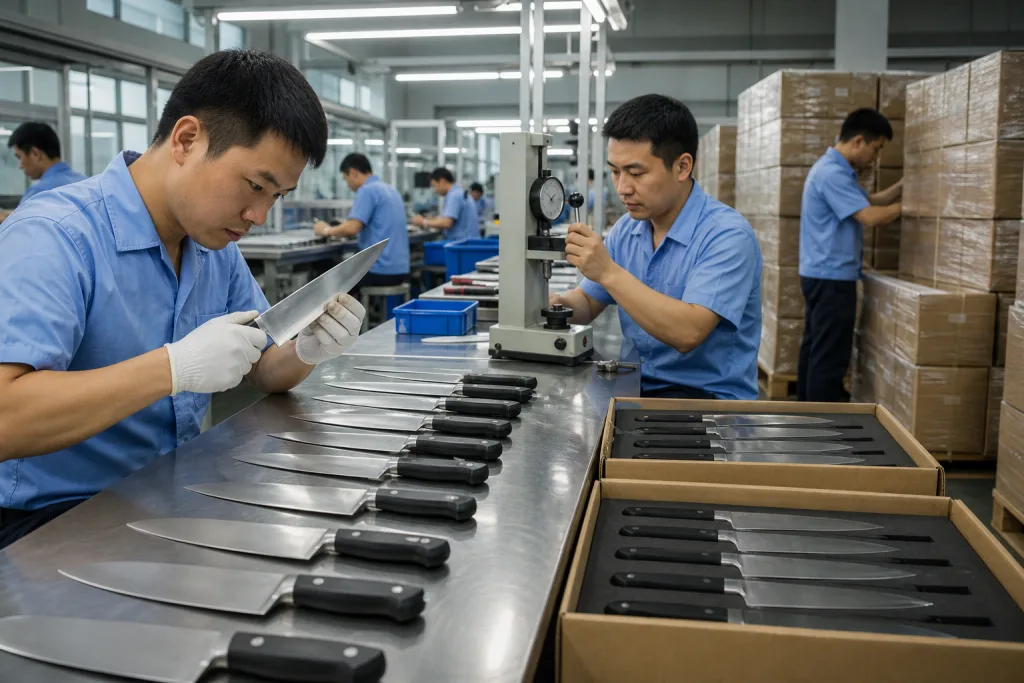
A golden sample only matters if the factory can repeat it on the line and check it the same way every time. Before approval, ask for a QC plan. It does not need 40 pages. It should spell out incoming D2 material checks, first-piece checks at the grinding line, final inspection, and packing checks with carton drop notes. We run this off a simple sheet: heat number, blade thickness in mm, handle gap, logo position, and inspector name. ISO 9001-style discipline beats pretty wording.
For D2 steel knife factory China production, we normally suggest AQL 2.5 for major defects and AQL 4.0 for minor defects unless the buyer has stricter standards. Critical defects should be zero tolerance. For knives, critical means the sample gets stopped: lock failure under hand pressure, cracked blade found under LED light, exposed sharp burrs on the spine or handle edge, wrong steel on the mill cert, wrong logo, wrong barcode, severe rust after packing, or packaging that fails a compliance requirement. QC pulled a sample last month where the PO said D2, but the blade stamp artwork still showed “440C.” That shipment did not move.
Major defects include loose handle with screw movement over 0.3 mm, blade play, wrong hardness, poor sharpening, coating peel, off-center blade beyond the approved tolerance, sheath retention failure, or carton damage that hurts saleability. Minor defects include small cosmetic scratches under 10 mm, slight color variation inside the signed color chip range, minor glue marks, or small printing shift on a hangtag. Be careful here. A factory may call a tiny logo scratch minor, but your retailer may reject the carton if the front blister looks cheap on the shelf. We have seen this go sideways.
A practical inspection checklist should name the tools, not just say “check quality.” Use a digital caliper, HRC tester, edge sharpness method, torque driver for screws, go/no-go visual board, barcode scanner, and carton weight scale. For private label shipments, scan at least 32 retail barcodes and FNSKU labels before cartons are sealed, or use the buyer’s sampling rule if it is stricter. Mislabeling can cost more than a blade defect when Amazon, 3PL warehouses, or distributors reject inbound stock. The math does not work if a $0.03 label error blocks 600 cartons.
If you use a third-party inspector in China, send the approved sample, drawings, and defect list before inspection day. Do not expect an inspector to read your brand standard from one product photo. Give them the tolerance sheet: blade length in mm, target HRC range, logo artwork, barcode file, packing layout, and any retailer red lines. The best inspections happen when the buyer, factory, and inspector use the same limits; otherwise the inspector spends half a day asking whether a 1 mm logo shift is pass or fail.
How to Approve or Reject Samples
Do not approve a D2 sample with a casual email saying “looks good.” Use a sample approval form. List every open point, mark approved or rejected, and attach dated photos; our QC team usually shoots blade centering, bevel width in mm, logo position, carton mark, and any rust spot under the bench lamp. If you accept a defect because the launch date is tight, write “accepted for sample only” or “accepted for production.” Those two lines save arguments later. We have seen this go sideways over a 0.3 mm handle gap.
When a sample fails, sort the problem first. A design issue means your drawing or concept must change. A process issue means the factory must adjust grinding, heat treatment, assembly, or coating; on the grinding line, that might mean resetting the jig angle from 18° to 20° before the next sample. A communication issue means the factory built what was written, but not what you meant. A cost issue means the target price cannot carry the requested spec. Same failure, different fix.
For first-time importers, we recommend approving 3 levels before mass production: prototype sample, golden sample and pre-production sample. The prototype confirms shape and hand feel. The golden sample freezes steel, finish, carton label, insert card, and packaging, with one signed piece kept as the reference. The pre-production sample proves the factory can run it through the mass production process, not a hand-tuned sample-room bench with a senior worker and a fresh sanding belt. At TANGFORGE, this matters for D2 folders and tactical fixed blades with black coating, Kydex sheaths, or lock-up gaps under 0.2 mm.
Keep one signed sample at your office and one at the factory in Yangjiang, Zhejiang. If you cannot physically sign it, use detailed photo records and sealed reference samples; we label ours with PO number, revision date, and buyer name because one typo on a PO can mix up satin finish and stonewash. For repeat orders, check whether any material, supplier, heat treatment batch, coating vendor, or packaging vendor has changed. China manufacturing stays stable when controls stay stable. Change parts quietly, and the knife changes too.
The final approval question is simple: would you accept 1,000 pcs exactly like this sample, within the written tolerances? If not, do not release the deposit for bulk production. This is the wrong question to ask: “Can we fix it during mass production?” The cheaper question is asked now, while QC pulled one sample, not after 1,000 blades are boxed and the buyer flagged blade play at final inspection. Sampling is the cheapest time to be strict.
Frequently asked questions
For most D2 steel knife OEM projects, a realistic MOQ is 300-500 pcs for a fixed blade using available handle materials and standard packaging. Folding knives, coated tactical knives or models with new tooling usually start at 500-1,000 pcs. If you need custom color G10, molded sheath, gift box, FNSKU labeling and spare parts, MOQ can rise because each component supplier has its own minimum. At TANGFORGE, we try to separate blade MOQ from packaging MOQ so you can see the real cost driver. Existing designs can sometimes start lower, but a fully custom D2 steel knife with exclusive geometry should be planned at 500 pcs or more.
For most commercial D2 knives, specify 58-61 HRC. That range gives a practical balance between edge retention and toughness for EDC, hunting, outdoor and tactical use. If you sell a premium slicer with controlled use, 60-61 HRC may be acceptable. If the knife has a thin tip, heavy chopping use, or aggressive hollow grind, avoid pushing hardness too high. The sample approval should state where HRC is tested and how many pieces are checked during production. A single reading on one sample is not enough for a 5,000 pcs order. For tighter programs, request batch records and random hardness checks in final QC.
Most D2 knife samples cost USD 80-350 depending on complexity. A simple full-tang fixed blade with G10 handle may be around USD 80-180. A folding knife with bearings, CNC handle, coating and retail packaging may be USD 120-300 or more. If new tooling, sheath molds, special screws or custom printed boxes are needed, sample cost can exceed that range. Many factories refund part of the sample fee after bulk order confirmation, but you should confirm this before payment. DHL, FedEx or UPS sample freight is usually separate and often costs USD 35-90 depending on destination and package weight.
D2 steel itself is generally not the main compliance problem. The higher-risk items are coatings, handle materials, adhesives, packaging inks and food-contact declarations for kitchen knives. For Europe, ask about REACH and, for kitchen knives, LFGB-related documentation if your importer or retailer requires it. For the US, FDA food-contact expectations may apply to kitchen products, while outdoor knives usually focus more on labeling, packaging and local blade laws. A responsible D2 steel knife factory China supplier should provide material declarations where possible, but the importer must confirm market-specific legal requirements. Lock compliance needs before sampling because changing coating or handle material later can affect cost and lead time.
Check steel certificate, HRC target, blade dimensions, edge angle, grind symmetry, sharpness, coating durability, handle fit, screw tightness, logo position, sheath or folding action, packaging, barcode and carton marking. Use calipers, photos and a written approval form. For folders, check blade centering, lock engagement, blade play and clip tension. For fixed blades, check sheath retention and handle comfort. If the sample is approved with exceptions, write each exception clearly. The factory should keep one reference sample and you should keep one. Before mass production, request a pre-production sample made with the same process planned for bulk, not a hand-polished showroom piece.
Send Your D2 Knife Sample Brief
Share drawings, target price, MOQ, packaging and market requirements. Our Yangjiang, Zhejiang team will review manufacturability and quote practical OEM options.
Request a Quote