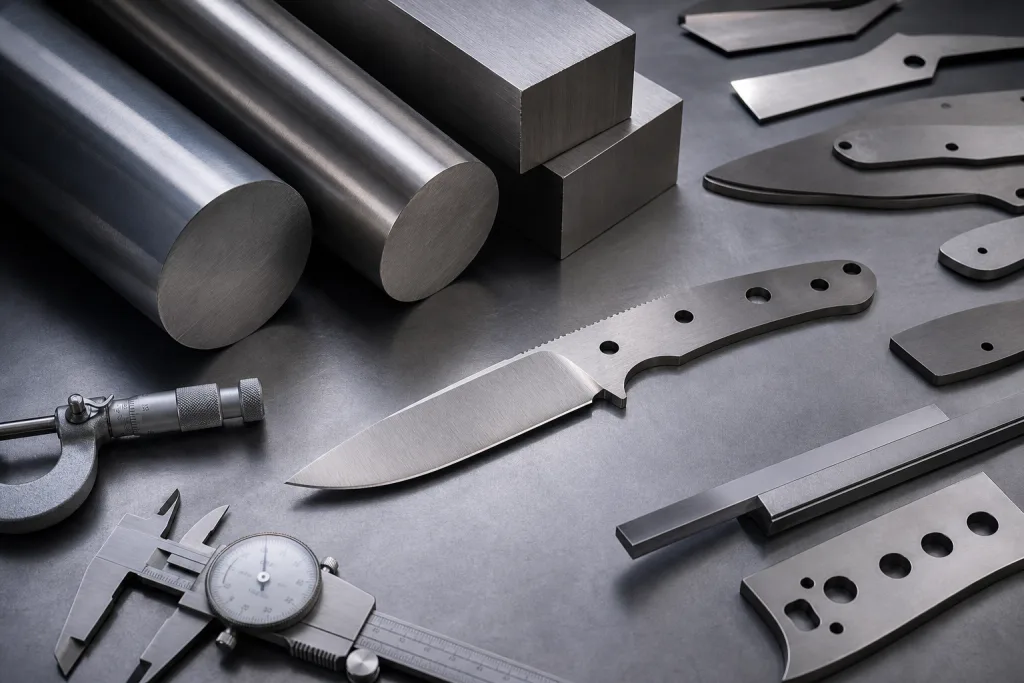
D2 looks simple on a quotation sheet: tool steel, strong edge holding, mid-range cost. Then the shipment arrives and QC finds the bill. One batch cuts 80 cartons clean on our rope-cut rack, then shows brown spots after 48 hours in a seaside retail display. Another batch looks fine in the carton, but the 0.25 mm tip chips after field use because the grinding line thinned the bevel past spec. D2 punishes loose drawings. We have seen this go sideways when a workshop treats it like basic stainless knife steel.
For EDC and outdoor brands, “is D2 good?” is the wrong question to ask. Lock the lines that decide repeat orders: hardness target and edge angle first, then specify whether the finish is satin, black stonewash, or coated, with oiling, VCI bag packing, and AQL checks tied to defect photos. At TANGFORGE in Yangjiang, China, we run D2 steel knife OEM projects for pocket folders and fixed-blade hunting/tactical ranges, usually from 600 pcs MOQ per model and 45-60 days lead time after sample approval. QC pulled the sample last month because the PO said black stonewash, but the approved sample was satin. Small typo. Big argument.
Spec Line: Steel Grade Is Not Enough
A PO line that says “D2 blade” is still loose. Too loose. We ask buyers to write ASTM A681 D2, JIS SKD11, or GB Cr12Mo1V1 on the spec line, then match that grade to the mill certificate before the blanking die starts running at 80 strokes per minute. One buyer wrote “D-2 stainless” on the PO; QC pulled the sample because the steel tag said SKD11 while the carton mark said D2. We stopped that lot at incoming inspection, not after 2,400 blades were punched. The chemistry window is the real spec: carbon drives carbide volume, chromium sets wear and stain behavior, molybdenum supports hardenability, and vanadium matters when the grinding line takes the edge down to 0.3 mm behind the edge.
D2 gets called semi-stainless because chromium is usually around 11.0-13.0 percent, but a large share of that chromium is locked in carbides. It will not behave like 8Cr13MoV in a low-cost kitchen set or 14C28N in a wet EDC folder when the blade sits wet overnight in a tackle box. “Is D2 stainless?” is the wrong question to ask. If your product page says “stainless D2,” expect complaints after camping or fishing use; we have seen this go sideways on Amazon returns within 30 days, usually with orange spots near the plunge line and thumb stud. A cleaner claim is “high-carbon, high-chromium tool steel with improved wear resistance.” It still sells to EDC buyers who understand sharpening feel and patina risk.
For a D2 tool steel knife program, ask for mill certificate control by steel lot, not a supplier promise written in one email. On our side in Yangjiang, Zhejiang-linked export documentation usually includes incoming material records, 0.01 mm micrometer thickness checks, and heat-lot traceability tied to the furnace batch. For large OEM orders over 3,000 pcs, we keep one retained blade from each heat-treatment lot for at least 12 months; the blade gets labeled with lot number, HRC reading, and packing date. Cheap insurance. When a distributor asks why one market reports staining or edge chips, the math does not work without a retained sample and a traceable heat-treatment record.
Hardness Target: Edge Life Versus Damage
Buyers ask for 62 HRC because it looks good on a spec sheet. With D2, this is the wrong question to ask. For EDC folders, we run a safer production band at 58-61 HRC; on the Rockwell tester, QC pulls 3 blades before sharpening and 2 after tumbling so we catch heat-treatment drift by lot. Hunting knives and thicker outdoor fixed blades usually sit at 59-60 HRC when the edge has enough steel behind it. Don't chase the number. We avoid promising 62-63 HRC for general outdoor use unless the tip is thicker, usually above 0.8 mm near the last 10 mm, and the buyer accepts higher chipping risk in writing on the approved sample sheet.
The buyer impact is direct. At 57 HRC, D2 feels soft because the edge rolls or loses bite after 30 cartons, rope cuts, or field-dressing passes. At 62 HRC, it can look sharp in a rope-cutting video, then chip on staples, bone contact, or side pressure. We've seen this go sideways: the buyer flagged 14 returns in the first 60 days because end users treated an EDC knife like a small pry bar. Warranty wording rarely saves the brand. Specify the hardness band and tie it to behind-edge thickness, measured with a 0.01 mm micrometer before final sharpening on the grinding line.
| Application | Suggested HRC | Behind-edge thickness | Buyer risk |
|---|---|---|---|
| EDC folder | 58-60 HRC | 0.35-0.45 mm | Balanced return rate for pocket use |
| Outdoor folder | 59-61 HRC | 0.40-0.50 mm | Better margin when the edge hits wood or grit |
| Hunting fixed blade | 58-60 HRC | 0.45-0.60 mm | Lower tip and edge chipping risk during bone contact |
| Light-duty premium EDC | 60-61 HRC | 0.30-0.40 mm | Higher cutting performance, tighter grinding line control |
For QC, one Rockwell test per finished order is not enough. We sample by heat-treatment lot: 5 pcs minimum for small lots and 12 pcs for 5,000 pcs production, because one mixed tray can hide a bad tempering cycle. Test the right spot. The test point should avoid the sharpened edge and cosmetic face; QC pulled the sample last month and found a 1.5 HRC spread between blades from two baskets. A usable report records HRC values, machine calibration date, batch number, and operator initials, not just a green stamp on the carton label.
Heat Treatment: The Hidden Purchase Order
D2 heat treatment is where 6 out of 10 low-cost projects we review start to slip. You cannot inspect a bad quench back into the knife after grinding and PVD coating. Put the route on the PO: preheat range, austenitizing temperature, soak time matched to blade thickness, quench method, cryogenic treatment if ordered, then double temper with target HRC test points. Write it down. The furnace chart, 58-61 HRC readings, tray position, and batch number all need a record; our QC once found two tray lots mixed because the heat-treat tag had one digit wrong.
For D2, vacuum heat treatment is the safer route for cleaner surfaces and steadier oxidation control. Salt bath and atmosphere furnace routes can work, but they need tighter surface cleaning before coating or stonewash; QC once pulled a batch with dark scale still sitting near the plunge line after 180# blasting. In our China production, we run D2 blades through vacuum hardening, air or gas quench, then double temper on a rack where the operator marks blade orientation with a paint pen. Cryogenic treatment is optional. It can reduce retained austenite and improve dimensional stability, but it adds cost and needs validation with actual HRC and flatness data from the same blade shape. Buying it as a magic word on a quote is the wrong question to ask.
The buyer feels poor heat treatment through edge-retention returns and broken-blade complaints. Warpage matters too. Thin pocket knife blades around 2.8-3.5 mm can move during heat treatment, especially with aggressive swedges or long clips. If the grinding line straightens too late or too roughly, microcracks can start near the plunge or thumb-hole area; we have seen a 0.18 mm bend turn into lock rub after assembly. For folders, blade flatness affects centering and lock consistency, so QC checks the blade on a granite plate before it reaches the assembly bench.
A practical D2 steel knife OEM spec should require heat-treatment batch records and hardness mapping during pilot production. For a new model, we like a 30-50 pcs pilot run before mass production, especially when the blade has holes, deep milling, or a tanto tip. QC should pull at least 5 blades across the tray, not just the top piece near the furnace door, and log each HRC point against the blade position. Small run first. That pilot run tells you more than a perfect hand-made sample, because we have seen polished samples pass while the first mass-production tray came back with tip warp.
Edge Geometry: Where D2 Wins Or Chips
D2 sells because it keeps a working edge after budget stainless starts to drag. On our carton-cut check, the same pattern gives about 18 passes before drag shows, against roughly 12 passes on a 3Cr13 sample from the same grinding line. Big carbides bite cardboard and sisal rope well. They chip fast. If the user twists through a zip tie, a thin D2 apex will lose small pieces before it rolls. Put edge angle, behind-edge thickness, tip shape, and final grind height on the drawing; QC should be reading 0.35 mm behind the edge with a digital caliper, not writing “good cutting” on the inspection sheet.
For most EDC and outdoor folders, a per-side sharpening angle of 18-22 degrees is sensible. A 15 degree per-side edge looks good in a showroom paper test, but the math does not work for mass-market returns when users hit dirty rope or light wire. We have seen this go sideways after a buyer asked for “razor sharp” and then flagged 7 chipped tips from a 200-piece pilot run. For fixed blades, 20-25 degrees per side is safer in most builds, depending on spine thickness and grind height. Want a slicer? Say so and accept the warranty profile. Want a field knife? Leave more steel behind the edge and have the operator check the bevel on an angle gauge before packing.
Grinding heat is the quiet problem buyers miss. D2 can lose temper at the edge if sharpening belts run hot, glazed, or past their service count; QC can still read 60 HRC near the blade face while the apex cuts like softer steel. We run fresh 600 grit belts on the finishing pass, set cooling pauses, and write the pressure limit into the operator sheet. On a 3,000-piece run, random edge-retention checks catch drift before the carton is sealed. CATRA testing works for benchmark development, but for routine OEM production we prefer controlled rope-cut or cardboard-cut tests with fixed media, cut length, and pass/fail criteria.
For procurement, asking only for “sharpness” is the wrong question to ask. Define starting bite and edge durability. A practical check can require clean slicing of 80 gsm paper before packaging plus no visible chipping after 50 cuts through 10 mm sisal rope. It is not a laboratory standard, but QC pulled the sample under a 10x loupe last month and found overheated blue spots before shipment. That check catches bad sharpening fast.
Corrosion Spec: Semi-Stainless Needs Discipline
D2 carries enough chromium to stain less easily than 1095 or SK5, but it is not stainless you wipe once and forget. Buyers still miss this. We have watched a D2 tool steel knife pass final appearance check under a 6000K light box, sit through 35 days of humid sea freight, then arrive with freckles under EVA foam or inside a nylon sheath. Same steel. Same heat lot. QC checked the return with a 10× loupe, and the rust marks matched the foam contact points, not the blade grind. The packing trapped moisture against the blade and exposed the weak spot.
Surface finish changes corrosion behavior more than most spec sheets admit. Satin D2 from a 400-grit belt leaves directional lines that hold sweat and fingerprints differently from stonewashed blades or coated blades. Bead blasting looks tactical, but a rough blast without oil or coating gives rust more surface to bite. Black oxide and PVD/DLC-style coatings can cut staining risk if the line controls degreasing, blast profile, and bake schedule; powder coating brings its own adhesion risk at the edge and around logo etching. The sharpened edge is still bare steel. Last year QC pulled one coated sample from the grinding line with rust starting exactly at the bevel shoulder, about 0.8 mm above the cutting edge.
For EDC and outdoor brands shipping to Europe and North America, we set corrosion checks around the product promise, not a fake stainless target. A humidity cabinet at 40°C and 90-95 percent RH for 24-48 hours catches finish and packaging problems before mass packing; we run this before inner-box sealing, not after the carton is taped. Salt spray per ASTM B117 is tougher and makes sense for coated blades, but uncoated D2 will not behave like true stainless. A 96-hour salt spray demand on raw D2 is the wrong question to ask. The math does not work. We have seen this go sideways when a buyer added that line to the PO after sample approval, with “D2 stainless” typed into the spec column by mistake.
Packaging needs the same discipline as heat treatment and grinding. Use VCI paper or anti-rust oil for bulk shipping when the brand allows it, and reject acidic paper sleeves before packing; silica gel belongs in the box, not rubbing the bevel. For retail boxes with foam, test the foam and adhesive with the actual blade finish, not a clean coupon from another batch. We ship container loads from China, and one 18-carton trial showed clean blades staining on one side because the insert held moisture tight against the satin face during transit. The buyer flagged it as a steel problem; our inspection finding pointed to the foam tray.
QC Plan: Inspect The Failure Points
AQL inspection is needed, but a stock checklist will miss the D2 problems buyers actually pay claims on. For export orders, we normally set AQL 2.5 for major defects and AQL 4.0 for minor cosmetic defects as the baseline. Critical defects stay at zero tolerance: unsafe lock failure during spine pressure; cracked blade under a 10x lamp; loose handle screw that affects function; exposed burrs that cut the user; wrong steel shown on the mill certificate. We run final random inspection, then put process checks at incoming steel PMI, heat treatment HRC test, the grinding line, assembly bench, and packing table. Shortcuts cost money.
For folding knives, D2 blade QC needs lock engagement percentage, blade centering checked with a 0.2 mm feeler gauge, inspector notes on detent feel, pivot torque, opening smoothness, and spine pressure where the design allows it. A hard blade does not save a bad liner lock. We have seen this go sideways on a 3,000 pcs PO: the buyer approved the blade steel, then rejected the lock travel during pre-shipment inspection. For fixed blades, check tang fit with no visible step, handle bonding after clamp cure, sheath retention after 20 pull cycles, and edge protection inside the sleeve. Outdoor buyers selling through retail or e-commerce should specify carton drop or vibration checks. One buyer flagged crushed clamshell corners after a 1.2 m drop test, and he was not wrong.
The inspection report should show numbers, not soft words like “good” or “acceptable.” Ask for blade thickness tolerance, overall length tolerance, edge angle range, HRC readings, coating thickness if coated, and carton drop-test result. For example, a 3.2 mm blade might allow +/-0.10 mm thickness, blade length +/-0.50 mm, handle gap below 0.20 mm where visible, and logo position +/-0.50 mm. Small numbers matter. Laser engraving depth and contrast should be approved against the golden sample; QC pulled the sample under white light because a stonewash finish made the same logo look weak. The buyer was right to flag it.
At TANGFORGE, our factory output is about 180,000-220,000 knives per month across kitchen, outdoor, pocket, and Damascus lines, so process discipline beats heroic final inspection. The math does not work if you try to catch every D2 problem at packing. For D2, we keep QC on the known failure points: hardness scatter from the furnace rack; overheated edges after belt grinding; corrosion marks after oil wipe; lock function at assembly; packaging moisture before carton sealing. We also check desiccant placement before the carton tape machine runs, because one wet master carton can ruin 48 knives before anyone opens the box.
Commercial Specs Buyers Should Lock Early
Put the technical spec and commercial spec on one sheet. D2 gives outdoor brands a workable price band: wear resistance above 3Cr13 or 8Cr13MoV, cost below powder metallurgy steel, and a steel name EDC buyers already search on blade forums. FOB moves fast when the drawing changes from a 3.0 mm flat grind to a 4.0 mm coated blade. That extra 1.0 mm adds belt time on the grinding line, slower polishing, and more rejects when the coating shows uneven scratch marks under the bench light. Price these items before sampling: blade thickness with grind type, handle material with lock structure, coating with packaging spec, and AQL inspection level. The math doesn't work if the buyer locks retail first and asks us to “just improve the blade” later.
As a rough OEM reference, a D2 folding knife with G10 handle, liner lock, stonewashed blade, standard clip, and color box may land around USD 6.80-12.50 FOB China at 1,000-3,000 pcs, depending on closed length, pivot hardware, and screw count. A larger D2 fixed blade with full tang, G10 or micarta scales, Kydex sheath, and coated blade may sit around USD 9.50-18.00 FOB. Planning range only. We run the quote from the BOM, not from a photo. Last month the buyer flagged T8 screw color after the pre-production sample; that small change meant a fresh hardware purchase, 3 extra cartons to sort, and one more QC check at packing.
MOQ decides how much customization makes sense. At 600 pcs, we can normally adjust laser logo, blade finish, color box artwork, and one standard handle color already in stock. At 1,200-2,000 pcs, custom handle milling and a new clip design make more sense because the CNC fixture cost spreads out across the order. New tooling, special coating fixtures, or private molds need firmer orders because sampling can take 15-25 days and mass production commonly takes 45-60 days after approval. Small wording causes real trouble. We have seen this go sideways when a PO says “black G10” but the approved sample was black-gray layered G10; QC pulled the sample at 9:40 p.m. and the caliper showed the scale stack was right, but the written spec was wrong.
For regulated markets, confirm REACH, RoHS where relevant, packaging heavy metals, and country-of-origin marking before sampling. Food-contact rules such as LFGB or FDA matter more for kitchen knives than EDC, but gift sets and outdoor food-prep knives still need material declarations. If you sell through Amazon or large retailers, define barcode and FNSKU first, then carton label, spare screw policy, and instruction sheet before the pre-production sample. Boring paperwork, but it saves days. QC pulled a carton sample last season and found “Made in PRC” on the PO but “Made in China” on the artwork; that mismatch held the shipment for 12 days.
Frequently asked questions
No, not in the way most retail buyers understand stainless. D2 is better described as semi-stainless steel because it normally has about 11.0-13.0 percent chromium, but a lot of that chromium is locked in carbides. It resists staining better than simple carbon steel, yet it can still spot rust in sweat, salt air, wet sheaths, or humid packaging. For an outdoor D2 tool steel knife, specify the finish, oiling, VCI paper if needed, and a humidity test such as 24-48 hours at 40°C and 90-95 percent RH. If you need low-maintenance corrosion resistance for fishing or marine use, D2 is usually the wrong first choice.
For most EDC folders, specify 58-61 HRC, with 59-60 HRC being the safest commercial center. If your brand sells to careful knife enthusiasts, 60-61 HRC can make sense when the edge is not too thin. For heavier outdoor use, 58-60 HRC often gives a better balance because it reduces chipping complaints. Do not approve only one lab reading from a sample. Ask for heat-treatment lot records and random HRC readings during production, for example 5 blades minimum per heat-treatment lot on small runs. Also pair the hardness with edge geometry, such as 0.35-0.50 mm behind-edge thickness for folders.
Cryogenic treatment can help D2 by reducing retained austenite and improving dimensional stability, especially when the heat-treatment route is already well controlled. It is not a cure for poor grinding, wrong tempering, or weak edge geometry. If a supplier charges extra for cryo, ask what temperature, hold time, and process point they use, then validate with HRC readings and cutting tests. For many OEM orders, a controlled vacuum hardening process with double temper is more important than adding a cryo claim. On higher-positioned D2 steel knife OEM projects, we usually test cryo during pilot production and keep it only if the performance gain justifies the cost.
Use AQL 2.5 for major defects and AQL 4.0 for minor cosmetic issues as a baseline, but add D2-specific checks. Require HRC readings by heat-treatment lot, edge inspection under magnification, paper cut or rope cut checks, corrosion review after packing simulation, and lock testing for folders. For liner locks or frame locks, check engagement percentage, vertical play, side play, detent, centering, and opening force. For fixed blades, check handle gaps, sheath retention, edge protection, and coating damage. Final inspection should include carton labels, barcode or FNSKU, country-of-origin marking, and carton drop test if the order ships by courier or e-commerce warehouse.
For TANGFORGE in Yangjiang, China, a practical starting MOQ is usually 600 pcs per model for existing platforms with custom logo, finish, or packaging. For deeper changes such as new blade profile, handle milling, clip design, or private mold, 1,200-2,000 pcs is more realistic. Sampling normally takes 15-25 days after drawings and deposit, while mass production is commonly 45-60 days after sample approval and packaging confirmation. If you need third-party inspection, special coating, or retailer compliance documents, build another 5-10 days into the schedule. D2 itself is not slow; unclear specifications are what usually burn the calendar.
Send Your D2 Knife Spec For Review
Share blade drawing, target HRC, finish, handle material, order quantity, and market. We will flag the D2 risks before sampling starts.
Request a Quote